
Alexander Grabovetskiy, woodcarver, School of Woodcarving · Published 2020
What does a wood carver mean by "see if it's going to work"?
Quick answer: In part 11 of my workshop 70, I named a number 9 to clean up and go even deeper, said I would find out if it worked, and then said yes. My other lessons carry the same words for sweeps and sizes, and for a blade and a leather for sharpening.
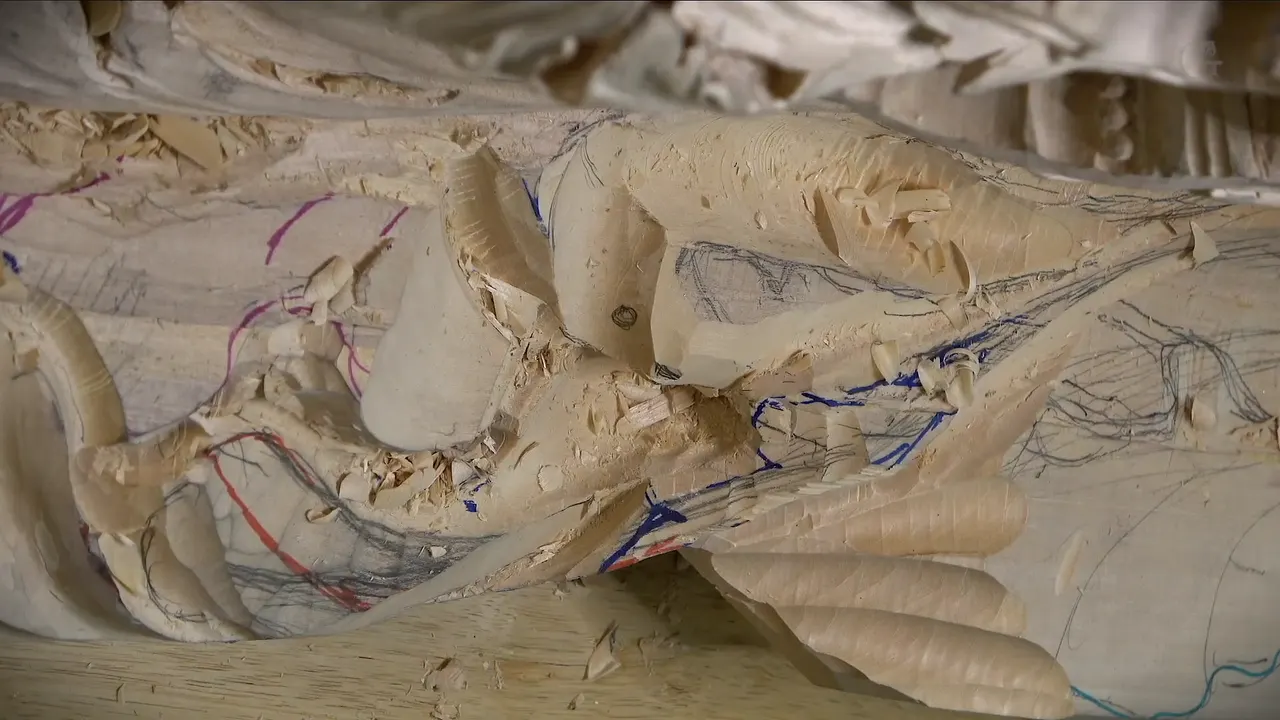

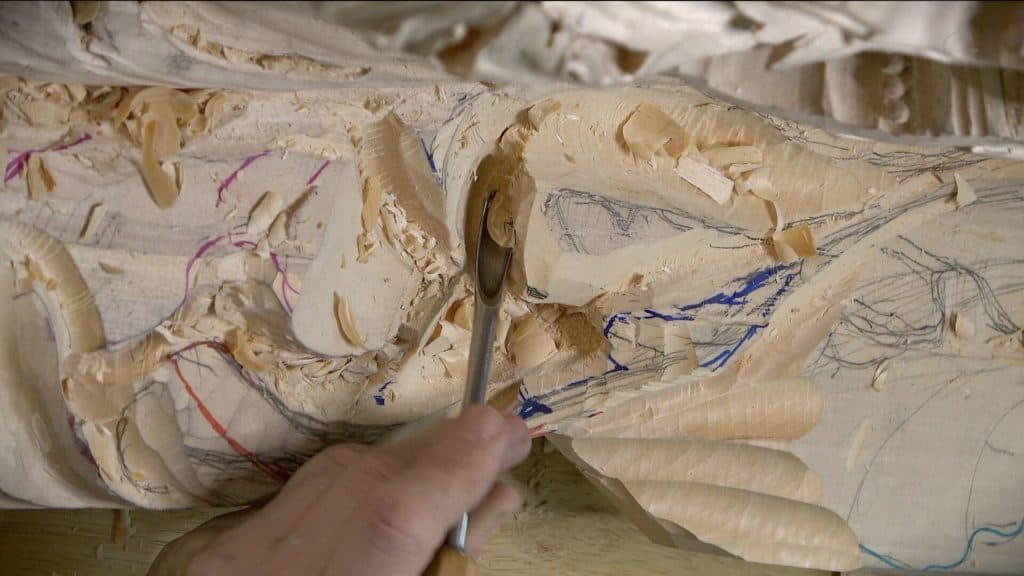
In workshop 70, part 11, I named a number 9 to clean up, and I said I would find out whether it worked. Then I said yes. My other lessons use these words before a new sweep or a size. A jigsaw blade and a sharpening leather get them too.
Ever grabbed a gouge for a spot and had no way to tell if it was the right one? Ever started a pass and felt the tool pull when you wanted it to glide? Come through part 11 with me, then through the lessons where I tried a tool the same way, and listen to how I find out in wood carving.
What was my plan before I touched the wood in part 11?
Early in part 11 I named an option. "So now what I could do, I could create the plug cut on inside. And give that area really beautiful shadow before I make all the divisions." One line named the tool, "number nine and one-quarter inch, six millimeters," the same one I had used before. Next I would go in "little by little until that plug pops out."

How deep did I go?
Next I had "about a quarter inch in" (6 millimeters), and I said "I can go as deep as I want to, and all the way if I wish to. That way, I can create a really deep undercut." Then "I've got one inch on inside really quickly" (25 millimeters). And "even deeper." A line told where I would stop for now, "Later on, I'll be able to get much deeper, of course, but for now, it's good."

I kept a margin of wood, and the line was "I'm leaving approximately one-eighth of an inch right here, because I still have to develop my concaves and convexes" (about 3 millimeters). "I don't want to go all the way to the ridge. So important for me not to rush it."
One spot was strong, I said, "because the grain runs this direction, and that's supposed to hold really nicely, so I can be really extreme, actually, in this area." I believed that spot would give me beautiful shadow.

Why a number 9 for the last clean-out?
Number 6 came first and number 9 came second, and the second one got a reason. The 6 was a plan for a little cleaning, "about 12 millimeters or so" (just under 1/2 in). After it came "I think I should use number nine. Same number nine what I used before, 10 millimeters, and get rid of some of that mess on this side" (about 3/8 in).
I asked why number nine and answered at once: "Because I can wiggle, and that's a half-a-round." Number 11 was possible too, "but a lot less ability to wiggle."

The other side was harder. My tools would not reach underneath it easily, so I named back bends, "a number five sweep back bend." I added "And my apologies if you don't see it." The price was in my words too, "a little harder to clean." I thought it would give me "beautiful movement."

These are the last lines of the part. "Okay. So now what I have to do, just clean all that and go even deeper. And to clean it, let me use number nine first, and I'll see if it's going to work." Next, "Just get all that mess out," I said, and then "Yep, and it does work. See? Just pops out."

Below are other lessons with the same kind of line.
Which gouge did I try in other lessons, and how did it go?
Workshop 74, part 2, has a no in it. "That one doesn't work." Another gouge got the try, "Number six, let me try in the quarter inch." I said we would see how it worked out. The next line was "And yes, number six is actually excellent." It was a quarter inch, about six millimeters, and "That gave me beautiful movement."

A no and a swap sit in workshop 67, part 12. First I named "Maybe six, but 15 or 16 millimeters or so" (about 0.6 in), then ruled it out. Next came "Let me think which else. Maybe number three." My pick was "Number three and one inch" (25 mm). My verdict was "And that works really good, actually. So it's gradually moving up. That is exactly what I'm after."

Workshop 66, part 8, has my words "I need the second concave," and "I'll get a bigger tool." "I think bigger tool will work much better." The size was "Even maybe 20 millimeters" (about 0.8 in), a number 11. If you asked me why, "because I really need the concave-convex movement that gives me." And "right away, it gives me clean cut."

Part 2 of workshop 69 was about raising a part, "I want to raise a little bit this part." My plan was "after 5 millimeters, I should use bigger one, maybe 10 millimeters." Then "But even 10 millimeters is too small." Next, "15 millimeters, because I don't need that sharp ridge on this side" (0.59 in). My verdict was "So yes, I achieved that result what I'm after. I raised that up, but it's not clean." And "That is not clean because it is kind of against the grain, but it's okay."

Workshop 60, part 6, used the same sweep I named in part 11: "Now we're going to take a back bend." The size was "probably sweep number five at six millimeters" (about 1/4 in). My reason was "Because I need to create that roundness," and then, a limit on it, "But in this case, it's not raised as much. Still has to be rounded, but not as much."
How does a yes sound?
Workshop 40, part 11, had a ridge I could still see inside. I could use a number seven, though not at one inch, so "let me use 7/8" (22 mm). Then "And yes, it does work," and I also said "I know you don't see overall shape how it's supposed to look."
Three short ones sit in the later workshops that I read for this page. Part 4 of workshop 92 needed "something flatter. Maybe like number three or so." My check was "Let me think if this one will work," and the answer was yes. Workshop 100, part 5, had a number seven in mind for "the part between this line and the opposite side," and then "So that would be the main concave." Turning a tool over was the move in workshop 98, part 6, "number seven upside down," and "And it works just fine."

Sizes went up in steps in workshop 118, part 1. "For the concave, we're going to take probably seven millimeters because, I don't know, maybe 10." I named 10 millimeters first. Then a bigger thought: "Maybe even 15 millimeters, like 5/8 of an inch." Then came "That actually worked really good, except I have to attack that from two sides." In my words, "because the grain of the wood and the property of a tool, one side is always going to be clean and another side is always going to be somewhat messy."

How does a no sound?
Part 9 of workshop 64 had a no in it. One side of a pipe was done. "I need to use a different tool." The reason was "Again, because I'm carving against the grain my tool has to be super sharp." I took "number two and a six millimeters" (0.24 in), and "I did hone it on a 6,000-grit sandpaper." And "I really needed a really super sharp edge." After that, "And looks like it works really good. Okay, wonderful."
The next part of workshop 70 opens with a no for a number 9. "And number nine is not the best tool for that. Number six, number seven is actually better, like fishtail number seven." I added "I would think it's probably better." That tool was "14 millimeters, like half an inch" (0.55 in). Later in that part I held a number six of 20 millimeters (about 0.8 in) and said "I think it works just really good."

Furniture Panel 19, part 4, is a mixed answer. The gouge, I said, "would be number five and 12 millimeters on this curvature. Pretty close, okay?" (12 millimeters is 0.47 in). Then "it doesn't work too much on this side." I had a fallback, "I can always go with the small gouge, like number three and 6 millimeters in this case" (0.24 in), "and go little by little."

Here is one more, from Furniture Panel 22, part 9. I told you I would try "a bigger gouge." Then "Probably not." The gouge was number seven, and I said "I don't want to dig inside of the background. I should be more careful." I used "just number three," a quarter inch, six millimeters. "Yes, I am breaking my rule."
Venice Room 1, part 7, is a jigsaw, not a gouge. I wanted "a different blade." And "So I hope it will." Later came "the blade, just because I turned, I just killed my blade." Then "That is not appropriate blade for that thick of a wood, so I shouldn't do that," and "I'm going to use progressive."
Can the same words cover a sharpening tool?
Not every try is on wood. The same kind of line turns up when I sharpen. Part 2 of workshop 61 finds me sharpening, with "CBN wheel right now installed, which is at 1,200 grit right there." The inside bevel was still to do. For it, "I would use a stone, which is a ceramic stone, but in this case, it is little too big." So "I've got to use a leather." After a hit "from inside," I gave a yes.

Part 5 of Furniture Panel 15 had a number five of 12 millimeters (close to 1/2 in) that was not sharp yet: "I guess I need to sharpen it. So right now, it's not too sharp for me." After a touch on a stropping wheel, the answer was "Yep, it does." Right after, I held back, "It's too early to judge, like I said, but we will see the process."
Which of my other courses carry the same words?
In Hashemi Flowers 20, part 1, "I need to find the right sweep to clean that edge." The check was "Let me check with number eight, smaller number eight, probably." The tool was "about 5/16 of an inch, number eight" (8 millimeters), and I said it looked like it worked.

Floral and Molding 3, part 2, was about a more pronounced concave. I thought of "a little more pronounced concave, maybe just by grabbing maybe number five or so." Then "Maybe number seven." After it, "Yeah, number seven will work." One more plan, "But I can do that a little later with the number seven."
A size fix sits in Lily Box 7, part 3. I named a seven at a quarter inch (6 mm). Next, "It's a little too small. I need a bigger one." Then "Bigger number seven, maybe about 10 millimeters will do. Yep. And 10 millimeters is good" (0.39 in).

Part 10 of Lily Box 10 had a cost in it. "I probably could use just number five gouge." A number seven came next, and then the price, "a lot more to clean, just because I'm leaving all the extra facets on the backside." And "number one gives me a much cleaner cut without extra facets to clean."

Part 8 of Furniture Panel 21 set up a fallback before the pass. "Let me try to use first one millimeter, number 11" (0.04 in), and "If it doesn't, I'll show you different approach." In part 12 of that lesson I said "looks like it works fine."
Where does each trial sit next to the others?
Each lesson on this page, the tool I named, and what I said after.
| Lesson and part | What I picked up for that pass | My words after |
|---|---|---|
| Workshop 70, part 11 | Nine, named after the back bend work | Just pops out |
| Workshop 74, part 2 | A different gouge, named right after a no | Actually excellent |
| Workshop 67, part 12 | Number three, named after another size was ruled out | Gradually moving up |
| Workshop 69, part 2 | A bigger tool, named after a smaller size | Not clean |
| Workshop 40, part 11 | Seven, a size below the one I first named | And yes |
| Workshop 118, part 1 | Bigger sizes for a concave, after a smaller size | Worked really good |
| Workshop 64, part 9 | Number two, honed on sandpaper for a sharp edge | Okay, wonderful |
| Furniture Panel 15, part 5 | A five that I touched on a stropping wheel | Yep, it does |
| Lily Box 7, part 3 | A seven, then a bigger seven when it was small | Too small |
| Lily Box 10, part 10 | Seven, then number one for a cleaner result | More to clean |
Where can you watch part 11 and the lessons on this page?
You can watch part 11 in Venice Room 70. Workshops 62 to 73 sit together in Venice Room Part 6. The other lessons on this page have pages of their own, linked above, and each one is open to you with school access.
Want to hear me say it in my own voice? This page starts you.
How it's done
- Name the tool. Before the pass I named the tool, a number 9 in part 11, and the reason I took it.
- Say you will find out. With the number 9 chosen, I told you I would see how it went.
- Say what you see. After the pass I said yes, and that it pops out.
- Swap when it is a no. Workshop 67 had me rule out one size and name a number 3.
- Go bigger when it is too small. In one Lily Box lesson a seven was too small, so a bigger one did it.
Frequently asked questions
Which gouge did I name in part 11 of workshop 70?
Number 9, at 10 millimeters (0.39 in). My reason was that I can wiggle it, and it is a half round. Number 11 would work also, I said, but with a lot less ability to wiggle. I came back to the number 9 at the end, to clean.
How deep did the plug cut go in part 11?
About a quarter inch (6 mm) in at first, then one inch (25 mm) on the inside, and then even deeper. Next to it I left approximately one-eighth of an inch (3 mm), because I still had concaves and convexes to develop.
What was my move when a tool was wrong?
Workshop 67 had me rule out a six of 15 or 16 millimeters (0.59 to 0.63 in) and go to a number 3. Workshop 64 had me take a number 2 of 6 millimeters (about 1/4 in) and hone it on 6,000-grit sandpaper.
What to carve next