
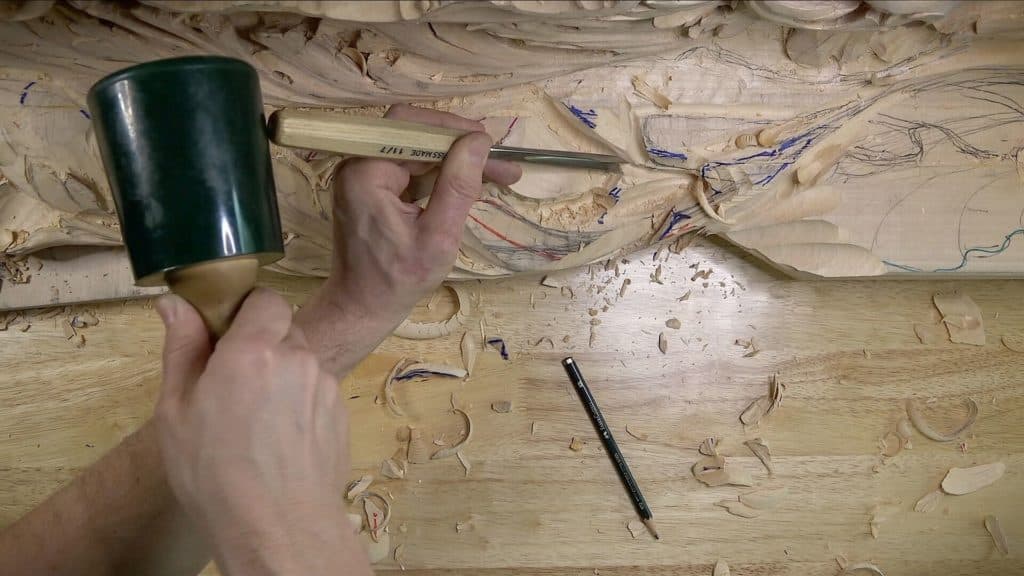
Alexander Grabovetskiy, woodcarver, School of Woodcarving · Published 2020
What does a wood carver mean by "absolutely different"?
Quick answer: Workshop 70, part 8, has my first words about one part of the carving and the movement beside it. Other lessons of mine have the same two words beside olive wood, flowers, tools, cuts and depth, and in those places I say what is different.
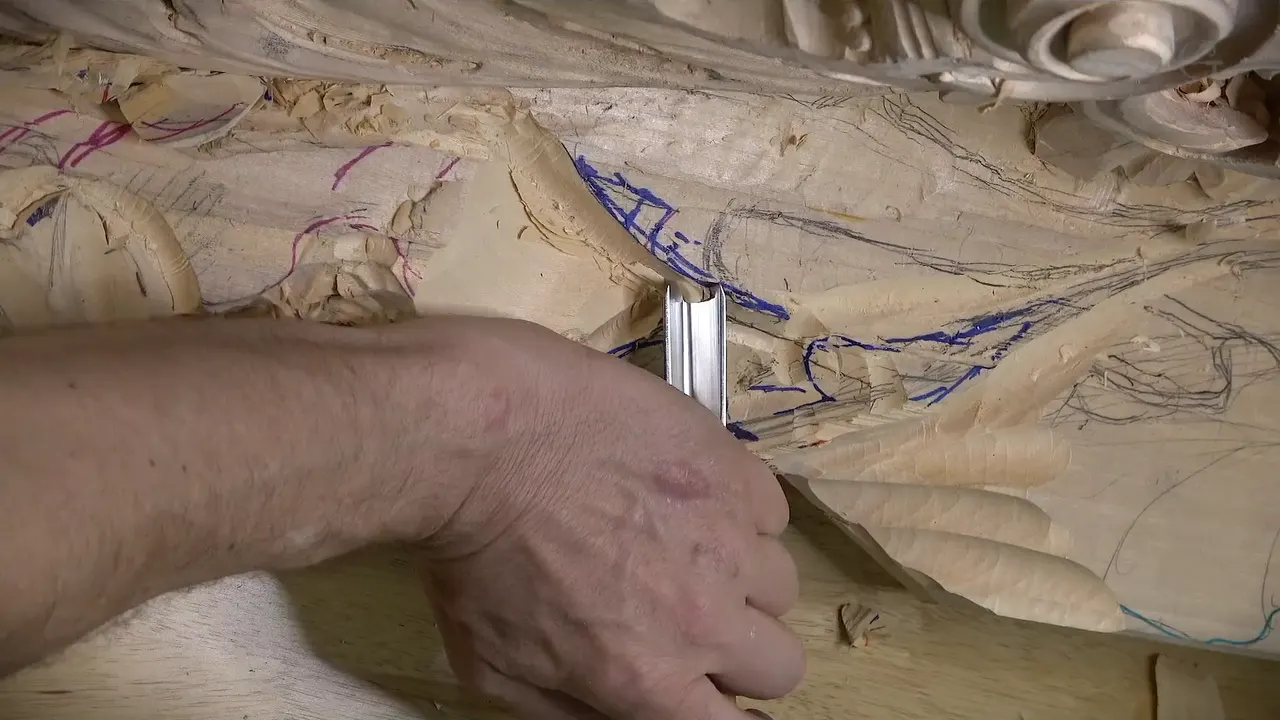

"Absolutely different" is what I said in part 8 of workshop 70 about one part of my carving. My lessons use the same two words for olive wood, flowers, tools, cuts, depth and even the sound of oak, and in each one I say what is different.
Ever started a new board and felt the wood act in a way you did not plan? Ever set one flower beside another and seen they are not twins? Then walk with me through the places where I say these two words, and listen to what I name right after them.
What was absolutely different in part 8 of workshop 70?
The words came in the first seconds of the part. "And so this part is not going to be part of this movement. It's absolutely different." For the shell, my reason was one clause: "because the shell is a big element."
That part had a job beside the shell. My word for it was "a framework," and then "like a framing around." Small moves followed, "outline this way also" and "a little blending," along with a call for depth: "And yes, I need to get much deeper in this section."

Shorter, a bit later: "I need much deeper." My reason followed: "Otherwise, it's not going to make sense."
Then came a short remark, "Stuff keeps falling," and a plan with an if in it: "Even if I have to chip a little bit this way." Right before that I had said "Okay, that is wonderful."

Next came the lowering: "That is good. So now, this part of this wrapping has to be much lower, actually, I need to make a really deep excavation in this section." Then, an offer: "You know what I can do? I can actually attack from this side." Then a warning: "I got to be careful not to bang too hard."
How did I dig the deepest spot in that part?
That area, I said, would be the deepest spot, and the look I wanted from it was "a really dark shadow." A few lines later, the same area got another word: "a really beautiful shadow."

A limit came with the plan. "But I have to be mindful how much thickness I've got left, which is not that much." The next step, in my words: "it's time to create the plug cut on inside this area."
Then the tool talk, loose enough that you can hear me think: "Okay, let me take number nine and let me think, should I do a small number nine, number eight will work also, number nine will work, it doesn't matter." The size I settled on was "10 millimeters, like, 3/8 of an inch or so" (10 mm is 0.39 in). The angle got a caution of its own: "I have to be really mindful, really mindful."

"And let's start rotation." Next, a thought on size: "sometimes the smaller tool is better, but in this case, it's okay." And the plug itself: "So here, I remove that plug. Beautiful." My first look at the shadow: "See, it's already giving me that shadow. Preliminary, but still, it's a really good shadow."
Right after the plug: "all of my cuts are going to go toward this created hole." And: "I can go much deeper if I want to."

What did I say about the deeper cuts?
Here is the rule in my own words: "The deeper I go, a smaller tool I should use." The size was "a quarter-inch number nine, six millimeters" (a quarter inch is 6.35 mm), and I added "I could start, actually, with that tool." The idea, as I put it: "to use a smaller tool if I want to do a deep excavation."

The oddest line of the part is next: "It doesn't feel like I'm even carving, it looks like I'm just drilling holes," and a little after it, "And here you go, I've got really deep."
"I doubt that anybody will look inside, but I still want to make it look really clean." My way of doing that, in my words: "one of the cuts I'm doing this way, and another cut I'm just doing on an angle." What it gave me: "it just creates a really much cleaner cut."

My plan for the following step was the undercut, "Let me now undercut underneath of this movement," and a need came with it: "So now I need to undercut it."
One last line looks past this carving. "And by the way, the section what we're working on right now could be used on the top of the mirrors, on the frames." Of that ending: "It's actually a really beautiful ending, the upper part." And: "this part could be used anywhere, pretty much."

Does the wood make a carving absolutely different?
I said it about olive wood in the Lily Box course, workshop 4, part 1. The slab was olive wood, and I called its property "absolutely different property from a bass wood or lime wood or even other harder woods like walnut and so on." My slab was "really curly," so "I don't know how it's going to behave."
Workshop 7 of the same course went through the woods again, with basswood first, "Of course, it's not the same as basswood," and then walnut, cherry and oak. Next: "I'm not saying it's harder or easier." The words I gave the olive: "absolutely different feel, especially on a curly wood like this, on a curly grain."

Part 4 of Corinthian lesson 3 puts the word on one species. Of a new board, "you just expect it would act exactly the same like you carved, let's say, last week on another piece, and it was a absolutely different piece of basswood." And: "you'd be surprised when you take in a new piece, I mean, new lumber, and start carving, and it feels absolutely different." One reason I gave: "It also depends where it's growing." And "It was closer to the water or not."

In Roman acanthus lesson 16, part 1, the same board changes with time. "So like I said, same piece of wood could be one day it's really good, and a couple of days later, a month later, it could be absolutely different. And it feels different."
The Dining Table Apron course, workshop 7, has a sound. "I like this oak. So dry and nice." And then: "the sound of when you're carving oak versus limewood is absolutely different. It's more crunchy sound." Next line: "It's just absolutely different sound."

Is a tool absolutely different too?
Part 2 of Hashemi lesson 33 has my number five. Maybe you think it is my favorite tool, I said, but "it's not necessarily," and then I looked ahead, to "the next project" and an "absolutely different tool."
I named another tool in that part. "But as of today, yes, I'm using it a lot, this number five, and also number 16, a V tool."

A chisel has a mark in Venice Room 10, part 4. "I'll just use a skew chisel, which would be number 2 in London pattern, but if it's European, it's marked absolutely differently."
Hands came into Byzantine acanthus lesson 8, part 1. "Pay attention what I'm doing, how I'm holding my hand now. I'm holding the absolutely different thing." My next words: "And I'm still locking, I'm still holding on something. So that hand is solid." Of the other hand: "this hand is just almost does nothing. It's just a supports." Plus a short rule: "Don't air carve."

Is every flower absolutely different?
Copies are the subject of Hashemi lesson 47, part 1. I can try to repeat a flower, and the next one will not come out the same every time. On copying, I said "Even if you think to do something like you've done before, and if you even try to copy it," and the flower still comes out different. That, I said, is "the beautiful thing, actually, of carving flowers," and my line after it was "absolutely different flower."

Two details sit side by side in Floral and Molding lesson 3, part 1. "They almost the same, but they not the same at all." And: "They absolutely different." Then: "Even if it looks like it's symmetrical, it is absolutely not."
Of those two I said, "I like that approach, not to do symmetrical stuff." Both directions symmetrical? The client "probably wouldn't notice that. But for me, it wouldn't be so interesting to work on." My reason: "I want to make sure I'm having fun when I'm carving something."

A bow is the subject in Chamomile and Bow Rosette lesson 2, part 3. "If you pay attention," I said, one side "goes like those two parts going downhill and then return," while "the opposite side is absolutely different." As I put it, "This one goes downhill and those ones go uphill, and that creates a different movement." For a 3D bow I named a helper, "you can use clay," and "In my case, it's a plastilina."

A drawing holds a plan in Furniture Panel lesson 12, part 1. "Maybe I can place absolutely different flower right here." Then, "when I'm saying different," I meant "absolutely different type of flower." Another idea from that part: "I also want to repeat the same type, but I want to do a small one, smaller than this one, fill this space." Its part 2 has "maybe I can create absolutely different type of leafage, like triple leaves," and "I can always change it."

Does where people look from change what I carve?
A spot seen from below turns up in Venice Room 16, part 9. "Again, why I'm doing the way I'm doing, because it's going to be visible from the bottom." Then: "So I would approach absolutely differently to this development if it would not be looked from the bottom."
A curve and a camera are in Venice Room 58, part 2. "I know when you look at the angle, like I mentioned before, it looks like almost straight line." Then: "it's not true, okay? So it's just the angle of the camera. In real life, it is different, okay? It is absolutely different."

"But if you look in overall development, it is not a straight line anymore. So it actually repeats this curvature."
Light is the subject of Greek acanthus lesson 15, part 1, and shadow is a word I used in part 8 too. "You can see it actually gives you really nice shadow lines. Depends how the light actually shoots to the piece. It gives me absolutely different shadow, and that's what I like about it."

What does one cut change?
The cut turns on a direction in Venice Room 53, part 8. "I like the idea of number 11 because I can use it as a gouge if I'm just holding this straight," and when I move to the right or the left, "I'm creating absolutely different cut."
That time I planned to move to the right, "to make it blending, to get rid of this ridge I created previously."

Depth is the subject of Furniture Panel lesson 17, part 2. "I'll change my blade." My depth, I said, would come out "absolutely different." If you asked whether I fear losing the deeper spots, I said "I can always reference whatever I have right there," and for now "I'm going to do really shallow cuts."

A change of plan sits in Venice Room 109, part 2. "Let me change what I just explained to you. I'll do absolutely different." Then: "This part going to go underneath of this line. So that is not right." And: "And I'm going to start little by little."

Do I say it about more than carving?
I do. In Hashemi lesson 8, part 1, I talked about drawing for the chisel. "Even if you beautiful designer, you can just draw on a piece of paper, it doesn't mean you do have ability to design for woodcarving, because it's absolutely different medium."
The design part of the Furniture Panel course, lesson 1, part 3, was about the view. "West versus east, how we read and how we view at the canvas and pieces of art absolutely different." The Western world reads left to right, I said, and the East reads right to left.
And in Antique Style Rosette, workshop 5, I said it about a country. "When I came to United States, I saw a lot of opportunities, and that's not a joke. I saw absolutely different country with a lot of different opportunities."
Where do these lines sit side by side?
Here is each lesson, what I was comparing, and the words I named for it.
| Lesson | Compared | Named |
|---|---|---|
| Workshop 70, part 8 | a part beside the movement and shell | that part |
| Lily Box 4 | olive wood against basswood, lime and walnut | its property |
| Lily Box 7 | this olive against basswood, walnut, cherry, oak | the feel |
| Corinthian lesson 3 | new lumber against last week's basswood piece | a piece |
| Roman lesson 16 | same piece of wood, a month later | feels different |
| Apron workshop 7 | carving oak against carving limewood by sound | that sound |
| Hashemi lesson 33 | favorite tool today and another next project | next tool |
| Venice Room 10 | a skew chisel in London or European | the marking |
| Hashemi lesson 47 | one flower beside a copy of it | every flower |
| Chamomile lesson 2 | the two sides of one 3D bow | opposite side |
| Venice Room 53 | a number 11 moved right or left | one cut |
| Furniture Panel 17 | my depth after I change my blade | the depth |
Where can you watch every lesson named on this page, part 8 included?
You can watch part 8 in Venice Room 70. Workshops 62 to 73 sit together in Venice Room Part 6. The other lessons on this page have pages of their own, linked above, and each one is open to you with school access.
Want to hear the two words in my own voice, with the shell beside them? Would you like to watch the plug come out and the shadow show up? This page starts you.
How it's done
- Name the part. One part beside the shell stood apart from the movement, and I called it a framework and a framing around.
- Go deeper there. Depth was the need in that section, and my reason was that otherwise it would not make sense.
- Cut the plug first. A number nine at 10 millimeters, like 3/8 of an inch or so, was the tool I named for the plug cut, and all my cuts were to go toward that hole.
- Pick a smaller tool. A deeper excavation called for a smaller tool, and the one I named was a quarter inch number nine at six millimeters.
- Keep the inside clean. Few eyes would look in there, yet I wanted it clean, with one cut this way and another on an angle.
Frequently asked questions
How did I describe the part in part 8?
It would stand apart from the movement, and the big shell was my reason. A framework and a framing around were my words for it, and I needed much more depth in that section, otherwise nothing would make sense.
How deep and with which tools in part 8?
For the plug cut I named a number nine of 10 millimeters (0.39 in), and number eight would work too. For going deeper I named a quarter inch number nine of six millimeters (0.24 in), since a deeper cut calls for a smaller tool.
What made the deep cuts feel like drilling?
The excavation did not feel like carving to me. I doubted anybody would look inside, yet I wanted the inside clean, and I made one cut in one direction and the next on an angle.
What to carve next
- Venice Room 70 lesson
- Venice Room Part 6 course
- Lily Box course
- Corinthian lesson 3
- Roman acanthus lesson 16
- Dining Table Apron course
- Hashemi lesson 33
- Venice Room 10
- Byzantine acanthus lesson 8
- Hashemi lesson 47
- Floral and Molding lesson 3
- Chamomile and Bow Rosette lesson 2
- Furniture Panel lesson 12
- Venice Room 16
- Venice Room 58
- Greek acanthus lesson 15
- Venice Room 53