

Alexander Grabovetskiy, woodcarver, School of Woodcarving · Published 2020
What does a wood carver mean by "how deep am I going"?
Quick answer: In the first video of Venice Room workshop 71, I said it over a deep spot, called it a big question and then named the wood I would leave under it: three millimeters, then maybe five. I kept checking while I worked. Other lessons of mine put the same question in new words, each with its lesson below.
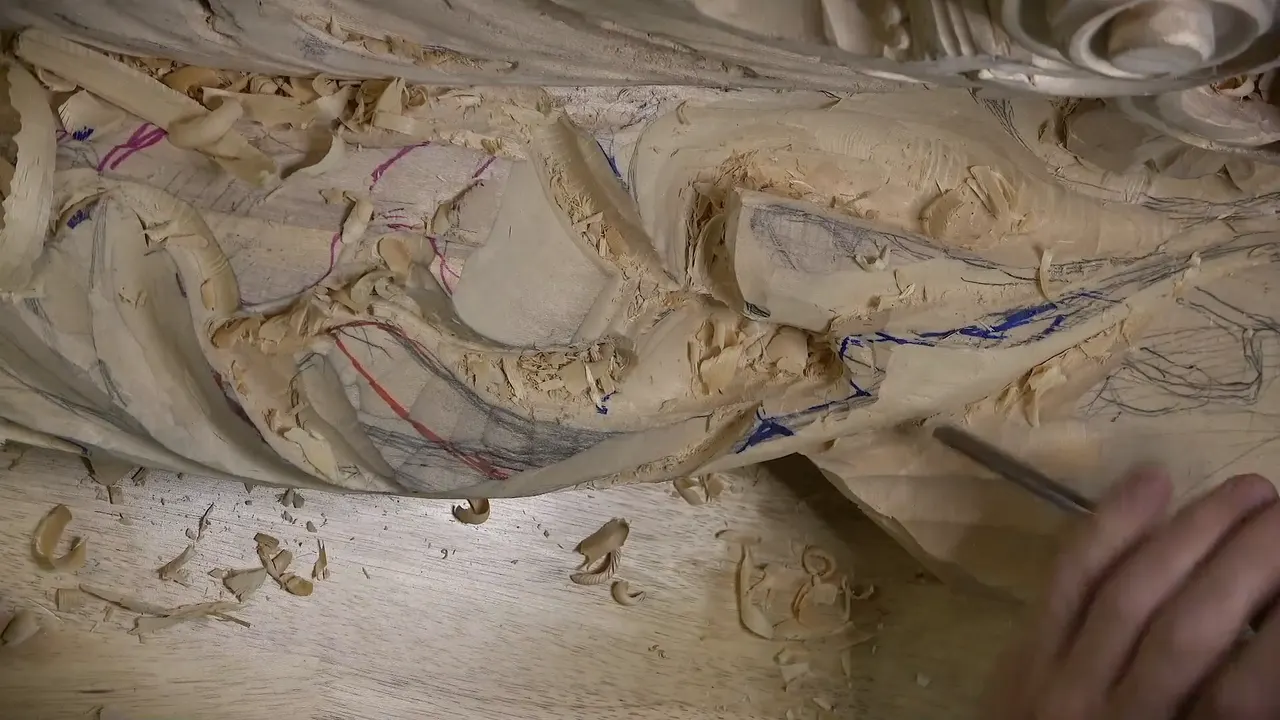

In the first video of Venice Room workshop 71, I asked myself out loud how low a deep spot would go, called it a big question, and named how much wood would stay under it. Other lessons of mine ask the same thing in new words. Each one is below, with its lesson.
Ever held a gouge over a carving and not known how deep to go? Do you check before the cut, or after it? Read on for what I said each time.
What was I carving when I asked it in part 1?
Part 1 starts with a check: "that is actually really, really good." But "I need to clean a little more this way," I said, and I named a tool for what my skew cut left behind: "number 11 in 5 millimeters" (0.2 in). Then I asked you: "Are you able to detect this movement?"
Detail was next, and I would "work little more detail right here." A straight tool was "not going to cut it," and I slipped, "so I need to use skew... Not a skew, I'm sorry, spoon." The size: "Four millimeters" (0.16 in).

"Again, have to be really mindful how much material I have right here. It's not that much in all." And "I still have some, but I have to leave for the cleaning."
That sets the limit: "I can't go too deep right now because I really need to clean later on." A second thought followed. "Maybe not even later. Maybe I can start establishing this part right now."
Which gouge did I pick for the deeper shadow?
I called that part "a shadow section," and I planned "a deeper shadow right here." My first thought was "I think number nine will work better." The size needed a pause. "Seven millimeters or 10 millimeters I should use." I settled on "10 millimeters" to try. In inches, 7 mm (0.28 in) against 10 mm (0.39 in, close to 3/8 in). I named it "Spoon gouge number nine."

What did the question itself sound like?
"I have to lower this part all the way to 1/16 of an inch" (1.6 mm), I said, to make it feel like it really wraps. "That's what I left right here," I said, with a word to be careful, "but that's what I have to do."
The question was how low that spot would go, and I called it "also big question." A line followed: "Maybe I have to improvise a little bit."

A figure came next. "But at least I have to go three millimeters at least for visually." I explained it: "I'm talking about the thickness, what I'm going to leave to the bottom, three millimeters, like 1/8 of an inch." That is 3 mm (0.12 in), and 1/8 in works out to 3.2 mm. The deep spot would be "about 1/16 of an inch" (about 1.6 mm).
A higher number followed. "Maybe even more than that. Okay, maybe about five millimeters" (about 3/16 in), I said, was what I would leave.
How did the cut go once the gouge went in?
"Let me go this way," I said, and "that's against the grain." Then "a little dangerous, but it's okay. It's still possible." One condition: "If the tool is sharp, I shouldn't have any problem." Of my own tool, "in my case, the tool is really sharp."

I stopped there: "That is enough." About the raised part: "I'm okay with this part is raised up a little bit, which is okay." And "Let me blend that nicer."
Then I told you I was constantly checking the depth, and "Constantly checking it." A warning from my own past came with it: "Just like I said, I've done that mistake too many times when I got a little too deep."

Next, "That is good. Here you go. So now it feels like it does wrapping, or wraps, I should say."
A spot was left. "So I need to take care of a little bit of this triangle right here. You don't see it. I apologize." Then "Let me try a different view," and "It has to flow on inside, okay?" Last, I said I would take a skew.


Do the other parts of workshop 71 come back to it?
An eye is on the way in part 2. "2 millimeters or even 1 millimeter I could do" (0.08 in or 0.04 in), and then "But let me do 2 millimeters, number 11." After that, "I can excavate a little deeper." And "Yes, I will clean it a little later, but for now, it will do."
Over in part 3 I said "I can actually take it a little deeper this direction." Next came "Now I'm able to do a plug cut." I named the tool: "Same number nine, what I used before, quarter inch" (6.35 mm). Near the end I looked: "Let me see how deep I've got. About three-quarter of an inch deep, I would say, but it's already giving me some shadow" (19 mm).

Part 4 brings a warning: "It would be a huge mistake to go too deep." Then comes the other side, "But as far as getting closer to this surface, I can go as much as I wish."
Did workshops 62 and 64 ask it too?
In workshop 62, part 2, I was about to outline a side. Depth needed care there, I said. I would undercut it, I said, and it would show, "but I still have about three millimeters right there, and I'm keeping it" (a little under 1/8 in).

A loose plug turns up in part 7 of workshop 64. "And that plug is already loose." Then "now that's just a matter of the decision." The decision was the depth. Then the tool: "if the tool is too big, I can always switch to smaller one and start excavating with the smaller one."
"farther you get, smaller tool you should use," I said, so that people who look inside do not see a poor finish. The switch I named was "my favorite, a quarter inch. Number nine" (about 6 mm).

How did a plug cut and a hole change it in workshops 70 and 72?
Part 3 of workshop 70 has plug cuts: "maybe plug cut because I need that to remove a big chunk." "It just gives me quick material removal," I said, and the catch was being "mindful how deep I want to do it, because later on, on inside, I have to clean it."

Then: "It looks like in this case, I'm still able to get pretty deep and open up a little more and give that area more shadow."
Rough cuts belong to part 9, and "later on, I'll do much cleaner cuts." One cut ran into a hole: "that hole is really deep, about 25 millimeters or so" (about 1 in). Next, "I think I need to switch to a spoon."

A shell part sat close in workshop 72, part 6. "That shell part, I cannot damage." After it, I told you to be really careful about the depth.
When did I say the depth did not matter?
Going all around a plug comes up in workshop 29, part 11. "It doesn't really matter how deep I'm going to go there because it's not going to be visible anyway. All I need is just a shadow line."

Tools there: "number 11 and 4 millimeters" (0.16 in), then "a much smaller one, 2 millimeters maybe, right away, and excavate much deeper" (0.079 in).
Over in part 8 of workshop 49, the line is "In this case, I don't worry about how deep I'm going." There are some cases where I don't want to go that far, I said, but "in this case, it's okay."
A hole turns up in workshop 99, part 12. "I'm already deep," I said, and "About an inch deep, so it's plenty. Otherwise, it's going to be a problem for me to carve." Of the area: "somewhat forgiving," and I would still try to get it clean (an inch is 25.4 mm).
And when the number was still open?
The first Venice Room course has it in workshop 9, part 10. I did not want to dig the background deep yet, because I still wanted "some really good development of acanthus somewhere right there." Of the depth: "So which I don't know yet."
From workshop 40, part 7: "I still want to go deep, but to the degree." I also said I really have to be mindful of the depth.
Stock came first in workshop 59, part 2. "I'm glad that I do have an eight quarter material" and "a little less than two inches, but like one and 15/16" (about 49 mm). I gave the metric too: "About 50 millimeters, a little less than 50 millimeters probably" (a little under 2 in). Be mindful of the depth, I said, "And also how it's going to blend all together."
In part 12 of workshop 81 comes a number nine of "one-eighth of an inch, three millimeters" (3.2 mm). A reminder on the depth came with it, and after that "so I'll use just the two millimeters" (0.08 in). The cut came to "about 25 millimeters or so. About one inch deep right there."

Depth is "the question" in workshop 87, part 9. Then "Well, I could go quite deep." And "maybe about even half an inch or so" (12.7 mm).
How do I find the number?
In part 3 of workshop 100 the tool answers it: "about as deep as my tool." Looking at the edge of the tool would set the depth, and the aim was "really consistent depth."

A pointing machine appears in workshop 106, part 3. "I really, really like my pointing machine," I said, and in this case it would help me. "I can just place that on the surface, measure the depth." And then "I'll know exactly how deep." The same on the other side: "So I'll take my needle, measure it."

Floral and Molding lesson 4, part 1, points to a first piece: "Before I cut too low, I have to reference with my first piece." The high spots come next: "I need to measure those, and that's going to give me the depth."
A number goes on a channel in Greek Acroterion lesson 5, part 5. "I think it would be the best idea to keep it about 16th of an inch deep" (1.59 mm). Then "And if I need to get deeper, I always can."

Where else do I keep watching it in other courses?
Furniture Panel, lesson 16, part 2: "There is a danger in this operation. You can dig too deep in the middle." Of that area I said "little lower section," and "I don't want to make it too low."
Lesson 18 of that course, part 4, has me saying I would take a one millimeter number 11 (0.04 in) for my outline. In that corner "I really want to keep a sharp point."

In Floral and Molding lesson 10, part 2, I first said I was not supposed to go far, then "Actually, no, I can go really deep, have no problem." Next, a warning: "Don't move your tool up and down."
Drilling the other side as well was my plan in lesson 13 of that course, part 1. "I think it's about maybe a quarter inch or so" (6.4 mm).

In Lily Box, lesson 11, part 1, I came to "Those deep, deep, deep concaves." Lesson 10, part 2, has me not wanting to be too deep, because "it has to grow over the main design." And lesson 6, part 6, has the lower detail blending with the opposite side: "so I can't take this one really low." Then "So that's why it's really important to sometimes stop and look."

Which lessons did I put the question in?
Rows without a course name come from Venice Room Part 6.
| Lesson | What I was cutting | Depth |
|---|---|---|
| Workshop 71.1 | A part lowered so it feels like it wraps, with the wood left under it | 3 to 5 mm (0.12 to 0.2 in) |
| Workshop 62.2 | An undercut | 3 mm kept (about 0.12 in) |
| Part 6, workshop 70.9 | A cut that ran into a hole | About 25 mm (nearly 1 in), I said |
| Part 7 course, workshop 81.12 | Two sizes | A cut 25 mm (1 in) deep |
| Part 8 course, workshop 87, part 9 | A deep cut | Maybe half an inch (12.7 mm) |
| Course Part 9, workshop 99.12 | A hole | About an inch (25.4 mm), I said |
| Carving Greek Acroterion, lesson 5, part 5 | A channel | 16th of an inch (1.59 mm) |
Where can you watch the full videos?
Every lesson above sits inside one of my wood carving courses. This workshop 71 holds all twelve parts of that workshop, and workshops 62 to 73 are in Venice Room Part 6. To watch the full videos, start here.
How it's done
- Say what wood is left. At one spot I said how little material I had, and that some had to stay for the cleaning.
- Pick the gouge. Seven millimeters or ten: I tried ten, with a number nine spoon gouge.
- Name the wood to leave. The thickness for the bottom was three millimeters, then a figure near five.
- Name the risk. Grain was the risk, a little dangerous, and my tool was really sharp.
- Keep checking. Constantly checking the depth, I told you.
Frequently asked questions
How much wood did I plan to leave at the bottom?
Three millimeters (0.118 in), like 1/8 of an inch, was the thickness I named for the bottom. Straight away I said maybe even more, and named five millimeters, a little under a quarter inch.
Why was part 1 not deeper right away?
The wood left was short. "I still have some," I said, "but I have to leave for the cleaning." Going deep right then was out, because I really needed to clean later on.
Did I ever say the depth did not matter?
For a spot nobody would see, yes. Workshop 29, part 11, says it did not really matter, because nobody would see it anyway. Workshop 49, part 8, has me not worrying in that case, though there are some cases where I hold back.
What to carve next