

Alexander Grabovetskiy, woodcarver, School of Woodcarving · Published 2020
What does a wood carver mean by "really limited"?
Quick answer: In part 10 of workshop 71, I said I was limited in the tools I could use, since I was hitting the main body of the carving. Other lessons of mine say it when a ceiling, a ridge or an edge is in the way, and when room, time or tools run short.
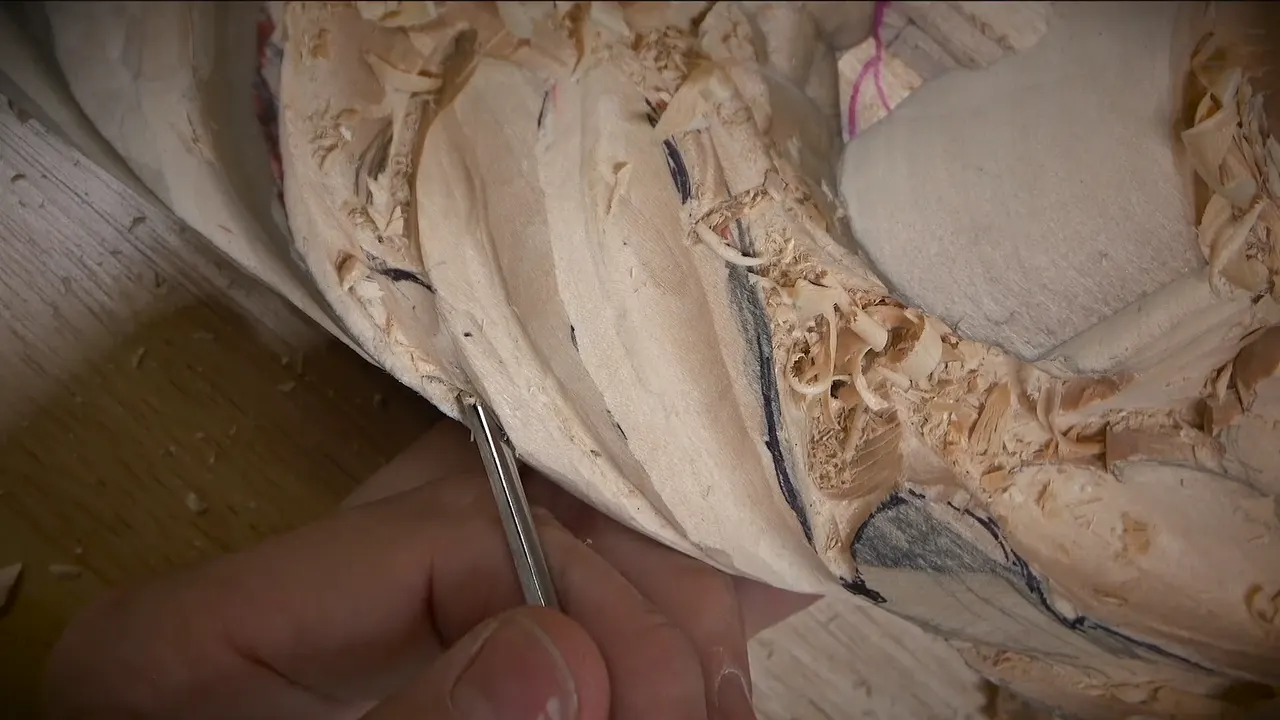

In part 10 of Venice Room workshop 71, I said I was limited in my choice of tools, right after I mentioned the handle hitting the main body of the carving. Other lessons of mine use the same word when a ceiling, a ridge or an edge is in the way, and when room, time or tools run short. A few say the opposite.
Ever pushed a gouge toward a spot and felt the handle touch wood first? Did you trade the tool and keep going? Here they are.
What did I say in workshop 71, part 10?
The part opens with "So that's probably the most I can go," and then "I don't think I'm going to be able to do a full rotation. Maybe I am. Yes, I am." Next, "So now it's just a matter of cleanup," and after that "And that just gave me beautiful shadow." Then "Beautiful shadow and beautiful movement."
The edges still needed cleaning, "but that's just not a big deal for me at all." My plan was "I can just take number five, a small tool, and ride it again right on the edge like that." Later in the part, "That is good and sharp and beautiful," I said, and "really clean and nice."

"Of course, I need to get all that junk out." Then, "Got a lot of junk going inside." It would wait for later. "I'll take it out a little later with the vacuum cleaner," I said, and "I'll just suck everything out with the vacuum cleaner."
Where did the deep spot go next?
"Okay, let me also outline this side," I said, and "that part is going to be a deep excavation." I named it "more like a shadow spot." Next, "I can probably take a little bigger tool and take care of it right away." The size I planned was "Maybe seven millimeters" (about 0.28 in), and "Seven millimeters is like a quarter inch or so." Of that bigger tool, I added "it's not really big."

I planned to undercut this way, and "That's what's going to give me beautiful movement." About the last step, "I'm not going to do to the final depth because I still have to work on my shells." What I was doing, I called "Just preliminary."
How did I protect the thin edge?
About the edge, "I have to be also careful not to touch this edge," I said. Also, "I don't want to use it as a leverage point." Of the risk, "It would be a mistake. I can easily break it." For that, "So that's why I'm placing my finger underneath. And if I need to crank it, I'm using my finger."
"But also be mindful, you can actually break your finger," I said, with "Yes, I'm not joking." One line followed, "If you crank too hard and you're trying to dig too deep, so you can just push too hard and break your finger." And then "No, it's never happened with me, but I know it is possible." The last word on it was "Okay? So be careful."
A cut straight down was my next plan. "That is probably as deep as I want to go. Not deeper than that."
Why did I change a line while carving?
"Now I need to work on this side," I said, and "That doesn't feel natural for me." Of the line itself, "It's just a little too straight in my opinion." For the fix, "I need to create that curvature a lot nicer," and "I think it's going to look much better this way."
"See, that was a good thing that I did not dig too deep from the beginning because I'm changing my mind on the go," I said.
"I think that would give me really nice movement." Next, "And again, what I could do, I could actually give a convex cut. Let me see if the convex will work in this case." Those were plans, and one more followed: "I'm going to use a back bend."
A reason for the tool came right after: "Because, again, you don't see that, but it's already, I'm hitting with the handle on the main body." The part ends with "And I'm really limited what tools I can use. I'm really limited."

Did a ceiling limit me too?
A ceiling is the limit in workshop 59, part 2. "Again, that is a challenging area because it is actually right in the transition to the ceiling." After it, "Because really, I'm limited from both sides." Depth came up too: "So I have to be mindful how deep am I going to go."
The ceiling comes back in part 12 of that workshop, along with "other parts." Close to it, "So it's not everywhere possible for me to use it."

Workshop 60, part 2, has another reason. "I really need that shadow," I said. And "this is the case, actually, how I excavate without damaging anything because I'm limited from what angles I can attack it."
What else stood in my way in the Venice Room?
An eye did, in workshop 63, part 6. "I have limitations," I said, and "I mean, I'm limited by this part of eye." My plan was "So I need to use probably even smaller, like one and a half millimeters" (0.06 in). Afterward I said "I don't have to, okay? Don't get me wrong," and "It's still going to look beautiful." Last, "I want to, okay? And it makes a big difference for me."

A ridge did, in workshop 73, part 2. "But I'm limited because I do have this ridge in my way, and I really can't use full potential of the tool in some of the areas." Later, "Again, some limitations I'm facing."
Workshop 72, part 11, has "I'm kind of limited to what I can do." After that, "But I still want to create the feel."

Part 9 of workshop 6 has "But I am kind of limited. That thing is in my way." I planned a number 11 spoon gouge, to clean a little bit.

Part 1 of workshop 4 brings the grain in. "That's not the best idea to work that way, so you're supposed to attack from that side." Then "But sometimes you're limited, and I am limited in this case because I don't want to rotate my piece, and I don't like to swap my hands because it's still not comfortable for me."

Space is the word in workshop 82, part 2. "I can now create the concave cut because I really need the middle part somewhat convex," I said. Later, "Really good shadow, actually." Then "It has to be readable."
Space comes back in workshop 96, part 12, over five divisions. "It has to do again now with the Fibonacci sequence," I said, and "I can do my fives a little differently."
Was space the limit in my other courses?
The deep area in Lily Box 8, part 11, brought "Okay, I can't do it too deep. I am limited in this area, but still, as much as I can." The tool was "number seven and a quarter inch" (about 6 mm), and after that "And I'll concave it all the way down if it's possible, okay?"

Its part 13 says it again, about space. After it, "Got really deep enough," and "plenty for casting shadow." The size was "one millimeter, now it's a half a millimeter" (0.04 in, then 0.02 in).
Lily Box 11, part 2, also talks about a back bend. "You could use just a straight tool," I said. "You don't really have to use a backbend, but sometimes you can't use a straight tool, some stuff on your way." And "in my case, just because I have a goose neck, I can get in some areas that I would be limited with a straight tool."

"I am working against the grain," I said in Hashemi Flowers 12, part 7. And "if you would ask me why, because I don't have ability to come and attack from this side." Then, "Or I should say I have a limited space to work with."
In my Hazelnuts course, lesson 7, part 3, I said "Not exactly three o'clock because it's impossible with the stem and this angle." A plan followed it, "Later on, I'll be able to get from the side here, like so, and get it flat. But for now, I am limited."

The tray course says it about an edge, in The Tray of Blessing 7, part 2, and later in that part "I wanna make sure I'm not digging in too much."
A V tool is the limit in Greek Acanthus 9, part 3. "And I am limited with the V tool, with the straight V tool," I said, and a hit on my carving could damage it. Next, "But it would be better if you would use short bend V tool, like this one is a number 12, and that's three millimeters" (0.12 in).
"If I would be at home, I would just go really deep. Okay, but we are limited," I said in Modern Acanthus 6, part 1. Before it, "I still put my finger or thumb as my leverage point and couple fingers."

Roman Acanthus 10, part 1, has a knife. "So this one is not flexible. So you're really limited, actually, what you can do with this type of knife. I really like more flexible metal."

Did the clock limit me?
In Lily Box 12, part 5, I said "But when I'm doing that for a client, sometimes I'm limited with the time, and I have to compromise and just stop at some point."
The Maine class has it too, in Grinling Gibbons Maine 15, part 2. "We are limited with only five days," I said. Then "And I do have to push." Next, "But if you're gonna do it at home, I would highly recommend just to finish the first layer first."

Is it about how many tools I own?
My October 2020 livestream has "There was a time when I had only one knife and one gouge, which was number seven, by the way." Next, "I was still able to do my work." Next, "You really don't have to have a lot of tools to create something nice, but you are limited. You're really limited if you don't have plenty of tools."
"But it would take me so long," I said, and "So long, because limitation, it just also reflects on the speed." One more, "And reflects on design, because some of these unique tools, they're made for specific application."
Flower Rosette 6, part 3, has a knife too. "I would still suggest to buy good gouges because on the more complicated projects, your knife is not going to fly, I should say," I said. Then "So you are really limited if you have only knife. But for the beginning, that's probably number one tool."

"I don't want you to buy tools just because I used that particular tool. I'm not in the business of advertising tools," I said in Furniture Panel 15, part 12. Then "Yeah, of course, it's nice to have more tools. But you can do lots of operations with a limited amount of tools."
Where did I say I was not limited?
Number nine shows up in workshop 5, part 10, after "And again, number 11 and 3 millimeters" (0.12 in). Then "Number nine will work also, by the way. So I'm not limited to this one."
Flower Rosette 6, part 5, says to push yourself, just for practice. "Sometimes it's a good idea just for practice to push yourself to do something which sometimes you think it's impossible to do with just limited tools and just to start doing it, and you'll see it's actually not true at all." Later, "If you don't have a small V tool, again, you're really not limited. So we can use just a knife."
How do the lessons line up against my words?
This table puts each lesson beside the spot where I said it, and the words that came with it.
| Lesson | Spot | Words |
|---|---|---|
| Venice Room 71.10 | The handle on the carving's main body | Really limited |
| Venice Room workshop 59, part 2 | A challenging area | Right in the transition to the ceiling |
| Lesson 60.2 | How to excavate without damaging anything | From what angles |
| In Venice Room lesson 63, part 6 | An eye | Limited by this part of eye |
| Lily Box 11.2 | Goose neck reaching past a straight tool | Straight tool |
| Hashemi Flowers lesson 12, part 7 | Against the grain | I said I have a limited space |
| Roman 10.1 | A knife that is not flexible | What you can do |
| Wood Carving Live, the October 21 livestream | One gouge | Limited without plenty of tools |
| My Rosette 6.3 | A knife alone on a complicated project | Really limited |
| Furniture Panel lesson 15, part 12 | Lots of operations | With a limited amount of tools |
| Greek Acanthus 9.3 | A straight V tool that could damage | Short bend |
| Modern Acanthus lesson 6, part 1 | An undercut | I would just go really deep |
| My Lily Box 12.5 | Work for a client, not for history | I have to compromise |
| In Venice Room lesson 5, part 10 | A number nine | Not limited |
Where can you watch the full videos?
Every lesson above sits inside one of my courses, and a workshop number means the Venice Room. The other lessons carry their own course name. This workshop 71 holds all twelve parts, and workshops 62 to 73 are in Venice Room Part 6. To watch the full videos, start here.
How it's done
- Keep a finger under the thin edge. I did not want to use the edge as a leverage point, so I was placing my finger underneath. If I needed to crank it, I would use my finger.
- Hold back from the final depth. The final depth was not for that moment, since I still had to work on my shells. Anything I did there was preliminary, just so I could see what was going on.
- Change a line that feels too straight. The line did not feel natural to me and needed a curvature. It was a good thing, I told you, that I had not dug too deep from the beginning.
- Pick the tool the handle allows. Because of the handle, my plan for the convex was a back bend.
Frequently asked questions
Which tool came after the handle hit the carving?
A back bend came next, for a convex I wanted to try. My reason was that the handle hit the main body, and the part closes on a line about the tools I can use.
Which lessons use the word for a ceiling?
Workshop 59 has me limited from both sides near the ceiling. The ceiling comes up again in part 12 of that workshop, and workshop 60 has my angles of attack limited.
Does limited mean a tool I do not own?
Sometimes. The livestream says I once had one knife and one gouge, and that you are limited when you don't have plenty of them. In the Lily Box course the limit was a straight tool, and a goose neck could get into the area.
What to carve next