

Alexander Grabovetskiy, woodcarver, School of Woodcarving · Published 2020
What does a wood carver mean by "can you see that"?
Quick answer: In the third video of Venice Room workshop 71, I asked you to look at a movement, answered it myself and gave my reason for asking. Other lessons of mine put a shadow, a curl or a ridge to you the same way. Each one is below, with its lesson.
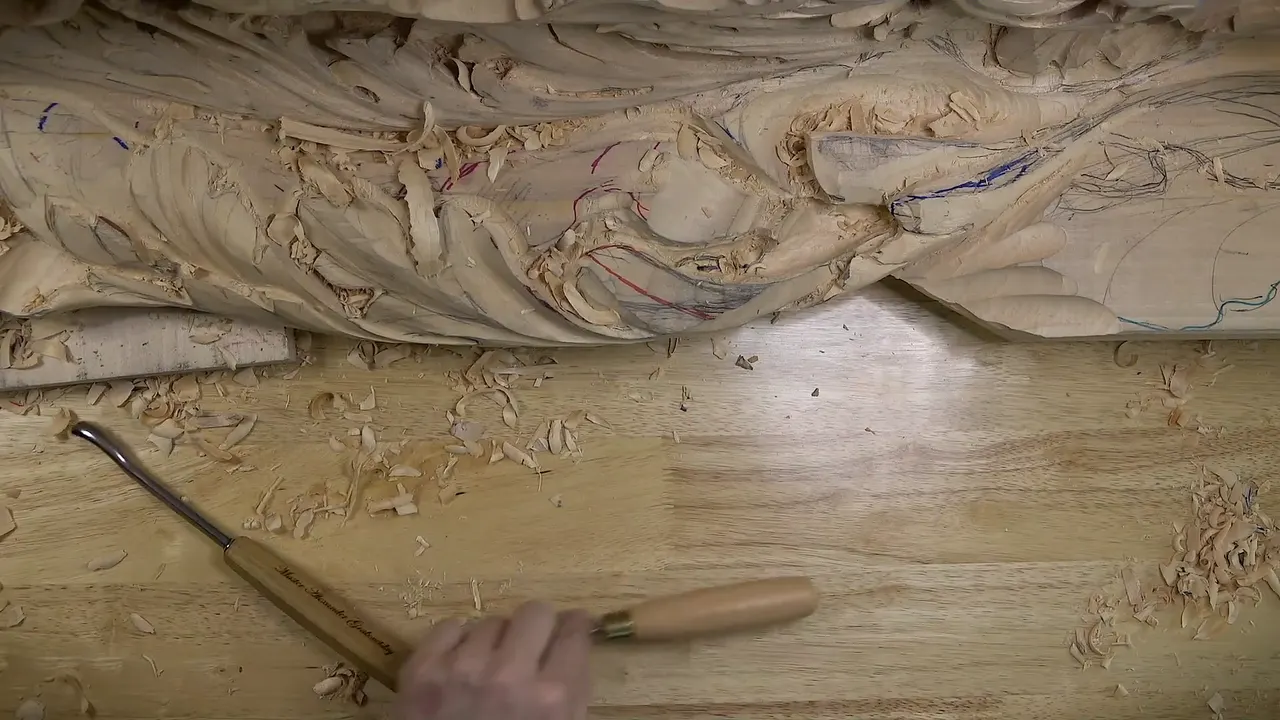

In Venice Room workshop 71, part 3, I stopped in the middle of the carving to ask you about a movement. I gave a blunt reason: "Otherwise, there is no reason to just make a video if you can't see that." Other lessons carry the same question, at shadows, curls, ridges or shiny cuts. Each one is below, with its lesson.
Ever watched a carving video and wondered what the carver wanted you to look at? Did the shape or the shadow reach you? Read on for where I ask, and what I point at each time.
Where was the carving in part 3 when I stopped?
Part 3 opens with a need: "I need to get actually another separation somewhere right here." I named a tool for it, "just another skew, a small one." The next cue is "And here you go. That is really, really nice."

My job after that, in my words, was to "just establish my middle lines and create convexes and concaves." Of the middle line I said "that is the middle," and of what it would give me, "beautiful movement."
Then I stopped to think. "Let me double think. Maybe I should bring this one a little bit this way." What it would give me was "a little more curliness," and my verdict was "I would say yes."
Which tools did I name before the question?
Number 11 came first: "Number 11 is what I'm going to use. Three millimeters." In metric terms that is 3 millimeters (0.12 in), and I added "And right here, too."
A number five followed. The size was "about 15 millimeters or so" (0.59 in), and my verdict was "I think this is a good one." I put the size another way, "Like 5/8 of an inch" (about 16 mm).

A smaller one came next: "maybe half an inch, maybe about 14 millimeters or so in this case right here." That works out to half an inch (12.7 mm), or about 14 millimeters (0.55 in). My next line was "exactly the same right there."
What exactly did I ask?
I turned to you and asked: "Can you see that? That movement?" The answer came from me, in the same breath: "Of course, you can see it." A reason followed.

It was this: "Otherwise, there is no reason to just make a video if you can't see that." After it came "And let me clean a little bit."
What came after the question?
A thought about the inside came first. "By the way, on the inside right here, I can create the plug cut and create beautiful shadow." Before that, a check: "this plane, this movement, what I should do with that." I said "I can actually take it a little deeper this direction." Then "Now I'm able to do a plug cut."

The tool was "Same number nine, what I used before, quarter inch" (6.35 mm). I gave myself a warning too: "I've got to be really careful."
The rotation had limits: "I'm not going to be able to do a full rotation, I don't think, because this plane, it's on my way." The cue goes on with "at least to that plane, like three-quarter of rotation, and then I'll attack from opposite side." It would not be a true round plug, I said, "but that's okay. It's still going to work."

"And I can go deep," I said, and then "Carefully. I can just go deeper and deeper." On slow removal I said: "if it's not removing quickly, that's okay. You can leave it right there."
The part ends on a measurement: "Let me see how deep I've got. About three-quarter of an inch deep, I would say, but it's already giving me some shadow." In metric, that is 19 mm.

Did parts 2 and 4 of workshop 71 ask too?
You are asked in part 2 to look at "what I just created," which I wanted to have "some curvature, just goes inward." Further on comes a question on the blend, "can you detect the movement? How nicely it just blends in?" and my opinion, "I think it's really beautiful."
A marker enters in part 4, and I said I would use one "for you to see that much better." The line I was marking got the words "that separation."
Which shadows did I point to in workshops 62 and 64?
My first stop is workshop 62, part 8, where I said I had to use "a bigger number 11 now." My goal: "I need shadow, and I need big swoops, big cuts." Then came "Okay, wonderful."

Much of the work would happen "off-camera," I said, but "you already see the development."
Workshop 64, part 3, opens on a result: "And that just gave me beautiful shadow casting." After "I know it's kind of a little far" came the camera: "I've got the camera a little closer to you," with a hope about "how deep shadow it casts."

The depth of a shadow comes in part 4 of that workshop, followed by "Isn't it beautiful?" From part 8 come "I'll try to show you what is possible to see on a camera," and "you really don't see what's going on on the side." Then: "It casts shadow now."
How did workshops 62 and 63 ask about the development?
Workshop 62, part 4, puts the development to you, and then: "Let me know if you like it, okay?" More followed: "If it even helps you." Then "you can take a small section and use it somewhere else."
Its part 11 asks again and goes on with "I can show you probably in overall how it looks." In workshop 63, part 4, my words were "It just gives me that feel of, it's like starting convexing," and then "Little by little."
What did workshop 67 say about a shadow you might miss?
In part 2 of workshop 67, I told myself to "hit a little bit with the bigger tool and soften overall movement." The size, in my words, was 15 millimeters (0.59 in) or 5/8 of an inch (about 16 mm), "a little less than" that.

On "all the shadow place" I said "They are obvious." Then came "If you don't see it, that's I guess not my problem." And then: "I can see them."
A line about the camera sits in part 3 of the same workshop: "And you see actually much better than me because on the camera, you see a lot closer to you."
Where do workshops 68, 69 and 72 ask?
For workshop 69, part 2, the start was "With the same tool, I can actually get to the point." My question was about "what I see." The job after it: "Now I need to take care of this ridge and make it more convex."
Over in workshop 68, part 6, I put "acanthus coming out" to you and answered "It should be." What I needed was "gradually moving uphill like this." Its part 10 has "acanthus is born, almost?"

"That's going to give me also extra, if you wish, shadow," I said in workshop 72, part 12. Then "It's already casting a really beautiful movement, a beautiful shadow," and "And yes, I could hit that side again."
Does the question appear in my other Venice Room courses?
It does, starting with workshop 39 in the Part 4 course. A movement I put to you in part 3 reads "Right there is a lower movement, which is going to be part of this one, and that's going to go downhill like this."
"I think it's really nice," I said of how "nicely it develops," in workshop 42, part 5. And then "of course, there is always room for cleaning."
Next came workshop 45, part 2, with "I should say hang over," a phrase I used before asking. After it came "Yes, I could blend pretty much this pipe." I called it "a hard area to blend."
Over in the Part 7 course, workshop 74, part 10, I planned a number seven, then asked and said "It's actually really beautiful movement."
Two more sit in workshop 83. In part 1 came "Let me get to the final shape," with a question on how it forms "the detail," and part 9 puts "the development of this" to you, with "It is simple, but looking good one."
The Part 14 course has it too, in workshop 162, part 3: "Let me explain one more time." I named "my eye, the eye of acanthus."
Which cuts do I point at in the Floral and Molding course?
Lesson 1, part 3, shows a shiny cut. My question was "how shiny that cut is," with a hope that the camera caught it. "That means that tool is really sharp," I said.

In lesson 10, part 3, it was a shadow: "I hope you can catch, it's already casting a shadow." A line about the craft followed: "wood carving, like I said multiple times, it is always about light and shadow."
I went on about the light. "I have lots of light going from all the points," I said, and in real life, once the piece is installed, "pretty much only couple sources of light." At night: "just from above." By day: "coming from the front."

Lesson 13, part 3, names a number 11 veiner at half a millimeter (0.02 in). I said "I also want to excavate a little deeper inside." Then "Really, really deep shadow." "How deep shadow that is" was my question, and "It's casting beautiful shadow" my comment.

In lesson 9, part 1, the subject was a pipe. "But don't want to force it." Then I put "how raised that micro pipe is" to you.
What do my Hashemi flowers lessons point to?
For Hashemi lesson 47, part 1, the words were "let me make that curl out even more." Then "Just like that." About the tool I said "I do use just one-eighth of an inch" (3.2 mm), and in the same part I named a carving knife: "Small, tiny carving knife."

My hope there was that you "can detect the edge, and that has a lot of movement." And I said "more movement you do, more beautiful it's going to look."
Lesson 39, part 4, has me saying I would get a small gouge, "like 1/32 of an inch" (0.8 mm), and make an undercut. I asked about "that shadow." Next: "I'm going to do on this side exactly the same. But like I said, have to be really careful."

One more, in lesson 46, part 1: "number eight, an eighth of an inch" (3.2 mm). A question about "that curl" came with "I really like how it looks."
How does Modern Acanthus handle it?
In Modern Acanthus lesson 5, part 2, I named where shadows come from: "concaves and convexes. That's the thing what gives you shadows." A plan for your sake: "Let me turn the lights off and you probably gonna see much better." The dark shadow got a question too.

"if you have to attack from the opposite side. Do it just like that," I said in part 3, and of the shadow there "It's casting beautiful shadow in my opinion."

The motion gets its own questions: lesson 3, part 2, asks how it "develops the motion," with "before I undercut" ahead of it, and lesson 6, part 1, asks how "I'm creating that motion," followed by "Can I say motion motion is good, right?"
What do I change so you see it?
I sometimes name what I will change so that you see more. The change can be a marker in workshop 71, a camera move in workshop 64 or the lights in Modern Acanthus. Floral and Molding lesson 10 goes to where the light comes from, night and day.
Some of my lines are about what the video leaves out. One has "off-camera," and the line I started with sits in workshop 71.
Which lessons did I point you to?
Each lesson is listed under the course it comes from.
| Lesson | What I pointed to, in a few words | Words I used |
|---|---|---|
| Venice Room 62 (Part 6) | Big cuts for shadow, and a question on how it develops | If you like it |
| Venice Room 64 (Part 6) | Shadow casting, with the camera nearer to you | Beautiful |
| Part 6 workshop 67, Venice Room | The shadow places, and a line about not seeing them | Obvious |
| Same workshop, part 3 | You see more than I do, because of the camera | Much better than me |
| Floral & Molding 1.3 | A shiny cut from a sharp tool | Really sharp |
| Floral & Molding 13.3 | A really deep shadow, with a plan to dig a little deeper inside | Beautiful |
| Hashemi Flowers 47.1 | A curl, and a hope about its edge | A lot of movement |
| Modern Acanthus 5.2 | The dark shadow, and a plan for the lights | Much better |
Where can you watch the full videos?
Every lesson above sits inside one of my wood carving courses. This workshop 71 holds all twelve parts of that workshop, and workshops 62 to 73 are in Venice Room Part 6. To watch the full videos, start here.
How it's done
- Name the tool. In that video I named a number 11, then a number five, then a smaller one.
- Put the movement to you. The movement came first, then my own answer. The reason I gave was the video.
- Clean first. I would clean, then take it a little deeper in that direction.
- Plan the plug cut. My plan was a plug cut with a number nine, for shadow on the inside.
- Check the depth. I looked at how deep the cut was.
Frequently asked questions
Why do I stop and ask you to look?
Right after naming three tools in that video, a number 11, a number five and a smaller one, I put the movement to you. The reason I gave was the video itself, since it is pointless if you cannot see the movement.
What did I do next?
I planned a plug cut for shadow after cleaning a little, with a number nine as before, and I told myself to be careful.
What if you do not see the shadow?
In workshop 67, part 2, I said "If you don't see it, that's I guess not my problem," and then "I can see them." The camera was nearer to you in workshop 64.
What to carve next