

Alexander Grabovetskiy, woodcarver, School of Woodcarving · Published 2020
What does a wood carver mean by "a good thing"?
Quick answer: Part 9 of workshop 71 has it, once the waste was out of a deep cut. Other lessons of mine say it about extra wood, a paper on the board, grain on my side and a few mistakes. A few lessons say the opposite.
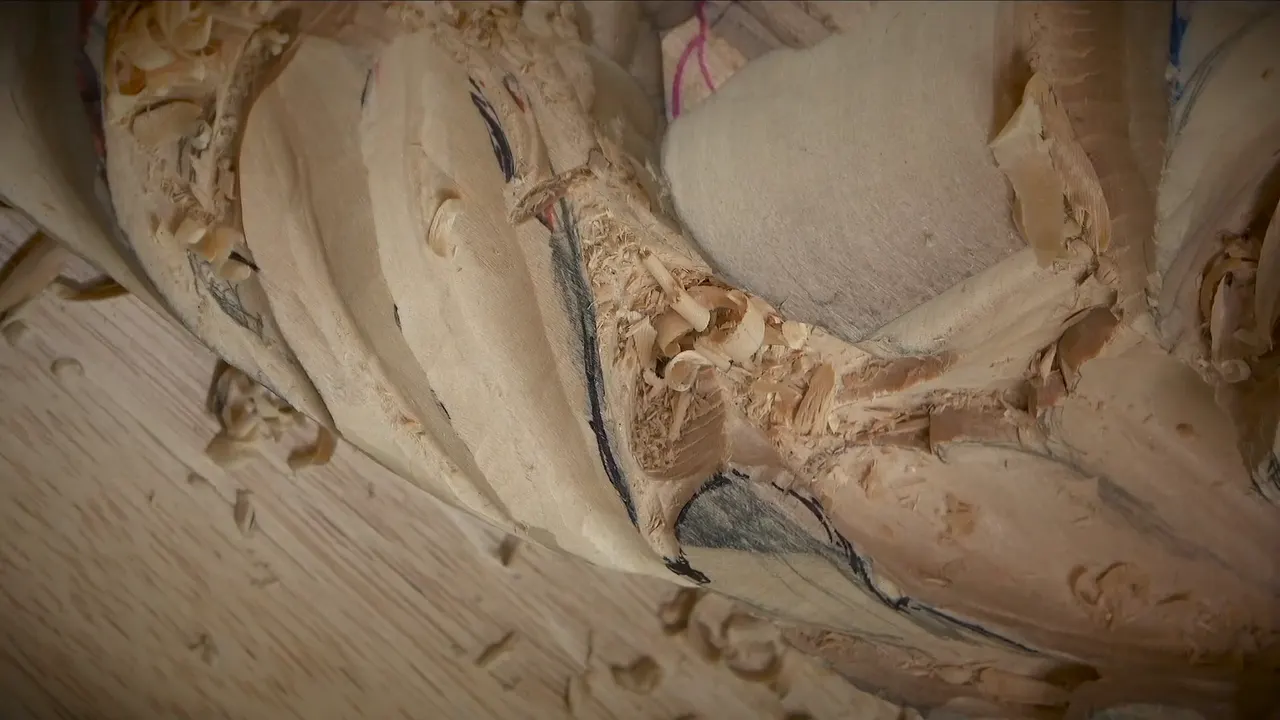

In part 9 of Venice Room workshop 71, I said "a good thing" right after "I got it," about waste in a deep cut. Other lessons of mine carry the same words beside extra wood, a paper on the board, grain that ran my way and a few mistakes. A few places go the other way.
Ever pulled a gouge out of a deep cut and found it clean? Did the wood or the tool do you the favor? Here is each place.
What did I say in workshop 71, part 9?
The part starts with a plan and a check. "I'm going to give some roundness to this movement," I said, and "Let me check what position I should attack that." The tool was "back bend." Then came "Carefully round this up," and a name for the shape, "That is going to be a pipe."
"I like how it takes shape already," I said, and then "I'm really happy about this pipe." Following it, "let me clean a little bit."

"Go that direction, too," I said, and "that's going to go right underneath." Then "beautiful movement, I believe." For the clean-up I named "that number 11 and 5 millimeters" (0.2 in), and said "I've got to be careful again." Then a switch, "Maybe I need to use a smaller number 11," and "Let me use the 3 millimeters" (0.12 in). Then "Here you go. Wonderful movement."
What was in the eye?
"I do see my eye, not the eye," I said, and then "the eye of Argus, of course." Then came "really beautiful separation," and "I really love that separation." A doubt followed. "Should I keep that movement on inside, or I could get rid of it completely?" Next, "Which I'm probably going to keep it for now, and if I don't like it, I'm okay."

What is a plug cut, the way I called it here?
The plan was to "remove inside of the eye" with "number nine and one-eighth of an inch, 3 millimeters," and "start again, like I call it plug cut." After "And just go in," came "It's going to give me a shadow that I'm after." Next, "And little inward also like that."

"And yes, I can go deep if I wanted to." And "I don't need to remove that plug, because I don't have enough space right here with the number nine, but I'm able, actually, to" dig toward that cut "with 1.5 millimeters, or 1 millimeter even." Those are 0.06 in and 0.04 in.
"But even let me try 2 millimeters first" (0.08 in), I said. The tool was "Number 11." Then "I'll go toward that cut little by little again," and "remove whatever I need to remove." Then "create deep shadow," and "Beautiful and deep shadow." Last, "let me use 1.5 millimeters."

What happened when I could not grab the waste?
"And let me try again number nine." Then the snag, "I know I've got a really deep cut, but for some reason, I cannot grab that waste." My plan was "Let me hook this out somehow." "Right there. I got it." The next words were "It's a good thing."

"Here you go," I said, then "Now it's clean," and last "You don't see it, but it's beautiful, deep, and clean." Then again, "Beautiful, deep, and clean."
The part ends on a plan. "And, of course, I could do exactly the same toward that side. Maybe I should. Why not?" Next, "I'm going to do a plug cut, but toward this direction."

Did the other parts say it too?
Part 6 has "Have to use a long bent," a number 11, "just a quarter inch for now," six millimeters. Then, "it's a little thicker closer to this part, which is a good thing." Part 10 has it after a line I did not like. "It's just a little too straight in my opinion," I said, and "I need to create that curvature a lot nicer." Then "See, that was a good thing that I did not dig too deep from the beginning because I'm changing my mind on the go."
Was it about wood I still had?
A void is the story in Lily Box 5, part 6. Before it, "Let me get a flatter gouge, like maybe a number three, and chop out this." Then, "What just happened? Inside of the wood, there is a void, and that's a good thing that I have enough meat right here, so actually, I didn't lose anything."

In workshop 35, part 6, my plan was "chop out this section," with "otherwise, it just doesn't look too organic" after it. Then "round this up a little bit," and the "extra material" got the words "a good thing." Soon "I think it's much better," I said.

"My grain changes direction," I said in Greek Acanthus Leaf 7, part 3. A moment later came "a good thing" with "extra material right here."

Hashemi Flowers 41, part 3, is about berries, and "I don't want to make those berries too big," I said. Then "I'll take just a quarter-inch number nine" (about 6 millimeters). Of the "extra material" I said "a good thing," with "so I can create stuff like that" after it.

"Even without the measuring," I said in Floral and Molding 10, part 3, and "I got the right spot." Next, "I guess that's always a good thing." My next words were "I'm glad I didn't excavate that deeper. That would be a big mistake."
A pipe in workshop 72, part 9, was "not dimensional enough for me, so I need to exaggerate as much as I can." Soon after, "a good thing I did not undercut underneath, and I do have enough thickness on inside." Then "so I'm safe to do that concave with no problem."
Was it something at the bench?
Green tape is the helper in Lily Box 2, part 1. "See? I almost destroyed it." I called the "green tape underneath" "a good thing." Next, "I actually just scratched the green tape," and "I did not touch the wood itself."
Glue is the check in Lily Box 8, part 6. "Let me see if I have any glue underneath, squeeze outs." Then "And no," followed by "a good thing. I don't have to clean anything," and last "There is no glue."
A paper helps in Furniture Panel 22, part 9. "Carefully, carefully create that concave," I said. I called the paper "a good thing," along with "I can always see where I hit with my tool." My number seven there was "just marked quarter inch" (about 6 millimeters).

The paper shows again in Furniture Panel 20, part 7, with "my paper helps me to see the edge" and "a good thing." Soon "Here's my pipe," and "I clearly able to see that."

A ceiling part is a different helper, in workshop 50, part 9. "I need to keep that plastic closer to myself because the movement itself is not exactly the same," I said. Then "a good thing" about "a ceiling part," and "I can see exactly what is going on and reference."

When did the wood go my way?
In workshop 155, part 2, "maybe I can lower that down using my side of number 11." Right then, "I've got that grain working in my favor," and "that is a good thing."
One cut met the next in Lily Box 11, part 5. "You can see I am actually connecting to the next cut," I said, and "a really good thing." Later, "I need to turn to a smaller one, like a half a millimeter" (0.02 in), and later "I connected that to the next cut right here."

"Going to attack from two sides," I said in Furniture Panel 21, part 2. Soon "it's not flying out," and "a good thing, a really good thing." Next, "that means my straight down cut did not go all the way to one-eighth of an inch" (3 mm), and "I need some space for cleaning."

"The tools, they have to be really, really sharp." That is from Roman Acanthus 10, part 1. Later, "I do have to make some excavations that I'm even not able to see with my eyes." Then "Looks like I am all the way through," and "a good thing." My goal, I said, was "continuous cut underneath."
A shadow is the setting in workshop 63, part 7. "Okay, now I can see that is also casting shadow, which is good thing, and that is exactly what I'm after."
Can a mistake turn into a good thing?
In Lily Box 12, part 5, I "pushed too hard," and "I'm safe because just that leg broke." "Maybe it's actually a good thing what happened," I said. "That way I can show you when you work with just the fingers, holding with the fingers." Last, "you got to be really careful when you do it that way, okay?"

"It's not like end of the world," I said in Lily Box 13, part 3. "Now, because it happened, I had a separation cut between those two, but now I can actually glue them together." After it, "I can put the drop of glue right in the middle," and "it's going to be more stable." I wondered if what happened was "a good thing." Then "But still, I kind of have to be careful with that."
The Maine class has my own error in Grinling Gibbons Maine 10, part 3, "the mistake what I've done it was before I excavated too much from the backside." After it, "let me take advantage of that mistake." Later, "Maybe it's a good thing," then "But see it's how fragile that is."
Later still, "That's separation." Then "I can see the stem right below of this flower," and "Maybe it is a good thing." Last, "But kind of weak spot," and "Because there's nothing to hold on," I said.

Where did I say it was not good?
Rushing is the subject in Floral and Molding 2, part 2, with "I don't want to rush it." Next, "Even if there is a deadline, rushing is not really a good thing." As you know, I said, "woodcarving is an art of deduction, art of subtraction, and once you take too much, you can't put it back."
A rasp is the subject in workshop 11, part 5, "just because I use rasp, you can see the new concaves a lot more clearer, I'd say." Then "it's not necessarily the good thing." And "I can always hit that with some type of sandpaper or just with the reed brush."
A mallet finish is the subject in my April 2020 livestream on wood carving mallets. "Look at the finish," I said, and "sometimes it's not a good thing, okay, to have finish on your mallet." Next, "a good idea to protect maybe, but it's not the best idea."
How do the lessons line up against my words?
This table puts each lesson beside the spot where I said it, and the words that came with it.
| Lesson | Spot | Words |
|---|---|---|
| Venice Room 71.9 | Right after I hooked the waste out | Deep cut |
| Venice Room workshop 71, part 6 | A little thicker | Long bent number 11 of six millimeters |
| Workshop 71.10 | I had not dug too deep | Changing my mind |
| In my Lily Box course, lesson 5 | A void | I have enough meat right here |
| Workshop 35, part 6 | A section I planned to chop out | Extra material |
| Greek Acanthus Leaf 7, part 3 | Grain changed direction | I have extra material, I said |
| Hashemi 41.3 | A quarter-inch number nine for berries | The extra material |
| Workshop 72 in my Venice Room course | A pipe | Not undercut, and enough thickness inside |
| Lily Box 2.1 | A slip where I almost destroyed it | Green tape |
| Furniture Panel lesson 22, part 9 | Carving a concave | We do have a paper, I said |
| Panel 20.7 | A paper and the edge | Here's my pipe |
| Workshop 50 in the Venice Room course | Ceiling part | Just place it to my view |
| Workshop 155, part 2 | Lowering it with the side of number 11 | Grain working |
| Furniture Panel lesson 21, part 2 | Not flying out | Straight down cut short of one-eighth inch |
| Roman 10.1 | A cut I could not see | Continuous cut underneath |
| My Lily Box lesson 12, part 5 | Leg broke | Maybe it's actually a good thing |
| Olives, Lily Box 13.3 | A separation cut I could now glue | More stable |
| Grinling Gibbons Maine class, lesson 10 | A weak spot | Nothing to hold on, I said |
| Floral 2.2 | Rushing, and I said not really | A good thing |
| Workshop 11 of the Venice Room, part 5 | A rasp | It's not necessarily the good thing |
| Lesson 8.6, Lily Box | Looking for any glue squeeze outs underneath | No glue |
| Lily Box lesson eleven, part 5 | A little wiggle | I am connecting to the next cut |
| Livestream April 2020 | Finish on a mallet, I said | Not a good thing |
Where can you watch the full videos?
Every lesson above sits inside one of my courses, and a workshop number means the Venice Room. The other lessons carry their own course name. This workshop 71 holds all twelve parts, and workshops 62 to 73 are in Venice Room Part 6. To watch the full videos, start here.
How it's done
- Round the pipe with a back bend. I planned some roundness for the movement and wanted to check what position to attack from. A back bend was the tool, and I called the shape a pipe.
- Clean with an 11, then a smaller one. For the clean-up I named the number 11 at 5 mm (0.2 in), then said maybe I needed a smaller one, and named the 3 mm (0.12 in) for it.
- Plan a plug cut inside the eye. Inside the eye I planned a number nine at 1/8 in (3 mm), the start I call a plug cut, for a shadow that I'm after.
- Go toward the cut with thin tools. A plug needed space I did not have. Thin tools could still reach, and I planned 2 mm (0.08 in) first, then 1.5 mm (0.06 in), little by little.
- Hook the waste out. A deep cut held waste I could not grab. I planned to hook it out somehow, and then came "Right there. I got it."
Frequently asked questions
Which lessons mention extra material?
Workshop 35 of the Venice Room has me naming it, and so do my Greek acanthus and Hashemi courses. One Lily Box class names "enough meat" after a void in the wood. Each time I called it a good thing.
What came after the waste was out in part 9?
A plan for the same cut toward that side came last, with a "Why not?" before it, and a plug cut toward this direction. Before the plan I called the cut clean, and said you don't see it but it's beautiful.
Can a broken piece be good news?
A leg broke in one of the Lily Box flowers, and I wondered whether that was actually good. "That way I can show you" how to work with just the fingers. Another lesson had a separation cut that glue could hold, and I wondered about that one too.
What to carve next