

Alexander Grabovetskiy, woodcarver, School of Woodcarving · Published 2020
What does a wood carver mean by "extra movement"?
Quick answer: In part 5 of Venice Room workshop 71, I said a shell part needed a lot more details, and called extra movement inside a maybe, along with extra separations. That was only a plan. Other lessons of mine use the same words for a concave, a ridge or a groove, each with its lesson below.
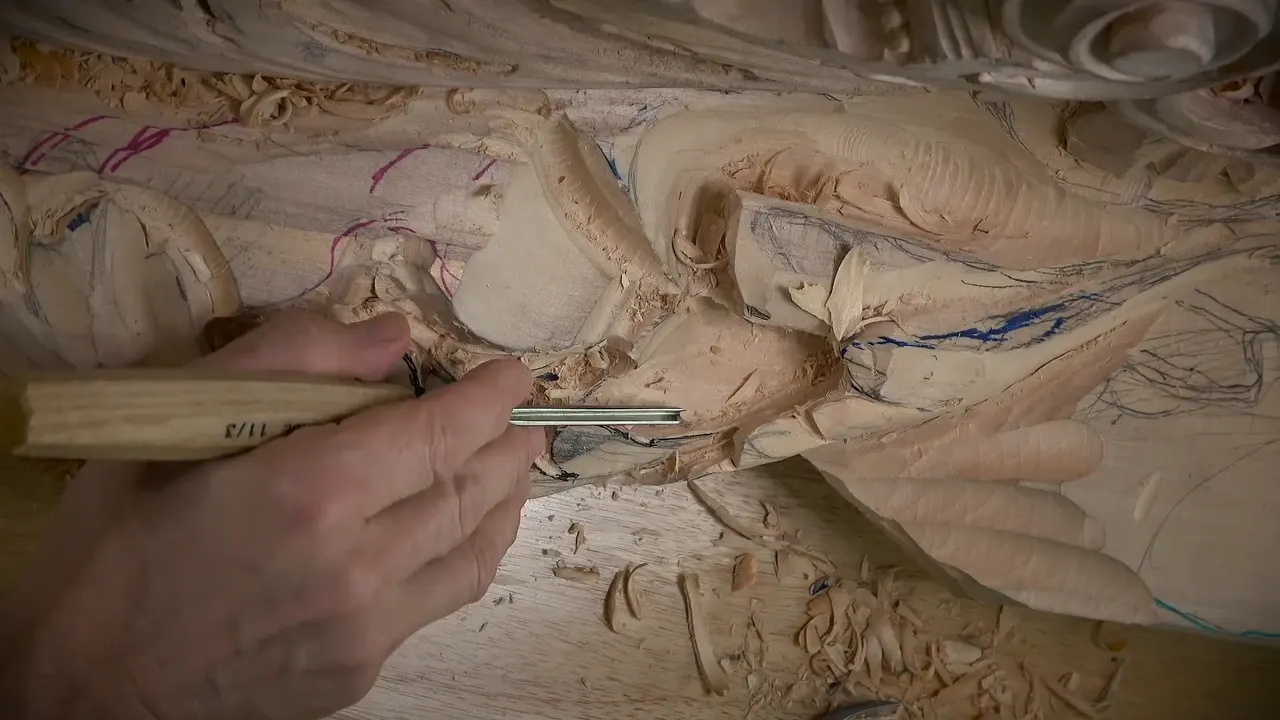

In part 5 of Venice Room workshop 71, I said a space on a shell was a little too open, and I called extra movement a maybe for it. Other lessons of mine use the same two words for a concave, a ridge or a groove. Each one is below, with its lesson.
Ever looked over a carved spot and felt it was missing something? Did you reach for a smaller gouge or a bigger one? Read on for what I said each time.
What did I say in part 5 about extra movement?
Part 5 opens on a plan. "That is going to be a shell," I said. After a check of the wood ("I'm just checking how thick the material I've got right there"), I named what was left: "I still have to create a nicer movement on inside, but I have to be really careful with that."
Tool talk came next. "Let me think what tool I should use. I'll use probably number six," I said, to create "my beautiful movement" on the inside. A smaller number 11 was on my mind too, for "the undercut underneath of this section."

The camera got in my way: "It is a little challenging for me not to cover camera," I said, so "I have to stretch my hands really far." Later I told you how I would finish: "now I can establish my concaves and convexes on inside. I want to make sure it does look good."
The space itself came next. "For me, this space is a little too open. It's beautiful, but there's going to be a shell." My plan was "I'm going to go from underneath and continue this way, and that almost repeats inner part of a shell, like a concave part of a shell. And that's not what I want to see."
Here are the words this page is built on. "So which means I need to bring this part to a lot more detailed look." Then: "And maybe just create extra movement on inside." After that: "Extra movement with the extra separations and so on."
The other part, I said, was "going to die in," and "I could create separation." About every side, one line: "I want to make sure it looks good from all points of view."
The tool I named was "3 millimeters again. Number 11" (0.12 in). A second thought followed: "Maybe I should use already a spoon. Because right now I'm cranking against this edge, which is not the best idea." And "Beautiful separation right here."
A chunk had to go. "I don't need that chunk at all," I said, and "Let me just remove it with the spoon gouge, like number six." Number five came up too: "I can use number five, I believe, safely now." It would at least give me the movement I was after.

Careful, I told you. "I don't have too much left material," and "Have to be really mindful." Then "at least I can see the main movement." With a shell in mind, I said, "I need to get a lot more details on this part."
Near the end I came to a maybe. "What I could do, I could create a pipe, but it's on a concave, and logically, the pipe's supposed to be also concave inside." Then: "But I'm not sure if I want to do that way or not."

Is extra movement made for just the eye?
Workshop 12, part 3, of the first Venice Room course puts the words beside a pipe. "Now I can see my pipe is not as nice as it's supposed to be," I said. My plan was "create extra movements like what I did right there, with a really shallow number five or number seven," maybe "like three millimeters, one-eighth of an inch." And what it was for: "Again, it's for just the eye."

A little later I said what I could do, "just to give an extra movement, maybe just with the one millimeter, I give extra cuts somewhere." Then: "Just one, okay? That's all I need."
Part 11 of that workshop has a deeper one. "Maybe I can actually put an extra, maybe deeper concave 5 millimeters right here on the side of the pipe" (0.2 in). Next: "Just give extra movement for the eye." And "I think it's good. But it's enough. It is enough for this area."

Workshop 20, part 4: I weighed leaving a small tool mark. The mark would not bug me at all, I said, and it "just creates extra line, extra movement, actually, to draw your eye." Then I changed my mind: "Actually, no," and I would take care of it. With "one millimeter" (0.04 in), I said, I would get rid of it.

When does a spot ask for extra movement?
Workshop 29, part 12: "I've got this subdivision, but I don't think it's enough." Next, the move: "I think I should do an extra movement right there because it doesn't feel too light yet." One was my plan, on the inside, and I called it "extra subdivision," and "extra eye." Moving my pipe a little bit "is absolutely okay."

Workshop 30, part 5, gave a plain reason. I could probably add extra movement there, I said, "because right now it doesn't look too good." I named the cut as "shallow, not deep, almost no concave, but concave."
Workshop 44, part 3, had a separation on my mind. The line was "Maybe I need to bring this separation right here" for an extra movement, "because I'm really not too happy about how far that sticks out." Then "Not a big deal."

In the Furniture Panel course, lesson 23, part 4, an undercut that went too deep made one. "I just created an extra movement, which is absolutely okay." The reason came next: "extra movements, it's the next step, what I have to do with those flowers. Otherwise, it's just looking too dull."

Does extra movement make a shape more logical?
The later courses used it over a spot I found odd or doubted. Workshop 94, part 5: I called it "a weird looking area," and said I could give it extra movement this direction. "And that's gonna look really good."

Workshop 95, part 9, was a maybe: "I don't know if I like it or not, maybe maybe if I add extra movement like this. It's going to look more logical."
Workshop 98, part 2: "Maybe I just want to clean and I can create an extra movement." That would "make more sense in overall," I said.
Workshop 99, part 2, was about a leaf. I had "a big doubt about this leaf," I said, and "it doesn't really look like oak in all." Then "Maybe what I can do, I can get extra movement like this, and then that becomes one part and this is going to stick from underneath." It would be "more logical," I said, and about all of it: "it's my opinion."
What does an extra movement give the carving?
Workshop 35, part 2, ties it to shadow. "Definitely could use some depth and just to create extra shadow. Extra movement." Next came a tool problem: "this tool is not going to fly, so I have to use something different. Maybe number three."

A ridge did it in workshop 32, part 5. "I think I like the ridge." About it: "Just gives extra pop," and "it gives extra movement." Then "that is a beautiful thing." The same detail goes around, and "I have to create exactly the same idea on inside right here."
Workshop 61, part 5, looks at it overall. "It just gives some extra movement, and that repeats busyness of this area, and it repeats busyness of those shells." "That's spread at approximately the same distance," I said, so "it's strategically designed."

Workshop 97, part 7: "I decided to get an extra movement underneath of this leaf." The light source would strike from above, and "I think it's going to give me a really nice shadow."

Workshop 102, part 11: "So some extra movements. Okay." After that I said maybe actually "create even deeper excavation in that section and create extra shadow."
Workshop 20, part 8, plans a concave on inside that would already add an extra movement. "Plus on the edge, you're going to have some multiple separations," and "a really nice interesting feel to it."

Does extra movement come before the main shape?
Part 12 of workshop 71 has "I know it's looking really big right now, convex and concave, but that's okay. We're going to establish extra movements. I need just the main shape at this point."

A main line came first in workshop 46, part 8: "that line is the main line, and I do not want to lose it." Then "Maybe I could actually give an extra movement going that direction and go underneath of that one. I'll figure this out little later."
One I doubted: workshop 25, part 3, "the extra movement this direction, which I doubt I want to do." And workshop 38, part 8: I could put extra movement inside, "which you really don't see," but "I'm not going to do it now, okay? I'll just going to leave it like that for now and see later if I need to do anything."

How did extra movement show up in my other courses?
Lesson 19 of Furniture Panel, part 6: my work was "almost from nothing. It's almost invisible what I'm doing." With the paper on you can see it, I said, but once the paper comes off, "on a camera, it's almost impossible to see. But there is extra movement, which makes it really nice and beautiful."

Lesson 23 of that course comes back to it. With "Number eight," I said "in this case, it's only 3/32 of an inch" (2.4 mm), "or maybe a couple millimeters." I would love to give extra movement, I said, but not with a feel "like it's just extra separation." Part 6 has me with "the smaller gouge, like one millimeter, number eight" (0.04 in), and "I can excavate a small spot." After it: "It's a small detail, but it's a really nice detail. It just gives me extra movement, I would say."
Floral and Molding lesson 10, part 3, shows a choice. About a piece I made before, I said I had a secondary movement inside. Of it, "it's like an extra movement" that "casts extra shadow," I said. And "Totally don't have to do it, okay? But I like that stuff." Then: "So let me do it."
Grape Onlay lesson 14, part 1, was about the tool. When you work on details like "creating some extra movements," I said, "sometimes it's a good idea to use" somewhat smaller tools, "because a lot less material you will remove." I was minding the thickness: "no more than three millimeters left, like one-eighth of an inch only."

Venetian Flowers Rosette lesson 3, part 1: I wanted extra movement "in this section." The move: "a little deeper concave on this side," and the result would be "an extra dark spot."
And in Lily Box lesson 12, the small filler flowers of the lily box, part 8 has this: "I can take a number eight and create extra concave movement." Next came "I just created extra movement." Then a slight cut on inside: "Give that extra pop."
Which tool did I take for extra movement?
Workshop 17, part 9, has "This gives a little extra movement," and "I think it's a good detail." Then "probably a spoon, number 12 spoon," I said, and "Maybe 2 millimeters will do" (0.08 in). "3 millimeters was too big" (0.12 in). Workshop 27, part 6, is the other: I would probably start with just number five or maybe six, I said, and the concave would give me extra movement. The table below has the rest of them.
| Lesson | What I was after | Size |
|---|---|---|
| Workshop 71, part 5 | The inside of a shell, with a number 11 and maybe a spoon | 3 mm (about 1/8 in) |
| Part 3 of workshop 12 | Movements for the eye, with a really shallow number 5 or 7 | Maybe 3 mm |
| Venice Room 12, part 11 | A deeper concave beside the pipe, only a maybe | 5 mm (0.2 inch) |
| Workshop 17, part 9 | A small detail still to clean beneath it, with a spoon | Number 12, 2 mm (0.08 inch) |
| Part 4 of workshop 20 | A tool mark that I decided to clean off after all | 1 mm (0.04 inch) |
| Venice Room 27, part 6 | A concave I said I would bring down | Number 5, maybe 6 |
| Furniture Panel 23, part 4 | Giving movement without a feel of just an extra separation | 3/32 in (2.4 mm) |
| Furniture Panel lesson 23, part 6 | A small spot I said I could excavate with a smaller gouge | A 1 mm number 8 (0.04 inch) |
| Lily Box 12, part 8 | An extra concave movement all the way to the edge of the wall | Number 8 |
Where can you watch the full videos?
Every lesson above sits inside one of my wood carving courses. This workshop 71 holds all twelve parts of that workshop, and workshops 62 to 73 are in Venice Room Part 6. To watch the full videos, start here.
How it's done
- Name the space. I called this space beautiful, and tied it to the shell.
- Say what the shell would repeat. Going from underneath, I said, almost repeats the inside of a shell, and that was not what I wanted to see.
- Ask for more detail. I said I needed a lot more detailed look, and maybe extra movement for the inside, plus extra separations.
- Pick a tool. Number 11 in 3 millimeters (0.12 inch), and a spoon was a maybe, since I was cranking against the edge.
- Look from every side. I wanted it to look good from all points of view.
Frequently asked questions
Which part of workshop 71 puts extra movement on a shell?
Part 5. On a shell part I named extra movement, with extra separations and so on, as a maybe. In that part it was a plan, and near the end I said I was not sure about the pipe.
Which tools did I name in part 5?
Number six first. Later I named 3 millimeters (0.12 inch) in number 11 again, and a spoon, maybe. I could use number five, I believe, safely now, I said. Every one of those was plan talk or a maybe, as I said it.
Did I carve every extra move that I mentioned?
Workshop 25 has me doubting I wanted it. Workshop 38 has me leaving it alone for now, to see later. In Floral and Molding lesson 10 I said I totally did not have to, and then said let me do it.
What to carve next