
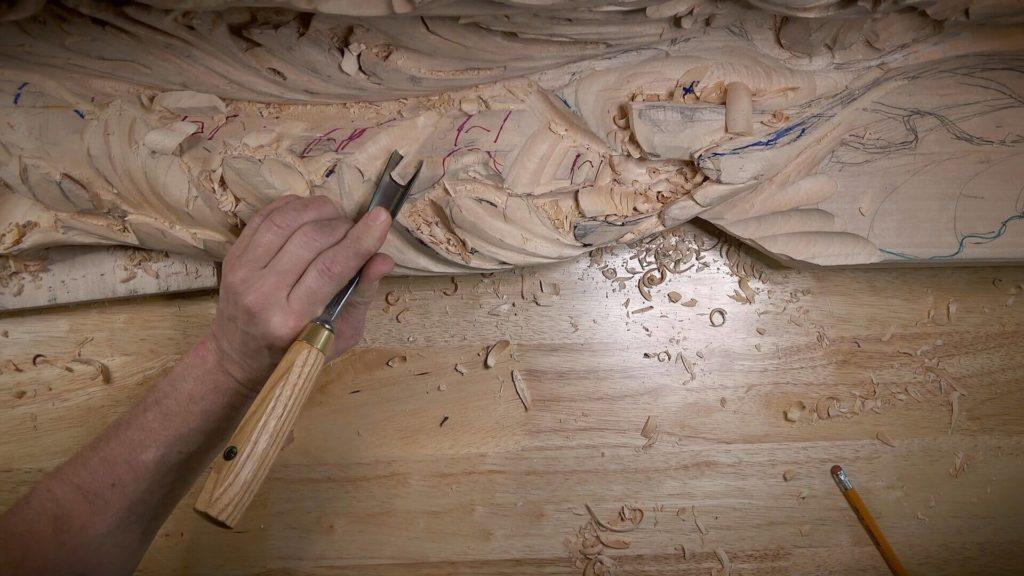
Alexander Grabovetskiy, woodcarver, School of Woodcarving · Published 2020
What does a wood carver mean by "persuasion"?
Quick answer: In part 11 of workshop 71, a mallet and a number nine came with "A little persuasion." Part 4 of that workshop has a plan for some persuasion too. Elsewhere in the Venice Room the word sits beside a spoon gouge or a number five.
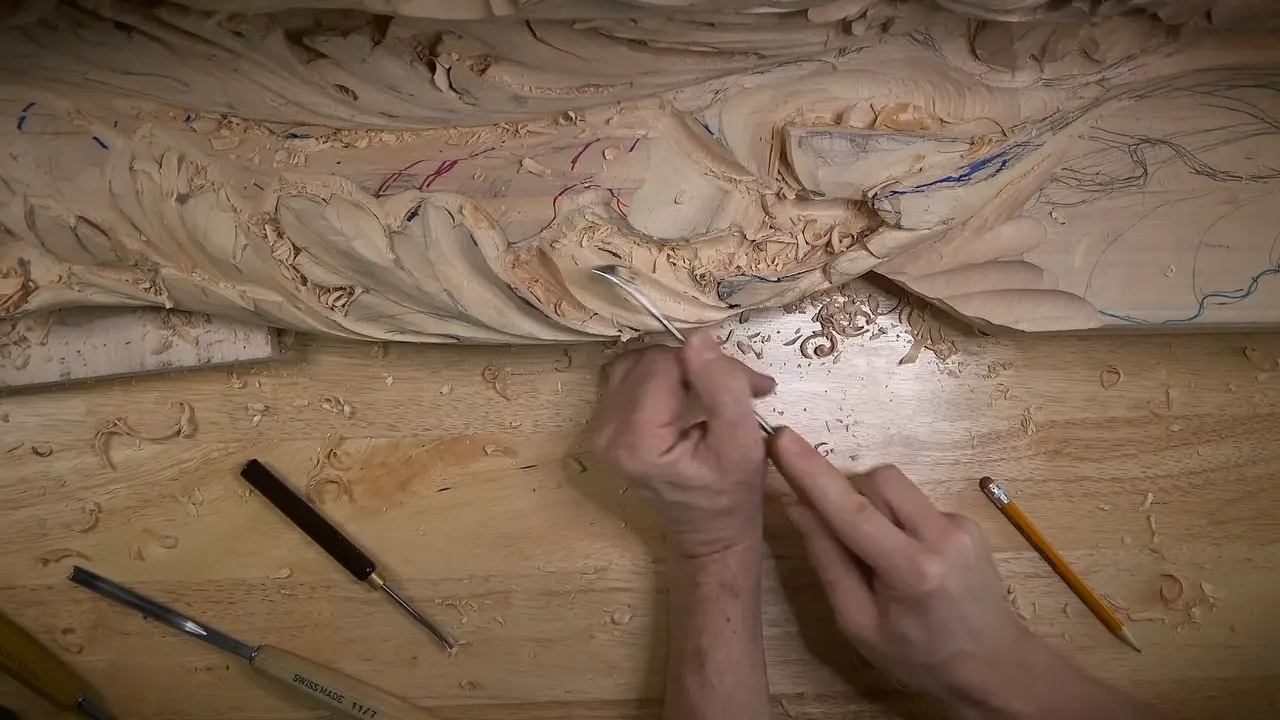

In part 11 of Venice Room workshop 71, I said "I'll use number nine and a mallet," and the next line was "A little persuasion." Other lessons of mine carry the same word, a few beside a mallet and a few beside a spoon gouge or a number five.
Ever stood over a shell and felt one tool was taking too long? Did you pick up a mallet? Come through this part with me.
What did I say before the mallet in workshop 71, part 11?
The part opens on a tool I could use for carving against the grain. In this case, I said, it "is really good." About the tool itself, "But I need to sharpen it a little bit."
"And that is beautiful," I said. Then, "That is just beautiful movement. I love it." I could blend it in, I said. Next, "I don't really need that pronounced convex right here." The last word was "Really good."

How far did I plan to go before the shell was done?
Detail had a limit. "I can go only to the certain degree of details until I've done with the shell," I said, so "I cannot do too much around this area."
What I could do was "just preliminary kind of outline and establish the main form." Later on, "I will give better shape to it." I planned extra separations "right there," and maybe "later on" on the side, "in those areas." I gave a reason, "Because I love it, and that's going to give me a really nice curl in this round."

Where did the shell movement go?
I wanted to "jump on the shell." It would be "a shell movement," running "all the way to somewhere right there." Its start would be "right at this point."
A plan came next: "let me reestablish my convexes and the concaves." My list was a convex, another convex and another convex, and "the rest of it is going to be concaves." That "should give me beautiful movement," I said, "all three-dimensional," with "really deep excavations" that would go "underneath of this movement."

Why did I go slowly near the shell?
"Let me start on developing those," I said. A pace followed: "little by little, okay, because I have to be really careful in this area." On hurrying, "It is better for me not to rush. Don't want to make mistakes. Not in this case at least."

Bead moldings came next, with "There's going to be a bead moldings" in my words, and "I need to determine which side am I going to do." My guess was "Maybe right there on that side and right here it makes sense." The bead moldings were to sit on one more side as well. Still, "first what I have to do, establish my main convexes and concaves."
Where does the mallet come in part 11?
Number nine is the first tool I name in this stretch of the part. A switch follows. "Or you know what? I should use probably just number seven." After that, "Well, kind of don't like how long it takes."

Then the line: "I'll use number nine and a mallet. A little persuasion." Nothing in the part says what the word means. Next came "Oops. That is not good enough."
Some of the stuff right here had to go "later on," I said.

What was left to watch at the end of the part?
Of its length, the shell would go "almost all the way to this point." About the edge, "I have to create the edge exactly the same what I've done in another cases." Then "I have to leave some space right there. And this one."
The last lines are "Got to be careful" and "Have to be careful."

What do parts 10 and 12 of workshop 71 add?
A "deep excavation" waits in part 10. The tool, I said, is "not really big," maybe "seven millimeters," which is "like a quarter inch or so" (7 mm, about 9/32 in).
The beads return in part 12. "I really don't have to do those beads in this area, but I think it's going to look nicer, I should say, with the bead moldings." On space, "I would just do about 45 degrees bevel all around."

Number seven came up for a reason, "I can damage my main movement." The switch would be safer: "it's better to switch to a different tool and work a little safer." For the convexes I leaned to "skew for the beginning," and it would be "much quicker for me."
Something went deep, too: "Oh, that's really penetrated deep." The close was "I know it's looking really big right now, convex and concave, but that's okay. We're going to establish extra movements. I need just the main shape at this point."
Did workshop 71, part 4 use the word too?
Part 4 puts the word in a plan: "I'm going to use a little bigger 7 millimeters tool," or 7 mm (a bit over 1/4 in), "and maybe some persuasion with the mallet."

A warning follows: "I have to keep an eye how deep I'm creating my cuts. It would be a huge mistake to go too deep." Closer to the surface, "I can go as much as I wish."
Where did I say a spot needed some persuasion?
In workshop 68, part 1, I thought of "maybe 18 millimeters" (0.71 in). I said "I got already to the ceiling, so I can't twist." Then, "Really deep and nice. Beautiful movements." Later I thought of "even bigger, maybe 20 millimeters" (0.79 in).

"Oh." Then, "It needs some persuasion." I named another tool: "what I need is just a spoon gouge right now. Or a spoon veiner, I should say. Because it is not the right way I'm doing it." And "See, I'm actually laying right on the board already when I'm doing those cuts."
Which spot in workshop 69 needed more persuasion?
The word meets a letter S in workshop 69, part 9. "I'm taking my time," I said, "and maybe I'm just trying to be a little more accurate." A "letter S movement" was coming in that section, and "I need a little more persuasion. This way, that way, and that way."
"It was number five, by the way," I said, "about 16 millimeters, like five-eighths of an inch" (16 mm is 0.63 in). "It is just really good," I said, and then "I am ready for the establishing main concaves and convexes."

Was a mallet in the plan in workshop 82?
A size change comes in part 4 of workshop 82. "I need to switch to smaller one, maybe 2 millimeters or even 1.5 millimeters" (0.08 in or 0.06 in). On the view, "Unfortunately, you really don't see what is going on."
I said I had to be careful about "how I approach this area, and let me... Maybe I can persuade that with a mallet." Close behind came "I need the smaller tools to get inside right here."

Which tool did I plan to persuade with in workshop 125?
Part 2 of workshop 125 opens on "I'm safe to use number two this way. And I can then persuade it. And clean up with the number 11." A smaller one was next, "number two, maybe about 18 millimeters or so" (0.71 in). Later, "And I love it."

Was there a mallet beside the word in workshop 130?
In workshop 130, part 3, a smaller tool was wanted "and take care of whatever the mess I've got right here." The plan was "number eight, or seven, I'm sorry. With number seven. And I'll use a mallet to persuade."
About one of the flowers, "I'm really happy how deep I freed up the material area." A plan for 30 millimeters, a number 11 (1.18 in), came next, "to clean this area around."

How deep was the plan in workshop 145?
Part 3 of workshop 145 has "I need to excavate much deeper because I really want to see that folding effect." I planned a smaller number 11 of 7 millimeters (0.28 in) "and excavate a little deeper."
"Really, really nice shadow casting," I said. Then, "Probably persuade it with the mallet." A back bend followed in the plan: "I don't want to use a flat right now to blend even deeper."
Which mallet did I pick for small tools in Lily Box 3?
"Any mallet will do," I said in Lily Box, workshop 3, part 3, but for small tools "like this, I don't like to use a bronze mallet." I have a small bronze one, "but it's overkill." A rubber one was lighter. "I can control much better," I said.
On the grip, "just by the head of the mallet." And "I'm not holding that by the handle, just the head."

"A lot of times, you can gain a lot better control," I said, "and especially it helps on the harder woods."
Can a mallet go on the smallest tools?
A veiner, a number 11 at half a millimeter (0.02 in), turns up in Furniture Panel 22, part 7. "You're not supposed to use a mallet on those micro tools, but if you have a mallet like me with a rubber head, so you shouldn't have any problem." And "Just don't hit that too hard."
In Furniture Panel 19, part 7, half a millimeter (0.02 in) was to dig even deeper. A mallet was probably the plan, "So I need to control it better." And "just tap it." A warning came with it, "please make sure you don't do that movement upward. You can ruin your edge. So just hold really steadily in one position."
What does Hashemi Flowers say about a mallet?
A small mallet shows up in Hashemi Flowers 21, part 2, with "I probably even could use a small mallet. Okay, just carefully, barely hitting." After it, "I do have much more control, I can actually control better my cut."

Hashemi Flowers 10, part 11, has a piece that "becomes fragile." About it, "With every move, I can easily damage it, and my goal is not to." Of the mallet, "I barely hit that."
In Hashemi Flowers 43, part 2, a mallet was still an option, I said, "you still could," but "you create too much shakiness." Of the screws, "they can become even more loose." And "So that's why actually using just hand and taking my time," I said.
When did a mallet help me pull a plug?
A plug turns up in workshop 52, part 11, and I said "The grain of the wood is not in my favor," I said, and a mallet might be there "to help me a little bit." Then "I can do removal of my plug just like that, still rotating my tool." And "see, the plug just pops out."

The tool in part 7 of workshop 64 is "a little big tool," and I said you have to check whether it will be okay. A mallet, I said, can do "exactly the same thing," and "that plug is already loose."

vibration comes up in workshop 76, part 11. The mallet came up as a way to "help myself," and "It would be much easier." Then "there is some, of course, vibration, but it doesn't bug me."
Which warning did I give about hitting a tool?
A spoon gouge and a mallet meet in workshop 38, part 1. The use was "like I'm using right now on a spoon gouge," and "please keep an eye what your tool does, because you can break it. Because it's jumping, like a springy."

"You hit that way, but in reality, you cut that direction," I said. Hit it too hard and "you can break that." Then came "ask me how I know, okay?" and "Ask me how I know," followed by "Because, of course, I broke one."
Big tools and a mallet appear in workshop 45, part 8. "This end is just weak," I said, and "Our grain runs like this, and it's always better to approach from the end itself, okay?"
How do those lessons line up against my words?
This table puts each lesson beside what was in my hands, and the words I used for it.
| Lesson | Moment | Words |
|---|---|---|
| My workshop 71.11 | Shell work, number nine, then a mallet | Little persuasion |
| Workshop 68 of the Venice Room | Spoon gouge next | Oh. It needs some persuasion, I said |
| Lesson 69.9 | S movement, then a number five | Little more persuasion |
| Part 4 with a 7 mm tool | Mallet plan | Maybe some persuasion, using a mallet |
| Venice Room 82.4 | Smaller tools to get inside right here | Persuade that |
| Venice Room workshop 125, part 2 | Number two tool | Next I can persuade it, I said |
| Lesson 130.3 | Number seven and then a mallet | Mallet, then persuade |
| In Venice Room lesson 145, part 3 | Number 11 | Probably persuade it using the mallet |
| Lily Box 3.3 | A lighter rubber mallet for small tools | Control better |
| Furniture Panel lesson 22, part 7 | A micro veiner | Don't hit it too hard, I said |
| Hashemi 10.11 | A fragile piece I could damage | Barely hit that |
| In Venice Room lesson 38, part 1 | Spoon gouge | Eyes on what the tool does |
Where can you watch the full videos?
Every lesson above sits inside one of my courses, and a workshop number means the Venice Room, which is a relief panel, while the other lessons carry their own course names. This workshop 71 holds all twelve parts, and workshops 62 to 73 are in Venice Room Part 6. For all of them, start here.
How it's done
- Keep detail light until the shell is done. Detail had a limit: I could go only to a certain degree until I was done with the shell. What I could do was a preliminary outline and the main form.
- Reestablish the convexes and concaves. I wanted to reestablish my convexes and the concaves. That should give me beautiful movement, and all of it three-dimensional, with really deep excavations that go underneath of the movement.
- Go little by little. The area called for real care. It was better for me not to rush, and I did not want to make mistakes.
- Say the tool, then the mallet. Number nine was named, number seven came up next, and persuasion followed in the line about the mallet.
Frequently asked questions
Which tool did I name before the mallet in part 11?
I named number nine first, then changed my mind toward number seven. After I said I kind of did not like how long it takes, my line named the nine again with a mallet.
Which line came right after the persuasion line?
"Oops," I said, and then that it was not good enough. I had to remove some of the stuff right here, I said, at a later point. The shell came up afterward, running almost to a point I showed.
Is a mallet beside the word in other lessons?
Workshop 82 has a mallet in the plan for one spot, and workshop 130 names a mallet too. For one spot in workshop 68, I said it needed some persuasion, and a spoon gouge was what I said I needed. Workshop 69 has a letter S and a number five.
What to carve next