

Alexander Grabovetskiy, woodcarver, School of Woodcarving · Published 2020
What does a wood carver mean by "stuff"?
Quick answer: In part 3 of workshop 80, at the bench, I said stuff was flying from my workbench, and I gave no name for the stuff. Other lessons put "that stuff" beside two tools, one small and one bigger, beside the pieces that bother my eye, and beside what is in my way or hidden.
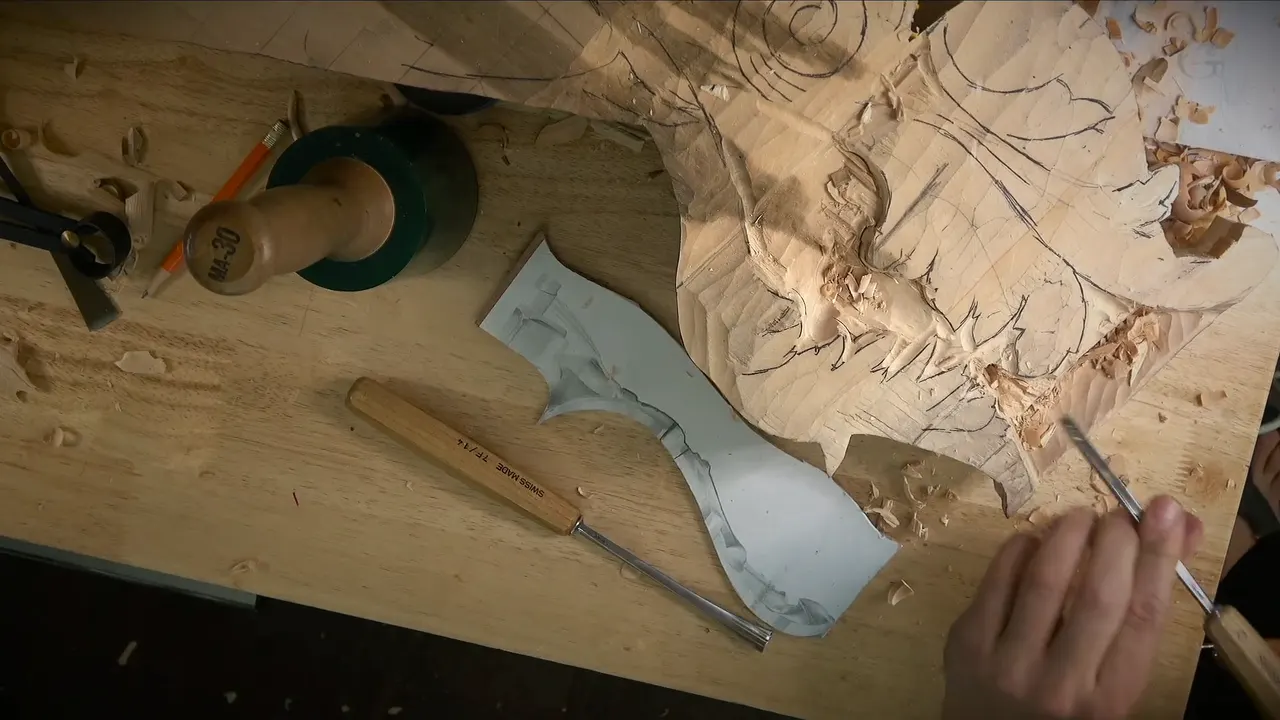

In workshop 80, part 3, I said "Yeah, I know. Stuff is flying from my workbench." I did not say which stuff. In other lessons the same word sits beside what I remove, beside a spot that blocks me and beside parts that end up hidden.
Have you ever looked at a half-carved block and wondered what to call the pieces that still need to go? Could you say, in one plain word, what blocks your tool? Each place below gives my words and the lesson.
What was going on at my bench in the third video of workshop 80?
The part opens with "Let me see what is going on right here," and then "There I do have a small little thing going this way." A short line follows: "But almost doesn't count."

Next I said "Little by little," and "Straight down cut," and I added "I also want to make sure I'm not undercutting under this section and that section, because it's going to be a big mistake for me." After that I told myself to be more careful.
The flying stuff comes in the middle of the part. What it was, I did not say, and the words around it do not say either. The frames of this part show chips around a pencil and the gouges. Then I said "Okay," and "Let me see how deep I've got."

What did I do next at the bench?
"Clean little bit on the side," I said, then "And here you go," and "So let me mark it." Then "Let me mark that with the blue marker," followed by "So that would be much better," and "So I'll mark blue."

More marks follow in my words: "I also mark blue right there," and a further spot, "also blue." The reason I gave was "So that way I'll know exactly where the points are." Then came "There you go," and "So now I can go down to this position."
"Again, that is somewhat rough," I said. There would be a chance to refine everything once I work on the final design of those, and I would have "a lot more space to work with." Next: "But it will do for now."

Which tool came next, and what did the grain have to say?
My plan was "a number nine and a quarter inch, and kind of attack just like that." That makes a number 9 of a quarter inch (about 6 millimeters). A warning followed: "But I have to be really careful because it is along the grain, but I don't know where the grain goes, so I could create a problem." I asked myself whether I wanted a problem, and my answer was "I doubt."

Next came "Let me use a spoon gouge just like that. Preliminary create a concave." Getting those acanthus leaves done, I said, would make everything much easier.
Where did the highest spot sit in the hollow?
"I've got a high spot, which is the highest spot right there, and gradually it's supposed to go downhill," I said. The next thought was "So really, I can really take a straight cut down channel between those, and go to that point, which I still have to be kind of careful."

Drilling multiple holes was an option "if I wanted to," and my guess was that it was not needed.
Then: "So let me leave that alone, and I think I'm going to jump right now and create this cut." The plan was "probably just four millimeters for now," in a number 11. Four millimeters is about 5/32 in. The idea was to go "little by little" to the point.
The part ends with "Anyway, I know it's supposed to be lower than that point, so I safely can remove a lots of material pretty much from both sides." In that line I said material.

What do parts 2 and 4 of workshop 80 say?
Part 2 ends with "Let me just chop down my future acanthus," after I said I had a tiny spot, so I had to be careful and use just the small tools.
The next part starts with "I'll do it probably off camera," and my expectation that I would get much quicker when I'm not talking. Its last words are "I think I have to use a spoon gouge to get to the depth I need." The workshop 80 lesson holds all three.
Do I say stuff about what I take away from the wood?
Take workshop 73, part 7, where I was still working a section: "Here I can go probably even deeper and remove even more," and then "Use one millimeter number 11 and remove some of that stuff out." The size is 1 millimeter (0.04 in).

A bigger tool is in workshop 97, part 1: "I'll take number seven and 14 millimeters, half an inch, and clean all of that stuff, whatever's left right here." The pair is 14 mm (0.55 in), and half an inch is 13 mm.

Over in workshop 70, part 12, I used "just number 11 and 7 millimeters," and said "Okay. 7 millimeters and clean all that stuff out." Seven millimeters is about 0.28 in.
Stuff I did not need is in workshop 84, part 6. "So now I'm happy," I said, then planned to take out part of the stuff I did not need, and then "And now I can just clean up a little bit this side."

Material and stuff sit side by side in workshop 61, part 1. I had to be mindful, I said, how much material I was removing, "Because I don't want to damage too much, and I could probably just take out some of this stuff."
Carving Hazelnuts lesson 4, part 3, finds me working around a nut. "So which means I can safely just chop around right now in this area," I said, and the nuts, "they're going to go much, much lower." Then: "So I'm actually safe to remove some of that stuff." For the job I said "probably wise to use right now number nine," a tool of about 19 millimeters, about three-quarters of an inch (0.75 in).

A mallet is in workshop 71, part 11: "I'll use number nine and a mallet. A little persuasion." Then "Oops. That is not good enough." The need was to take the stuff out right there later on, and I said "but that's okay."
Do I say stuff about what I do not want to see?
Workshop 21 has the same words about a big mistake that workshop 80 has about undercutting. In part 12 I said "So that would be a big mistake for me to get to the final cut too early." Then "Let me clean a little bit on the side right here. Just get rid of some of the stuff I don't want to see, which distracts my eye, and I'm going to use number seven 4 mm and establish this movement a little nicer."

That means a number 7 of 4 mm (0.16 in).
Over in workshop 22, part 6, I went another way: "Yes, of course, it's far from done, but at least you can see. And let me just clean that stuff. I've got too many chips." Chips gave me a business idea: "I'm thinking to start a business selling chips, wood carving chips," and "I think I can make good money on it."

In Floral and Molding 6, part 2, the stuff had to come out, I said, and the next lines were "Just too much mess," and "Need to take that mess out, and you'll understand what I'm doing."
Can stuff be in my way?
A number 8 of about 1/8 of an inch (3 mm) was the tool in workshop 93, part 5, and I said "And carefully. It's not that convenient for me because that stuff is in my way, and I also don't see that well, so I need to make a little more lights shining in this area."

Floral and Molding 1, part 2, is about measuring. "I made a mistake. Not a mistake," I said, and stuff was in my way. I had to just change the position how I measure it, and my next step, I said, was to extend my rod and try it first.

A spoon gouge was the answer in lesson 2 of that course, part 3. "But with the spoon, I'm able to get in a lot more tight spaces where with a straight tool, I don't have that ability sometimes, just to get some spaces because it's in the way. I mean, some stuff is in the way, I should say." Then "Get a little closer to the line."
A spoon gouge is in workshop 80 too, in part 3 and in part 4.

Heavy stuff turns up in workshop 126, part 1. Something flatter was on my mind, "maybe like number two," and then "I really don't need the heavy stuff on this edge." Everything, I said, is supposed to be really light and close to the background.
Can stuff be hidden?
Furniture Panel 5, part 4, comes from the design course. I said "I can probably make my return movement like this, kind of," and then "And again, like I said, a lots of that stuff is going to be hidden."

The design course has more in lesson 9, part 3, where I was "developing actually just a background of this panel." The main idea was still to be developed, with flowers and some movements, and I said "you'll see some of the stuff," which would be covered with those flowers.

Is stuff only about wood, or can it be something that happens?
The grain comes back in workshop 91, part 2. Its direction does change, I said, and "It changes because it wraps around and the grain does all kinds of weird stuff." My next words were "All right, so that is a preliminary cut."
Extra stuff comes in workshop 25, part 9: "I just don't have to do what I don't have to do, and I just got some extra stuff what I should not do. That's why that stuff happened." Then: "But once I get this done, nobody's going to know that that thing was even there."
A back bend and a wrong direction are in workshop 64, part 1. "And when you're doing it the wrong direction, sometimes that stuff happens," I said, and then "Now, I need to do it deeper."
A good kind of stuff shows in workshop 50, part 3. Of a tool that is not expensive at all I said "Still carves beautifully. So you can create beautiful stuff with less expensive tools." And of a separate piece in lesson 1 of the molding course, part 1, I said "I kind of like it anyway," and then "What you can do with that stuff, just imagine."
All the places side by side
| Lesson | What I was doing when I used the word | My words |
|---|---|---|
| Workshop 73, part 7 | Still working a section, with a 1 mm (0.04 in) number 11 in my hand | Use one millimeter number 11 |
| Venice Room 97, part 1 | Cleaning what was left right here, with a bigger tool | clean all of that stuff |
| Lesson 84, part 6 | Happy, with a side left to clean and some stuff to remove | the stuff I don't need |
| From workshop 21, part 12, where I planned to clean on the side | Getting to the final cut too early | which distracts my eye |
| Video 93, part 5 | A number 8 of about 1/8 of an inch (3 mm), and a need for a little more light | in my way |
| The molding panel course, lesson 1, part 2 | Changing the position how I measure it, with a rod I could extend | in my way |
| Furniture Panel 5 (the design course), part 4 | A return movement | a lots of that stuff |
| Video 64, part 1, where I cut the wrong direction | Cutting with a back bend | sometimes that stuff happens |
Where do these lessons sit in the school?
The workshop 80 lesson holds this part and its two neighbors. Venice Room Part 7 holds workshops 74 to 85. The rest of the places come from other Venice Room workshops, from the panel molding lessons, from the Furniture Panel design course and from Carving Hazelnuts.
Wikipedia has short pages for wood carving, a chisel and a mallet, if one of those words is new to you.
Is there a spot on your block where you could name the stuff and say what you will do with it? Could you say which tool takes it out?
How it's done
- Look at the spot. In workshop 80 I wanted to see how deep I had got.
- Mark the points. Marking blue was the idea, "so that way I'll know exactly where the points are."
- Pick a small tool. Four millimeters, "probably," and "for now," in a number 11 (about 0.16 in).
- Check the grain. I said the cut ran along the grain and that I did not know where the grain goes.
- Name the stuff. Other lessons pair it with a number 11 tool and a number 7 tool.
Frequently asked questions
Which stuff was flying in workshop 80?
I did not name it. The frames of that part show chips around the pencil and the gouges, and my next words were about how deep I had got.
Does stuff mean only the pieces I take away?
No. Workshop 93 pairs it with what is in my way. The design course pairs it with what ends up hidden and with what flowers cover.
Can the word cover things that happen, too?
Yes, by my words. Workshop 64 uses it about the wrong direction, and workshop 91 uses it about the grain.
Which plan did I make when stuff blocked my measuring?
What to carve next