

Alexander Grabovetskiy, woodcarver, School of Woodcarving · Published 2020
What does a wood carver mean by "the same operation"?
Quick answer: In part 4 of workshop 80 I told you the operation would be the same as the one I had done right there, and that I would probably do it off camera. Other lessons put those words beside a number nine, around a back bend and the grain, and with a knife.
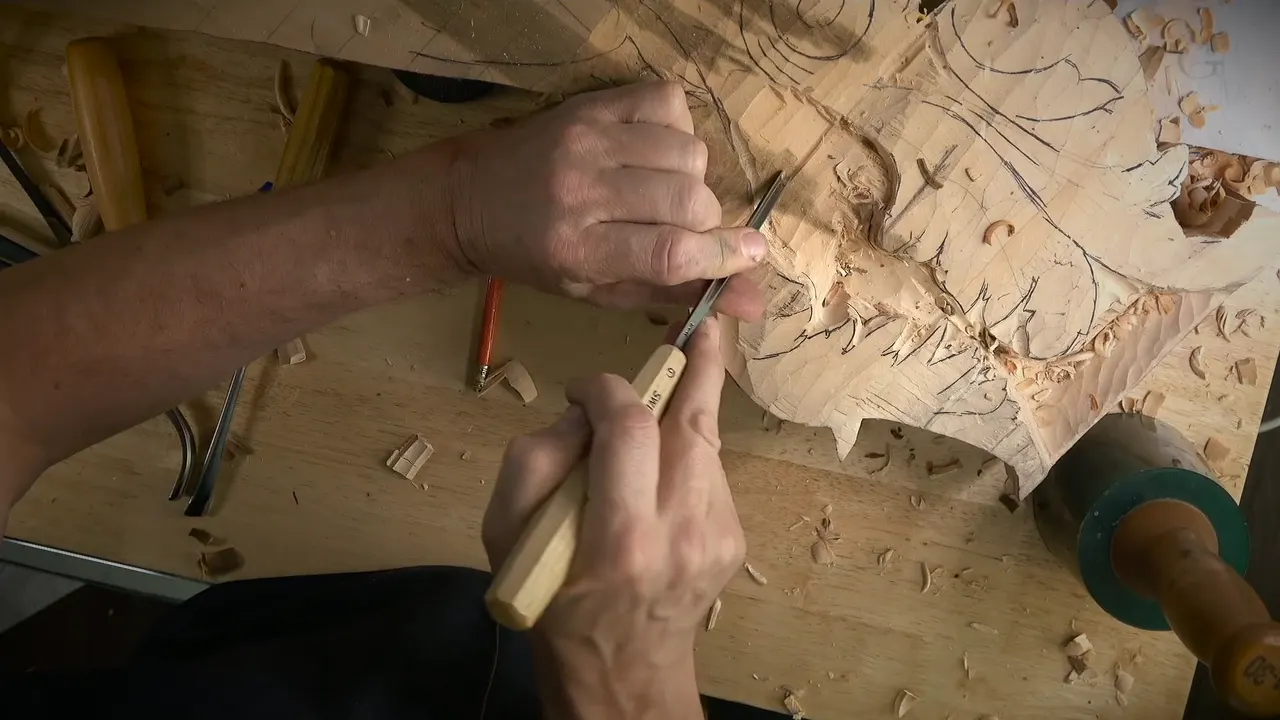

In workshop 80, part 4, I said "And again, the operation is going to be the same as what I've done right here." That line does not name the operation. In other lessons I use the same words about passes, tools, leaves and sides.
Have you ever made one clean pass and then faced more spots that call for the very same one? Would you pick up the same tool, or a smaller one? Each place below gives my words and the lesson that holds them.
How did part 4 put it?
That line opens the part. Next came "And I'll do it probably off camera," and then "I'm going to get much quicker when I'm not talking."

Chips cover the bench. Gouges, a blue pen and an orange pencil lie on it beside my hands.
Another line from the part: "I think I have to use a spoon gouge to get to the depth I need." One frame shows a gouge with a bent blade and a brass band on the bench.

What came before it in parts 2 and 3?
Parts 2 and 3 of workshop 80 come before this video, and both stay with the hollow between two acanthus leaves. Part 2 has a number seven at an angle: "I'm going to angle it like 45 degrees." I said it was "going to give me much better slicing." The concave waits. "It's not concave yet," I said, and "Later on, I'll just attack and create the concave."

The drill comes next. I put the depth at "approximately three-quarter of an inch," which I called "about 20 millimeters." After that came "about another 10 millimeters" (0.39 in), then "Another 6 millimeters or so. Like a quarter inch." The last figure is "approximately three millimeters left" (0.12 in), and the distance at my stopper was "about one-eighth of an inch."
Part 3 has a tool plan: "Let me use a number nine and a quarter inch, and kind of attack just like that." That is a number 9 of a quarter inch (6 millimeters). A spoon gouge comes in: "Preliminary create a concave." After it come "probably just four millimeters for now" and "Number 11, of course." Four millimeters is 0.16 in.

The workshop 80 lesson holds all three videos. The rest of this page is where else I use those words.
Why would I not show the operation again?
Workshop 1, part 9, has "What I did off-camera, I need to explain to you." And "I did not want to repeat myself." The job was "exactly the same operation, what I did on the first layer," and a second layer and a third came after it. All together the piece was "about six inches thick" (about 150 mm), and it would reach "nine inches right there" (about 230 mm).
"And today is the day," I said. I planned to take "one of the big gouges" for "establishing my form," 3 1/8 in, "exactly 80 millimeters." My mallet was to be "really heavy-duty," "30 ounces" (about 850 g).
Rosette lessons do it too. Venetian Flowers Rosette 2, part 2: I would "show you just one." Then "There is no reason for you to see exactly the same operation on all of them." What I wanted was an undercut "on the side like this."
Grape leaves go the same way. In Carving Vase with Grape Leaves 3, part 2, I wanted an undercut without piercing it, and that operation would be done on all of those leaves. My words about it: "I don't want to bore you." And "At least not on this project."

The clean-up is in workshop 124, part 1. "probably I don't have to create any videos how I going to clean it off-camera," I said. Then "I'll do my final cleanup right here. Pretty much it's going to be that operation."
Furniture Panel 21, part 14, says it outright: "I'm pretty much doing the same operation over and over and over." Tool: "just a small gouge, like number eight," with "maybe one-eighth of an inch, three millimeters."

Care came with it. I wanted "to make sure I'm not going to break anything, and pop that center out." Elsewhere in the part: "I can probably go a little deeper right here. But again, not deeper than the background."
Which tool changes when the operation stays the same?
Workshop 64, part 7, has the plainest words: "And that's the same operation, just the number nine." Number eight "will work also," I said, but "I kind of like number nine." I wanted it "a little bigger, maybe about three-eighths of an inch," about 10 mm.

Then the angle. "The angle supposed to match," I said. Digging "that way" would be "too close to undercut." My plan was "just a half a round," then probably a full one.
Number nine comes up in workshop 60, part 6, at "10 millimeters, three-eighths of an inch." An 11 could do it too: "the same operation with number 11, of course. That would give me the same thing." "Pretty close to the exact same, I think is what I should say," I said.

More spots wait in part 9 of workshop 57: "a couple more spots." The tool was "number six, by the way." Others would work: "I could use number seven, and even number five, in this case, would work also."

Smaller tools come up in Rosette 5, part 2: "the same operation with a smaller tool, obviously." Then I said "let me actually use a smaller one right now." Part 1 of that lesson has "just the number 11" and "small number 11."
Over in Rosette 3, part 1, a knife comes in: "the same operation by using just a knife. A small knife."
What do I watch for when the job is the same?
Workshop 62, part 7, brings in the grain. A back bend could do the job, "but have to be really careful how I do it because of the grain."

It went wrong there, and I said "That's no bueno." My guess was a dull tool: "Maybe my tool is a little too dull for this operation." And "I just chopped too much," I said, then "It's not a big deal."
A middle line turns up in workshop 68, part 7: "the same operation, but I don't want to forget that is my middle line right here." The concave there would "die somewhere right here."
A high spot is the point in Furniture Panel 19, part 12: "let's do this leaf" with "the same operation." I planned to "leave that point right here as a high spot," and "This is going to balance a three-dimensional look."

In part 13 of that lesson I planned "number three first, straight down cut, but not too deep." And "Because I really want to see a clean background."
Does it go on the other side or the next spot?
Pipes are next in workshop 65, part 10, and I called the job "the same operation." Then "just number 11 and seven millimeters," which is 0.28 in, and I called it a quarter inch. My plan was to start "from all the way down, which is off-camera already."

Chamomile and Bow Rosette 3, part 3, jumps sides. I had removed one part, so I could probably use "the same idea" there. On that side I said "the same operation," and "just to get some corners." A reminder came too: "I am showing only one of the multiple ways we can create those beads."

Petals repeat in part 2 of Chamomile and Bow Rosette 4, and the tools change with them: "Different number 11s, of course." It depends on "how wide the petal is."
Part 2 of Furniture Panel 18 outlines again: "the same operation what I've done before with 3 millimeters" (0.12 in). "Really close to the line" was my plan, though "maybe it's a good idea to stay away approximately half a millimeter or so" (0.02 in).
Both sides count in lesson 1, part 5. After the first push pin I said I had to repeat the operation "on both sides. So I want to make sure." Then "Let me double-check."
The opposite side is a number seven in Venetian Flowers Rosette 1, part 3: "a big one." Then "That's not big." The next step, I said, would be a clean-up of "all that mess I've got on the side from chopping," with "number 11 veiner" at "10 millimetres" (0.39 in). Other sizes could work, "eight, five millimetres" (0.31 in and 0.20 in), and "It's still going to work all right."
Does the same operation need the tool I own?
More from workshop 57, part 11. I do understand "not all of you having the same amount of tools like I do," I said, "but at least you will be confident" that the same operation works "with the tools you have." Then "I could do that, all the beads, with just a knife pretty much."
Of one tool in workshop 55, part 1, I said "you don't have to have" it, and I gave "the same operation just by using any other skew or chisel." "It's about the same idea," I said, and of that tool, "it's not cheap."
Small handles are in workshop 77, part 9. The full-size tool gives "the same operation," I said, but the small one "has a really small handle, and it's really comfortable to hold." It "feels like almost pencil inside of your fingers."
In the Questions and Answers lesson on straight and fishtail gouges I held up "a fishtail" and "a longy." The two do "the same operation." They part ways at a hole: "With this one, I cannot rotate."
A router plane comes into Furniture Panel 15, part 10: "without a router plane, it's still possible to do that, and there's a lot of wood carvers in history who've done it." The work was "the flatter gouge." And "It just makes more sense with the router plane."
How deep does the same operation go?
Rosette 4, part 2, answers with sizes: "the operation is the same, however extreme you want to go." You "attack that from the side," with "two millimeters at first" (0.08 in). Then "one millimeter" (0.04 in) and "half a millimeter" (0.02 in). "It's up to you," I said.
One tool did it faster: "with the one tool, I can just do much quicker that operation." It "doesn't leave me a really sharp line in the middle" the way "a normal V tool or parting tool" would.
Byzantine Acanthus 6, part 2, opens "the operation is easy. We're going to do it the same way." The question was "should the bowl go deeper on the second layer?" My answer: "I wouldn't. We're still just after a shadow." Going deeper risks "a chance you're going to get through."

Then "We can probably deepen it later on." In Byzantine Acanthus 8, part 3, a knife or a skew gets "the same operation," attacked "from the right point." Rotating, I said, hides it from view: "Just because of the camera."
Is it in the later workshops too?
Workshop 162, part 3, has it. "So now let me get the pipes in place. And as you remember, that's the same operation." The first concave was to be "really wide," and it would go underneath the volute.

Workshop 125, part 2, has "same operation as always for the plug cuts." The tool was a number nine, "Half an inch, that's what I'm using," about 13 mm. Before it I thought it would "create beautiful shadow."
Workshop 79, part 12, sits in Part 7 of the Venice Room, like workshop 80. Other methods may exist, I said: "maybe there's other methods for doing that operation." My choice was "the number seven and 14 millimeters," at 0.55 in, "little by little" rather than rushing it.

All the places side by side
| Lesson | What I was doing around the words | My words |
|---|---|---|
| Workshop 1, part 9 | Explaining the second and third layers I added | off-camera |
| Workshop 64, part 7 | Moving to a number 9 of about 3/8 in (10 mm) | a little bigger |
| Workshop 62, part 7 | Taking a back bend to a spot where the grain mattered | with the back bend |
| Panel course 19, part 12 | Starting another leaf and keeping one point high | this leaf |
| Workshop 65, part 10 | Working the pipes with a number 11, 7 mm (0.28 in) | my pipes |
| Workshop 57, part 11 | Telling you what a knife can do for beads | I've done it multiple times |
| Rosette 4, part 2 | Going underneath with a smaller tool each time | up to you |
| Workshop 162, part 3 | Planning to put the pipes in place and start the first concave | as you remember |
Where do these lessons sit in the school?
The workshop 80 lesson holds this part and its two neighbors, and it is where the first line of this page was said. Venice Room Part 7 holds workshops 74 to 85. The other places come from more Venice Room workshops, from the Furniture Panel course, from the rosette courses, from the Byzantine acanthus course and from the grape leaves vase.
Wikipedia has short pages for wood carving, a mallet and a chisel, if one of those words is new to you.
Is there a spot on your block where you could say what repeats, and what changes? Could you say which tool takes it out?
How it's done
- Say what repeats. Part 4 of workshop 80 opens with me calling the operation the same one as before.
- Change only the tool. Workshop 64 has me taking number nine for the same operation, and I said number eight would work also.
- Watch the grain. Workshop 62 has me taking a back bend to a spot where the grain mattered.
- Leave a high spot. On another leaf in the panel course I planned to keep one point high, to balance a three-dimensional look.
- Name the tool for the depth. Workshop 80 has me naming a spoon gouge for the depth I needed.
Frequently asked questions
What did I say about the operation in workshop 80, part 4?
I called it the same operation as the one right there, and I said I would probably do it off camera. I also said I would get much quicker when I'm not talking, and that I thought I had to use a spoon gouge to get the depth.
Can a different tool take over?
A number 8 would work as well as a number 9, I said in workshop 64. Workshop 57 had me telling you to be confident about what you own, and a knife for the beads. In workshop 55 I named a skew or a chisel.
Does the operation reach one depth everywhere?
The rosette lesson gave me sizes: 2 mm (0.08 in) at first, then 1 mm (0.04 in), then finer, and I said the depth depends on how deep you want to create. A Byzantine lesson had me still just after a shadow, so no deeper on the second layer.
What to carve next