

Alexander Grabovetskiy, woodcarver, School of Woodcarving · Published 2020
What does a wood carver mean by "hold on"?
Quick answer: My "hold on" is a stop I make when I need to look for something, think, change a tool, fix the light or read a number again. Workshop 80, part 2, has it right after "Let me measure it. Where is my paper?" Other lessons attach it to a gouge change, a light and a depth I read again.
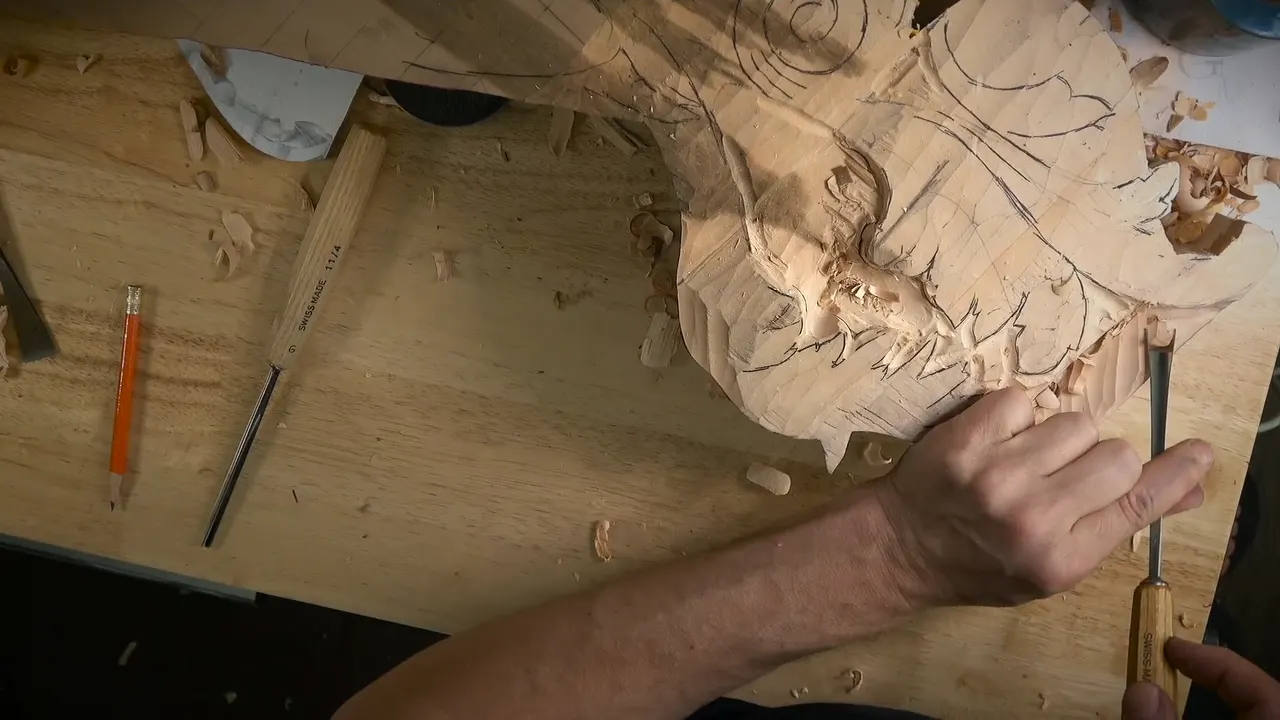

"Hold on" is a stop I make when I need to look for something, think, change a tool, fix the light or read a number again. The first case is in workshop 80, right after "Let me measure it. Where is my paper?" Elsewhere I stopped for other reasons.
Have you ever stopped with a gouge in your hand because the next pass felt wrong? Could you say what you needed first? Each place on this page has the words I used, and the lesson they came from.
What was I doing when I said "hold on" in Venice Room 80, part 2?
The part opens with a marker. Sometimes I use a red marker or a blue one, I said, and blue probably makes more sense, because "blue is deep and red would be high," deep like the ocean and red like the sun. Or maybe orange. After "Get sides done," I planned a number 7 again, angled like 45 degrees, for much better slicing.
"That's pretty much it, at least in this area," I said. I'd gone all the way to the cut, but it was not concave yet. Later on, I said, I would attack and create the concave. For now I needed a somewhat rough form between those two acanthus leaves.
My plan was to measure one spot, so I'd know exactly how to blend and could create a hole right there. I said I would measure it, asked where my paper was, and then "Which is... Hold on." The recording picks up with the words "This spot."
Why does that spot matter? Look closer and it is like an S curvature, smooth, but already transitioning at about that spot: a convex going one way, and a concave if you look from this position. I called it approximately the breaking point. It could sit somewhere between those lines, and I said I'd choose this one.

Next came "I need my pointing machine," and the news that I had to drill approximately three-quarters of an inch (19 mm). Check. About 20 millimeters (0.8 in), I said, and another 10 millimeters (0.4 in). Double-check. Later came "I could actually go a little deeper," and a figure of another 6 millimeters or so, "like a quarter inch."

About three millimeters were left (about 1/8 in). The distance at my stopper was about one-eighth of an inch, maybe a little less, maybe three-32nds (2.4 mm), "but it's pretty close." That was the final depth of at least this spot. So it was a concave, and my concave point.
Safe, I said, to go almost straight and remove all of that section, then concave it down to that point. One tiny spot meant care and small tools. My last words in the part were "Let me just chop down my future acanthus."

Do I say "hold on" when I change the tool?
Furniture Panel 15 shows it, in part 7. The job was a panel background, and I wanted a bigger gouge to take a lot more material at once. The first one was a number five, and it was "not completely, I shouldn't say, perfect." Then "oh, hold on," I said, and "let me use even bigger."

The next gouge, a number 7 of 80 millimeters (a little over 3 in), matched one shape. "Maybe it's a little too big," I said, "but it gives me perfect line." A new plan followed: maybe do what I'd done before, take about half an inch (13 mm) first and chop multiple spots closer to the line. Near the background I needed care not to go too deep, since tool marks would be hard to remove later.
From Venice Room 43, part 4, comes a number one that turned into a number three. I wanted a concave that was not too deep. First, "maybe just a number one." Next I said "well, actually, hold on, maybe number three." My idea for it was to go from the edge to the pencil mark, and then "I don't think it's enough."
Over in Lily Box 8, part 11, the turn was toward a backbend. "I can't get really deep," I said. Maybe I should use a backbend. Number two came up, then "well, hold on," and "let me use number five." The idea was 2 millimeters (0.08 in) going carefully underneath. A backbend has a goose neck, so you can see it from the side, and a straight tool really can't get to an area like that. Why a number 11 first? That area was really fragile, and I wanted to make sure I did have a relief cut.

Byzantine Acanthus 10, part 4, was about a smoother surface. You take a flatter gouge, I said, and in my case a number three, though you can use number three or number two. Then "we'll see," "hold on," and "just let me strop it for a second." Later: "just like almost shaving."

Two short ones come from Greek Acroterion 1, part 4, and Venice Room 126, part 2. For an ogee profile I thought a number 25 of 10 millimeters (about 3/8 in) would fit really good: "let me try that first. Okay, hold on, let me check first. Yeah, I'll make my line." The 126 lesson had a plan for 10 millimeters (about 3/8 in), number 11, to relieve it little bit, and I added "hold on" right after.

What happens when I stop to think?
Look at Venice Room 63, part 5. I was making a concave and said I could probably use a long bent, "but it could be mistake." I stopped with "hold on just a second, let me think." Maybe a little smaller tool, I said. In my hand was a skew gouge, a number 7, slightly bent, 14 millimeters (about 9/16 in), which I called about half an inch.

Maybe skew the opposite direction, I said, and it was going to give me a much better cut. What I liked about the skew idea was "I'm just pushing and it's already slicing." Workshop 80 gave 45 degrees as the angle for much better slicing.
Venice Room 94, part 12, is a thinking stop about two parts: "well, hold on, let me think." If I wanted it that way, I could do the opposite direction and just send one part underneath. For the cut I planned just two millimeters (0.08 in) with a number 11, and two would work, I said, and so would three (0.12 in).

In Venice Room 45, part 9, the words were "on another hand, I need to figure out, hold on," followed by "let me clean little deeper here." A number 11, 12 millimeters (about 0.5 in), came just before it. The movement itself still needed figuring out, "because there is also different ways of doing it."

Another stop saved an idea. In Venice Room 41, part 4, I said "and this is going to be also like a, hold on, don't want to lose the idea." The idea was a rotation, with one part concave and going underneath another. Venice Room 39, part 9, has a number 9, a quarter inch (6 mm), which I could probably use to excavate straight down and rotate, until "well, actually, hold on," then "don't want to break it."

Where does "hold on" show up with a measurement?
The sixth part of that panel lesson has "okay, hold on" before "I made a mistake I have to fix." My molding was the spot: too deep a cut right there, so I had to pay attention.

Then I checked how deep I got: about 1/32 of an inch (0.8 mm) of cut, which meant the overall height of that molding was going to be 3/32 of an inch (2.4 mm), lower than that part. I should have paid attention, I said, and I still was planning to lower it anyway. A little deeper would have been a huge problem, an unforgivable mistake.
One more depth stop sits in Venice Room 66, part 4, where I read a depth out loud. First it was almost three inches down (just under 76 mm), then "no, it's two and a half" (64 mm), and "well, two and a quarter, say" (57 mm). Then "about 50, 60 millimeters" (2 to 2.4 in), and "about 60, I would say."
After "maybe more," came hold on, because I was looking straight down and it was really hard to see. "Oh, it's 2 7/8 to be exact," which is 73 mm. It was really deep, I said, and I had to stop because I had some limit.

Is "hold on" something I say to the camera?
I do, and the words can be a question. In Carving Modern Acanthus 5, part 2, I wanted a blend with no sharp line, using a number 7 of 14 millimeters (about 9/16 in), and said I probably needed to be really slow and explain. First came "let me turn this camera on." Next, "hold on" came with "let me turn the lights on, can you see it?" I showed rotation motions and called it a slow motion.

Modern Acanthus 3, part 3, has a smaller one. I left approximately six millimeters (about 1/4 in) and asked "can you see?" Another "hold on" came before "I'll try to show you," and then I asked whether it was visible now.
In Floral and Molding 5, part 2, "it goes all the way" to the line, I said, and "hold on just a second, let me explain what I mean by that." One point had to sit at the same height as my concave, and it would feel like it was rolling to the same spot.
Byzantine Acanthus 6, part 3, is a stop to find a picture: "let me find the picture of it," and "hold on." Next came "oh, this is a good picture." The picture was actually from the solid piece, "but not exactly what we're going to do," and I said it goes like this and turns back.
Does the bench make me stop too?
A few stops had nothing to do with the cut. Over in Venice Room 146, part 3, I could go right away with the 1 millimeter number 11 (0.04 in), I said, and "something not too stable, let me stabilize my table, that's shaky." My next words were "hold on." Some kind of shim had to go underneath, and the table was "more stable."

Chamomile and Bow Rosette 4, part 3, was about order. I could attack it from the backside, I said, and "hold on, I forgot something." This side had to be attacked first, completely done, and then I would take it out. I had missed an undercut underneath the flower, and checking everything before you take it out from the background, I said, is a good idea.

Then there is Venice Room 159, part 1. I really like an across the grain approach if it's possible, I said, then "hold on," followed by "let me mark this side also before too far." Furniture Panel 20, part 3, finds me going around a pencil mark, about to attack from one side, with "hold on," then "I'm not going to do that right away." My plan was a number 8 of one-eighth of an inch (3.2 mm) to twist the part a little inward, for a much more interesting result.
One more sits in Floral and Molding 14, part 1: "so pretty much, hold on," with "let me get the right line" right behind it.
The stops side by side in my lessons
| Lesson | What I stopped for | My words |
|---|---|---|
| The second part of workshop 80 | I needed paper before I could measure it | measure this spot right here |
| The seventh part of the panel background lesson | A gouge | maybe it's a little too big |
| The fifth part of the Venice Room 63 lesson | I said a long bent could be a mistake | it could be mistake |
| The sixth part of that panel lesson | Too deep a cut | too deep cut right here |
| The part of workshop 66 where I read a depth | A reading from straight above, hard for me to see | about 60, I would say |
| The second part of Modern Acanthus 5 | The lights | turn the lights on |
| Part three of the Venice Room lesson 146 | My table was shaky and needed a shim | that's shaky |
| The third part of Chamomile and Bow Rosette 4 | A side I had forgotten | I forgot something |
Where do these lessons sit in the school?
The workshop 80 lesson belongs to my wood carving work on a corbel. It holds this part and its two neighbors, and Venice Room Part 7 holds workshops 74 to 85. The rest of the stops come from other courses and from Venice Room workshops between 39 and 159.
Wikipedia has short pages for a chisel, a mallet and a pencil, if one of those words is new to you.
Is there a spot on your bench where you could stop, read the number and say it out loud? Could you say what you need before the next pass?
How it's done
- Name the spot. In the hollow lesson I planned to measure a spot, so I'd know exactly how to blend.
- Ask for the paper. I asked where my paper was, and my words were "Which is" and then "hold on."
- Say what comes next. Elsewhere a new gouge, the lights or a check came right after those words.
- Read the number again. My first reading in Venice Room 66 changed after I stopped and looked straight down.
- Steady the table. Workshop 146 called for some kind of shim underneath.
Frequently asked questions
Does "hold on" always mean something went wrong?
No. Part 6 of the panel lesson has "I made a mistake I have to fix." Greek Acroterion 1, part 4, has a plan to check first. And in Venice Room 41, part 4, the stop saved an idea I did not want to lose.
What did I say right after "hold on" in the hollow lesson?
The next words on the recording are "This spot." I then asked why that spot matters, called it an S curvature and chose one point. A drill and a stopper gave me the final depth of that spot.
Can "hold on" change my tool?
In three lessons it did. Panel lesson 15, part 7, swapped a number five for an even bigger gouge. In workshop 43, part 4, number one gave way to number three, and Lily Box 8, part 11, swapped two for five.
What to carve next