

Alexander Grabovetskiy, woodcarver, School of Woodcarving · Published 2020
What does a wood carver mean by "softer"?
Quick answer: In workshop 91 of the Venice Room, part 5 has "softer" beside a second concave that is still a plan, with a number nine named for it and a number seven for the inside. Lessons of Furniture Panel, Roman Acanthus, Venice Room and Grape Onlay put the same word beside edges, ridges, facets, a pipe and a division.
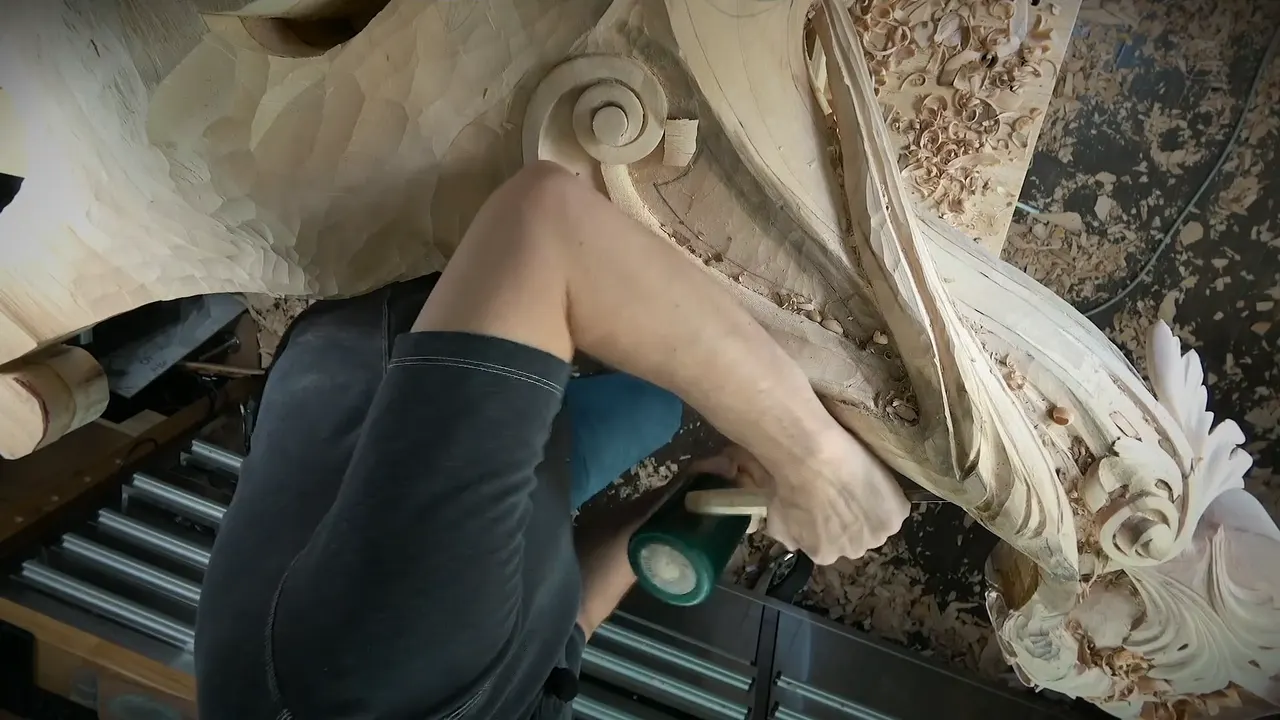

"But what I want to do, I want to create another concave, but it's going to be a little softer concave right here." That line is in workshop 91, part 5 of the Venice Room, and the word "softer" gets an explanation of its own in the same part. Other lessons of mine put the word beside edges, ridges, facets, a pipe and a division. Others use it for wood, leather, wheels and a pencil. Part 5 comes first here, and every wood carving lesson after it has its link.
A hollow can sit too hard beside its neighbor, and it is hard to say what to change first. Start with this part.
What is in part 5 around the word softer?
- A challenging area, and the material it is named for.
- An undercut planned underneath of a section, so it feels like it is rolling.
- A smaller number 11, only a maybe, that has to be really sharp and small.
- The shadow's sake, said twice.
- A second concave, planned softer, with its first tool named.
- A tool that goes dull in this section, and a guess about sharpening it.
Why does the part open on a challenging area?
The part names the spot, and the reason sits in the same breath. "So that is little challenging area. Challenging area because of the material." A remark about the work follows in the same stretch of the part, and it starts with "But it's okay." Then comes "It's not like I'm complaining." Another line says "I'm not complaining about it and all."
Next, the plan. "But I want to undercut a little bit underneath of this section, for it would just feel like it's rolling from underneath." A tool is named beside the plan, and only as a maybe. "Maybe in this case, I should use a smaller number 11 because of the material section. It has to be really sharp and small."

Where does the shadow come into the work in part 5?
Twice, as the reason for the work. "Again, what I'm doing, it's just for the shadow's sake. For the shadow's sake." Next comes a plan, "So this one also needs to be rolled like this," and then a verdict, "Okay, so that is good."

How does a happy verdict lead to the word softer?
The verdict has two forms. "So I'm kind of happy with this development, how it looks." Then "I am happy with that development."
That plan from the top of this page sits right behind it.

What does the part mean by a softer concave?
An answer is given in the part itself. "Softer concave, what I mean by that," and then "just the number nine to start that concave, okay?" Number nine is a plan there. A note on the path comes next, "And that's going to go all the way, like that," and the explanation closes on one short line, "And that is what I mean by softer."

Is the inside a number seven or a number five?
For the inside the plan reads "Let me get with the number seven on inside." Right after it the word appears again as "much softer inside right here," followed by a plan to "exaggerate a little more coming this way."
A slip follows. "Well, I said number seven, but I grabbed number five." Right after, the tool just grabbed is rejected, "That is not the one I want to use, okay?" and the fix is plain, "Number seven, that's what I want to use."

What happens to the tool inside this concave?
The next note is about feel. "It feels like almost there is abrasive on inside." The tool had been stropped only a moment before, "Just a second ago, I just stropped," and yet "it becomes dull, just in this section."
A comparison with sand follows, "it becomes dull, like almost there is some kind of sand on the side of the wood," and then a contrast between the start and the rest. "When I start, it's absolutely sharp and clean. It's beautiful and nice, but when I continue, it becomes dull right away." And once more: "And here you go. It's dull again."
A short remark on wood follows, "Sometimes it happens with some of the woods," and then a guess, "I guess I have to sharpen my tool more often in this section."
Which plan closes part 5?
Blending is the plan. "Also blend that a little nicer because just little too sharp." In these words the blend is still ahead.
Do the other parts of lesson 91 use the word as well?
Venice Room 91 has it in part 2, twice. "And again, I'm going to make it a little softer." Soon after, a limit is added: "But I still don't want to lose the feel of the concave, but a little softer movement."
Over in part 6 the area is named too, in plain words. "It's like a really abrasive area, and I'm getting my tools really dull." A "transitional concave" is planned there, and one is called "a short concave, by the way." Another blend, for "too many sharp edges," is planned in part 4.
Which other lessons put words beside softer?
Below, each passage keeps its own wording, and each lesson has its link.
What replaces a sharp edge on a furniture panel?
Furniture Panel 19, part 8, holds a plan and a dislike side by side. A "softer transition" is the plan, and the dislike is "I just really don't like really sharp edges, okay." The check after it is short, "That's already actually looking much better."
A second round sits in the same part, and it starts with a taste. "It's just too stripey for my taste, okay." After that the move, "Let me just soften a little bit. Just slightly softer," and the verdict, "And for me, it looks much better."

Which sanding plan is in Furniture Panel 22?
Sanding is the first plan in part 5 of Furniture Panel 22. "Let me use a little bit of sanding," and then "again reed rush." Some lines later the amount and the aim arrive together: "And maybe just a little bit. Make it little softer."

Which edges get softer in Roman Acanthus 9 and 14?
In part 1 of Roman Acanthus 14 the work is small, and the part says so in its own plain words. "And that's almost like jewelry work at this stage." Then "so tiny" and "so micro," and "I like it." Next comes the move on the edges: "Take those edges a little bit and make them softer."

Roman Acanthus 9, part 4, opens on a direction, "I should attack that from this side," and the aim that ends the thought is "little softer," a plain one.

Number 17 or a V tool for an undercut?
Two tools sit side by side in part 2 of Roman Acanthus 16. "So when you're doing undercutting with the V tool, so if it's a V tool, this point would look kind of sharp. But with the number 17, what I do, it's actually kind of round a little bit on the inside. It just gives me a little softer look, okay? So that's why I like this tool, probably."
Which tool touches the sides of a pipe in Venice Room 20?
A back bend is named in part 1 of Venice Room 20. "I could just use a back bend. Back bend and touch little bit the sides." The aim is a softer pipe: "Of the pipe, I'm talking about. Okay?"
A blend that ends on a repeat sits in Venice Room 17, part 5. "Kind of try to blend a little better everything together." Then "A little softer" repeats the aim.

Is a ridge needed in workshop 110?
In part 3 of Venice Room 110 a ridge is judged not needed. "So now I need to get rid of that ridge. I really don't need that ridge now." After a tool for the blend, one more line, "Make it softer."

What can a knife do to facets?
A knife does the work in part 2 of Grape Onlay 8. "Take a knife, any carving knife, and scrape them out slightly without damaging the finish." The verdict is a plain look at the result, "See how much softer it looks," and then "And that looks actually really nice."

How is an edge wrapped in the Maine class?
Grinling Gibbons, Maine class 11, part 3, starts at a sharp edge. "Until I'm happy with the edge. And looks like my edges good, really nice and sharp." The plan after it wraps the edge: "try to wrap that little bit. Make it a little softer."
Same plan for the other side, and the reason is its look. "Okay, exactly the same I need to do for this side because it just looks a little ragged."

Can a division be softer in Furniture Panel 33?
Exaggeration comes first in Furniture Panel 33, part 2, with "I can also exaggerate that movement like this." After it the division: "Again, in this case it would be this division, but softer division." Number 11 is only a plan.

Does the fourth Lily Box lesson plan a softer pipe?
It does, as a maybe, in part 11 of Lily Box 4. "But I like overall movement of this." Next the undercut, "right here," and the pipe: "Maybe I'm going to make a softer pipe right here, too."

Which lines get softer in Venice Room 158?
In Venice Room 158, part 1, the work is limited first, "so I don't want to create any more facets or anything." After that the job is only blending, "just that blending," and "a little more smoother, and so on, and just to create more softer lines."
Does softer ever point to the wood itself?
In several lessons it does. Part 11 of Venice Room 63 talks about two shades of lime wood. "Sometimes the wood itself, the density or softness of wood, even if it's the same species, I'm talking about the same lime wood. But even with the same lime wood, you can see variations of softness." Then "on a darker color right here, in my case, the wood is a little softer."
A sharpen lesson on a straight gouge sets it beside the angle of the tool. "Different woods, different angles. Softer woods, you have to do as little angle as possible." That lesson is Sharpening Straight Gouge.
Does a softer wood keep its edge longer?
Carving Dining Table Apron, workshop 9, is about basswood, and the part has a word for it, "kind of a paradox, I guess." Then "For some reason, the basswood is a much softer wood." The surprise is "my tools getting dull a lot quicker on basswood than on oak."
A comparison with other woods follows. "There is some abrasive inside of the fibers, but in a basswood, it's not the case." It ends with "the tools are getting dull quicker for some reason."
When does softer mean a pencil or a charcoal?
In the design lessons the word names a drawing tool. Furniture Panel 12, part 3, says "I'll use again, like a softer one," and later "let me also with the softer pencil." In Furniture Panel 13, part 1, the line is "let me get the softer pencil and kind of make another petal underneath."
In that lesson, part 2 carries a line about shadows. "Use, again, just a charcoal. This is a hard charcoal. Softer charcoal."
Does a softer strop round an edge?
A softer side of leather does, according to part 3 of Stropping, Honing, Buffing. "Now, which side should you use? There's a shiny side and there's a rough side, and it depends on the paste." The rough side comes next: "But it has a tendency to round a lot more because it's a softer side."
Wheels are the subject of part 5. "Yellow and the green wheel, they are softer, and that's actually pressed paper." The other two are harder, and the reason to use them is safety: "you're actually safer on the harder."
What did a viewer ask about paint thinner?
The question reached a live stream, Livestream October 2020, and the answer opens with a question back: "What do you mean by that? To make it softer?" Then "I never use anything like that." And "I just carve dry," with a reason, "the right feel for the fibers."
Which jobs sit beside the word in each lesson?
| Lesson | Next to the word |
|---|---|
| This part | one softer concave, planned, with number nine |
| Panel lesson 19 | softer transition in place of sharp edges |
| Acanthus leaf 14 | tiny edges taken a little bit, made softer |
| Workshop 110 | a ridge not needed, blended, made softer |
| Grape Onlay 8 | a knife scrapes the facets, and the look is softer |
| Lily Box 4 | an undercut, and maybe a softer pipe |
| Dining Apron 9 | basswood called a much softer wood, and dull tools |
| Maine class 11 | wrap an edge, then softer |
| Pencil lessons | softer pencil for the ends of two details |
| Stropping 3 | leather on a softer side rounds a lot more |
Is there a hollow on your own wood carving that sits too hard beside the one next to it, and do you know which tool to try first? All of workshop 91 sits inside one tuition plan, with the other Part 8 workshops. This page ends where the part ends.
How it's done
- Name the area. A challenging area, with a plan to undercut underneath of the section.
- Give the shadow's sake. It is the reason for the work, and it is said twice.
- Plan the second concave. A concave planned a little softer, with its starting tool named.
- Move to number seven. Number seven is named for the inside.
- Watch the edge. Sharp at the start, dull soon after.
- Sharpen and blend. A guess to sharpen more often here, and blending a little nicer.
Frequently asked questions
Which tool starts the softer concave?
Number nine, as a plan, in the same line that explains the word. A number seven is named for the inside after a number five was grabbed by mistake.
How does part 5 describe the inside of that concave?
As "much softer inside right here," with a plan to "exaggerate a little more coming this way."
What happens to the tool in this section?
The edge starts "absolutely sharp and clean," then goes dull, even just after a strop, and later "It's dull again." The part ends that thought on a guess to sharpen more often.
Which lesson uses softer for a division?
What to carve next