

Alexander Grabovetskiy, woodcarver, School of Woodcarving · Published 2020
What does a wood carver mean by "more natural"?
Quick answer: In part 4 of Venice Room 91, the words sit beside a carve planned "like this," and a deeper concave is planned later because the spot is not natural yet. Lessons from Furniture Panel, Lily Box, Hashemi and Rosette put the same words beside petals, ridges, shadows and movements.
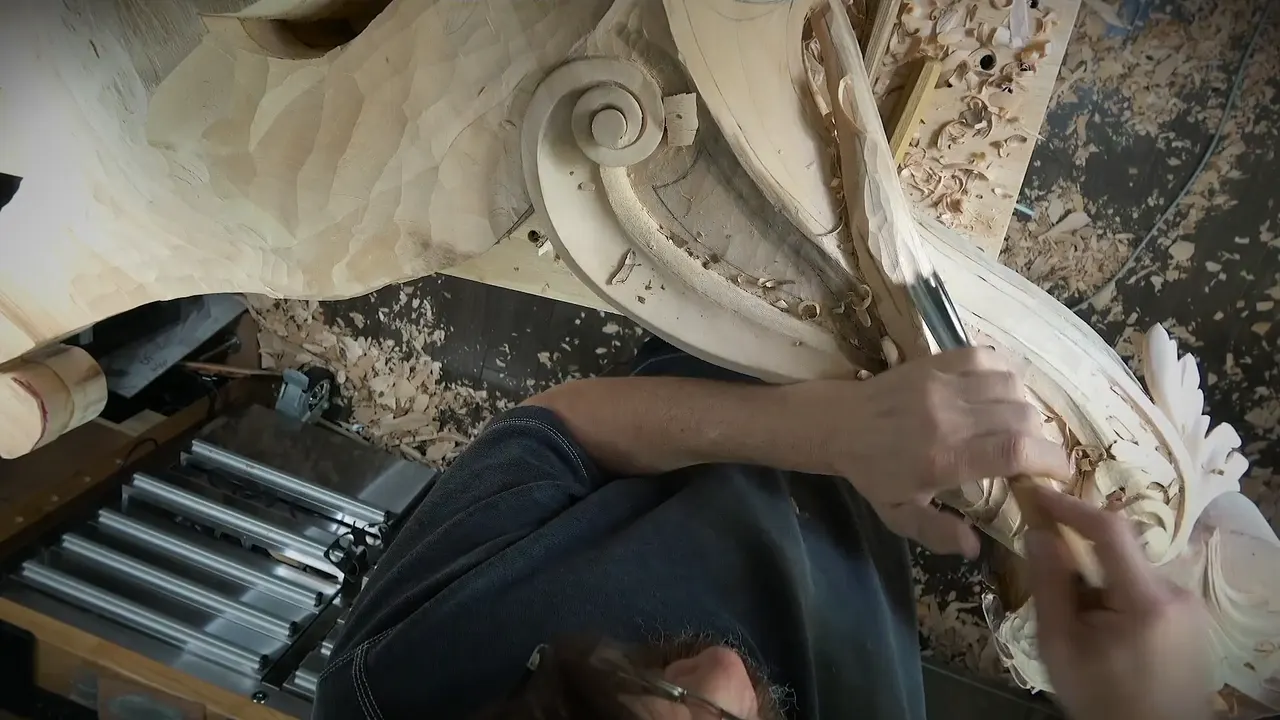

"I want to create even deeper, probably, concave right here, because it doesn't look too natural yet." That line is in workshop 91, part 4 of the Venice Room. Both words, "more natural," are in the same part too. Other lessons of mine put them beside petals, ridges, holes, grapes and acanthus. Here, part 4 comes first in the order it runs, and the other wood carving lessons follow with their links.
A carved hollow can fail to read right, and it is hard to say what to change first. Start with this part.
What happens in part 4 before the words "more natural"?
- Number nine, as a maybe, then an undercut that is planned for the shadow.
- Number 11, with an undercut effect planned for the shadow.
- A fold that is exaggerated, and a maybe for 4 mm (0.16 in).
- A carve planned "like this."
- Sharp edges to blend, with a number three.
- A section that looks like it grows from underneath.
- One more concave, planned, for a spot that is not natural yet.
Which tool starts the undercut?
The first words are a maybe: "Maybe I should use a smaller--" Then: "Maybe I can actually start with the number nine and then create that undercut." Number 11 is next, another gouge. "Now I'm going to take number 11."
After that: "Let me get rid of some of the tools." A small "Oops." follows, and then "My pencil wants to go there, too. And now I'm going to create that undercut effect."
Why is the undercut there?
A reason sits in the part itself: "Again, that's only for the shadow's sake, okay? Because I really need that shadow." The check that follows is "And you can see it already gives me that shadow, and I can actually excavate a little deeper."
The same words come with a deeper spot: "And even deeper in this case, again, for the shadow's sake."

Does the part call the shape exaggerated?
Plain words: "And yes, I am exaggerating pretty much the--" A comparison with real life follows. "In life, it's not going to look exactly like that."
Next: "exaggerated version of it, okay?" Then comes "Like a fold, just because of the shadows we're going to create."
The size of the tool sits in the same stretch: "And even with the smaller number 11, I can probably get even deeper with the four millimeters." Four millimeters are 0.16 inch. The word is "probably," so a maybe it stays.

How should the next carve go?
It opens on a verdict: "I am happy with that." Then a hedge, "Maybe I'm happy with that." After both comes the plan, "What I want to do, like I said, I want to create the cut like this, for it would look more natural."
One line is added to the plan: "And that's going to be a continuation of this cut."
Which edges get blended, and with what?
"Okay, now I need to blend a little nicer, because it's too many sharp edges." Right after, the tool is named: "Number three, upside down. That's what I'm using, okay?"
A second need sits close behind. "But now, just because I created that part, I need somehow to blend that nicer right underneath right here."

How does the section look after the blend?
After the blend comes "So now it looks like that section is actually growing from underneath right here. Not growing, but you know what I mean."
A correction is next. "So fold is not growing, but the movement is growing from underneath."

Which other side is blended?
"And I'm also going to blend this side a little better. Same idea." Then the plan is to roll it, "like this." After that: "And blend little bit." Then "All right. Let me clean it."
One more aim reads "Not disappears, but I want to make it feel like it's folding from underneath."

How does part 4 end?
With a remark on the feel: "Just changing the overall feel, how it feels." Right after it comes the line that opens this page, the one about a deeper concave and the word natural.
The last cue names the next tool, "Let me use number 11." In these words the deeper concave is only a plan.
Do the other parts of lesson 91 carry the word natural too, and where?
Other parts of Venice Room 91 have them too.
One part opens with a blend of one side, and its reason ends on the same word, natural. A second part carries the same word and goes on to a roll.
A third holds a plan. "Maybe I have to actually lower that quite a bit because I have a main body really far. So maybe I have to actually just get rid of a lot of material and redo some of the concaves." After it, the reason is the same word, natural.
Which other lessons put words beside "more natural"?
Below, each lesson keeps his own wording, and each is linked.
Which line moves in workshop 8?
Venice Room 8, part 5, holds "I still don't like how this line moves. I think I need to move it like that." Its verdict ends with "more natural that way."

Which part gets reestablished, and what tool follows, in workshop 5?
In Venice Room 5, part 3, comes "So I guess I have to reestablish this part," and the reason that follows is the word natural. Next: number seven. Then: "this part going to go underneath."

Where does a feel matter in workshop 11?
The note in Venice Room 11, part 5, mentions paint grade, and after it comes "Now it feels more natural." Soon: "So let me actually clean this one little bit right away."
Where does a downhill slope help in workshop 34?
Down in Venice Room 34, part 4: "And maybe I can give actually, overall movement a little bit downhill. Why not?" Next: "Even more natural feel, I would say." Then: "I'm really, really happy actually with the movements."
Which petal goes underneath?
Chamomile and Bow Rosette 1, part 3, brings a petal under another one. "So the right-hand side is going to go underneath of left side." A line after it ends with "more natural."
The tools come later in the same stretch: "Number 11 and small one, maybe about four millimeters or so" (0.16 of an inch).
How do petals read in Hashemi Flowers 43?
Hashemi Flowers 43, part 3: "So we can actually take those ridges out." And right after, "more natural, I would say."
Two petals are described next. "This one going to grow downhill," and the next goes "uphill like this."

Where are the same words in the negative in Hashemi Flowers 45, and what follows them?
In Hashemi Flowers 45, part 7, a warning comes. "you don't have to do those holes everywhere," and then: "It's not going to look natural, because some petals are actually closer to each other, some are farther, and when you do the hole, it creates a really big spaces."

Which hollow adds a dark spot in the Venetian Flowers Rosette?
In lesson 3 of the Venetian Flowers Rosette, part 1: "So create a little deeper concave on this side." Next: "an extra dark spot." The lines after it close on "more natural, I would say."
Its size is small. "Make it a small cut like this. It doesn't have to go all the way, by the way, to the center."

The second part of that lesson says it in plain words: "to create more shadow in this section," and the word natural ends the sentence. Its tool is "Small number eight, like about four millimeters or so," and 4 mm are 0.16 in. The plan is "a deeper concave right there."
Lesson 5 of the same course, part 2, has "I need to take out and make it more natural."

How can a carving be natural and exaggerated at once?
Furniture Panel 19, part 8, answers straight: "It has to look natural, but a wood carving is all about exaggeration, okay? So we're actually exaggerating natural movements. And the reason why, because we're really after shadows."
A verdict follows: "All right. And I think it looks much, much better that way." Then: "Let me just blend that in nicely."

In Furniture Panel 21, what does an undercut that grows look like?
At Furniture Panel 21, part 4: "And I can always undercut even deeper right here. And I think I should. So it should look natural, like it is growing from right here."

Which blend changes the movement in Lily Box 12?
Lily Box 12, part 5, says "Just create that shadow casting spot. All right. And let me blend a little bit, make it more natural movement." Then, "I like overall movement."

Where do the same words turn into a warning in Lily Box 13?
Lily Box 13, part 4: "just follow that same curvature, and that should look good. It should look like more natural movement, okay? But I see the problem. I am catching the grain."
Further on in the same part comes a longer warning, a brake on the whole move. "It's a subtle effect. Just don't be exaggerating too much. Okay? So it's going to be not natural if you're going to do too much."

Which direction looks right in Acanthus over Moldings?
Over in Acanthus over Moldings 6, part 2, sits "pretty much overlapping should happen like in One Direction." Next comes the reason, and it is the word natural again. "I would say it doesn't have to be but I think it's gonna look natural."
How do tendrils twist in Grape Onlay?
Near the grapes in Grape Onlay 4, part 2, comes this: "it's important with the grapes, okay?" Then: "With uh, tendrils, I mean you don't have to do it, but if you really wanna see uh, more natural motion, that would look much better."
Then: "So now let me twist this guy right underneath of uh, that motion."

Do the Floral and Molding lessons chase natural movement?
In lesson 6, part 3, a bulge goes downhill: "I also need to blend it" and then: "So it's got to be natural movement."
Lesson 11, part 2, has a pipe and a warning: "I don't want to undercut underneath of that pipe." A following sentence calls it not natural. Its fix is plain: "But just clean up."

How can a reed give a more natural edge in Hashemi Flowers 18?
Hashemi Flowers 18, part 4, is about a sharp edge, and sandpaper is not wanted. "And what I did, you can use as a tube." Then: "I actually placed it on a roll of paper, and it's dried, and they use that actually to work on the edges."
Plain talk follows. "I don't, I want to be authentic." Then: "So it's a more natural, more authentic way." The tool: "Just a Dutch reed."
When does a slice feel natural in Grape Onlay 3?
Grape Onlay 3, part 1, talks about slicing: "Even if I'm doing a small cuts, I am still slicing." Then: "And you can slice by the way, to the right or to the left, doesn't really matter. Whatever, in this case feels more natural."
Why did a move stop short in Venice Room 76?
In Venice Room 76, part 4, a reason is given for a choice: "I could, but it would look unnatural toward the ceiling, the overall movement." Then: "You're still going to detect that there's something just wrong."
The choice is closed with "That's why I didn't." The other way is named too: "If I would do all the way pierced work, that would be okay, but I didn't."
Does a spooning effect look natural in Grape Onlay 14?
At Grape Onlay 14, part 3, comes an angle of attack: "I gonna go from the edge first, just to lower down the whole edge." A dislike comes next: "when you're raising the tool and excavate, it creates like a spooning effect."
On the look: "It doesn't look natural, in my opinion, of course." The fix: "it's better for me to just excavate and exit, and actually go downhill."
Which jobs sit beside the words in each lesson?
| Lesson | Next to the words |
|---|---|
| This part | a concave still to come, with number 11 |
| Workshop 5 | a part to reestablish, then number seven |
| Workshop 8 | a line to move, with a verdict after it |
| Workshop 11 | a note on paint grade, then a feel |
| Workshop 34 | overall movement, a little bit downhill |
| Venice 76 | a move not taken, with a reason given |
| Chamomile 1 | a petal brought underneath another one |
| Hashemi 18 | a Dutch reed in place of sandpaper |
| Hashemi 43 | ridges taken out, petals downhill and uphill |
| Hashemi 45 | holes that are not made everywhere, and why |
| Rosette 3 | a dark spot from a deeper concave |
| Panel 19 | natural movements, exaggerated for the shadows |
| Panel 21 | an undercut made deeper, so it looks like it grows |
| Lily 12 | a blend, to make the movement more natural |
| Lily 13 | a subtle effect, and a warning on too much |
| Moldings 6 | overlapping in one direction, near the middle |
| Onlay 3 | a slice to the right or to the left |
| Onlay 4 | a twist underneath the motion, for tendrils |
| Onlay 14 | a spooning effect that does not look natural |
| Floral 6 | a bulge that goes downhill, then a blend |
| Floral 11 | no undercut underneath the pipe, just a clean-up |
Is there a spot on your own wood carving that does not read as natural yet, and do you know which move to try first? All of workshop 91 sits inside one tuition plan, with the other Part 8 workshops. This page ends where the part ends.
How it's done
- Pick the tool for the undercut. Nine, then 11, for the shadow's sake.
- Check the shadow. "It already gives me that shadow," with room to excavate a little deeper.
- Plan the next carve. The cue reads "a continuation of this cut."
- Blend the sharp edges. A number three for the blend, then a blend right underneath.
- Make it feel like folding. The aim is a section that feels like it is "folding from underneath."
- Plan a deeper concave. It reads "doesn't look too natural yet," so the plan is a deeper concave, with number 11.
Frequently asked questions
Which tool opens the undercut in part 4?
Nine is only a maybe at first, then number 11. The plan is an undercut effect, and the reason is the shadow's sake.
How deep does the smaller number 11 go?
The line is "I can probably get even deeper with the four millimeters." That is 4 mm, or 0.16 inch, with "probably" in front.
What tool blends the sharp edges?
"Number three, upside down," after the remark about too many sharp edges.
Does the part call the shape real or exaggerated?
What to carve next