

Alexander Grabovetskiy, woodcarver, School of Woodcarving · Published 2020
What does a wood carver mean by "droppings" on a corbel?
Quick answer: In workshop 91 of the Venice Room, part 8 plans "a bunch of concave cuts to get that idea." Before them the section has to blend in nicely and may go lower, with number seven named. The measure to the main body is about half an inch (about 13 mm), with 10 millimeters (about 0.4 in) possible.
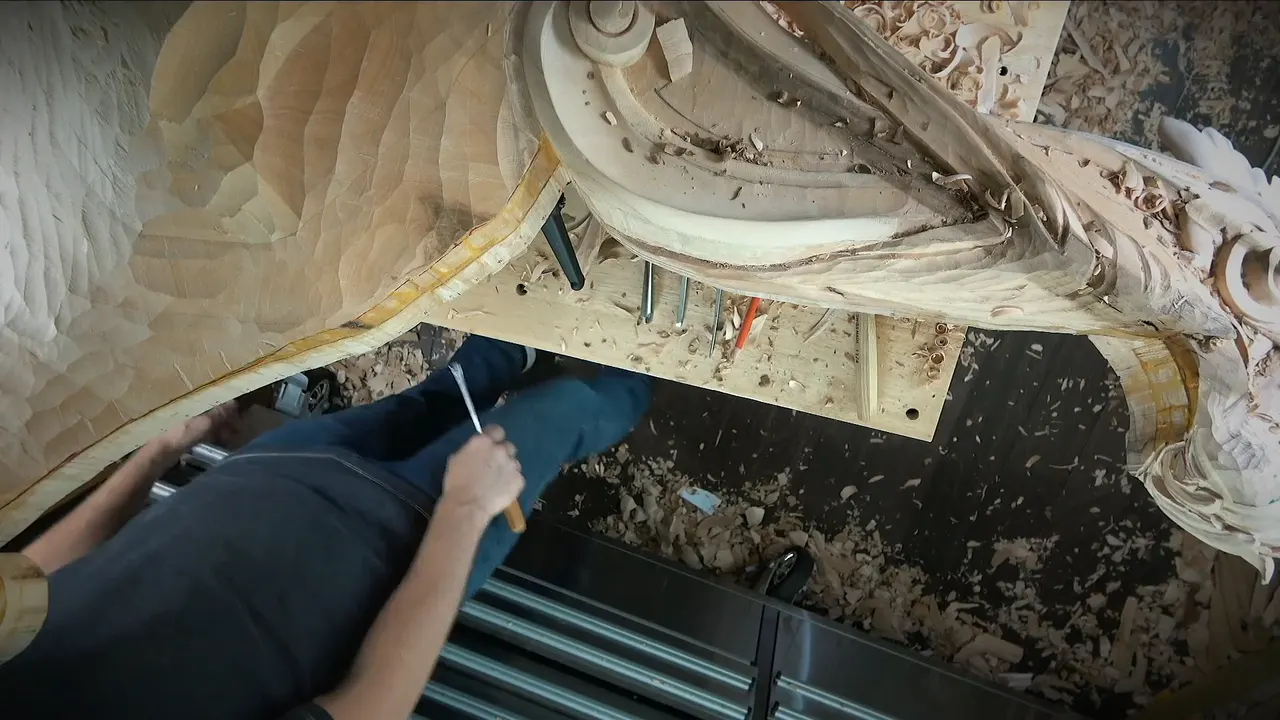

"Now it's going to be like droppings. Right?" That line sits in workshop 91, part 8, of the Venice Room, on a corbel. The word is in the plan for a bunch of hollows and in the line about how deep they go. Part 9 uses it, and so does part 6.
Ever carved one hollow and found the wood beside it standing too far out? What do you do then, short of digging a hole under it? One answer sits in part 8. Further down, the same hands talk about paint and rasps.
What are the droppings in Venice Room 91.8?
First, a plan. "So I'm going to just create a bunch of concave cuts to get that idea. It's droppings." And a condition sits right behind it, "But to do that, first I need to make sure it blends in nicely."
Over in part 6 the word follows a plan for a smaller concave, in "really nice droppings, okay, right on the side of it." A short verdict follows, "So it's one of the details I like."

What has to happen before the droppings start?
Blend first, and maybe go lower. "Blends in nicely, and maybe I have to actually lower that down a little bit." The hedge has a reason behind it, "Otherwise, it's not going to look good." The hollow itself? "So let me exaggerate that concave."
The tool is number seven. "But I need to get with my number seven and completely lower that down below the main body." "I'll use number seven for this operation." Both lines are plans.

How far from the main body does the section go?
Here is the measure. "So I've got about half an inch to the main body of our corbel." In metric that is about 13 mm. The limit sits right behind it, "But I can go all the way to 10 millimeters, like three-eighths of an inch." Ten millimeters is about 0.4 in, and three-eighths of an inch is about 9.5 mm. The hope is that it will "look better."
A worry about the material comes earlier in the part. "get rid of a lot of material" is one half of it, and "it doesn't look too natural as of now" is the other.

A tool and a stop line come before the measure. "I'll use just a big one." Then "Otherwise, I have to just excavate too much underneath. And that's no bueno. I really don't want to do it." After them sits a verdict, "So that is much better now."
How deep do the droppings go?
Deep, and for a reason. "Don't want to lose it, my main line. But on the other hand, I have to create a really deep excavation because those droppings have to look also natural." A need, not a finished job. Number nine is named next, in "With number nine."

The light check sits earlier in the part. "I am happy overall, but you see only with the light source from one point." Moving the light to another side is the plan, "let me check." The verdict is "So now it gets in a different direction, and it feels like it does fold." One limit stays, "I'm not too happy yet with this section."


How are the droppings planned in part 9?
Straight down. Part 9 plans it in "just pretty much straight cuts like this just to create those droppings," with number 11 as the tool and "Just straight down cuts" as the words. There is also "And I can make them a little wavy" in part 9.

The camera gets in the way. "I apologize if you can't see what I'm doing, but later on you'll see it." A need is spoken for the camera too, "Once I develop this side, I have to reposition completely," and right after it "That way you'll be able to see." The multiple passes are planned for "off-camera." Then "it's just not convenient to get with the camera." Showing one section is planned beside it, and a straight view follows, "if you would look right straight to it."

Which tool smooths the droppings in part 9?
Rasps, and the strength is named. "And yes, I will use probably rasps" comes first, then "somewhat aggressive rasps." Two short lines follow, "I've got those ones, I just bought them. They really are aggressive."
The reason is "that way I can just create really nice and smooth movements." The plan ends on "just rasp everything and clean it."

Why are there so few details on the droppings?
Paint. "And again, I really don't worry about creating too many details in this case" comes first, and the reason named is a "paint job." A limit sits later in the part, "a couple more details probably," and "Not more than that."
Other lessons talk about paint too, and each one has its own link below.
Why does the grain matter less on a painted board?
Leftovers from other parts make the board in Venetian Flowers Rosette 1, part 2. Its grain runs a certain way. "Painted gray" is what the board will be, and "so really, I don't care about the grain direction as much."

How much time does a painted petal get?
The petals are done in Chamomile and Bow Rosette 4, part 2, and the talk turns to time. A lot longer is possible, in "I could spend a lot longer if I wanted to," but paint is the plan for the project. In between sits "I don't really need to spend too much time on that." Soon after, "a couple more things" are named, and then it will be done.

Is there a reason to clean a painted leaf?
A sandpaper is named first, in the molding course, lesson 10, part 3, in "I could probably just use sandpaper, but I'll show you what the normal procedure is when I don't use a sandpaper." The paint line is "it is gonna be painted so it's gonna be just a white color." Next comes "And there's no reason to spend so much time on cleaning stuff."

In lesson 7 of that course, part 2, comes "But I have to keep in mind," and the piece will be painted. After it come "I have to paint the whole thing" and "I understand how I'm going to get with the brush." The brush is the tool named there.
How does paint change a carving?
The words in workshop 14, part 9, of the Venice Room are "somewhat softened," after the paint. Paint "like a layer" is the reason.
Pencil marks are the topic in workshop 23, part 8. "the pencil marks left a lot of dirt on the surface." A next line is "I really don't worry about it because like I said," and the paint comes next, with "just give a nicer, cleaner look."
In the panel course, lesson 13, part 1, the paint is a chalk paint, and it is "not just penetrating paint." "Which means a lot of those facets, what you see, will be completely covered with the paint." Next, as a plan, "first primer, maybe even two times." A "really thick primer" is the one named, and primer is the topic of the next lines.

Does an unpainted carving get a longer clean?
The panel course, lesson 14, part 3, speaks of a contrast. "some of the stuff what you saw in this course, I left somewhat rough." The cover is the paint, in "Absolutely no reason." The turn is furniture "which is not going to be painted," where "I would spend little longer." One more line, "I would suggest to spend a little longer and just clean it."
A dome under a line sits in part 2 of lesson 13, and the dome is optional, "if you wish." Next, "I don't have to because, like I said," and the paint follows.
How does paint treat a deep spot?
A micro tool shows in workshop 144, part 3, in "Half a millimeter, number 11 micro tool," which is about 0.02 in. Next, "But I really don't need to, because" paint is coming. Two lines about the paint follow, "some of the paint's going to get in," and dust is named as well. The last line is "But at least I can get a really deep shadow."

Which Venice Room lessons mention rasps?
Rasps get an honest start in workshop 50, part 8. "I did not use rasps before this year, before this project, because always I thought that's not really authentic to wood carving." The turn is "But you know what? I think I lost a lot of time not using it and just doing everything out of chisel." Next, "I could save a lot more time just by using rasps."
The grid gets a word too. "10 grid, that would be really rough, and 14 would be really nice." My own set is "about 13." The same stretch holds a plan, "start collecting those rasps also." The stretch has a "maybe" about "nicer grade rasps" too, with paint grade as the reason.

A different feeling sits in workshop 28, part 6. "I'm still feeling guilty every time when I'm grabbing those rasps or sandpaper. I feel guilty of not utilizing the true woodcarver's approach. Maybe I shouldn't feel guilty."
A rasp has a job in workshop 146, part 1, in "use a rasp and blend everything," then "look really nice." In part 2 it is "I'll just rasp majority of it and create the shape I'm after." A hope sits there, "save me some time," and a doubt, "sometimes after rasp, you have to really also just do something else." The end is "But we'll see."
Further into part 2, "And yes, I did use some small rasps to give some rasp job and so on." The next line gives a reason, "many times, maybe too many times," about the paint.
Workshop 112, part 1, treats a rasp as a question. "And I said to myself, Why not?" The next words are "Why not to use it," then "because anyway," and the paint. After that come "it saves me time" and "Just rasp it and forget it."

Do other courses mention rasps?
Lily Box 4, part 10, states a habit first. "by the way, I usually don't use any tools beside my carving tools." After it, "But you can use sometimes rasps to create that nice and flowing line." On sandpaper the line is "I wouldn't use sandpaper," and the tool "dull really quickly" is the reason.


Which lessons speak about which job?
Rows with only numbers come from the Venice Room workshops.
| Lesson and part | What the lines in that part are about |
|---|---|
| 91.8 | hollows planned, then a section to blend and lower |
| 91.8, later | a measure to the main body, 10 mm possible, and a need for depth |
| 91.9 | straight down with number 11, a little wavy, rasps, and a paint job |
| Venetian Flowers Rosette 1.2 | painted gray, so the grain direction matters less |
| Chamomile and Bow Rosette 4.2 | a longer job possible, but the project is to be painted |
| Acanthus over Moldings 10.3 | white paint, and no reason to spend so much time cleaning |
| Acanthus over Moldings 7.2 | a line to keep in mind before the paint, then a brush |
| 14.9 | paint like a layer, and a result somewhat softened |
| 23.8 | pencil dirt left on the surface, and a nicer, cleaner look |
| Floral and Molding 13.1 | chalk paint, with the facets covered by it |
| Floral and Molding 14.3 | somewhat rough left, and a longer clean for furniture that is not painted |
| 144.3 | a micro tool, a deep shadow, and paint that gets in |
| 50.8 | rasps not used before this project, time that could be saved, and a grid of about 13 |
| 28.6 | a guilty feeling about rasps and sandpaper |
| Lily Box 4.10 | rasps for a flowing line, and a word on sandpaper |
| 112.1 | one rasp, and the words Why not |
| 146.1 and 146.2 | rasps to blend, a hope to save time, and a rasp job |
Is there a spot on your own piece that stands too far out? All of workshop 91 sits inside one tuition plan, with the other Part 8 workshops from Venice. The droppings are in workshop 91, and the rest of this wood carving lesson goes on without talk, as the end of part 9 says: "So just enjoy."
How it's done
- Plan the hollows. A bunch of hollows is planned for one spot, and the section has to blend in nicely first.
- Lower the section. The section may go lower, and the tool named for that is number seven.
- Check the distance. A distance to the main body is stated, and a second figure is possible.
- Dig deep. A deep excavation is a need, with number nine named.
- Plan straight passes. Part 9 plans straight down passes, some of them "a little wavy," and names number 11.
- Rasp, and let paint carry it. Aggressive rasps are planned, and few details are carved because of a "paint job."
Frequently asked questions
Where does part 8 put the word droppings?
In the plan for the hollows, in the line just before number seven is named, and in the need for depth. A small concave in part 6 and a row of straight passes in part 9 carry the word too.
Which tool numbers sit near the droppings?
Number seven is named for lowering the section below the main body, and "just a big one" comes after it. Number nine is named right after the line about depth. In part 9, number 11 is named for straight down passes.
Are rasps planned for the droppings?
Yes, as a plan. "I will use probably rasps" and "somewhat aggressive rasps" are the words, and "really nice and smooth movements" is why. The last words of the plan are "just rasp everything and clean it."
What to carve next
- Venice Room 91
- Venice Room Part 8
- Venetian Flowers Rosette 1
- Chamomile and Bow Rosette 4
- Acanthus over Moldings 10
- Acanthus over Moldings 7
- Venice Room 14
- Venice Room 23
- Floral and Molding 13
- Floral and Molding 14
- Venice Room 144
- Venice Room 50
- Venice Room 28
- Venice Room 146
- Venice Room 112
- Lily Box 4
- Byzantine Acanthus 10