
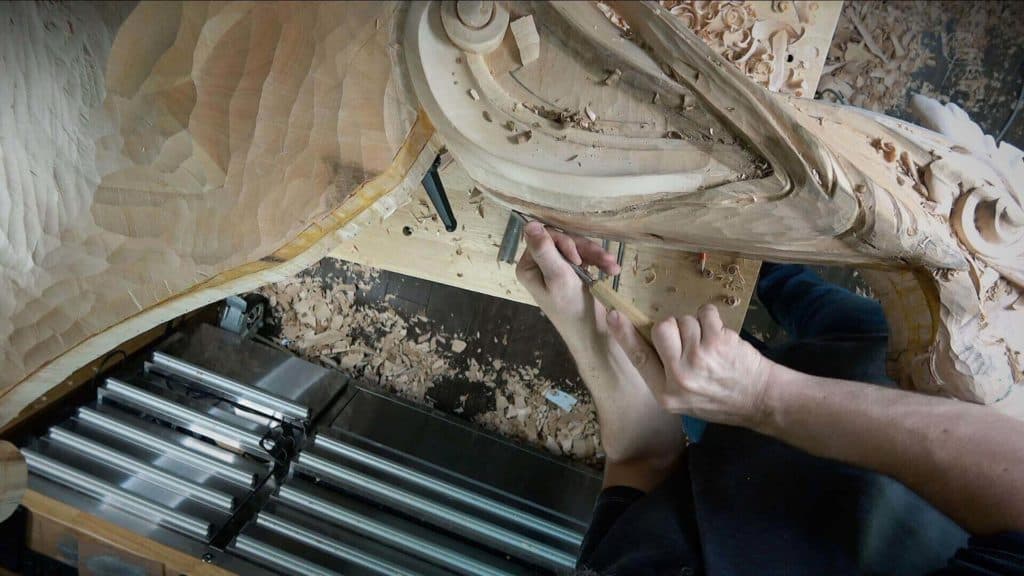
Alexander Grabovetskiy, woodcarver, School of Woodcarving · Published 2020
What does a wood carver mean by "abrasive"?
Quick answer: In workshop 91 of the Venice Room, part 6 puts the word abrasive beside dull tools in one sentence, after a short concave, before a side that is hard to show. Other lessons use the word for basswood, sandpaper, Dutch reed, a rasp and a mesh sheet, each with its own wording.
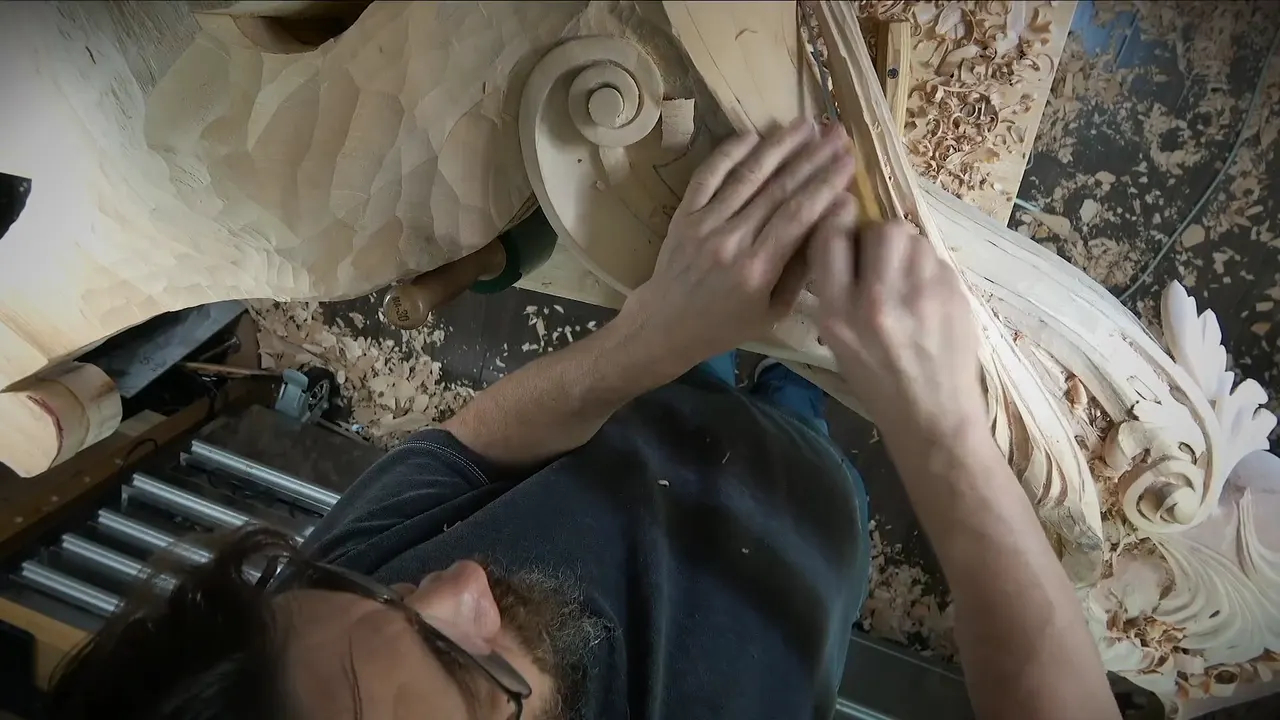

"When I'm approaching this area, it's like a really abrasive area, and I'm getting my tools really dull." That line is in workshop 91, part 6, of the Venice Room. The word turns up again in lessons about wood, sandpaper, a rasp and a mesh sheet. Part 6 goes first on this page, and every wood carving lesson after it has its link.
Your gouge goes dull after a few strokes in one spot, and you cannot tell if the tool or the wood is to blame. Start with this part.
Which lines of part 6 hold the word abrasive?
- A strop, then a concave planned to roll one way.
- A deeper section, planned.
- A shadow still in view, a transitional concave planned to go folding in, and a note that another concave is short.
- Tools that go dull.
- A side the viewer cannot fully see, and a hope that some of it will show.
- Another, smaller concave, plus droppings on the side.
How does part 6 open?
The part opens on a plan to strop again. "So I'm going to strop it again a little bit," and then "there you go. That's good." The next plan is the shape of the concave: "roll it this way, this concave."
A look is named next: "Okay, so that would look more natural." The roll is planned again, "roll like this." A verdict follows, "All right. That is good," and then a limit: "Except I want to create a little deeper section right here."

The tool for that spot is a plan, and a number nine is named: "A little deeper, and I'm going to use number nine." The first stretch closes with "And carefully attack this area."
Where does the shadow fit in?
The shadow is named after the first pass over that area. "I still see that shadow." A pause comes next, "but let me think," and then a need, for "another concave, I would say."
The plan has a name and a direction: a "transitional concave" that is "going to go folding in." The small tool starts it, as a plan. A note on size comes last: "this one is a short concave, by the way."

What sits beside the word itself?
The full line is at the top of this page. It follows the short concave and opens on "And here you go again." Two short lines come right after it, "And plant that in," and then "Just like that."
Part 5 of the same lesson, Venice Room 91, has a close match near its start: "So that is little challenging area. Challenging area because of the material." A tool is named there too, as a maybe: "Maybe in this case, I should use a smaller number 11 because of the material section. It has to be really sharp and small." Later in part 5 the feel is stated outright: "It feels like almost there is abrasive on inside." A strop is mentioned just before the dulling, "Just a second ago, I just stropped." Next: "I create a couple cuts, and then it becomes dull, just in this section."
A contrast follows in that part. "When I start, it's absolutely sharp and clean. It's beautiful and nice, but when I continue, it becomes dull right away." That thought finishes with a guess: "I guess I have to sharpen my tool more often in this section."

What happens when the side is hard to show?
A plan to carry the work comes first, "right underneath this side." A doubt follows about showing the work on that side, and then "Let me try to figure this out."
Hope is in the next lines, "hopefully you'll be able to see some of that," and later "but you don't see completely. But hopefully, you will understand."

The plan for the section comes after that: "this section is going to be a little different." The concave is planned to run "from all the way underneath right here and going all the way this way." Number nine is a plan again, with the words "Let me start with the number nine."
How does part 6 end?
The last stretch turns on a question and an offer. "And you know what? What I could do," and then the need again: "I need to create a smaller concave right here."
Its final lines look ahead to the side. "So there is going to be really nice droppings, okay, right on the side of it." And "it's one of the details I like." One more plan ends the part, and it starts "And I going to go."

Which other lessons put the word beside wood and tools?
Below, each passage keeps its own wording, and each lesson has its link.
Can a soft wood still dull a tool?
Carving Dining Table Apron, workshop 9, holds the clearest case. One line is about the sharpening station: "And you probably noticed that I don't go to my sharpening station as often as I do when I'm carving on basswood." Then "that's kind of a paradox, I guess."
The wood is called "a much softer wood," and a note on the name follows: "you call it basswood, or you can call it limewood. It's the same." The surprise is "my tools getting dull a lot quicker on basswood than on oak."
A teacher is named, then a doubt: "My teacher tried to explain me. I still didn't get it." After that the wood itself is named: "Basswood doesn't look like abrasive wood."

The line names some woods that are "really abrasive," and then "There is some abrasive inside of the fibers, but in a basswood, it's not the case." The stretch closes on a limit: "At least my tools. Maybe in your case, it's not the case."
What if you do not know how abrasive a wood is?
A new wood is covered in Lily Box 2: "And also, I don't know how abrasive this wood is, so I have to keep an eye always how sharp my tools are. So if they need to be resharpened or not." The report after that is short: "But so far, I have no problem."
Does sandpaper put abrasive in the wood?
In Lily Box 3, part 10, the answer is plain: "I just don't like sandpaper on the wood carving because it leaves abrasive inside of the fibers, and when you're carving with the tools, your tools becoming dull quicker. Much quicker."
A turn follows. "Although, I do have some customers, they actually ask me to sand it completely smooth."

Which plant leaves no abrasive behind?
In Furniture Panel 19, part 1, a Dutch reed is named. "That's the plant growing by the river, okay?" After it: "It's equal to about 400-grit sandpaper." The reason for liking it comes after: "I like that way better than the sandpaper because it doesn't leave any abrasive."
The result is "absolutely perfect surface." A limit comes with it: "for the sake of just showing the different techniques."

In part 12 of the same lesson a reed brush softens the edges: "that just softens those edges." It adds "It's not undercut yet, but it still just gives me a really nice result."
What else is used beside the reed?
In Furniture Panel 20, part 3, reed rush comes first, to "remove that paper without taking too much material," and "It's also quick." A second way uses a small knife: "you could just actually scrape it, okay, with the same knife." A warning follows: "that's not the best idea, but it's still possible to do it."
A question about the tool is raised, and the answer ends on "It's going to make it dull little bit." The verdict on scraping is "like almost it sands it, but without leaving any abrasive parts inside of that wood."

Is the reed itself abrasive?
Yes, in Curly Cutting Board 10, part 1. The reed is "actually a plant," and "you can find it by the rivers and by the swamps and by the different lakes and so on." Then "And that is quite abrasive, that Dutch reed." A few lines on, the word comes once more, "It is abrasive." And then "It actually takes some wood."

Does a rasp leave abrasive behind?
In Venice Room 10, part 6, the rasp follows a dislike: "But I kind of don't like what the pipe does, and I could probably clean it with the number nine." Then "See, the beautiful thing about this rasp, like I said, it doesn't leave any abrasive on inside. So I can always go back with the tool, and I know it's not going to dull my tool."
For the rasp there is a plan: "I can just shave some roughness out." A note on sandpaper follows: "I could use just a sandpaper." Two reasons come with it, "paint grade" and "I have to sand my first coat, the base coat."

In part 3 of that lesson, "I still don't like how this looks," then "Let me use a rasp again," and later a verdict on the tool: "it gives me a really good result." A short line in Venice Room 24, part 4, is about rasps, the fibers and the wood.
Which rasps were ordered later?
Later, Venice Room 17, part 12, puts it this way: "And yes, I loved the idea of, right now, those rasps, and I just decided to order just the cheap diamond ones, which has some curvatures also." The grit is last: "and it's little finer grit."
Next, part 5 of that lesson moves on to a mesh sheet that is see-through. "It does not leave too much abrasive. It still leaves, don't get me wrong, but to make it a little softer look, closer to whatever the Italian people like, and they really like to see everything softened. No crisp look."

Is a mesh sheet any better?
Floral and Molding 14, part 3, shows the mesh: "It's not going to clog." What is taken out goes "inside of that mesh." A taste is stated too: "I'm not the biggest fan of the sanding of the process itself." And then "I really like to leave all my work with the facets and so on."

In Chamomile and Bow Rosette 1, part 3, the limit sits in one sentence: "Well, it leaves some abrasive, but doesn't leave too much." It adds "And it's a little better for the tools."

In Chamomile 4, part 2, the sheet is used "just to show you the point." Then "just because this project is for the paint, I'm not afraid of using it." Two lines carry the gain: "it does not leave as much abrasive" and "It's easier for my gouges."

The same hedge is in Carving Vase with grape leaves 3, part 5: "It's still going to leave probably some of the abrasive, but not as much."

The Q and A lesson Should I Use Sandpaper in Wood Carving has a verdict on the same mesh: "a really big fan of that mesh." A sponge replaces paper in Lily Box 13: "in this case, it's just a sponge," and the grit stays in the sponge.
Can sandpaper be a sharpening tool?
In the Sharpening in-person class, Maine Coast workshop, part 1, a stone comes first for sharpening by hand. "If you don't have a stone, take a sandpaper. Okay, the same idea. It's still abrasive. You can achieve the same results with the sandpaper."
The talk moves to the bevel: "You establish the bevel, and you follow the tool."
Which jobs sit beside the word in each lesson?
| Lesson | Next to the word |
|---|---|
| This part (91.6) | a tool going dull in one area, after a short concave |
| Sibling part (91.5) | abrasive on the inside, a tool dull again, and a guess about sharpening more often |
| Dining Apron 9 | some woods are abrasive, basswood is not, yet the tools dull quicker |
| Lily Box 2 | a new wood, and an eye on the tools |
| Lily Box 3 | sandpaper leaves abrasive in the fibers, and the tools dull quicker |
| Furniture Panel 19 | a reed that is liked better than sandpaper |
| Furniture Panel 20 | reed rush, then scraping with a small knife |
| Curly Cutting Board 10 | Dutch reed itself, called quite abrasive, with a note on where it grows |
| Venice Room 10 and 24 | a rasp that leaves no abrasive |
| Venice Room 17 | diamond rasps ordered, then a mesh sheet |
| Floral and Molding 14 | a sheet of mesh that does not clog |
| Chamomile 1 and 4 | mesh with less abrasive, and easier on the gouges |
| Grape Vase 3 | mesh that still leaves some, but not as much |
| Sharpening class | sandpaper in place of a stone, with the same results |
Is there a spot on your own wood carving where the tool goes dull faster than anywhere else, and do you know which of these lessons it matches? All of workshop 91 sits inside one tuition plan, with the other Part 8 workshops. This page ends where the part ends.
How it's done
- Strop the tool. Strop again is the plan, with "there you go" after it.
- Plan the roll. The concave is planned to roll one way, and it "would look more natural."
- Plan a deeper section. A deeper section is the plan, with number nine named for it.
- Name the trouble. Tools going dull are named in the same sentence as the word.
- Show the side. A hope that some of it can be seen, and a doubt about how to show it.
- Plan the last concave. A smaller concave closes the plans, with a detail liked on the side.
Frequently asked questions
Where is the word abrasive in part 6?
In the sentence that opens on "And here you go again," just before "And plant that in."
Does another part of lesson 91 have the same trouble?
Part 5 does, and it ends on "It's dull again" and a guess about sharpening more often.
Which tools leave no abrasive behind?
Dutch reed in panel workshop 19, and a rasp in Venice Room workshop 10.
Does basswood count as an abrasive wood?
What to carve next
- Venice Room 91
- Venice Room Part 8
- Carving Dining Table Apron
- Lily Box 2
- Lily Box 3
- Furniture Panel 19
- Furniture Panel 20
- Curly Cutting Board 10
- Venice Room 10
- Venice Room 24
- Venice Room 17
- Floral and Molding 14
- Chamomile and Bow Rosette 1
- Chamomile 4
- Carving Vase with grape leaves 3
- Lily Box 13
- Sharpening in-person class