
Alexander Grabovetskiy, woodcarver, School of Woodcarving · Published 2020
What does a wood carver mean by "a couple more"?
Quick answer: In part 3 of Venice Room 91, "a couple more" follows "it doesn't look too good," and a number 11 starts the short concaves. Other Venice Room lessons, Lily Box, Furniture Panel and Grape Onlay put the same words beside notches, ridges, separations and grapes.
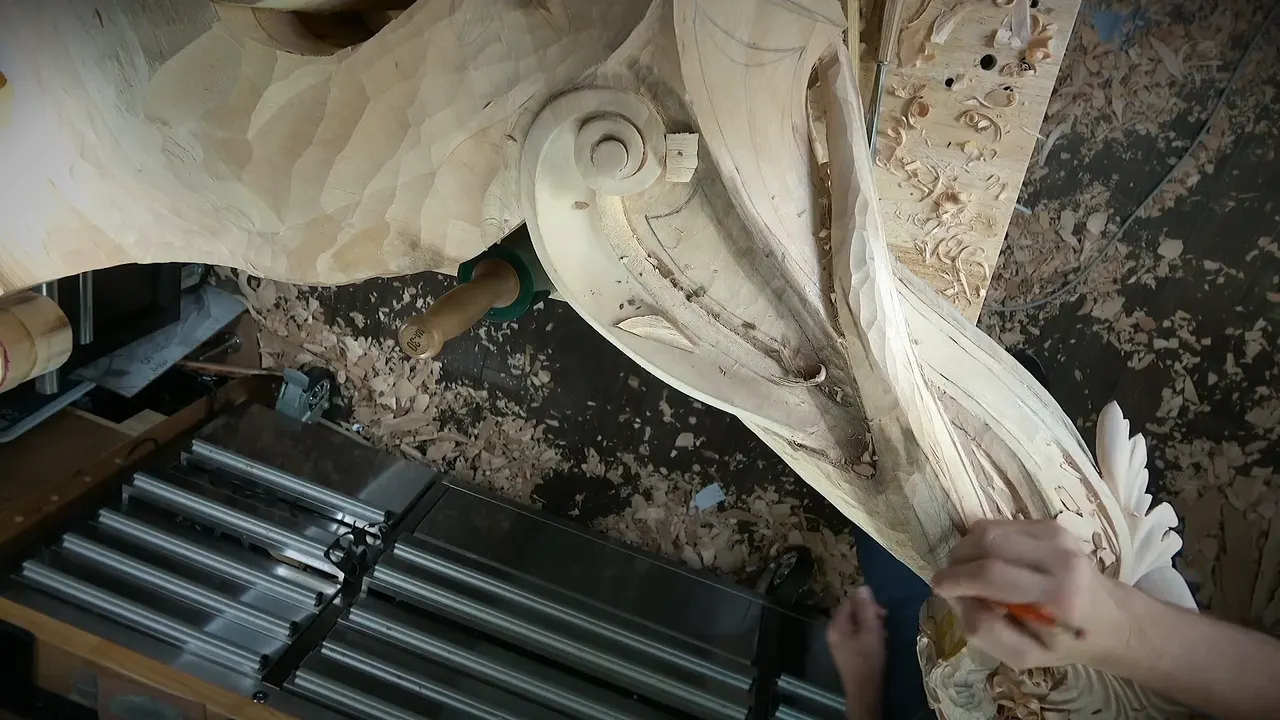

"So I still want to create a couple more concaves right here." That line is in workshop 91, part 3 of the Venice Room. The words "couple more" sit beside concaves there, and beside notches, ridges, separations, grapes and even tools in other lessons of mine. This page reads part 3 in the order it runs, then those wood carving lessons, each with its link.
Ever looked at a carved hollow, felt it fell short, and wondered how many more to add? This part is a fine place to start.
What are the plans and verdicts in part 3?
- A wide, short, deep concave.
- Number nine, a maybe, then sharpened.
- Dark wood, called "really mushy," and a tool that has to be sharp.
- A change of position.
- A softer ridge, with a look of folding.
- Short concaves from one start point, five millimeters (0.20 in), number 11.
- A second big movement, "all the way up."
- A tool at 12 o'clock, and a plan for about 2 o'clock.
What shape does the next concave take?
Words for this concave: "not as long," then "wide." Its picture is "an open mouth when you draw a human being." With a drawing beside it comes "a human mouth like this," followed by "short."

After the drawing, the words are "Short, but deep."
Which gouge does a short, deep concave need?
A maybe opens it: "Maybe I can use actually number nine for creating this one." Sharpening is stated, "And this number nine needs to be sharpened," and then "All right. That's much better."
Number nine is a gouge, and the reason sits with the wood: "the color of the wood is dark, which means it's really mushy. So tool must be super sharp to work in an area like that." The warning is "You don't want to overdo it."

What is planned for the ridge?
"Let me change the position and attack from this side." Softening is planned for this spot: "And this also needs to be softened a little bit, this ridge." The look wanted is "It's got to look like it's folding."
An idea for rasps sits there: "That would be a really good area to use the rasps to create really nice and soft movements."

Where do the short concaves begin?
"All right, that is good. So what I want to do now, because it doesn't look too good, so I still want to create a couple more concaves right here. Short ones, okay?" Its aim reads "But still just create the illusion that it's folding this way."
Tool: "the smaller number 11," with "I'm going to carry that right here. Start from this point." Then comes "Okay, one concave, and that's five millimeters" (0.20 in). A thought follows, "And let me think. Maybe a little deeper this way also."

Where does the new concave get blended, and from which side?
"And yes, I need to blend it from underneath." A verdict sits close by: "At least I think it takes shape." One more maybe is "I want to do a deeper concave right here."
A promise about the view is made there too: "And I'll show you how it looks in the roll movement later on. I'll try to show that in overall movement later on."

Where does the second big movement start?
"So that was the first big movement. So the second one is going to be also starting from, I don't know, this point approximately." Then comes a direction: "Again, all the way up just like that." The depth named is "a somewhat deep cut."
How is the tool pointed for the fold going back?
A need opens it: "But I need to create some kind of fold going back almost because otherwise it's not going to look as nice." Its direction is "almost undercutting underneath of this line."
Position of the tool follows: "if the flute is up right now, like this 12 o'clock, I'm going to create my cut about 2 o'clock or so carefully." Then: "And yes, it's going to blend with this surface, but ... more undercut."

Where else are the words "a couple more" said?
Other lessons carry them, and each one pairs the words with a different job. Each quote below keeps his words, and each lesson is linked.
Which tool made notches in Venice Room 10?
Part 4 of Venice Room 10 has a plan: "I probably should do extra separations closer to the end." Then notches: "like a couple notches. Couple more notches. It's going to give even nicer look."
A tool is named: "I'll just use a skew chisel, which would be number 2 in London pattern." A caution is added, "But if it's European, it's marked absolutely differently." A wish follows, "And maybe just make them more popping," with "not much, just slightly" as the amount, and a verdict: "I still don't like right here how it looks."

Which size made subdivisions in workshop 69?
Workshop 69, part 1, aims at a look, "beautiful curliness," which is "almost invisible." The size is "Okay, two millimeters," and then "Number 11, two millimeters, and create couple more notches. Couple more subdivisions, okay?" Two millimeters come to 0.08 in. One need is added, "to undercut on that side."

What comes first before the separations in workshop 67?
A look at Venice Room 67, part 3: "So I was working in those two spots. Okay? Just giving little deeper shadow." Next: "so I'm still going to do a couple more separations on this piece because I think it's logical to do."
Relief comes first: "And I need to relieve it first. I need to relieve it with the number 11 and 2 millimeters" (0.08 in). Its limit has a reason: "Relieve it, but not too deep because I do not want to put the tool mark in a lower leaf." Another plan follows: "maybe just excavate a little bit this way, and even create that preliminary undercut," with "bigger undercut later on."

Which side skips the separations in lesson 118?
Lesson 118, part 3, has a match to make: "if I have to match whatever I had to do on the big piece." Next comes "a couple more separations and make it more unique or more curly, I should say, more curlier." A doubt follows: "I'm not sure if I should say even that."
Tools come next, "#11 and make relieving cuts." For one side nothing is planned, with its reason in the same breath: "I'm not going to do anything on this side because it's never going to be visible, and I really don't want to spend more time than what I have to." After that a smaller tool: "Let me get small, like #7. Like a quarter inch" (6.4 millimeters).

Which tool outlines the details again in Venice Room 19?
In Venice Room 19, part 7, a plan is stated for "a couple more details." A second plan sits beside it, "outline it again with the same tool. Carefully, carefully. Just go around."
A worry is set aside: "And no, I don't worry about losing my shell. I do have a lot of material yet."

How many divisions does workshop 32 name?
Over in workshop 32, part 10, the wish reads "a lot more divisions." The reason given is "I think it's just going to look much nicer if we're going to put multiple."
Then the list: "if you look at some of the work of ancient carvers, stone carvers, and wood carvers who did those acanthus leaves, they usually had at least three divisions. Some of them had five divisions, which means they would add a couple more, or eight divisions." One more line: "So it's equal to a Fibonacci number." Three, five and eight are Fibonacci numbers. The look promised is "much more richer look, I'd say." Another thought sits there: "maybe widened, and I could divide that little more, this movement."

What do a couple more minutes buy in workshop 35?
Rough spots are the subject in Venice Room 35, part 3: "I don't like to leave some spots rough, and I've done it many times. I left rough, and it is okay for a while, but when you look back, you understand it would look much better if you would just spend a couple more minutes and clean it."
Shadow gets a plan next: "And I also want to go a little deeper on the side of this. Just give extra shadow."

Which sweep made ridges in the Lily Box?
Lily Box 3, part 7, names a ridge: "that just created nice ridge. Okay? Beautiful ridge. And now I need to get a lesser sweep, maybe like number five or number four. Number four will do, I think."
Next is "a couple more ridges." After it comes the size: "This is number four, by the way, and about six millimeters. One quarter of an inch." Six millimeters are 0.24 in, and a quarter inch is 6.4 mm.

What verdict follows in the Furniture Panel?
Furniture Panel 19, part 8, names what the work is after: "What I'm after, organic, okay, organic movements." A check follows: "as of now, it doesn't look as appealing to me. Maybe, a couple more cuts toward this direction."
The verdict is "And now it looks much better. Much, much better." Then: "It looks more natural, I would say."

Which doubt starts the choice of tool in lesson 17?
Venice Room 17, part 10, states a doubt: "it's not that bad, but still something doesn't add up." Next is a choice of tool: "Let me think which I should use, maybe number seven and four millimeters." Four millimeters are 0.16 in. Its plan is "a couple more lines, and maybe that's going to help."
The result sits in two phrases: "and yes, I think it helps actually. It does help." Another doubt: "It looks like my separation is not so good after all."
Can a couple more grapes be a little off?
Grape Onlay 11, part 2, has the line "Okay, let me get a couple more grapes in, by the way, you don't have to." The line goes on: "You know, you can be little off and ... just create something."

Which tools would be a couple more?
The tools lesson holds an opinion: "For the professional wood carving, definitely it's not enough. I could add probably a couple more. In my opinion, that would help a lot."
One addition is "a smaller number 11, like maybe one millimeter for just to get underneath and undercutting" (0.04 in). The other is "V tool. It's 60 degrees, but I would change it probably to maybe 45 or even 35 degrees." A caveat is added, "that's only my opinion."
Which smaller jobs get a couple more?
Floral and Molding for the Panel 6, part 1, has "probably a couple more passes," and then "I'm still working right at the same spot." After "Let me check if I can fit this one right here, and it looks like I can," Corinthian Acanthus 2, part 3, has "There's a couple more spots I can do." Next sits "Looks like almost every one of those, really good for number five gouge." Lily Box 5, part 4: "a couple more times with the small tool."
Flower Rosette 4, part 1, gives "I'll take a V tool again, make a couple more cuts. Just lower that." Acanthus over Moldings 3, part 1, has: "I am almost there. So just a couple more Strokes and that should be okay."
Venice Room 73, part 6, holds a maybe: "extra separation in a couple more areas," with "just to give a little more interest." The Dining Table Apron has a finish line in workshop 18, linked as the apron lesson: "Looks like I'm all done. A couple more spots I missed."
What limit is set in part 9?
Part 9 of the same lesson, Venice Room 91, has "I'm pretty much done with this section." Next, "add a couple more details probably," and a limit: "just a couple more. Not more than that. Okay?"

Are there a couple more ways to attack a spot?
The remark in Furniture Panel 31, part 3, is "there are a couple more ways." Beside it sits "You can actually attack this area."
Which jobs sit beside the words in each lesson?
| Lesson | Next to the words |
|---|---|
| This part | short concaves with a small 11 |
| A ridge lesson | ridges, number four at about six millimeters |
| A notch lesson | notches, with a skew chisel as the plan |
| A panel lesson | more marks toward one direction, then a verdict |
| A subdivision lesson | notches and subdivisions, number 11 at two millimeters |
| A line lesson | lines, number seven at four millimeters |
Is there a hollow on your own carving that falls short, and could you say how many short ones it needs? All of workshop 91 sits inside one tuition plan, with the other Part 8 workshops. This page ends where the part ends.
How it's done
- Draw the short, wide shape. The next concave is "not as long," but wide, short and deep, like a mouth drawn on a face.
- Sharpen the tool for dark wood. Maybe number nine; it needs sharpening, because dark wood is "really mushy."
- Change position and soften. A new position and a softer ridge are planned, with a look of folding.
- Add short concaves. A small 11 at 5 mm (0.2 in) is planned, starting from one point.
- Blend from underneath. The plan is to blend the new concave from underneath, with a deeper one maybe to follow.
- Point the tool for the next fold. The flute is at 12 o'clock now, and the plan is 2 o'clock or so, carefully.
Frequently asked questions
What tool follows the words in part 3?
A small number 11, at 5 mm (0.2 in), for short concaves carried from a start point. Nine appears too, first as a maybe, then as a tool that needs sharpening. Dark wood gets the remark "really mushy."
Is the rasp used in this part of the Venice Room?
The text has an idea for it. One phrase calls a spot "a really good area to use the rasps to create really nice and soft movements." The idea stays an idea in these words.
Which tools does lesson 118 name?
Lesson 118 names #11 for relieving, then a #7 of about a quarter inch (6.4 mm). For one side nothing is planned there, with a reason given in the same breath.
What to carve next