

Alexander Grabovetskiy, woodcarver, School of Woodcarving · Published 2020
What does a wood carver mean by "so now"?
Quick answer: In workshop 91 of the Venice Room, part 7 opens on "so now" and uses it again before a verdict and a ridge to blend. Lessons from twelve other courses use the same two words, and on this page each one leads into a new job, such as a tool or a measure.
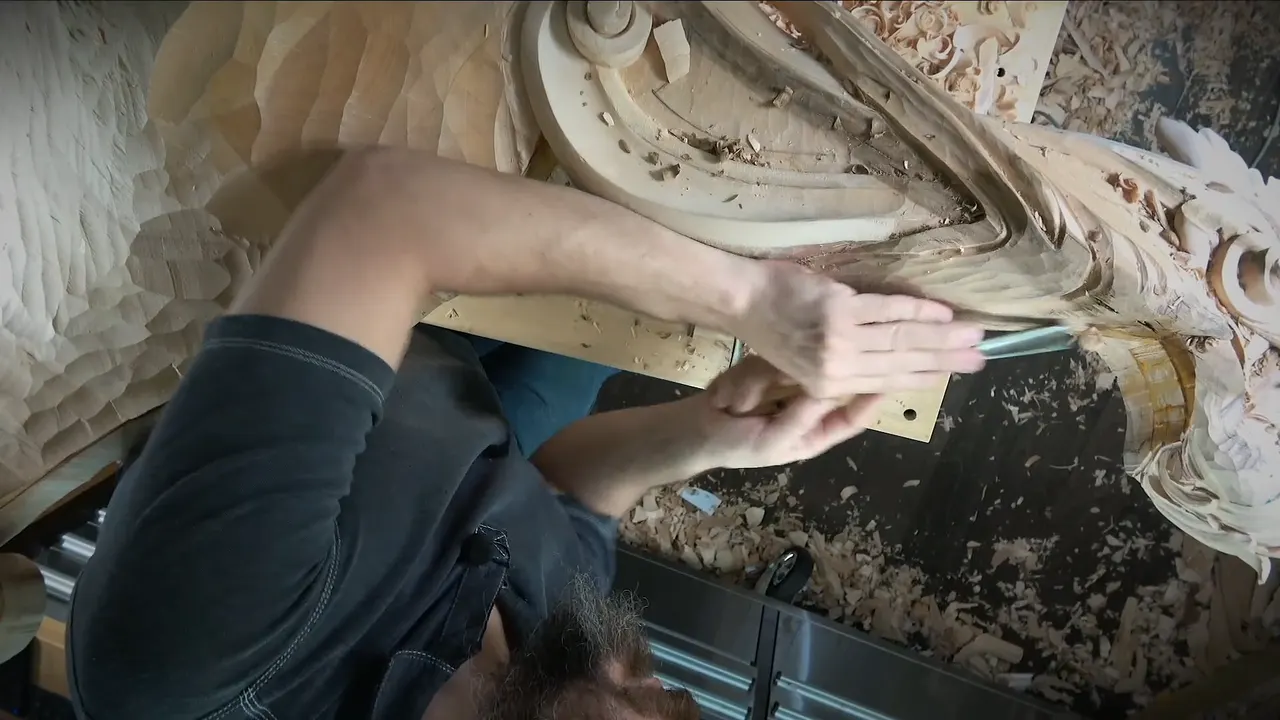

"Okay, so now I can take a bigger gouge again and get that concave going all the way like this." That line opens workshop 91, part 7, of the Venice Room. It carries the two words this page follows. They come back near the end of the part, and they turn up in lessons from twelve other courses. Part 7 goes first on the page, and every wood carving lesson after it has its link.
You finish one hollow and the tool is still in your hand. What comes next? This part answers twice, and the other lessons answer in their own words.
Which stretches of part 7 matter for the phrase?
- A bigger gouge, named as the next tool.
- Another concave on the opposite side, planned to feel like wrapping.
- A deeper pass for the shadow's sake.
- Another concave in the middle, planned for a folding motion, with a bigger tool to blend it in.
- Number seven, named for a deeper hollow underneath.
- A second "so now," and then a verdict with a limit before the ridge is softened.
How does part 7 open?
The plan moves to the other side at once. "Exactly the same what I've done now on the opposite side," is how it is put, and then "I'm going to do a second one." The route of that second concave is named in two short pieces, "like that" and "this way." A feel is added too, "it's just wrapping like this."
A need follows: "I really need to create a deeper cut, again, for the shadow's sake." The word shadow is the only reason in that line.

What sits in the middle of part 7?
One more idea arrives before the first hollow is finished: "I could actually carry this one all the way this way." A spot is named for another concave, "right between those two concaves," going "this direction." The reason fits in one sentence, "It's going to give me a folding motion."
The tool is a plan, not a fact yet: "a bigger tool to just blend that in." The other side gets a job too, "this side needs to be blended also a little nicer," along with a rule: "It's supposed to feel like it is going from underneath of this part."

What follows from that rule is one short sentence, "So which means I have to create much deeper concave underneath." It names number seven, "use number seven," and a thought is added, "maybe even deeper concave." Before the second "so now" come the words "And this way also."
Where does the second use sit?
Right here: "Okay, so now it looks good, except I'm still not too happy about this section because I want to make it feel like it does fold like this, okay?" The verdict opens it, a limit closes it, and a reason sits in the middle.

The plan comes next, and it is a plan in every word: "So which means, first of all, I need to blend this ridge so that's going to be more soft." The ridge gets a second job: "knock down a little bit this ridge." The part closes on one more plan, a "little deeper concave underneath of that section."
Does part 8 of workshop 91 use the phrase too?
Part 6, just before, opens on a plan to strop: "strop it again a little bit, and there you go. That's good." Part 8, just after, opens on a verdict and a limit: "That is somewhat what I want to see. Except this needs to be carried a little more this way." The phrase is in part 8 as well, once. It comes just after the light source is talked about, and the line is "So now it gets in a different direction, and it feels like it does fold. Right?" The next sentence is "Except I'm not too happy yet with this section." The words "fold" and "section" are the same as in part 7.

How do the Hashemi flowers use it?
In Hashemi 10, part 10, the phrase sits after a look: "It's actually already looking three-dimensional. At least for me, it looks three-dimensional." Straight after "so now" comes a job, "I can place my division lines and make it look even more nicer." A tool is named right after, "a smaller V tool," with "number 16" and "3 millimeters or 1/8 of an inch." Part 11 of that lesson has it again: "I barely create any pressure on that. Okay?" comes first, and "so now" opens "let me fix the edge a little bit."
In Hashemi 12, part 5, a warning about the grain comes first: "Just because I'm working with the grain, I got to be careful." The work "so now" introduces is "I have to lower this down even more." A plan follows, "remove it, just like that," and a word on the new movement: "a little different movement."

Which panel lessons say it?
Furniture Panel 1, part 4, uses it for a count: "And create another square from this opposite side. Okay?" The count itself comes right after "so now": "we've got two squares." A measure is next, "I have to measure," with "kind of hard" for the spot, and a plan, "Let's transfer that to this side."
In Furniture Panel 3, part 1, a name comes first: "This is the main square, okay?" Hand-over words, "so now," bring "I need to get this point and again, this corner and place another line." In Furniture Panel 14, part 2, they bring a verdict first: "I like the overall movement, how it looks, the feel of it." The limit sits right behind it, "But I still have to tie those lines with this movement also, and I need to develop this section." The last plan there is "this section right here."
Is there a case in the lily box?
In Lily Box 2, a repeat comes first: "Again, I am cutting that across the grain with number four, which I will repeat, it's equal to number three." It is "so now" that opens the next job, "I need to blend those two planes with the bigger tool." The bigger tool is named here too, as in part 7.

Where do the Greek leaf lessons put it?
In Greek Acanthus 11, part 3, the first thing is a distance: "approximately 16th of an inch" (about 1.6 mm) "from this rib down." The reason to stay there is "it's a rough cut, and it is safer to stay a little higher." Next, the phrase leads into a tool: "take number 12A. It's a short bent V tool, and start removing whatever we don't need." A warning closes that stretch, and it is short: "The main idea is not to rush."
In Greek Acanthus 5, (part 3 again), a sweep is judged first: "the sweep is two and a half. It's not three and it's not two, just somewhere in the middle of it." Then the call, "I'm happy with that." Then comes "so now," with "I could actually remove right here, but we don't need it." A background job follows, "I think we can also kind of refine the background in this area."
Do the Roman leaf lessons use it?
Roman Acanthus 10, part 4, puts the phrase after "I'm okay with that." What it opens is "I have to remove this section, and I have to remove this section because it just kind of not in my design." An edge comes first, "let me first refind the edge of it," and number 3 is named to "push it straight down."

A mallet is mentioned in that stretch: "You could use actual mallet. Mallet would be helpful in this area."
In Roman Acanthus 15, part 2, a reason comes first: "sometimes I have to attack from two sides." After the reason, "so now" gives "I'm attacking from this side." Then the movement gets a nod, "I'm happy with this movement," and the shadow gets a note: "You can see it's a really deep shadow, much deeper than here. It's casting shadow just because this edge is raised."

In Roman Acanthus 16, part 1, "Okay, that's good" comes first. A rotation arrives with "so now": "let me rotate, and I'll use exactly the same tool." The caution that closes it is "I don't want to break it," followed by "It's better to take my time."
Which knife lessons carry it?
In the Butterflies plate course, lesson 10, part 1, a knife comes next. The body comes first, "I can create the shape of that body somewhat rounded, but for now it's good." The phrase hands over to "attack my wings." The hold is spoken of at once, "my knife is going to be really low." A reason comes with the hand position: "That way, I know I'm not going to slip."

The second part of Butterflies 10 has the phrase after a distance: "maybe about half a millimeter" (about 0.02 in) "or some spots away from the line." It leads into "create the opposite direction cut, same angle." In Curly Cutting Board 10, part 4, the phrase shows up twice in one sentence: "So now I've got this cut is really deep, about quarter-inch (about 6 mm), so now I have to blend and bring my cut to that line." Part 1 of that lesson has "Just be really careful" before it, and then "so now" opens "work on those curls."

Can the phrase mean the work is clean?
In Floral and Molding 10, part 3, a small slip comes first: "I forgot to blow on my lower part of my bench, but it's okay." It is "so now" again before "I can continue my excavation," and the first one sets up "it's clean." A caution sits nearby, "And I don't want to rush it."

In the Chamomile course, lesson 1, part 3, "so now" is followed by "it's just all about blending it." A need comes next, "I need to create the right shape," and a plan for later, "definitely undercut."

Is it ever a happy word?
In Gibbons, Maine class 11, part 2, the line is "it's nicer," with "so now" ahead of it. Praise is next, "that is good and I really love it." A limit comes next: those areas are to be "refined as well." The class is in the Grinling Gibbons course.
What happens when it is a small step?
The Hazelnuts course, lesson 2, part 3, has a short measure: "maybe about three-quarters of an inch" (about 19 mm), with "as of now, but I need a little more. Maybe not. It's actually good." Right behind "so now" comes "I can probably somewhat get closer to that final shape," and then "Not really to the final, final shape, but pretty close."

In Dining Apron workshop 16, the step is a tool: "I need to get my flat chisel. Going to clean it. Make it look on purpose." Soon after comes a verdict, "that does look clean. And create the shadow." The flat chisel is the tool named, and the shadow is the next job.

Which jobs sit beside the phrase in each lesson?
| Lesson | Next after the phrase |
|---|---|
| Workshop 91.7, opening | a bigger gouge, and a concave to carry through |
| Workshop 91.7, later | a verdict with a limit, then a ridge to soften |
| Venice Room 91.8 | a change of light, and a fold that feels like a fold |
| Hashemi 10.10 | division lines, then a smaller V tool named |
| Hashemi 12.5 | the wood to lower even more, with the grain in mind |
| Furniture Panel 1.4 | a count of two squares, then a measure, then a plan to transfer it |
| The panel, lesson 3.1 | a point, a corner, and another line |
| Panel design 14.2 | the lines tied to the movement, then a section to develop |
| Lily Box 2 | two planes to blend with the bigger tool |
| Greek Acanthus 11.3 | number 12A, a V tool with a bend in it |
| Greek Acanthus 5.3 | a spot that could go, and a background to refine |
| Roman Acanthus 10.4 | a section to remove, because it is not in the design |
| Roman 15.2 | an attack from this side, then a verdict on the movement |
| Roman 16.1 | a rotation, then the same tool, with care |
| Butterflies 10.1 | the wings, with the knife planned low |
| Butterflies 10.2 | a planned pass in the opposite direction at the same angle |
| Floral and Molding 10.3 | a clean bench, then a plan to continue the excavation |
| Chamomile 1.3 | blending, with an undercut planned for later |
| Gibbons, Maine 11.2 | the areas that still need refining |
| Curly Board 10.4 | the deep spot to blend to a line |
| Hazelnuts 2.3 | a probable step closer to the final shape |
| Dining Apron 16 | a flat chisel to get, and a clean look on purpose |
Is there a spot on your own piece where the tool stops and you need a name for what comes next? All of workshop 91 sits inside one tuition plan, with the other Part 8 workshops from Venice. This page ends where the part ends.
How it's done
- Take the bigger gouge. Opening words name a bigger gouge and a concave carried "like this."
- Plan the second concave. One on the opposite side is planned, going "this way," with a wrapping feel.
- Deepen for the shadow. A deeper pass is wanted "for the shadow's sake."
- Plan the folding motion. A concave planned in the middle gives "a folding motion," and a bigger tool is planned to blend it in.
- Go underneath. A much deeper hollow beneath is planned, with number seven named and maybe an even deeper one.
- Soften the ridge. The ridge is planned to blend softer and be knocked down a bit, with a little deeper hollow planned under that section.
Frequently asked questions
At which spot in part 7 does "so now" sit?
At the very start, before "I can take a bigger gouge again," and near the end, before "it looks good, except." Part 7 ends on plans for a ridge to blend, a ridge to knock down, and a hollow below it.
Does part 8 of the same workshop use the words too?
Part 8 does, once, right after a talk about the light source. A new direction and a fold are named, and a limit follows once the viewer is asked "Right?"
Within the Greek leaf lesson 11, which tool does "so now" lead to?
Number 12A, which is called "a short bent V tool" right after "take number 12A." The stretch starts with "approximately 16th of an inch" (about 1.6 mm) from a rib, and a warning closes it: "The main idea is not to rush."
What to carve next