

Alexander Grabovetskiy, woodcarver, School of Woodcarving · Published 2021
What does a wood carver mean by "the deepest spot"?
Quick answer: The deepest spot is the place a groove goes lowest. In part 3 of workshop 100, I let the tool edge set it. Elsewhere the same words sit beside shadows, thin walls, one panel and one box in my other lessons.
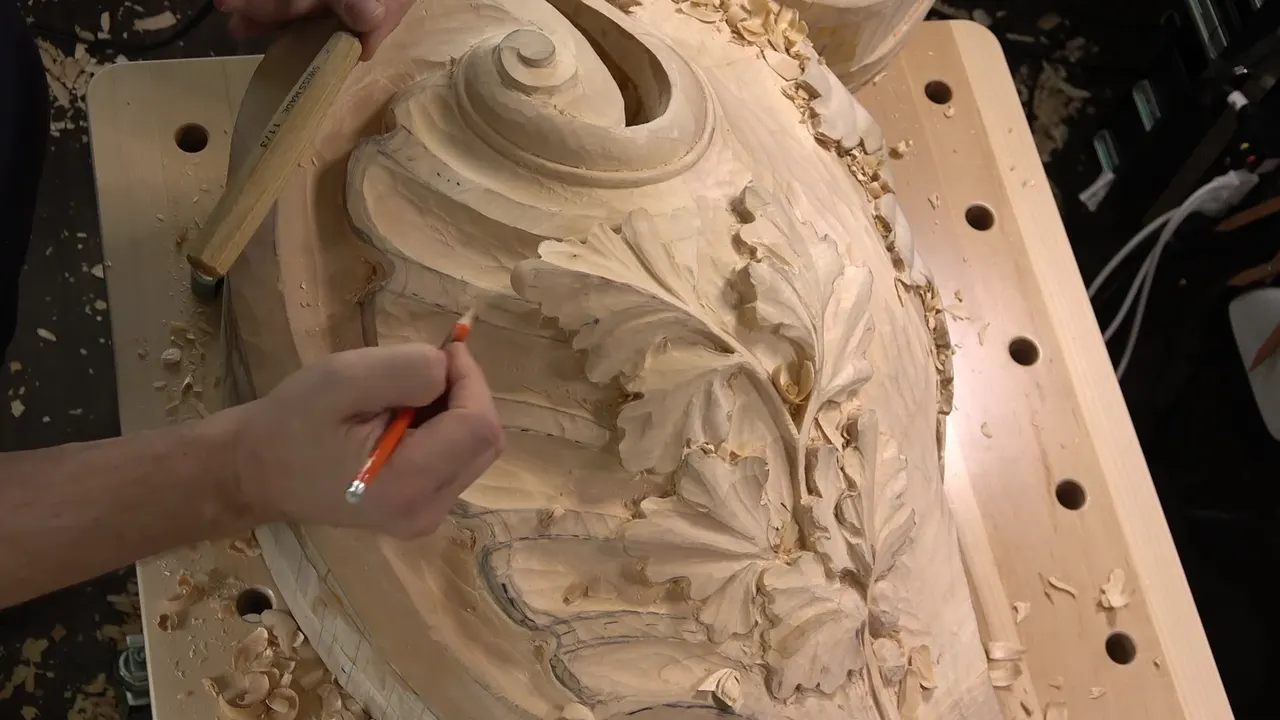

The deepest spot is my name for the one place where a cut goes lowest. Workshop 100, part 3, is where I give that place a rule, "as deep as my tool" and then look at the edge of the tool to set it.
Ever stopped in the middle of a groove and wondered how low to go? Ever wished the tool would tell you? Part 3 does that, and the same words sit in my other wood carving lessons beside shadows, edges, panels and boxes. Each passage is read here with the lines around it. Sizes come in millimeters and inches, my own figure first, with the conversion in parentheses.
What was I carving before the deepest spot in part 3?
Convexes come first: "just work on those convexes." I plan a number 11 veiner of three millimeters (0.12 in), and "I'll create my concave cuts right on the sides for my future convex."

My line is "the boundary of the cut." In one spot I need to make it "a little nicer on both sides." Then I rethink the size. "Maybe actually, I need to get a little bigger, like five millimeters, I would say." That makes 5 mm (0.2 in), a maybe and no more.
How deep did I decide to go with that tool?
The question is spoken aloud. "And how deep am I going to go?" My answer is "I'm going to go about as deep as my tool." The line this page is named for comes next. "So that's the deepest spot, and I'm going to just look at my edge of the tool, and that's going to determine how deep it's going to be."

My reason follows. "So that way, it's going to be really consistent depth." Almost right there, I say, and one more pass is planned before the opposite side.
What did the grain do to that groove?
A warning comes first. "I really have to be careful because the grain direction goes this way, and my cut is actually against the grain." Picture the wood. "I'm kind of raising up the grain so that there's no supporting grain, at least on the left side of my tool."
The logical side is out of reach. "But logically, I'm supposed to attack from this side, but I cannot because I have that leaf in the way."

One more check goes to the tool itself. "I want to make sure I'm not undercutting, so the position of the tool straight up. My flute is actually to 12 o'clock."
Some of you may not know that word, so I explain it. The flute is "the middle part" of the gouge, the part on the inside of the tool. "At least woodturners refer that as a flute, and that makes sense."
Why did the tool push back in part 3?
Then a feeling comes into my hand. "Feels like I am getting some kind of resistance, but I know for sure my tool is sharp, really sharp." My edge is fine. "But the resistance comes from the grain."

I remind you of the picture I just showed you. The grain runs one way, and I am "pretty much digging, not supporting grain." Resistance, I say, is the result.
Then I stop. "And that is enough for now." One side is left alone for now, because "I still have to develop that little more." The inside gives me "really good idea." My next need is to flatten that and show where it will sit, and I lose the word for the last part, which I admit out loud.

What do parts 2 and 4 say around the same groove?
Part 2 opens on a size. "Like three quarters of an inch, about 19, 20 millimeters." It is a preliminary one, "just to establish movement" and later it becomes convex. In one area a shell is planned, deep at first and fading to almost nothing.
The strength gets a check. "I got to check how strong I'm leaving them. And right now, I got about a quarter-inch thickness, so it should be strong enough." Six millimeters, near enough. My outside boundary could start with a bigger number 11, "like 20 millimeters or so, about three quarters of an inch." No undercut is planned there, so the wall drops "straight down almost."
Cleaning opens part 4. Number five, or number three, "will do" for the ridge I do not need. A rough look does not worry me, because "I can always attack from another side and make it a little cleaner." On the right side of the future convex, my plan is a skew gouge, "about number three," to shave that surface, since beads will sit right inside there.
Flat spots of about 1/8 of an inch, or 3 mm, come next, on both sides, and I eyeball them. My plan for the next groove is a number 11 of two millimeters (0.08 in), right on the side of it.
Where else does a spot get called the deepest?
Other courses bring the phrase back, and each time something different sets it. Shadows, walls, panels and boxes all show up. Every course name below is the folder name of the video.
Which Venice Room videos use the words for a shadow?
In workshop 70, part 8, one area is "the deepest spot" to me, and I call it "a really dark shadow." A warning for myself follows. "I have to be mindful how much thickness I've got left, which is not that much."
The plug cut comes next. I wonder about a small number nine, and number eight will work also. "It doesn't matter. I'll take 10 millimeters" (0.39 in).

Over in workshop 83, part 1, a number 11 is for "a somewhat deeper shadow." I could go extreme with one millimeter, I say, and then I say one and a half (0.06 in). For the chisel my plan is "like number one chisel," laid "flat on the previous surface" with "just the corner of it" to "slice it to the deepest spot."
The proof is on the board. "If you don't believe me that I created a really deep shadow, I did." You can see how deep a shadow I just created, I say.

Which Venice Room videos give a measurement?
Workshop 104, part 3, has me planning "probably a heavier mallet, like 30 ounces or so" (about 850 g), to outline with a number 11. I name that place the deepest one, and I say it is how deep I will go, "approximately 10 millimeters" (0.4 in).

In workshop 105, part 2, my tool works "a lot more closer to the deepest spot" while I stay back from the edge on purpose. About three millimeters sit between the edge and my groove, and I call that a safe zone. When you carve, I say, you dig inside of the wall. A smooth transition is what I want there, "not just a straight down cut."

Back in workshop 1, part 13, I want "really deep excavation right here." I ask how deep, and I answer that I do not know yet and it could change. Right now I am about one-inch deep, 25 millimeters deep, "at the deepest spot, okay?"

Which Furniture Panel videos carry the phrase?
Furniture Panel 16, part 9, puts the deepest part in the middle only, I say. Around it the areas stay at 1/16 of an inch (1.6 mm) and 1/8 of an inch (3 mm). The shallow 1/16 areas give "a lot more strength to the panel," I say.
That lesson's part 11 plans "number 11 and 3 millimeters" for outlining the last section, "the deepest spot, I would say."

Two minutes of my videotaping got lost in Furniture Panel 18, part 12, and I do apologize. I outlined "this section" with the knife, and little is left to do "in the deepest spots." Deep means five millimeters on this panel. "We're talking about deep in the context of this panel, which is only five millimeters, pretty much the deepest. 3/16th of an inch."

A colored depth map shows up in Furniture Panel 19, part 2, with three depths on it. "So the deepest one is the five millimeters." The one-eighth of an inch is the three millimeters, and 1.6 millimeters sits beside them.
The Furniture Panel Part 3 course has more. Lesson 26, part 2, names the deepest spot "right underneath of that overlap" and I say I can undercut right underneath, with a plan to grab my mallet for it. In lesson 28, part 1, the spot stays small. "I don't know the deepest spot probably, you know, right in inside of that concave, no more than half a millimeter" (0.02 in).

Which Lily Box lessons mention it?
The second layer of Lily Box 4, part 13, has me leaving about one-eighth of an inch (3 mm) right there. The rule is the one "we followed on the first layer," so the deepest spot gets that figure "and everywhere else." Consistency with the overall design is the reason, I say, and it blends better.

In the first layer of Lily Box 2, part 5, I use a different noun. Here is the line. "Again, I'm not going too deep. In this area, the deepest point would be somewhere right here, and that's approximately 3/32 of an inch. About a couple millimeters." Near 2.4 mm, by the arithmetic. Later I say, "I usually don't like to go deeper than that." A depth of 5 millimeters or 3/16 of an inch, or 6 millimeters, like a quarter-inch, would not look good, I tell you.

Which other courses use the phrase?
The Modern Acanthus course, lesson 1, part 2, sets the deepest spot at about one inch (25 mm) from the background, right in the middle, with the outside spots a little higher. There is probably no way to measure it, I say, so I eyeball it. Exact figures are not the point, and "it's not like you building a house."

Over in the Butterflies plate course, lesson 2, part 3, a quarter inch (about 6 mm) sits between that point and the surface, "the quarter inches deepest spot right there." You "cannot do quarter inch when you get too close to the borders," I say, and I call the place your shadow spot. Before that I say to take good time.

The Venetian Flowers Rosette course, in part 3 of the first lesson, has a groove all the way around that "would be the deepest." It is "determining overall shape and inside." I plan a number 11 veiner of 12 millimeters (0.47 in), "about half an inch or so" and I say that sets my depth for the first cut, with a look afterward at whether I need to go deeper.

The Vase with Grape Leaves has the same word. The first lesson, part 8, has me remind you there is "only 6 millimeters" (0.24 in), and I do not want a problem I cannot fix later. "Somewhere right in the middle" is where the deepest spot sits, and for now it is "about 16th of an inch deep" (1.6 mm).

Which lessons carry the phrase, side by side?
Rows follow. Each names a lesson and part, then what set the deepest spot there, and part numbers are the video numbers inside each lesson.
| Where it sits (Venice Room unless named) | What set it |
|---|---|
| 100.3 | A groove sized by the tool edge |
| 70.8 | A dark shadow in one area, named the deepest |
| 83.1 | A chisel corner slicing down |
| 104.3 | About 10 mm (0.4 in), with a heavier mallet |
| 105.2 | A safe wall margin |
| 1.13 | An inch of excavation that could still change |
| 16.9 | Panel 16, only the middle goes deepest |
| 18.12 | Furniture 18, five millimeters on a thin panel (3/16 in) |
| 26.2 | Part 3 course, under an overlap |
| 28.1 | Panel 28, half a millimeter (0.02 in) |
| 4.13 | Lily Box 4, an eighth of an inch, or 3 mm, all over, to stay consistent |
| 2.5 | Another Lily Box lesson, about a couple of millimeters |
| 1.2 | Acanthus, about an inch in the middle, with the outside spots a little higher |
| 2.3 | Butterflies, a quarter inch deep |
| 1.3 | Rosette, a groove all the way around, 12 mm (0.47 in) |
| 1.8 | Vase, a start in the middle |
Who is this page for?
Anyone doing wood carving or woodworking who has stopped halfway down a groove and wanted a rule will find one at work in part 3. The tool sets the depth. Its edge tells me how deep. The Venice Room has a whole course page for these workshops, and workshop 100 has its own page too.
Want to watch a groove go in beside a future convex, one pass at a time? Tuition opens the whole school, and the Venice Room is one long run of courses inside it.
How it's done
- Find the cue. Go to about 1:43 in part 3, where I ask how deep to take the groove.
- Read the rule. One line names the tool edge as the judge of depth.
- Check the grain. Grain ran one way, and some resistance followed.
- Look at a shadow. Workshop 70 calls one area a really dark shadow and the deepest one.
- Look at a measurement. Workshop 104 gives approximately 10 millimeters as how deep I will go at the deepest spot.
Frequently asked questions
How did part 3 set the depth of the groove?
I look at the edge, and that decides the depth, with a really consistent depth as my reason. Before that comes my spoken plan of a depth about equal to the tool.
Why did the grain matter in part 3?
My groove ran against the grain, which I call raising it up with no supporting grain on the left side of the tool. A leaf blocked the side I would pick. Some resistance came into my hand, and I trace it to the grain.
Which tool size did part 3 name?
On a number 11, three millimeters, or a hair under 1/8 in, is the first plan. Five millimeters (0.2 in) comes up as a maybe. My flute sits at 12 o'clock, so I do not undercut.
What to carve next