

Alexander Grabovetskiy, woodcarver, School of Woodcarving · Published 2021
What does a wood carver mean by "concern"?
Quick answer: In part 2 of workshop 100 the word comes as I look at how strong the wood is that I'm leaving, about a quarter inch (6 mm). In other lessons it comes beside time, depth, accurate lines and safety. I read each passage here with the lines around it.
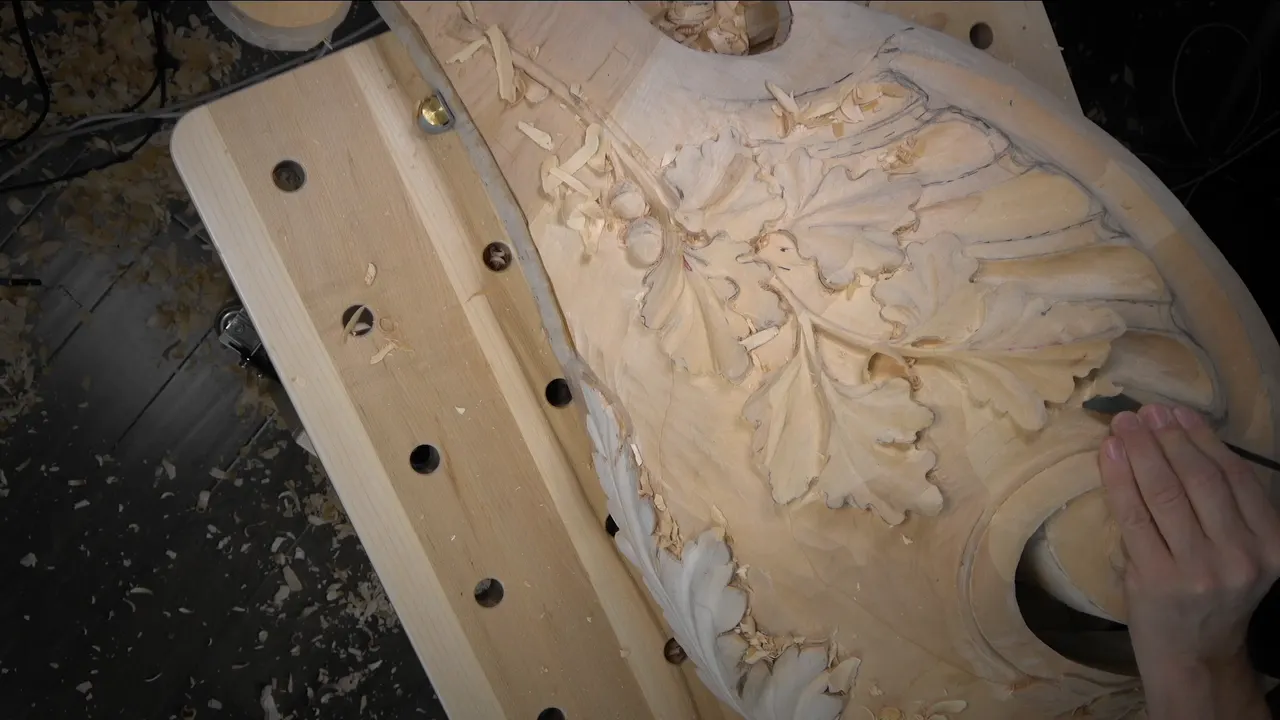

My second video of workshop 100 has me looking at how strong I'm leaving the wood, and I name shipping as my one concern. In my other lessons the same word sits beside time, depth, accurate lines, a board that might split, a bar that wobbles and a tool laid toward myself.
Ever stopped mid-carve and asked what could really go wrong with this piece? Ever wondered what I worry about, and what I let go? This part gives me a spot to say it out loud, and the same word turns up in other wood carving lessons of mine. Each passage is read with the lines around it, and sizes come in millimeters and inches, my own figure first, the other in parentheses.
What did I worry about in workshop 100, part 2?
This part opens on a size: "Like three quarters of an inch, about 19, 20 millimeters." I call it "a preliminary, of course. It's just to establish movement." Later on it will be a convex, I say. A shell comes next, in one area of the piece, and it will flatten out, with "just indication of shell."

Then I say "And here are some of the sections I can actually get with the same number three. Get really nice undercut." A look at the wood left follows: "But again, I got to check how strong I'm leaving them. And right now, I got about a quarter-inch thickness, so it should be strong enough." A quarter inch is about 6 mm.
Care comes up, and then the word: "But I have to be careful. Although it's safe. The only concern I have, shipping. Okay?" About the install I say "Once it's going to be installed, I know nobody's going to touch it" and the piece will "stay there for hundreds of years with no problem. If we're going to live on this planet that long."

For background on moving goods, Wikipedia has a page on freight transport.
How did I set my boundary after that?
My next plan is to "establish my boundary on the outside." A bigger tool comes up: "And, of course, I could probably take a bigger number 11 for the beginning. Let me actually do that, like 20 millimeters or so, about three quarters of an inch, and create some cuts like that."
An outline follows: "And now with the same tool probably, I can outline it. But the way I'm going to outline it, I'm not going to undercut it. Okay? Which means my wall is going to be straight down almost." I give a reason: "The reason why, I still have to establish the movement on the outside, and it's going to slope slightly. Okay? So I got to be careful with that."

Near the end I say "we got to be careful right here" and I plan to stop there. Then "So I've got pretty much initial boundary." It closes on "All right. That is good."
What did the other two parts of workshop 100 worry about?
Part 1 has a plan of "number 11 and 5 millimeters now" with "my initial undercut underneath of here." A line about rushing follows: "I guess the key for me at this point, not to rush it. Because when I'm rushing, I make mistakes." About the edge I say "I'm still going to leave approximately maybe eighth of an inch for now because I still not finished with the leaves yet." I think it "will give me enough space to work, 3 millimeters or so. But I got to check. I don't want to make it too weak."

Another check is due, for whether it is too weak. Part 3 turns to the grain. "I really have to be careful because the grain direction goes this way, and my cut is actually against the grain."
Next: "I'm kind of raising up the grain so that there's no supporting grain." One side is blocked: "But logically, I'm supposed to attack from this side, but I cannot because I have that leaf in the way." The tool is sharp, I say, and the resistance I feel is the grain: "the resistance comes from the grain." The pages of workshop 100 and the Part 9 course hold the whole run.


Does time count as a concern?
In the Hashemi Flowers course, lesson 5, part 3, I say I need a smaller tool "to get on inside." The micro tool number three is on my workbench, and I call it "Really handy tool to have."
Small tools slow the process down, I say, "Because with the smaller tools, you are taking a lot less material out. But on the other hand, you do have a bunch more control." The word follows: "And if time is not the biggest concern of yours, sometimes with the smaller tools, you can get more accurate results."

A limit comes in the next breath: "Not in every case, though, okay? Because smaller tools leave much more marks. You're going to see much more ridges."
What about how deep a gouge goes when I carve?
In Venice Room 57, part 5, I use a spoon gouge of about 14 millimeters, which I call "Little bigger than half an inch." My plan is to go "to the right line first because in this case, it's a cleaner cut on the right hand." The plan for that concave: deeper in this section, "but not as much at the end because I don't have too much material right there."

The word comes next: "And I really don't worry about how clean it looks at this point yet. All I worry about, not cutting too deep. That's the main concern I have." A straight tool brings a danger for the same reason: you "have to stop at the right point. Otherwise, you're going to dig in, and then you have to clean." So the spoon gouge would probably be the tool of choice, I say.
Venice Room 16, part 3, puts it beside going in. "What I want to do, I want to go as deep as possible inside right there. And I know I am wiggling and I'm creating really rough cut, which is all right. All I worry about is just get in. Okay. That's the main concern right now."

Tool choice comes up beside it in that lesson: "And maybe I should use a number 9, and a bigger number 9 because I do have some of the thickness right there." I add "sometimes it's easier to use a smaller tool and then follow with a bigger tool." Depth is the worry in the first lesson, and getting in is the worry in the second, where the rough cut is all right.

Where do accurate lines come in?
The Roman Acanthus course, lesson 4, part 1, starts with lowering two sides, since the center is planned as the high spot. Then comes "But my concern is I really have to make sure it's really accurate lines when I'm going to work around this center part." For the tool, "probably I should use, it would be a V tool." The plan is "number 12 and 8 millimeters," about 0.3 in, for "my preliminary cut."

Later I say "Later on, the whole center will go downhill. But still, I don't want to lose the main picture. That's why I'm actually doing preliminary cuts."

In Lily Box 12, part 3, the worry is line counts. The line is "My concern is to get equal amount of lines because it's like mathematics. Should say it's like a micro mathematics." While I work there, I'm looking at the magnifier glass.

In Furniture Panel 26, part 2, the concern is design. My tool is "the same number 11," for "straight down cuts" until I get to "approximately the line that I'm after." I can always go back and clean that section, I say, but "it's not the main concern as of now for me. So the main concern is I have to figure out what I designed." The final line will be a separation, I say.

What am I not concerned about?
The Lily Box part also has "I don't really worry about if I'm hitting a little bit of my petal. It's not a concern of mine." In the Greek Acanthus course, lesson 9, part 1, I plan a number eight of about five-eighths of an inch, 16 mm, to "make my cut little deeper." With a bigger tool "my inside is going to look much cleaner. Although, I'm not that concerned yet about how it looks."

In Roman Acanthus 2, part 1, I plan "a big number eight," "one inch to be exact," to work around. "Because our design goes almost all the way to the edge, so I have to work carefully." I call what I'm doing "kind of dangerous" and I work from inside out. Then "And you can see sometimes it just splits the wood, but I have really thick wood, so it's an inch and 7/8. I'm not that concerned about this." That thickness is about 48 mm.

A margin goes with it, from the same lesson: "Just don't get too close. Just leave about maybe a one-eighth of an inch, two, three millimeters away from the final design."
Sharpening has one too. The spoon gouge lesson has me saying the bar has "a tendency to just kind of wobble a little bit, which is not a big deal." Then "But if you stay in pretty close to one position and just rotate your tool, it should not be any problem. As far as for me, it's never been a problem. I never concerned about this, okay, as long as I'm staying pretty much at the same position."

When does a concern turn into safety?
That lesson also has me speaking of piece size. "Of course, that would be probably better if it would be on a smaller scale carving. Rotate the piece or walk around and attack from opposite direction. That would be smarter. Okay? Safer, I should say." Then "sometimes I have to deal with the huge pieces like that." Then "I just can't walk around. I would spend too much time." A deadline comes up: "It's not a real deadline, but deadline where I want to get the stuff finished."
The limit is "Only if it's still safe, okay? Because if it's a safety concern, no, I'm not going to save a minute." My next line is "But here, I already developed the skill how I'm actually controlling the tool without cutting myself."
The April 2020 livestream has two more. About tools laid on the bench facing me, about an inch apart, I say "Also, some people, they do have a concern about is it dangerous to place your tools like that or not, toward yourself. Can you cut yourself? Yeah, if your piece is too close and you grabbing like that, yeah, you can just bump again, and you could cut."
The same stream has a viewer asking "In a large carving like this, do you have concerns about moisture?" My answer is "No, I don't." I add "I do and I don't. I don't because I'm wise when I'm gluing pieces together. I'm paying attention to grain." My wood, I say, is "all seasoned" and "all air-dried" and I name the difference "between kiln-dry and air-dried, natural dryness."
The sharpening course has a straight gouge lesson where I work the micro bevel. The words there: "I know some people are afraid of rounding up the edge of the tool, and I know it can be a concern with the carpenter's chisels, but I found, in my case, it doesn't create a big problem. It actually helps me to work."
Which lessons carry the word, side by side?
Each row names a lesson and part, then what the word sat beside. Course names come from the folder of each video.
| Video | What the word sat beside |
|---|---|
| 100.2 | The wood I leave, and a worry about shipping |
| 100.1 | Too weak, said while the leaves were not finished |
| 100.3 | The grain against my cut |
| Hashemi 5.3 | Time, the biggest concern, if it is not yours |
| Venice 57.5 | A cut that goes too deep, with a spoon gouge |
| Venice 16.3 | Getting in, with a rough cut that is all right |
| Roman 4.1 | Accurate lines around a center part |
| Lily Box 12.3 | Matching line counts, with a petal I may hit |
| Furniture 26.2 | Working out what I designed |
| Greek 9.1 | How the inside looks, not a concern yet |
| Roman 2.1 | A thick board that may split |
| Spoon gouge | A sharpening bar that wobbles a little |
| Straight gouge 3 | A rounded edge, and carpenter's chisels |
| April 2020 | Tools laid toward myself on the bench |
Who is this page for?
Anyone doing wood carving who has wondered what to worry about at the bench will find my own words for it here. Workshops 98, 99 and 101 of the Venice Room sit around workshop 100.
Tuition opens the whole school, and the Venice Room is one long run of courses inside it.
How it's done
- Find the word. Open the second video of workshop 100, where I name shipping as my only concern.
- Read the lines before it. The wood left is about 6 mm (a quarter inch).
- Read the boundary plan. I plan to establish my boundary on the outside, and I could probably take a bigger number 11, about 20 mm (0.8 in).
- Compare time and depth. Hashemi Flowers 5, part 3, puts time beside the word. The Part 5 Venice Room course puts the depth of a cut beside it.
- Compare safety. In Venice Room 57, I say "if it's a safety concern, no."
Frequently asked questions
How strong did I say the wood was?
I said it should be strong enough, and I need to check how strong the sections are. The one worry I named was shipping.
Once the piece is installed, what do I expect?
The piece will stay there for hundreds of years with no problem, I said, and nobody is going to touch it, if we are going to live on this planet that long.
Why would my wall go straight down almost?
My plan was to outline without an undercut, so the wall stays nearly vertical. I still have to establish the movement on the outside, I said, and it will slope slightly.
Which lesson puts the word beside accurate lines?
What to carve next