

Alexander Grabovetskiy, woodcarver, School of Woodcarving · Published 2021
What does a wood carver mean by "a second pass"?
Quick answer: My Venice Room course, workshop 100, part 6: I said "And the second pass." Other lessons of mine use the same words with a router plane in the rosette course, and with a smaller tool in the Roman acanthus course.
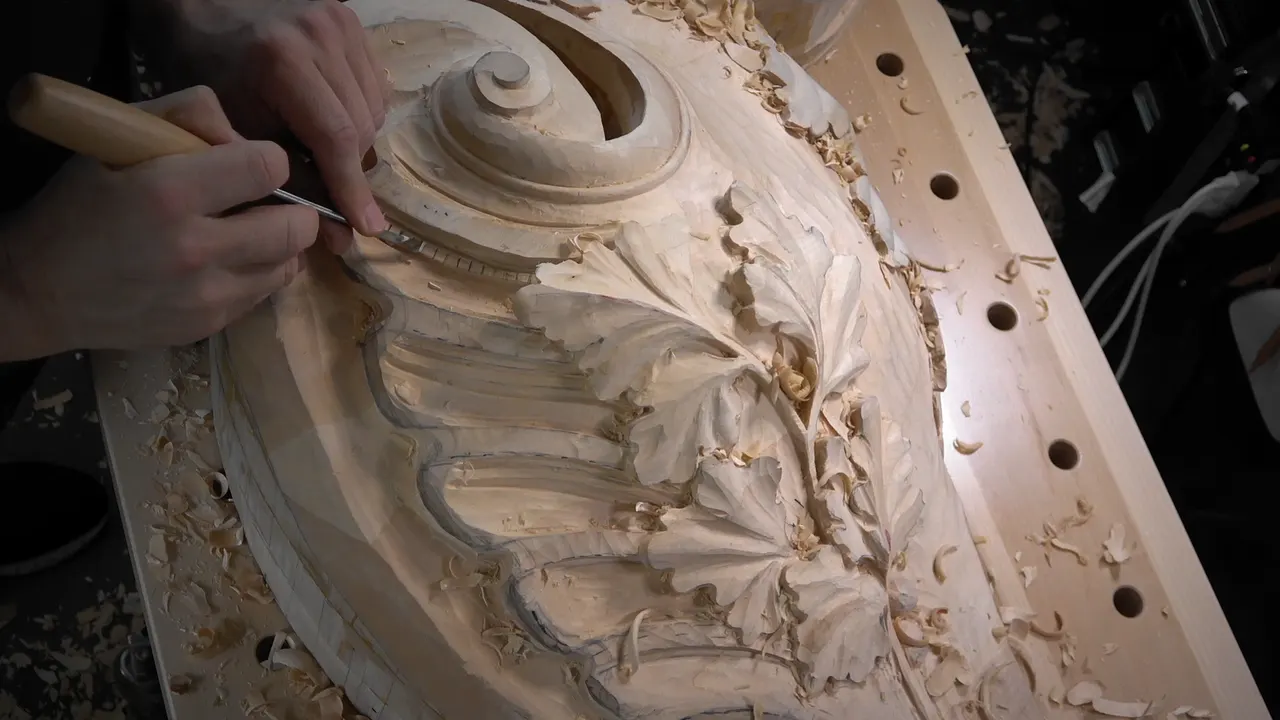

"And the second pass." That line is in part 6 of workshop 100, with my reason after it in my own words. Other lessons of mine use the same words at a router plane, in a knife circle and over a final cut with a smaller tool.
Ever dragged a gouge through wood once and wondered if the same line wants another trip? Ever stood at a grain that runs the wrong way and felt your hand want to push? Those are the spots where these words come up below. Every size comes in millimeters and inches, my own figure first, and each line sits beside the lines around it.
What was on the bench before I said it?
Part 6 opens with a skew. I say, "I can start creating some notches, just like that" and add, "And there is multiple ways to do that." For the other side my plan is to "attack that from opposite side."

After the notches, a number 11 comes in at 2 mm, about 0.08 in: "Take two millimeters again. Number 11. Remove whatever I just created, mess on inside."

"And now it's time to take a gouge and work with the gouge. I'll take number nine and five millimeters, and create the cut like this." Five millimeters is 0.2 in.
What did I say about care right before it?
A warning to be really careful with the cuts opens it. Then, "It all depends on your piece. But in my case, the grain, how it runs, I have to be super careful what I'm doing not to overdo it, not to over-press it, control my movements. Okay? But something like this."
Grain comes up in part 5 of this workshop too. There I say your skew chisel must be super sharp "because grain direction here does weird stuff." Part 7 brings a number 11 of 5 millimeters (about 1/5 in) and a first concave "right in the middle." My words are "But I really have to control my tool."

My reason for the second pass
The line is "And the second pass." My reason comes in full a little further on: "Again, just because I have to be careful, that's why I'm doing a second pass."

A plan follows it, "attack that from the opposite side." And, "Same idea. Over the cut."
What came after that in part 6?
Next I say, "here's some of the spots I have to work underneath. I'm not going to worry about that right now." I've got "initial beads," I add, and "I'm happy with that."

Next, "So now I can probably get from the side, exactly the same idea" and right after, "Well, actually no, because some of them not really round."
A plan for the corners comes with a tool. "Let me get inside of those corners and knock down some of that mess." On the tool, "Maybe I should use different tool right now, maybe number seven and four millimeters, and create cut like that." Four millimeters is 0.16 in.

Two phrases come next, "Attacking from two sides" and "Some of them actually go with one press okay."

A review is planned, "And we're going to review those beads with the same tool. I'll just clean it. And if I need to recut, I'll recut it right away."
Near the end I say, "That is how I work on my beads" and, "There is multiple ways to do the same operation, but I decided to do in this case, this way."

"Pretty much three tools is what I used. Small skew, chisel, and number nine, and number seven. That's it."

Where else in the Venice Room does it come up?
In workshop 129, part 1, I say "Second pass, I'll stay away." Next, "And let me attack this way. And got to be careful. See? So have to change position and really careful remove this." Forcing it would give me a problem, I say, and if the split continued I would lose the edge.

Over in workshop 147, part 2, it is going to be "a wide pipe right here." I want "to raise up the part of separation right here" and I plan "a little deeper excavation." Then comes "And again, second pass." After it, "Now I need to preliminary blend that ridge."

Workshop 146, part 3, has "And I'll give another pass" and the line before it is "But looks like I'm able to." Then, "And 2 millimeters is much better, but it's not the end yet." That is 2 mm, or 5/64 in. Next I plan to "start from this point again and go opposite direction."

Later in that part come "Let me get another pass" and "I'll try to get as deep as possible with 2 millimeters, and after 2 millimeters, I'm going to switch again to a 1 millimeter for the shadow again." One millimeter is 0.04 in.

In workshop 141, part 2, I say "And another pass." Next, "Now I can just go with 5 millimeters, and then 4 millimeters, 3 millimeters, and so on." Those are about 0.2, 0.16 and 0.12 in.
How do I use it with a router plane and a knife?
Antique Style Rosette, workshop 1: I talk about a router plane and say, "I adjusted my router plane not all the way yet." Then, "And a second pass, I will lower it down." On the depth, "Just want to make sure it doesn't go deeper than it's supposed to." Later, "Remove the background."

The same course, workshop 2, has a circle. "I finished my circle. Now, I am on the second pass, and I'm going deeper now." I add, "I can change actually the way I'm holding now." A rule rides along, "really important rule to know, when you cut with the knife, especially with the knife, your second hand is always away from the cutting blade."

Greek Acroterion 5, workshop 5, part 2, has me digging a channel. "Just taking my time to dig that channel." About the knife, "You kind of have to feel it, how far your knife's supposed to go." Then, "Okay, I'm not going to force it. What I'll do, I'll just make the second cut or second pass, if you wish to say that, and continue to work my way in little by little."

What does it sound like on a leaf or a ground?
The Lily Box course, workshop 2: I say I'll go around all of my thorns. "And what I did, I started from almost nothing. And now the second pass, I'm going to do a little deeper. Okay?" The plan is a depth of "approximately maybe 3/32 of an inch, maybe 1/8 of an inch," which is about 2.4 mm and 3.2 mm. "Although I really don't need to."

A tip rides with it. "Keep an eye how your grain or grain of the wood going to react and behave toward how you cut it, okay?" It is "a different type of wood," I say. You never know whether it will split, or "quite the opposite." If it does not split at all, "then you can break all the rules."
In Furniture Panel 21, part 4, I say "Okay. And second pass. Going to be a little deeper, cleaner cut. Should say final cut." Later, I say I'm "all the way at the same height as the opposite side." Then, "Hmm, looks good."

In the Greek Acanthus Leaf course, workshop 12, I say you "can always overdo stuff, and I've done it." Next, "let me make it second pass and hook it" and "I can see my shadow line." A while on, "you can see now there is a shadow line, although I'm not too happy with this line."

The Roman Acanthus Leaf course, lesson 15, calls a tool "not true half-round." Then, "this is a little too big for this cut, but on another hand, I can take smaller tool and make a second pass with the smaller one. But let me first clean this side."

Vase with Grape Leaves 2, workshop 2, part 6, comes to an edge. "And right on escape. We don't want to see a spooning effect." About it, "some people when they approach the edge, they're trying to escape upward." Next, "And we're going to do a second pass with the cut with the same tool." I will "lean it little bit to the left right now, just slightly, and kind of blend" and for the other side, "just leaning to the right."

How little wood can a second pass take?
The Grape Onlay course, workshop 12, part 3, has me working on facets. "It takes time. By the way, if you think it's a quick process, no, it's not to clean the whole thing, at least for me, maybe I'm, I'm doing it wrong." I add, "It's tedious and kinda annoying, somewhat work. But that is what I do. Uh, I create, um, the first pass, then the second pass, like micro, micro movements."

"See what I'm doing? I'm barely removing any material. But by that technique you can make it look like it's, uh, completely sanded." Later in the part, "zero facets left."
Curly Kitchen Cutting Board 5, workshop 5, part 2, has "And I'm really carefully just following this line." Then to you, "Please try to make it as straight as possible, because you really can easily detect any waviness." And, "Do the second pass."

What about two passes instead?
Resistance comes up in Furniture Panel 19, part 1. "Again, if it's going to give you too much resistance, just try to attack on 45 degrees. Just like that. Little by little. You don't have to rush it." And if that gives a problem, "then just try to do it on the two passes. You really don't have to do in one pass. There is absolutely no reason." And, "So a couple passes and clean cut."

First Cuts for Beginners, workshop 1, part 5, has "we place that point away from ourselves," I say, and "If you can't do that in two passes, that's absolutely fine, but you kind of have to skew that down, clean it." And, "you should be about maybe two millimeters down, okay, at this point." That is about 0.08 in.

Three short ones close this run. In Furniture Panel 18, part 9, I say "It's little too aggressive for now. That's okay" and then, "Another pass, little deeper." In Acanthus over Moldings 1, part 3, I say, "Although, I could do another pass." In Floral and Molding for the Panel 9, part 3, "let me excavate," I say, and "I can just do another pass."

Which lessons use the words, side by side?
Rows follow. Each names a lesson and part, then what the words sat beside there.
| Where it sits (Venice Room unless named) | What the words sat beside |
|---|---|
| 100.6 | A number nine of 5 mm, and a grain that asks for care |
| 129.1 | A split that could cost me the edge |
| 147.2 | A wide pipe, and a part of the separation I wanted raised |
| 146.3 | A 2 mm, much better, not the end yet |
| 141.2 | Another pass, then 5, 4 and 3 mm |
| Rosette 1 | A router plane adjusted, with a plan to lower it |
| Rosette 2 | A circle finished, a deeper pass, and a rule about the second hand |
| Greek Acroterion 5 | A channel dug with a knife, and a plan not to force it |
| Lily Box 2 | 3/32 to 1/8 in deeper, planned, plus a grain to watch |
| Furniture Panel 21 | A little deeper, then a cleaner cut I called final |
| Greek Acanthus 12 | A hook, and a shadow line I could see |
| Roman Acanthus 15 | A tool a little too big, and a smaller one I can take |
| Vase with Grape Leaves 2 | A spooning edge to avoid, and a lean to blend |
| Grape Onlay 12 | Micro movements that barely remove any material |
| Cutting Board 5 | A line to make as straight as possible |
| Panel 18, Furniture | Little too aggressive, then a little deeper |
| Floral Molding 9 | An excavation, and another pass I can do |
| Acanthus over Moldings 1 | Something I did not want to force |
| Furniture Panel 19 | A cut with resistance, 45 degrees, then two passes |
| First Cuts 1 | A knife point placed away from ourselves, and two passes fine |
Who is this page for?
Anyone doing wood carving, in relief or in the round, who has taken one stroke and wondered what comes next will hear the plain version in part 6. It names care as my reason and talks about my grain. The Venice Room has a whole course page for these workshops, and a page for workshop 100 sits inside it.
Would you like to hear the reason said out loud, in the middle of a real piece? Would a watched pass teach you more than a rule? Tuition opens the whole school, and the Venice Room is one long run of courses inside it.
How it's done
- Take the gouge. My pick for the cut is number nine, at 5 mm, about 1/5 in.
- Watch the grain. The grain asks me to be super careful about pressure and about my movements.
- Make the second pass. Care is my reason, and the words are "And the second pass."
- Go at it from the other side. A pass from the opposite side is my plan, and the words are "Same idea" and "Over the cut."
- Review the beads. I plan to review the beads with that same tool and clean them, and to recut right away if I need to.
Frequently asked questions
Which gouge did I name before the second pass in part 6?
Number nine, with five millimeters (0.2 in), came up first. A number seven and four millimeters (5/32 in) came up as a maybe.
Which words of mine cover the grain in workshop 100, part 6?
The grain of my piece runs in a way that has me being super careful. I named overdoing it and over-pressing it, and I said to control my movements.
Which tools did I name at the end of part 6?
"Pretty much three tools is what I used," I said, and named the skew, the chisel, a number nine plus a number seven.
How many passes did I suggest for a cut that gives resistance?
What to carve next
- Workshop 100
- Part 9 course page
- Workshop 129
- Workshop 147
- Workshop 146
- Workshop 141
- Antique Style Rosette, workshop 1
- Antique Style Rosette, workshop 2
- Greek Acroterion 5
- Lily Box 2
- Furniture Panel 21
- Greek Acanthus Leaf 12
- Roman Acanthus 15
- Vase with Grape Leaves 2
- Grape Onlay 12
- Curly Kitchen Cutting Board 5
- Furniture Panel 19