

Alexander Grabovetskiy, woodcarver, School of Woodcarving · Published 2021
What does a wood carver mean by "fuss"?
Quick answer: Workshop 103 ends its first part on loose pieces a blow will take away. My lessons from several courses use the word when I clean after a carving pass, with a knife, a number 11 or another small tool beside it. Each passage is read together with the lines around it.
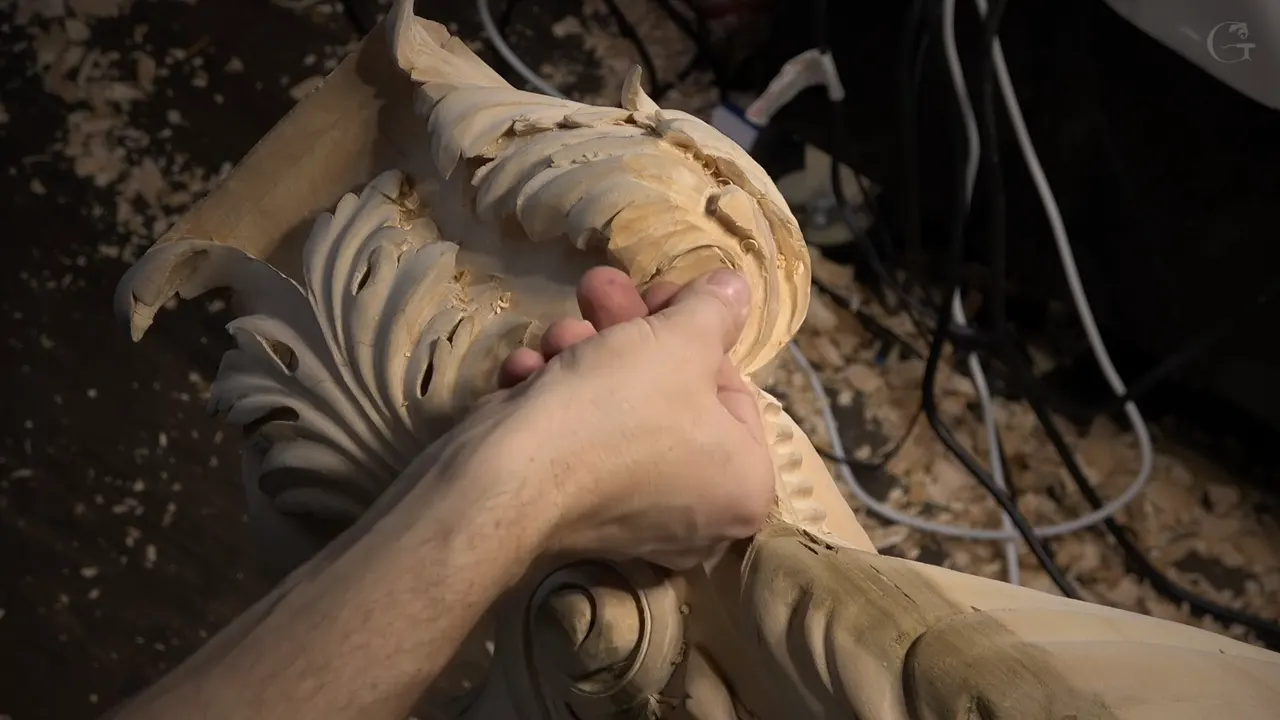

The last lines of workshop 103, part 1, are about loose bits of wood and a blow of breath. My other wood carving lessons use the word fuss when I clean up after a carving pass, and I read every passage in its own lines.
Ever finished a good pass and found ragged bits left in the corner? This page starts from workshop 103, which belongs to my Venice Room Part 9 course. The other Venice Room lessons here come from Parts 7, 8 and 10, and the rest from my Lily Box, Furniture Panel, Greek Acanthus, Roman Acanthus and Grinling Gibbons courses, plus two of my molding courses. Several of them are about acanthus leaves and molding, and every size is in millimeters and inches, my own figure first.
Where in workshop 103, part 1, do I say it?
It comes at the very end of the part, after the video opens on a size. I open on "10 millimeters probably" (0.39 in), and I call it a "good idea." A goal comes next. "So what I'm after, I want to raise the edge." The edge "has to be kind of raised up" and I add "And I can actually exaggerate that movement." Later I have "a convex right in the middle." And I say "I'm happy."

A back bend comes in with the words "like number five" and the job is to "get rid of some of the ridges." Caution comes next, "I have to be careful."

One little detail does not please me, and I say "I could do a really good eye." My first plan is "number 11" in "two millimeters" (0.08 in), but then I think again and say "I could use actually even bigger." The sizes I name are "Three millimeters or even four millimeters" (0.12 in or 0.16 in).

Further on I say "I'll take two millimeters, number 11, and create that cut little deeper" and "I will grab one millimeter and create that cut even deeper" (0.04 in). Depth has no limit here. "What I mean by that, you can just get that as detailed as you wish."

The paint matters. "This particular project will be painted with the white paint," I say, so "lots of details probably will be covered with the paint." My words on that are "I really don't need to worry about some of the stuff, okay?"
My tool is "number eight, and that's by Dockyard Gouge, three millimeters" (0.118 in). I plan to follow with "the one millimeter and remove that plug," because I "want to get really deep shadow spot." When I stop, "I think it looks really good" and I credit it with "extra dimension" and "really, really nice movement." A blend is still on my list, "I have to blend that."

Near the end a back bend returns, "just number one back bend," I say, and I use it "like a knife pretty much in place of carving knife." Some cleaning is still ahead of me, "Some cleaning needs to be done, and I am happy."

Last comes the line this page is named for: "Yeah, all that fuss is just loose pieces. They're going to be gone once I going to blow on it."
What do parts 2 and 3 of workshop 103 add?
The second part opens with a plan, "what I could do, I could take my rasp now and just give a cleansing job." Later I say "I'll probably just clean it a little more," once I "jump and work on that section right here."
The third part plans a number 11 with 5 millimeters (0.2 in) for "a cleaning cut, cleaning pass." Further on I say "I still have to clean up of course, but I can do that off-camera." Of the cleaning I say "Really easy. Just a flatter gouge" and the tool there is a gouge.

The corbel still needs a blend on its side, I say. The part closes on "a little more time cleaning everything, and hopefully I'll be able to create something really nice right here."
Which tool goes with the word in my other lessons?
A size in two systems comes first in Lily Box 2, part 2: "a number 11 and 3 millimeters, which is equal to 1/8 of an inch" (0.12 in). I "carefully just remove" the fuss there, and I say "If I need to dig a little deeper, oh well."

The pipe in lesson 11 of the floral and molding course, part 2, gets the same tool. "The same number 11," I say. The sizes are "the five millimeters" and "3/16 of an inch" (0.2 in). The fuss shares a sentence there with "all that mess" and my next word is "Blend it." Of undercutting under the pipe I say it would not "look natural," so "just clean up."

Two lessons name a fuss I just created. In Furniture Panel 24, part 6, "that is not coming out," I say, so "I can probably take again number 11," I say, and "half a millimeter" (0.02 in) is the size. A smaller tool follows, "smaller number three" to "blend that even better." The other lesson is workshop 110, which starts from "a spoon number three" in part 1. After it come "1 millimeter, number 11" (0.039 in) and the line "I don't like one of the spots right in this section."
Acanthus over Moldings 1 sets out two sizes in part 3, "two millimeters or two and a half millimeters in my case" (0.08 in or 0.1 in). The job is "whatever the mess I left without forcing." Near the end of that part I say "it's better to just clean it" with a 2 mm number 11 (about 5/64 in) for some of that fuss, "or mess, I should say."

Smaller still is the tool in Greek Acanthus 11, part 3. "I need a little smaller V tool, and I do have a 1 millimeter. It's actually number 16 and 1 millimeter" (about 1/25 in). With it "I can get as deep as I want to just remove whatever fuss left right there."
A micro tool is named in part 3 of Roman Acanthus 16. I see a "rough look on inside, like a line left" and say "I think it's going to look nicer." The size is "one millimeter, number 11" (about 1/25 in), and I say "I actually like number 11 a lot."
The Maine class has its own version, in the third part of Grinling Gibbons, Maine class 4. "This flower will go right underneath of this one," I say, and "another will be hidden." I ask what You will do with that fuss. The answer is "You grab #11-3mm" (0.118 in). Then comes the care I name here, "careful not to break it."

How deep do I go for it?
A limit on depth comes in part 6 of that lesson. I place the tool "just on one of the sides" and then I say "Make sure you're not undercutting yet, okay?" My reason is a big one. "If you think you could do that right away, you are making a big mistake." Next, "we still have to work on those surfaces and those leaves" and "if you already undercut, you messed up with overall design."

"Maybe I can actually clean that with the 1.0 millimeter right here" (0.04 in), I say in part 11 of Lily Box 5. My limit is "But I'm not going to give an undercut, just clean that fuss, which is barely noticeable."
Workshop 95 gives a caution in part 9. "Without getting too deep I need to use the small one, like 1mm otherwise I am undercutting too much" (0.039 in). Part 4 has a different one. "I don't want to go too deep the reason I said it multiple times because of the grain direction in this case, that would be a big mistake."

The limit in Furniture Panel 19 comes in part 7. "Carefully going to go deeper. Okay? Not much, again, because we really don't have that property for making really deep undercut, but even little bit will help." My favorite there is "half a millimeter" (about 1/50 in) in a number 11. Cleaning up "all that mess" is something I say I can do, and I can take care of the fuss too. A warning follows: "make sure you don't dig inside of the background."

When do I leave it for later, or not worry about it?
A "really, really deep shadow" comes first in part 1 of lesson 11 of the molding course. Right after it, "I don't worry about that fuss yet."
The Furniture Panel 20 lesson, part 1, has a knife. "Let me use just a small knife," I say, and "I could go even deeper." My next words are "I'm not going to worry too much about that fuss. Going to just clean a little bit, but later on, I'm going to have enough time to clean that better."

The Maine class gives its own answer in lesson 11. Its third part starts with "excavate them inside" until it is "a really clean." The fuss is no worry there. And "I'm super happy with this movement."
The twelfth part of workshop 102 says "I can get as deep as I wish." Its first words about loose pieces match the ones in workshop 103, and the rest is "okay, so I really don't have to worry about it." Then comes "let me fix this movement. Not really fix, but I need to create the concave, which I got rid of two concaves."

Is it the same as mess, or waste?
Two names go together in part 10 of workshop 89. The words are "remove all that waste or fuss, and create nice transition" and the reason that follows is "I don't want to see a sharp line." My tool for that job is "again two millimeters" (0.079 in).

The first part of that molding lesson has me say I "have to clean" it, "fuss or mess, whatever you call it" and "I'll get again 1 millimeter" (0.0394 in). The tool is "Number nine. Really small, tiny spoon" and I clean "it underneath."

The two names sit side by side again in the moldings lesson ("or mess, I should say"). Part 7 of lesson 19 in the panel course puts the mess first and the fuss after it.
Where does it come from, and how clean do I want the inside?
Edges are the subject of part 1 in Greek Acanthus 15. "Doesn't matter how sharp tools you have or doesn't matter how good you carver, you still going to have some kind of rough edges." Then "some fuss is still going to happen, especially if you're doing extreme undercut and your edge is pretty much going to the point." The lesson is on the Greek Acanthus course page.

I then say "you don't have to be perfect actually when you're cleaning." My first way is "probably my preferred way." I take "the same knife, what I used before, number 12" and "just run along the edge and just remove what I think it's actually not supposed to be." With the same knife, "it depends on the grain. You can kind of scrub it just like that," I say, and of that scrub "it also cleans all the fuss out."
An old way comes next. I name "one of my favorite wood carvers in the history" and give "Dutch reed rush" as what that carver would use. "I do have some," I add. Of how it was used, "They would just rub on the edge without even touching sometimes the surface." Then "it's a really good technique to clean the rough edges, just to kind of sand it little bit" and "you'll see it does create beautiful edge."
The inside counts in Roman Acanthus 11, part 4. "It's impossible to see what is going on inside when I'm undercutting," I say. "I still like to see all my undercuts really clean without any fuss left inside." Next comes "number one double bevel" to "make it a little nicer."

In workshop 83 I go at it from three sides, in part 1. "I need smaller one to attack from above," I say. Then "everything is super clean on inside." "Beautiful and clean," I say, and "you can take it to extreme if you wanted to and create the invisible point." My last word on it is "I'm happy with the result like it is right now."
Does the word only mean wood bits?
Not in part 2 of Furniture Panel 35. My words are "if you wanna do really accurate cut, you have to present your tool to the surface to about 45 degrees." Then "if there is a line and 45 degrees, I'm sorry for that fuss." Right after that, "the tool presents it to the 45 degrees, you know, towards the line. That way you are gonna slice it lot cleaner and nicer." The lines around that cue speak of a tool, a line and an angle.
Where do the frames come from?
Every picture here is a frame from a lesson named on this page. Most are from workshop 103, on the Part 9 course page. Each frame sits beside the lines it matches.
Lesson by lesson, the word in use
| Lesson and part (Venice Room unless a course is named) | What I do about the fuss |
|---|---|
| 103, parts 1 to 3 | Loose pieces that go when I blow on them, a rasp, then a cleaning pass with a flatter gouge |
| Lily Box 2, parts 2 and 6 | Number 11 at 3 mm (1/8 in), and no undercut yet |
| Lily Box 5, part 11 | A 1 mm (0.0394 in) clean-up with no undercut |
| Floral and Molding 11, parts 1 and 2 | A fuss I leave for now, and a pipe I will not undercut |
| Furniture Panel 19, 20, 24 and 35 | A half-millimeter number 11, a knife and a later clean, a smaller number three, and a word in a different sentence |
| Acanthus over Moldings 1, part 3 | A mess I left, cleaned without forcing and without pushing too hard |
| Greek Acanthus 11 and 15 | A small V tool with depth to spare, and rough edges that a knife takes off |
| Roman Acanthus 11 and 16 | Undercuts without any fuss left inside, and a micro tool |
| Venice Room 83, 89, 95 and 110 | From none inside, to waste or fuss, to a small tool so the work does not go too deep |
| Grinling Gibbons class, Maine 4 and 11 | A movement I am happy with, and a 3 mm (1/8 in) tool in number 11 |
Is there a ragged bit on your own bench that you plan to leave for later? Everything in these lessons sits inside one tuition plan. For a gentler start, try Lily Box, Greek Acanthus or Furniture Panel, three of my courses.
How it's done
- Look at what is left. Cleaning is still ahead of me, I say.
- Pick a small tool. Sizes of 1, 2 and 5 mm (0.039, 0.079 and 0.197 in) show up with the number 11 in my lessons.
- Hold off on the undercut. Lesson 2 of the lily box course waits on undercutting at that stage.
- Blend. The molding lesson says "Blend it."
- Check the loose pieces. Workshop 103 ends with the pieces going after a blow.
Frequently asked questions
What is the last thing I say in part 1 of workshop 103?
I am happy, I say, and the fuss is loose pieces that a blow will take away.
Which tools do I name in workshop 103?
The back bend works like a knife. I also name a number 8 at 3 millimeters (0.1181 in) by Dockyard, and a number 11 at 5 millimeters (0.197 in) for the cleaning pass in part 3.
How deep do I go for a fuss?
Part 6 of Lily Box lesson 2 holds off on undercutting. Workshop 95, part 9, picks a 1 mm tool (0.03937 in), otherwise the tool undercuts too much.
What else do I call it?
What to carve next