

Alexander Grabovetskiy, woodcarver, School of Woodcarving · Published 2021
What does a wood carver mean by "guys"?
Quick answer: In part 4 of workshop 103 I named two acorns "guys" and carved lines into the caps with a knife. In other lessons I said it before a separation, a clean-up and a plan to protect two nuts, and I used guy for a tool as well.
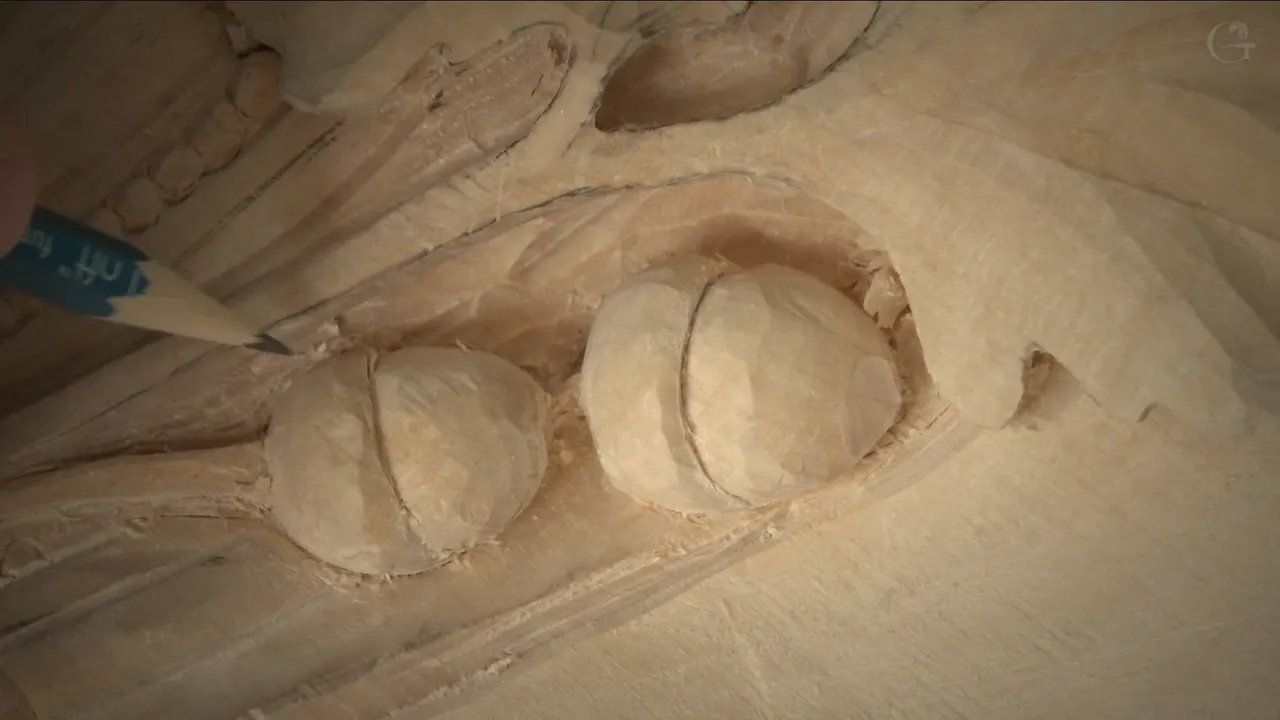

In part 4 of workshop 103 I say "those two guys, on acorns" and then carve the pattern on their caps with a knife. This page starts there and follows the same word into other lessons of mine, each read with the lines around it.
Ever stood at your bench with two small shapes in front of you and no name for them? This lesson belongs to my Venice Room Part 9 course. The lessons I borrow come from my Hazelnuts, floral panel, Furniture Panel, Grape Onlay, Rosette and Sharpening courses, and sizes are in millimeters and inches, my own figure first.
Where do I say it in workshop 103?
The part opens on "Final touches on this corbel." The corbel is "99% done" and I will clean it "of course, a little later." Before that, two acorns need a pattern. "Some of you actually asked me the pattern, how I should do the pattern," I say, and the answer is "It's easy, actually, but there is multiple ways to do the pattern on a cap side of acorn."
My first way uses a V tool. "You could take just a V tool and create a bunch of V cuts" and "the pattern itself is not that complicated." I could "probably do right away on all of them," since there are "only two guys I have." Then comes "I will create crossing ones just like this."

Small is the tool for that way. "It's a small guy. Okay? It's a really small guy," I say, and it is "a detailing tool, and that's just perfect for this job." Another line: "you don't really have to use a big one."
What does a knife pattern on an acorn cap look like?
What I want is "a little different approach. Okay? More true to life." That depends, since "it depends on the type of acorn you have." I say I "researched a little bit the different caps of different species of oak" and then "I made the decision I'm going to do more or less Mediterranean oak."
For this style, "what you're going to need, it's just a knife." I name a "number 12 knife, one of my favorite knives" plus a smaller one with "no number on that pretty much." Of that smaller knife: "I'll use this one just to prove the point, so any knife will work". I plan to "work on one on the camera." The "second one, I'll do off-camera."

The first marks I plan are "a few straight-down cuts, follow those lines" and "the knife's supposed to be really sharp." I can "probably attack that from opposite side" with "Straight-down cut one direction, and straight cut opposite direction."
Next is the inside. I plan to "excavate," to "get rid of just the parts, whatever the inner section is" and the strokes go "from approximately the middle part." To show it: "just place it almost flat, and create cuts like this." After that I ask "Can you see it" and say "So that is the idea."

Is the pattern right for an acorn? "Is that accurate to oak acorn? I would say absolutely," I answer, and "if you look really close to those guys, you'll find out it's actually really accurate." The same pattern is planned for the second acorn. An extra step you could do, "if you wish," takes "a different type of knife or any knife will work," for "small 45-degree cuts in the areas whenever it needs."

Which way do the veins on the leaf go?
The last thing before my final cleanup is "direction of, I don't know what you would call it, like veins on a leaf." Right now "all the lines going to the center point." On the oak "sometimes you can see the movement is actually more different angle, I would say." I will show "just probably one" and then I will decide: "I'll show you, and then I'll decide."

A carving is not a copy of life. "That is a carving, and the carving should not be exactly the same like life," I say. A few strokes with the gouge follow. "I don't have to do a lot" and "see, it already gives me some different feel of it." One more line, "I could take it to extreme, but I don't think I want to do that." Smoothing waits: "I still going to make it more smooth or smoother, I should say."
Why does this oak look different from the oak I know?
"We do have some kind of oak, although I don't know if you can say that is oak or not," I say, and "it doesn't really look like oak in my understanding." I am used to "Russian style" and to "northern states like in Michigan and Wisconsin, Illinois, Indiana." Even in the Carolinas, I say, the oak is "about the same oak." My reason sits in the Venetian era: "I had to be authentic to Venetian era, Venetian style, end of 15th, beginning of 16th century, and that is how they did it."
The piece is paint grade. "I really don't have to worry about too much and make it super detailed," I say. Another feature is "not normal acanthus," but "a Venetian-style acanthus." About the whole look I say "that Italian Venetian style, but I think it looks really, really good." And "if you would love to create something like that, you're going to make me proud."
What is left on the corbel after the acorns?
The way ahead is in my words: "So now I've got to do the second one, and I will fit those two pieces on the main body." The columns wait, and there is "a lot different details to do." Earlier in the lesson, part 2 speaks of "a fillet" and part 3 ends on "hopefully I'll be able to create something really nice right here." The whole lesson has its own page, Venice Room 103.
Which pieces do I call guys in Hazelnuts?
In Hazelnuts 2, part 1, I talk about the highest bunch: "those guys are going to be really the highest spots." Later in that part: "I have to protect those guys. Those two future nuts." For them, "excavate down" and "I don't want to lose the overall picture, but I still have to go low enough."

The third part of that lesson names the tool and the move. "Number five is about 5/8 of an inch, about 16 millimeters or so." Then "Do a separation cut" for the pair, and "it's better to attack from this side now." My aim is "a barrel, with the right direction." Further on, "I still want to create some kind of rough idea of those guys" and I want to "make sure I'm not losing the centers" of the pair.
Hazelnuts 3, part 2, has "introduce some motions on those guys" and "probably concave cut, concave cut, and leave it as a convex in the center." For that, "a little bigger number nine" in "a number nine and a quarter inch" (about 6 mm). Then a question: "how am I supposed to attack it? I guess I have to attack from that side, from the opposite side."

Over in Hazelnuts 4, I talk about a pair that will lie low. "Those guys are going to lay pretty much right on the floor, but there's two of them. So which means one of them going to be higher than another one. So I still have to keep some meat." Then comes a plan for a chisel: "Now I'm going to get my trusty skew chisel."

Which flowers get that word in the panel lessons?
Floral lesson 12, third part: "those two flowers, those two guys, I really want to show." The plan is "let me work first off-camera on those ones and that middle one" and "then I'll go back and show you how to get those because it's a little different."

In lesson 13, first part, I say I did not work on details yet, and I am "actually ready to jump on" the pair: "two guys, which I promised." A line follows about the other side. "If the detail is the same left side and the right side, there is no reason just to show that again how to do that."

At the start of lesson 14: "two guys to do, and then just clean up and clean up." After that comes paint. I call "those two little things" small acanthus, and I say "a really good idea to show" them.
Lesson 3 has me plan the right-hand side first and then the left, and "they really close. They almost the same, but they not the same at all." From above, "two guys, they repeat each other, and they just are pointing to the same direction." "Even if it looks like it's symmetrical, it is absolutely not," I say, and "I like that approach, not to do symmetrical stuff."
How do the guys sit on the furniture panel?
In Furniture Panel 31, part 2 has "those three little guys" and "I need to outline them first with the number 11." On size, "I'll use two and a half millimeters" (about 0.1 in).

One guy will go under two in lesson 32, part 3. "This guy is the highest one," I say, and "this guy gonna go underneath." Why outline now? "If I'm not gonna outline right now, I'll lose the feel of the flowers."

What do the guys need before the next pass?
A separation comes first in Venetian Flowers Rosette 4: "obviously, a separation cut between" "two guys, that one and that one." Then "this part going to go underneath of this part." My tool is "number 11" and "approximately four millimeters or so" (about 0.16 in), though "It could be a quarter inch, six millimeters."

In Rosette 1, first part, I show the parts and say "those guys. All right? So I've got all four of them." "pieces all over my shop," I say, "but my point is, I did not film it." And "as far as the design, it's authentic to that era, I mean, to that Venetian style." Workshop 84 of the Venice Room has "some small pieces, like it's sticking from underneath," which "makes it more richer and fills the space." Then "two guys. Okay?"

Height is the question in Grape Onlay 5, part 2. "I wanna drop a little more too," I say of two guys, and "those guys on the way" are "a little too high." I say "I'm gonna chop slightly" and "I have plenty, plenty of the material."

The grape final assessment has me say "Two guys and, they are somewhat smooth at the top and rougher, at the bottom of it." Of the tool marks, "personally, I do like, those marks because it's just the, nature of, wood carving." On sandpaper: "on a grape, it would look nice if you would sand that little bit" and "up to you obviously."
A slight clean-up is on my list in Chamomile and Bow Rosette 3, part 2: "I can take a small tool, like number three," for "a slight cleanup job" on the "two guys."

Can a guy be a tool?
The V tool of workshop 103 is one. Furniture Panel 32 has another, in part 2, where I go through ways to reach tight spots. "You can get like one millimeter blade" (about 1/25 in) "and you can get to the tiniest spots." Then "you can get this little guy, even smaller guy. That one is a microplane, I mean router plane."

Its blade "is kind of really small and tiny, and you're still able to get a really good support." And "of course there are some limitations with this one."
The sharpening class in Maine has the army idea. "Every tool is like a soldier in a army, does its own function" and "the bigger army you have, bigger area you can conquer, bigger projects you can do." Next, "if you have only two guys," meaning two tools on your side, "you're limited." I add "every tool is just like my army, and I'm a general in it."
Where do the frames come from?
Every picture is a frame from a lesson named on this page. The first six come from workshop 103, part 4, on the Part 9 course page, and the rest come from the other lessons, each beside the lines it matches.
Lesson by lesson, the word in use
| Lesson and part (course named where it is not the Venice Room) | Who the guys are |
|---|---|
| Venice Room 103, part 4 | Two acorns whose caps get a knife pattern |
| Hazelnuts 2, parts 1 and 3 | Two guys to protect, a separation cut, a barrel as the aim |
| Lesson 3 of Hazelnuts, part 2 | Motions planned with a number nine, a quarter inch |
| Fourth lesson of Hazelnuts, part 1 | Two that will lie low, one higher than the other |
| Floral and Molding 3, 12, 13 and 14 | Flowers whose movement differs side to side, and two I promised to show |
| Lessons 31 and 32 of Furniture Panel | Three little ones to outline at 2.5 mm, and one to go under two |
| Venetian Flowers Rosette 1 and 4 | Four pieces I did not film, and a separation cut between two |
| Grape Onlay 5 and the final assessment | Two I want to drop, two smooth on top and rougher below |
| Chamomile and Bow Rosette 3, second part | A slight clean-up with a small tool, like a number three |
| Part 2 of Furniture Panel 32 | A tool called a little guy, and an even smaller guy |
| Sharpening class in Maine, part 1 | Only two tools, each one called a guy |
Is there a pair of small shapes on your own bench that needs a name? Everything in these lessons sits inside one tuition plan. For a gentler start, try my Hazelnuts, Floral and Molding or Furniture Panel course.
How it's done
- Mark a few lines. A few lines go on the cap first, and I plan crossing ones.
- Pick a knife. The knife is supposed to be really sharp, I say.
- Carve straight down. Straight down in one direction, then straight in the opposite direction.
- Place the knife almost flat. My plan is to excavate the inner section, from approximately the middle part.
- Add 45-degree marks if you wish. Small 45-degree marks go in the areas whenever it needs.
Frequently asked questions
Which things do I call guys in workshop 103?
They are two acorns on the corbel, and I say it where I plan to work on them first. That part also has a small V tool called a small guy, a detailing tool.
Which tool do I name for the acorn caps?
A knife. I name a number 12 knife, one of my favorite knives, and a smaller one. A really small V tool is the other way, with crossing lines.
What do I say about oak in that part?
The piece doesn't really look like oak in my understanding. I had to be authentic to the Venetian era, the end of the 15th century and the beginning of the 16th.
What to carve next
- Part 9 course page
- Venice Room 103
- Venice Room 84
- Hazelnuts 2
- Hazelnuts 3
- Hazelnuts 4
- Floral and Molding 3
- Floral and Molding 12
- Floral and Molding 14
- Furniture Panel 31
- Furniture Panel 32
- Venetian Flowers Rosette 1
- Venetian Flowers Rosette 4
- Grape Onlay 5
- Grape Onlay final assessment
- Chamomile and Bow Rosette 3
- Sharpening class in Maine
- Hazelnuts course