

Alexander Grabovetskiy, woodcarver, School of Woodcarving · Published 2021
What does a wood carver mean by "easily"?
Quick answer: Part 3 of workshop 103 has the word inside my plan for the side of a corbel, before I say I am not quite sure. My lessons from other courses set it beside a deeper excavation, a tiny tool and a piece that can break. Each passage is read with the lines around it.
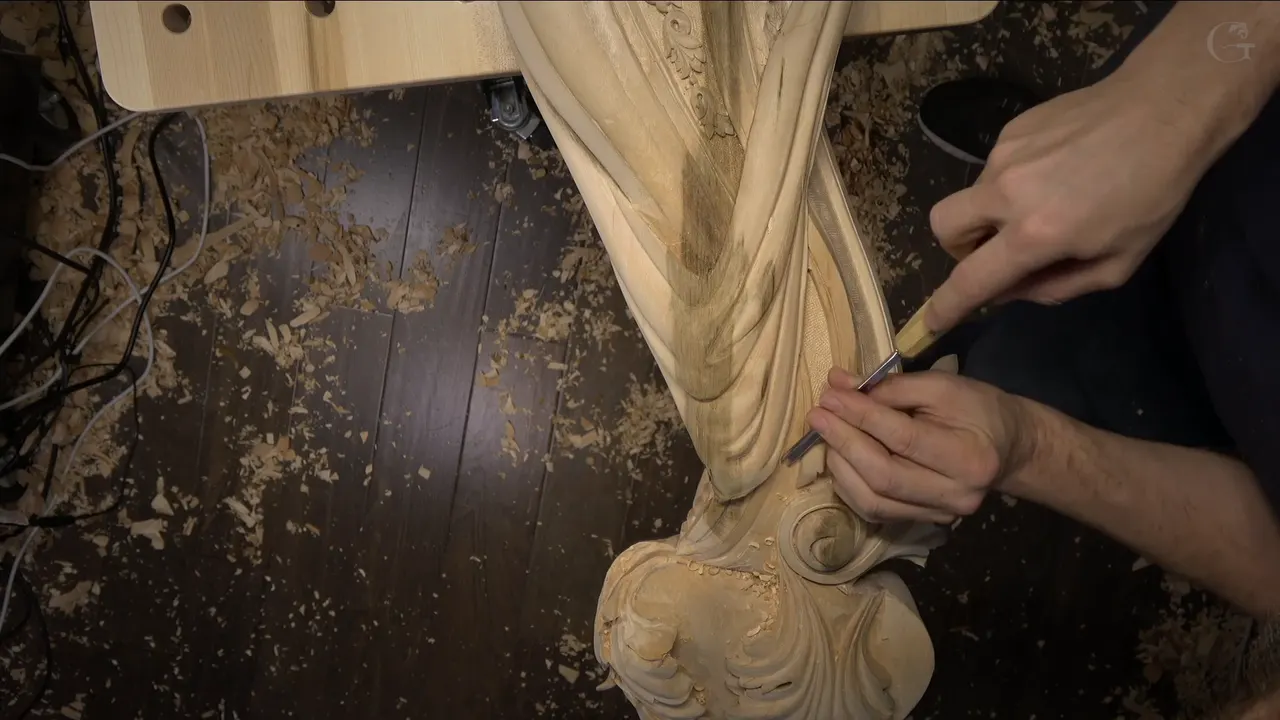

Part 3 of workshop 103 holds one line with the word "easily" and it sits inside my plan for the side of a corbel. The same word shows up in lessons from many of my other courses, and I read each one with the lines around it.
Ever looked at a carving and known that one move would make the next one simple? Or known that one wrong push would break a piece? This page starts in workshop 103, which belongs to my Venice Room Part 9 course. Parts 2 and 4 of the same lesson sit beside it. The rest come from workshops of the Venice Room and from my Hashemi, Furniture Panel, Greek Acanthus, Roman Acanthus, Corinthian Acanthus, Lily Box, Greek Acroterion, Flower Rosette and sharpening courses. Every size is in millimeters and inches, my own figure first.
Where in workshop 103, part 3, does the word come in?
It sits in a plan. The part opens with a tool and a size, "number 11 and 5 millimeters" (0.2 in), for "a cleaning cut, cleaning pass." A concave comes next: "So now I need to work on that concave." For it I name "maybe number eight long bent."

The pass has a direction. "And yes, it has to go this direction, but it is against the grain." Later: "So I'm happy. So that is actually a continuation of that concave right here on this side."
Cleaning still waits. "Yes, I still have to clean up of course, but I can do that off-camera. I don't really need to spend time showing you how to clean everything. Really easy. Just a flatter gouge." The form comes first, with "probably back bent," to "create preliminary form before I clean everything to the final."

A section has to go next. "Now I need to take out that section, and it has to be a continuation of that slope. Okay? But it has to be somehow nice transition. I'll probably going to do it with the same back bent." One side pleases me: "And I'm happy what I see from this side." The other side needs a blend, I say.

Word for word, here is the plan I give for that other side. "So I probably going to do really interesting movement. Okay? So that is going to be just going all the way to that groove cut, and that way I can easily hide that stuff underneath and blend that together so I can create..." My next words are "I don't know."

A second idea follows. "I want to try creating a concave" that is a "continuation of this side." A doubt follows: "And I'm not quite sure if I want to do that or not. Let me think first, okay?" I add "I guess that's probably the only way." The pass I name runs to "that previous groove, to the previous veiner cut, just like that."
So "easily" in this part sits in a plan that I hedge in the lines that follow, and the stuff underneath is what I want to hide.

The part closes on a result and a plan. "And that gives me exactly the same what I see on the other side of my drop. So it's going to look good. It still kind of doesn't really make too much sense. But as of now, I'm really happy." Last I say "I'm going to spend a little more time cleaning everything, and hopefully I'll be able to create something really nice right here."
What do parts 2 and 4 of workshop 103 add?
My rasp comes in a plan at the start of part 2: "what I could do, I could take my rasp now and just give a cleansing job." I am happy with it, and I will leave it like that. Another line has the two words "that way": "That is going to be beginning of our movement. Okay? That's what I want to do. That way, it's going to blend nicely."

A size shows up in part 2 as well: "number 11 cut, and I'll use 2 millimeters." Then "Well, 2 millimeters probably a little small. I will need to use 5 millimeters" (0.08 in and 0.2 in). The 5 is the size I name at the start of part 3.
The acorn caps come in part 4, and the tool talk there is about size: "You could just get a V tool, a really small, tiny V tool. You don't really have to use a big one."
The very next lesson of the course does use the word. In part 1 of workshop 104 I say "what I like about using iPad, how easily I can actually transfer that to the board itself. So for me, it's not a big deal at all." There the word sits beside a drawing and a board.
When does "easily" open the next step?
A match between two sides comes before the word in workshop 48, part 4: "that also has to match right now opposite side, so then I can easily excavate deeper. Much deeper, actually." My tool comes a little later, "big number seven" with a check that it fits, and my answer is "Yes, and I am."

Over a deep excavation in workshop 52, part 11, come the lines "I can actually get even more three-dimensional in this area just because I do have extra material right here." Then comes the word: I "can easily just go even deeper with this acanthus movement, and just create an even deeper shadow." Soon after, "all wood carving is about the light and the shadow."
A boundary leads in workshop 54, part 2: "That is my boundary of this movement. Okay? So I want to make sure I'm not losing it. But right here, I easily can excavate. It's actually another deep spot." Next comes "And I just made a mistake. Not a big mistake, but mistake I could avoid."

Two pipes sit in workshop 55, part 12: I talk through the center of one pipe and then a second pipe, and I "can easily use the same tool." Apologies follow for the view: "if I am covering that with my hands."

A limit leads in workshop 56, part 3. I leave wood at the edge, "approximately three millimeters, I'd say, thickness" (0.12 in), and add "About one-eighth of an inch" (3.2 mm). Then: "I am right underneath. And again, I can now easily remove those plugs and go to the hole with no problem."

The word and a warning share one breath in workshop 84, part 8. "Yes. So this going from all the way this direction. So which means I can easily outline it. But again, got to be super careful how I do it."

Waste is the topic in workshop 85, part 10. "So all of that is waste," I say, and then "I can easily just take a big gouge again." After it comes "And start my process."
Furniture Panel 28, part 2, gives numbers around the word: "I don't have to measure, it's just approximately, but just because I have uh, some space there, I can easily get my smaller tool in it." Just before that I say "maybe about two millimeters. I would say maybe two and a half millimeters" (0.08 in and 0.1 in). Lines after that size the tool, "a little bigger than uh, one millimeter and little less than millimeter and a half" (0.04 in and 0.06 in), and "that's number eight."

The Hashemi course gives a reason in plain words, in lesson 42, part 1. First I say "I would have to have a six-and-a-half-inch thick block, and there's no reason" (165 mm). Then comes "It would be really hard to undercut. But now, just because we created this technique, we created the sockets" and I "can easily use just the blocks of wood."

A tiny tool is the subject in Greek Acanthus 14, part 1. "I can go underneath of a pipe really easily, even undercut underneath of the pipe." For the sweep I say "it looks like it's number eight. It could be number nine. It's hard to tell because it's so tiny" and "it's not marked."

A drawn line is the subject in Roman Acanthus 6, part 2. "And since I've got my line, I can easily see the position of this line, and I can work from this from opposite side." After it I say "That would be my preliminary concave." The bigger tool I name is "number nine, 20 millimeters or three-quarter of inch" (0.79 in and 19 mm).

And in Lily Box 5, part 8, I say "I'm just recreating my working space." Then "That way I can easily redraw and recreate my main movements and make a lot less mistakes." Further on I name "the number three and six millimeters" (0.24 in), and then "Quarter inch, number three" (6.4 mm).

When does "easily" come with a break?
The Hashemi course has it in lesson 12, part 1: "I can't make really heavy cuts just because" the "piece becomes more fragile, and I can easily break it, and I don't want to break it. Okay? So even with the big tools, I still have to be kind of really careful." Later in that part I say "So much less to clean later."

An edge is the worry in workshop 71, part 10. The lines are "I don't want to use it as a leverage point," "It would be a mistake" and "I can easily break it." I place my finger underneath. "And if I need to crank it, I'm using my finger."

Wood stays for now in workshop 45, part 8: "I'm still going to keep some thickness for now." The reason I give has "easily" in it, about a piece that is too thin.

Tools can break too, and I say so in Corinthian Acanthus 5, part 1. "Really be careful with undercut. You think it's simple, but it's probably the most-- Well, I would say you can break your tools easily if you do an extreme undercut like I do. And I've done it. I broke some tools when I did the undercutting."

A hand is the thing at risk in Greek Acanthus 3, part 1, with a knife. The rule I name is "never place your second hand on the way of your cut, so you can easily slip and cut your hand. So your second hand should be right away on opposite side of the knife."

In Greek Acroterion 3, part 6, the word follows "I got a little too deep right here." The line is "But I can easily fix it." Later I say "I'm not afraid if I'm going a little deeper than I was planning to" and my reason is that "it creates the shadow line."
What else comes with the word?
It comes with a notch, a piece I hold and a sharp tool. In Furniture Panel 15, part 1, the notch is for a marking gauge. I call it "a good idea, just to put some kind of notch," a "small cut" where the knife of the gauge goes. Next come the words "I can catch that, and I can adjust it easily with this notch."

Holding is the subject in Flower Rosette 2, part 1. "You notice how I hold that piece, and I can rotate that easily." Soon after, "I'm all the time rotating my piece."
And in the V tool sharpening lesson, part 4, the tool has been polished: "You can see it polished really nice." Then "I like it to take it to extreme somewhat. Then the tool glides really easily and it's just a joy to use it."
Where do the frames come from?
Every picture here is a frame from a lesson named on this page. Most are from workshop 103, on the Part 9 course page. The rest sit beside the lesson they match.
Lesson by lesson, the word in use
| Lesson and part (all Venice Room unless a course is named) | What the word sits beside |
|---|---|
| Lesson 103, part 3 | A plan for a side, with a groove to run to |
| Workshop 48, part 4 | Opposite side to match, then a deeper excavation and a big number 7 |
| Venice Room 52, part 11 | Extra material, so the acanthus movement can go even deeper |
| Workshop 54, part 2 | A boundary to keep, and a deep spot to excavate |
| Venice Room 55, part 12 | Two pipe centers, one tool for both |
| Lesson 56, part 3 | Approximately 3 mm (1/8 in) of thickness, and plugs I can remove |
| Part 8 of workshop 84 | A line going that direction, and super care to outline it |
| Part 10 of workshop 85 | All of that is waste, and a big gouge again |
| Furniture Panel 28, part 2 | Some space there, and my smaller tool can go in |
| Hashemi 42, part 1 | Sockets created, so I can use just the blocks of wood |
| Greek Acanthus 14, part 1 | A tiny tool that can go underneath a pipe |
| Roman Acanthus 6, part 2 | A drawn line to see, the opposite side to work from, and a number 9 at 20 mm (0.79 in) as the bigger tool |
| Lily Box 5, part 8 | A recreated working space, and a number 3 at 6 mm (0.24 in) |
| Hashemi 12, part 1 | No "really heavy cuts," since the piece is more fragile |
| In workshop 71, part 10 | An edge not to use as a lever, and a finger underneath |
| From workshop 45, part 8 | Some thickness to keep for now, since too thin can break |
| Corinthian Acanthus 5, part 1 | An extreme undercut that can break a tool |
| Greek Acroterion 3, part 6 | Deeper than planned, and a fix to make |
Is there a step at your own bench that would make the next one simple? Everything in these lessons sits inside one tuition plan. For a gentler start, try Lily Box, Greek Acanthus or Furniture Panel, three of my courses.
How it's done
- Name the tool. Part 3 opens with a number 11 for a cleaning pass.
- Match the other side. In one Venice Room lesson the opposite side has to match, and a deeper excavation follows.
- Leave some thickness. About one-eighth of an inch (3.2 mm) stays near an edge in another workshop.
- Keep a finger underneath. A finger goes under an edge in a third one, so the edge is not a leverage point.
- Look for the fix. The Acroterion lesson answers a deeper spot with a fix.
Frequently asked questions
Where is the word in the corbel lesson?
It sits where I plan the corbel's side, and I say I can easily hide the stuff underneath. The lines after it hold a doubt about whether to go ahead.
Which tools do I name in the third part?
A number 11 for a cleaning pass comes first. A number 8 long bent follows for the concave, and a back bent for the preliminary form, in the order I name them.
Is the cut safe when I say it?
In a Hashemi lesson and in a Venice Room workshop, the piece is one I say I can break easily. In the Corinthian lesson I say you can break your tools easily with an extreme undercut.
What to carve next