
Alexander Grabovetskiy, woodcarver, School of Woodcarving · Published 2020
How wide is a number 5 gouge, half an inch or a quarter inch?
Quick answer: A number 5 gouge is a curve, and its width is a second figure. In one Venice Room video I named it at a half inch first, then a quarter inch. Other lessons gave 3 millimeters, one inch, or 35 millimeters.
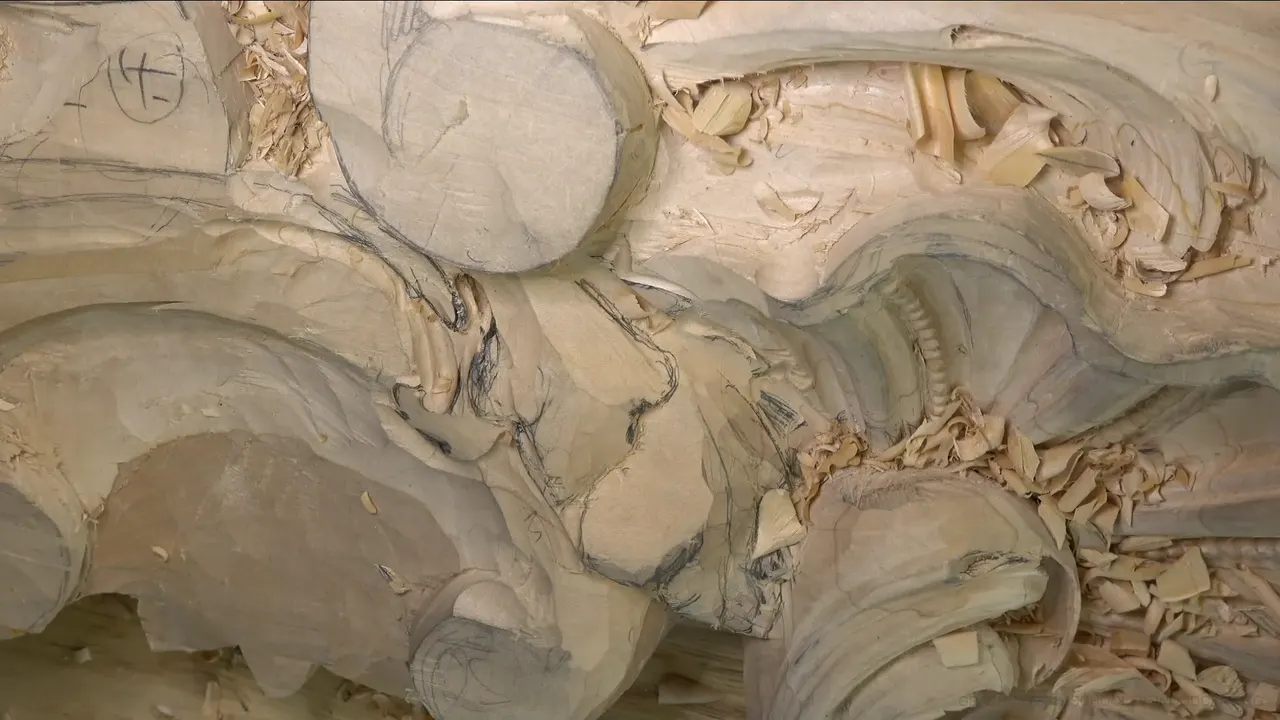
Each gouge number names a curve, and the width is a second figure I say beside it. In Venice Room workshop 19, part 11, I called my number 5 about a half inch at 06:38. Fifty seconds later I said quarter-inch, number five again. The video runs about eight minutes, so I went through my other courses and wrote down the widths I gave that gouge. Each lesson I quote has a public page, and I link it there.
Do you read the number stamped on a gouge and wonder what the edge measures? Would it help to hear the widths I named for it in my own lessons, one at a time? Then read the lines below. Each one has its time in the video, and where my widths differ, I say so.
Number 5 widths in one short list
- This video gives two widths for one number, and the second is smaller.
- A figure on the gouge names the curve, and the figure after it says the width of the edge.
- My widths run from 3 millimeters up to 35.
- Seven other lessons put it near a half inch; three of them gave 12 or 13 millimeters.
- Three lessons gave 16 millimeters, and three more gave a full inch, which is 25.4 millimeters on a ruler.
- A number six could be five-eighths wide too, I said in workshop 59.
Which widths did this video give?
This part opens with me not liking something I had just done. I needed to fix it somehow, although the upper layer would most likely cover the spot (00:29), "but still." So I made the subdivision and outlined a little better. Number three, I said, would do the trick right now (02:17).

A preliminary cut came next, done carefully (03:34). The line would become that line, I told you, flipping from the opposite side (04:04). After that I would round one side a little in that direction, I said, because otherwise the movement would not make any sense.
One spot, I said, could get fixed with some kind of bigger gouge, just to give it a nicer shape (06:17). I put it plainly: "Number five, that's what I used, about half an inch" (06:38). I named the number once more and added that I could go a little this way, just to indicate that (06:46).

By 07:09 I had already seen the final movement. The line that sent me through my other courses came next: "I'm using quarter-inch right now, number five again" (07:28). The first time I said a half inch and the second time a quarter inch, with the same number both times.
My words about depth followed. I did not want to dig too deep toward the background, since it would be really hard to clean later (07:33 to 07:43). At least the pass gave me an idea of the movement, and in my opinion, I said at 08:03, how it all looked together looked actually really good.

What do the two figures on a gouge tell you?
One is the curve of the steel, and the other is the edge width. I explained it in plain words in several lessons. The Cabernet Sauvignon tray, workshop 1, has me grab a number nine and 20 millimeters (00:51). "Nine 20 means the curvature," I told you at 01:01, and the second number means 20 millimeters (0.79 in), or three quarters of an inch, a little bigger than three quarters.
Workshop 57 carries the same idea at 06:44. An eight is a sweep, I said, and the six after the forward slash is how wide it is. That sweep is "this curvature," and the six is 6 millimeters (0.24 in), a quarter inch. Back in workshop 52 I told you a sweep is the curvature of a tool, and six millimeters, a quarter inch, is how wide that is (01:57). "So, that's how it's determined," I added.

A rosette lesson has a number six at nearly that width. In the first Flower Rosette workshop I called the sweep the gouge profile (02:54), and the six worked excellent, about that wide (03:13 to 03:21). That is a different number at nearly the width I gave in part 11.
How wide was number 5 in each lesson?
Here are the widths I gave, lowest first. My figure leads in each row, and the lessons carry the names the course pages use.
| Width as I said it | Where I said it |
|---|---|
| About an eighth of an inch, or 3 millimeters | The Hashemi course, workshop 47, then Floral and Molding workshop 5 at 21:38 |
| A quarter inch, 6 millimeters | Furniture Panel 19, Hashemi 20, that molding course at 22:22 of workshop 5 and in workshop 6, and the second figure in this video |
| Around 10 millimeters | Workshops 62 and 47 of the Venice Room |
| 12 or 13 millimeters, a half inch | Venice Room 74, 75, 73 and 40, Hashemi 11 and 13, Furniture Panel 15, and the first figure in this video |
| 5/8 of an inch, 16 millimeters | Workshops 59 and 69 of the Venice Room, and the Hazelnuts course, workshop 2 |
| 20 millimeters | Two Venice Room lessons, 50 and 70 |
| One inch | Venice Room 3 and 42, and Hashemi 37 |
| 35 mm, which is 1.38 inches | Workshop 5 of the Venice Room, in part 3 of that lesson |
When did I call a number 5 a quarter inch or smaller?
The smallest figure I found is in Hashemi flowers workshop 47, part 4, where I had to undercut an area like that. I was working with a number 5 at 02:04, about an eighth of an inch, or three millimeters (02:14). After that I told you I could skip it. A small gouge, about 1/16 of an inch (1.6 mm), could do instead if I wished (02:21 to 02:36).
That course has the same eighth, then a bigger one. The same small size is what I took in workshop 5, one-eighth, to keep working a messy detail, and said it would be okay (21:38 to 21:58). Less than a minute later I needed a quarter inch (22:22).
Workshop 6 of that course holds a line I like. Space for a convex was open, and I thought a number 5 would do (19:16 to 19:18). It was pretty much the same one, I said, a quarter of an inch, six millimeters (19:25). I tried to round it a little, and the line I like comes then: maybe number five is overkill, most likely (19:37 to 19:45).
Hashemi workshop 20, part 3, was waste removal. My pick was a quarter inch (04:40), and this wall was waste too, so it would go (04:43 to 04:50). "This is quarter inch, number five," I said at 04:56, and by 05:14 I was all the way through.

The Furniture Panel course gives it in millimeters, on a panel for furniture. In the nineteenth workshop, part 7, I was using number 5 (15:49), and at 15:51 I said, "that's a 6 millimeters number five."

Two more lines in this group are plans, so I print them as plans. Take Hashemi workshop 6, part 6, I could see the natural movement, and I could use not number one but some kind of number five, "a small number five, maybe quarter-inch" (00:43 to 00:53). Over in Venice Room 47, part 4, a big concave was out, only a small one would do, and a quarter inch would help me (03:54 to 04:03).
Which lessons had a number 5 near a half inch?
Workshop 62 gave it, in part 3, at 10 millimeters or so (0.39 in), a line I gave at 01:21. You get a line like that, I said, and you carve right inside, and now you should be able to detect the movement (01:25 to 01:42).

A back bend of 10 millimeters shows up in part 8 of workshop 47 (02:01). I called that area a little challenging, since I had a part in my way, not impossible, though not the easiest.
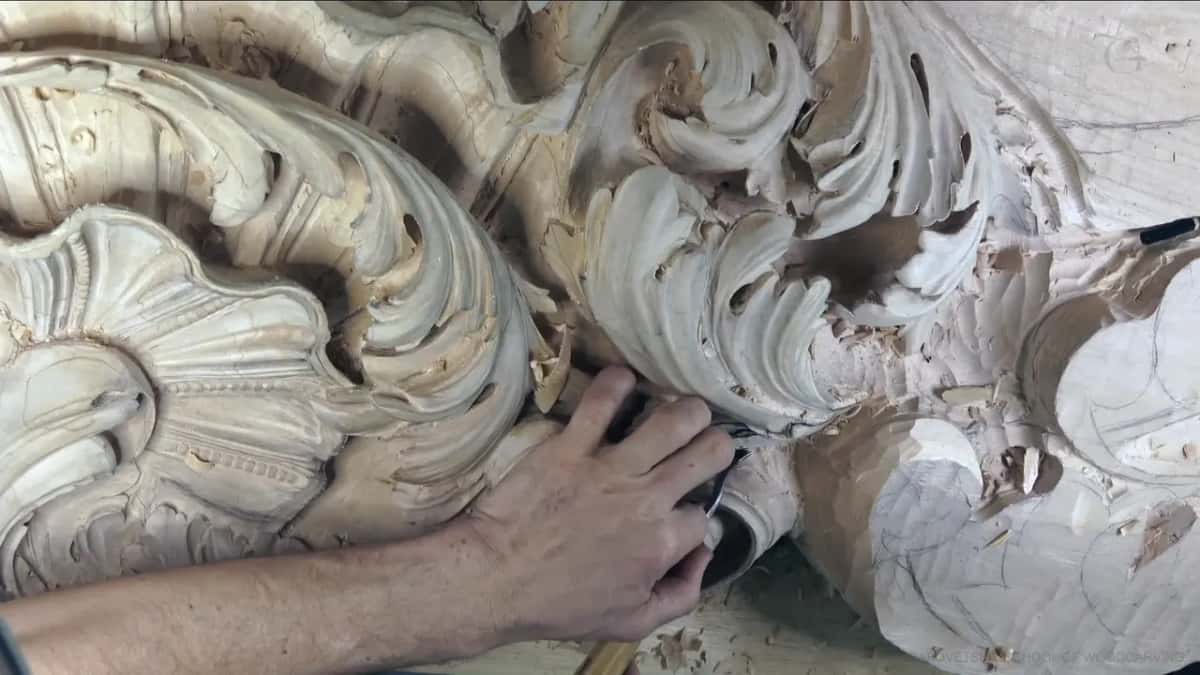
Matching the curvature was the job in workshop 74. My gouge was a number five, about 12 millimeters or so (0.47 in), a half inch, I said (02:04), and it fit that curve. Seconds later I was not really too happy with the section (02:15 to 02:20).

Next up, workshop 75, part 11, wanted a convex. I really needed that convex right there, I said, which is why the concave sits on the other side of it (03:54 to 03:59). The tool was a back bend, a sweep of five, "like 13 millimeters" (04:11 to 04:19). The edge was close, and I said so.

Workshop 73 is a tight spot. Not much thickness was left, so I had to be careful (06:21 to 06:25). Again I took a five sweep in a half inch, on a back bend, and I would work my way in (06:29 to 06:37). Yes, I was carving against the grain, though it was the only way I could work (06:42 to 06:51).
The same gouge went to a ceiling in workshop 40. A back bend with a five sweep went at the upper part of my detail (03:21 to 03:36), and I said I could even create a beautiful dome if I wished. Mind how much you excavate, I told you (03:48 to 03:54).
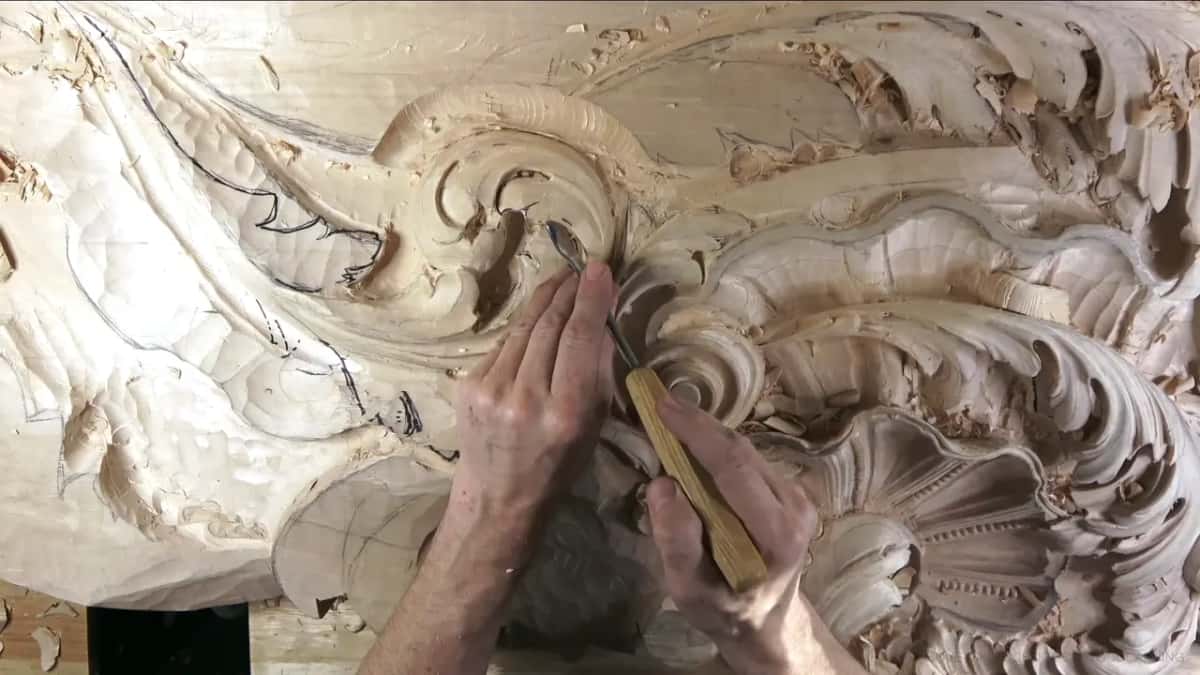
The Hashemi course has the same width. My first pick in workshop 13 was a five, with a half inch beside it, to establish my main movement carefully (00:41 to 00:48). I used that pair again for the upper part (01:24). The seventh part of workshop 11 weighed a number three against a number five (03:35 to 03:43). Maybe the five, but slightly bigger, a half inch, to take this ridge out (03:44 to 03:56).
Furniture Panel workshop 15, part 5, adds a note about sharpening. I reached for the five (05:33). Again, I had not sharpened them or done anything to them, and this one measured 12 millimeters, a half inch (05:35 to 05:39). I guess I needed to sharpen it, I said, because right then it was not too sharp for me (05:48 to 05:53).
When did a number 5 reach 16 millimeters or more?
My best line for this page sits in workshop 59, part 9, because a second number turns up in it. Number five was next (07:15), and "that's going to be about 5/8 of an inch, about 16 millimeters" (07:21 to 07:25). Next I added, "Actually, you know what? I could use number six," and said that one would give me a much better cut, also at that width (07:27 to 07:33).

An S movement was coming in during workshop 69, and I needed a little more persuasion (05:03 to 05:11). "It was number five, by the way," I told you at 05:22, about 16 millimeters, "like five-eighths of an inch" (05:25 to 05:28). Good, I said, and I was ready to establish the main concaves and convexes.

The Hazelnuts course used the same width. Number seven, I said in workshop 2, part 3, did not need to be that big, I just like how fast I can do it, and you can always use smaller tools (02:07 to 02:20). This one, I said, is about 5/8 inch, or 16 millimeters, more or less, and I was working underneath that area (02:38 to 02:44).
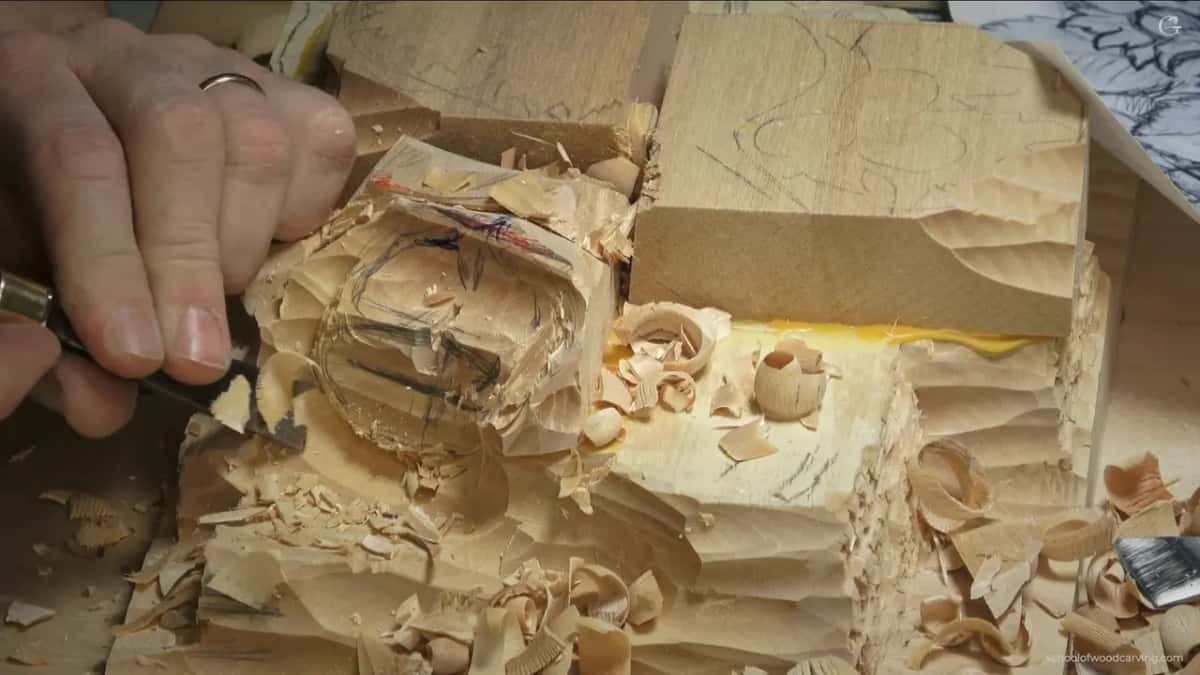
Twenty millimeters (0.79 in) shows up in two Venice Room lessons. The 50th workshop, part 8, has it at 00:10, "this is number five and 20 millimeters," and asks you to see how nice it gave me that shape. A beautiful shape, I said, and a really nice S shape that I could keep (00:14 to 00:33).
Part 2 of workshop 70 brings out a back bend at 03:17, a sweep of number 5 and 20 millimeters. I added: "But essentially, it's just number 5. That's what it is" (03:26 to 03:28). A little later I wanted to show the shadow side, because otherwise it just blends in (03:43 to 03:52).
Did I use a number 5 at one inch or wider?
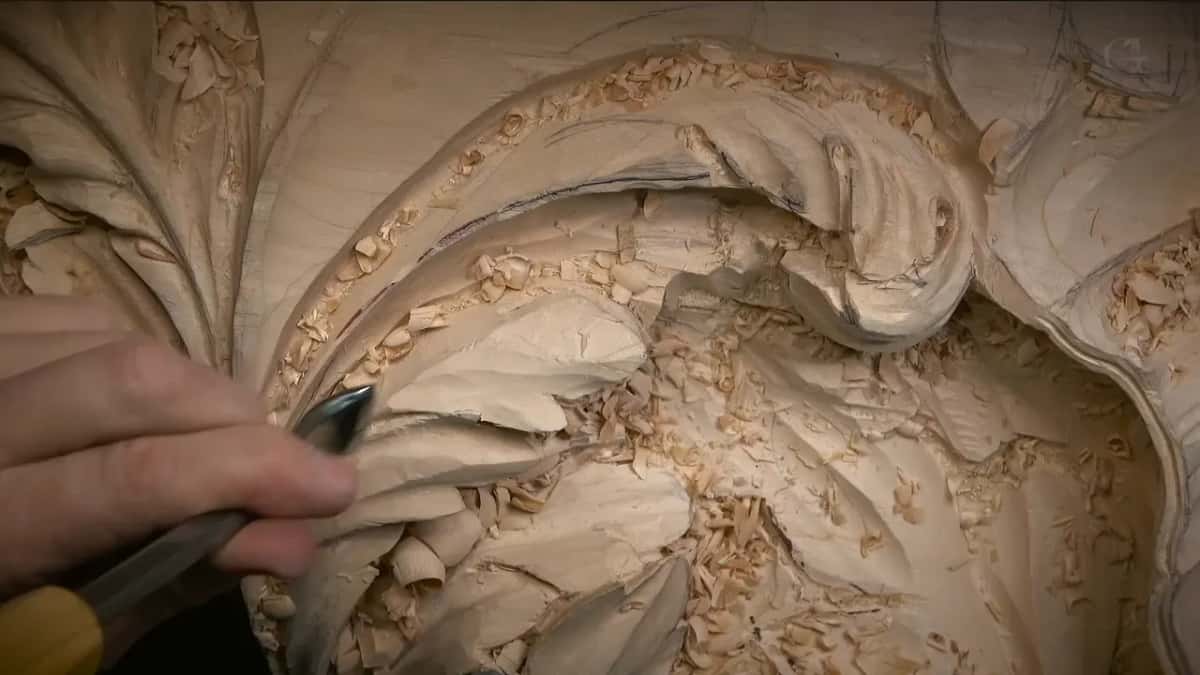
Yes, in three lessons I called it one inch (25.4 mm). In Venice Room 3, at 04:48, I asked whether this one was going to fit, and then, no, it was a little too small, so I had to use a different gouge (04:48 to 04:53). "I probably should use number five and one inch," I said at 04:57, and I thought it would be a really perfect fit, or pretty close to perfect.
A shorter one is workshop 42, part 11. I needed to chop out this section, and I would use a five, so at 07:30: "Number five. That's one inch." Hashemi workshop 37, part 1, goes to a ridge. I took number five at 00:46, went all the way down and cleaned on the inside, and at 01:12 I said, "This is number five on one inch."
The widest figure I found is 35 millimeters (1.38 in), in Venice Room 5, part 3. "Okay, number 5, 35 millimeters," I said, and I was going to chop a little bit of this side because it just did not look too good (00:44 to 00:55).

Does a number 5 have one width?
In my own lessons the number stayed 5 and the figure beside it changed. This page names 3 millimeters, a quarter inch, 10, 12, 13 and 16 millimeters, then 20, one inch and 35. Each came from a different lesson.
The job came up in a few of those lessons as well. One job was fitting a curvature, in workshop 74. Workshop 3 had a gouge that did not fit, and a one-inch five was my probable next pick. Workshop 59 had a six that could work too, at that same width, I said.
Why did I pick a width at a given spot?
My reasons were short. A tool had to reach a tight place, as in workshop 47, where I wanted only a small concave. A convex needed room in workshop 75, so the concave went to the other side. And in Hashemi workshop 47 the five was optional, since a small gouge would also work.
What did the widths look like on my bench?
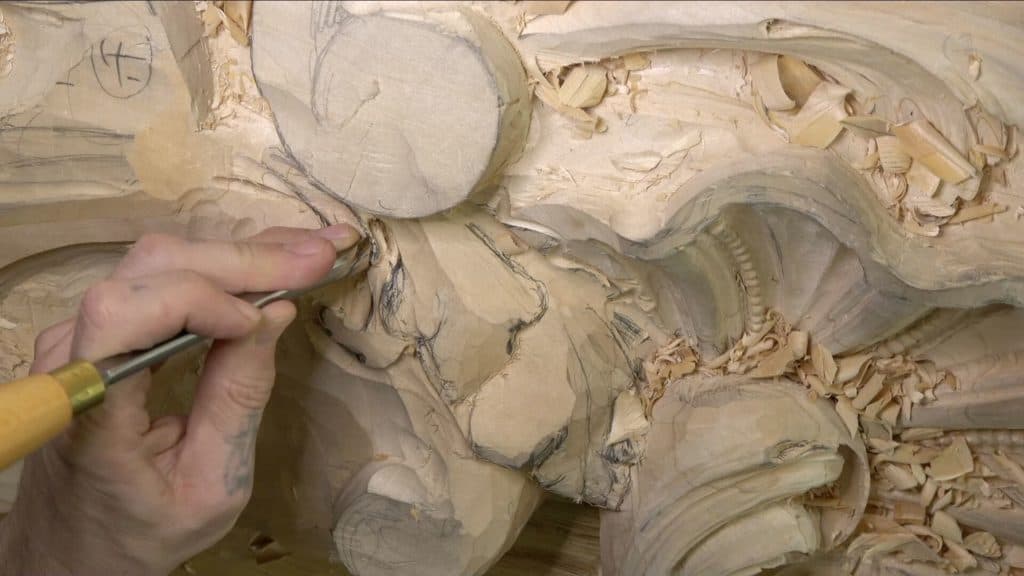
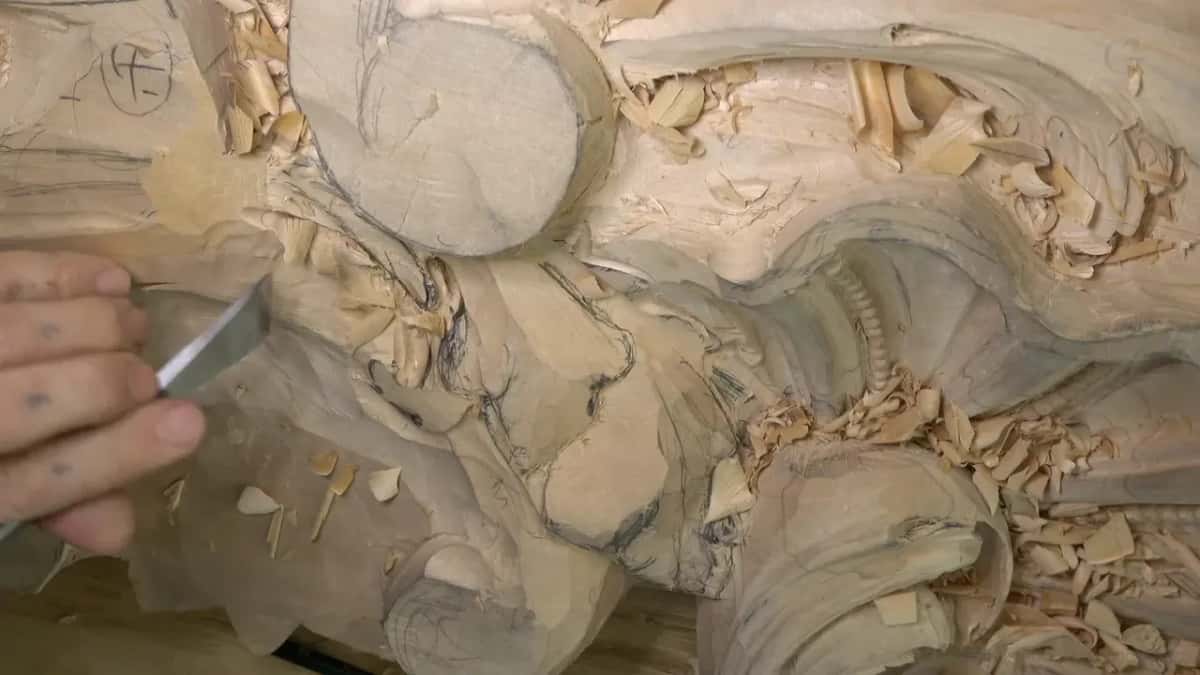
The frames on this page come from this video and from the lessons I quote, each one at a time I name.

Part 11 is one video of workshop 19, and the rest of it sits on the workshop 19 page. The course is Advanced Carving: Venice Room, Part 2. This craft is wood carving, a branch of woodworking that works wood. Next to a chisel, a gouge is a hand tool with a curved edge. One of my courses is about hazelnuts. Its sweep is a curvature of the steel, and my widths are in millimeters and inches. A relief is carved on a flat background, and the course name points to Venice.
Which number 5 will you reach for first on your own bench?
How it's done
- Read the curve first. On a gouge marked nine and 20, I said nine is the sweep, which is the curvature, and the second figure is the width, 20 millimeters.
- Look at the second figure. A six after the slash was 6 millimeters for me, a quarter inch, and it gave the width of the tool.
- Find a width that fits the spot. The first gouge in workshop 3 did not fit, and I thought a one-inch five would be a really perfect fit, or pretty close to perfect.
- Keep a smaller tool in mind. In Hashemi workshop 47 I said a small gouge could do the job too, so the five was optional.
Frequently asked questions
What does the number on a gouge mean?
In my lessons the number is the sweep, the curve of the steel. The number nine in the Cabernet Sauvignon tray course, and the number eight in workshop 57, were my two examples. The figure after it is the edge width.
Did I give a number 5 the same width every time?
No. Part 11 of workshop 19 gave about a half inch and then a quarter inch. In other lessons I gave it as 3, 10, 16, 20 and 35 millimeters, or one inch. The number stayed 5, and the width changed from lesson to lesson.
How many millimeters is a half inch on a gouge?
A half inch is 12.7 millimeters. Twice it was 12 millimeters and once 13, and each time a half inch came beside it. A quarter inch is 6.35 millimeters, and I said 6 millimeters for that one.
What to carve next