

Alexander Grabovetskiy, woodcarver, School of Woodcarving · Published 2018
Where do you put a hollow when the detail is already carved?
Quick answer: A hollow belongs on the far side, or anywhere still plain. Scooping drops the level of the surface itself, so any carved work standing there goes out with the waste. Shrinking the sweep is the other way out. Protect whatever cannot be carved a second time.
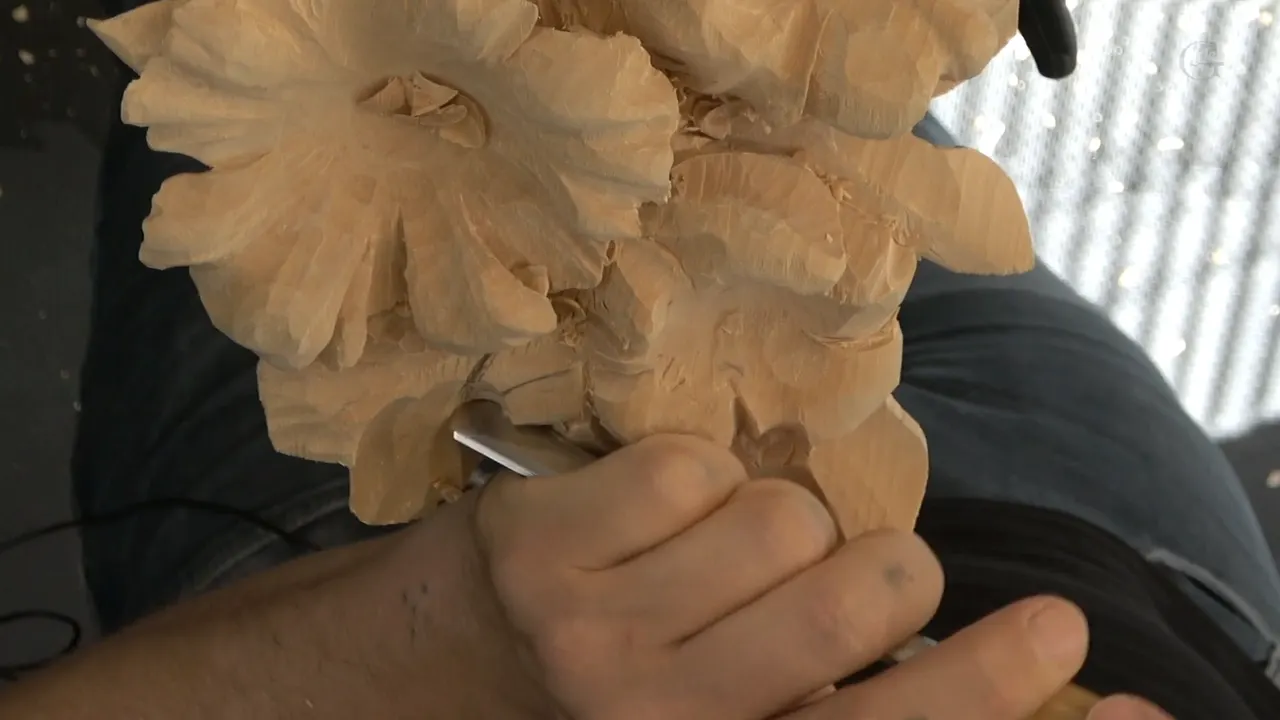
On the opposite side, where nothing is carved yet. Scooping wood out drops the surface itself, so whatever stands on it goes as well. I talk myself out of one in this lesson, mid sentence, and put it on the plain face instead. The detail survives and the movement still happens.
Ever spent a full hour on a shape and then wiped the whole thing out with one pass that seemed perfectly obvious at the time? Did you see it coming? Most of us do not, because a gouge going in feels like progress right up to the moment it is not.
Lesson 37 of the Hashemi flowers panel is mostly decisions. Where a hollow goes, which chunk to keep, when to stop pushing a petal that has started to flex. The carving itself is a V tool, a knife and four sweeps. What takes the time is looking.

What gets decided here
- One hollow moved clear across a shape.
- Looking at a lump twice.
- A parting tool laid on its wing and used as a chisel, which saves a swap.
- Mallet.
- Petals that flex under the blade before they break.
- Leaves from the middle of the group, and one from beneath a flower.
Where do you put a hollow when the detail is already carved?
On the opposite side. You can hear me work it out on camera: a really nice concave could go right here, then a pause, then the realisation that the concave would take the detail with it, then the hollow goes somewhere plain.
The trap is that both halves of that thought are correct at the same time. The shape does want a hollow there. It also has carved work sitting exactly where the gouge would run. Only one of those can win, and the one that wins should be the thing you cannot redo.
There is a second option people miss. Shrink the hollow. A shallower sweep held clear of the detail buys nearly all the movement and costs none of the work, and on a busy panel that compromise is usually the honest answer rather than a defeat. Undercutting work nobody will ever look at shows the opposite case, where the invisible pass is the one worth making.

What does a concave actually remove?
Everything above the new floor. Removal is the whole idea, which is also why people lose work to it.
Think of the surface as a level. Scooping drops that level across the width of the sweep and along the whole length of the pass. Anything standing on that patch was above the new level, so it goes with the waste. Twenty minutes of small gouge work, gone in a quarter of a second under a 9 at half an inch. Nothing warns you, there is no sound, and the surface afterwards looks perfectly good.

Why look at a chunk twice before you remove it?
Looking again is free. The wood is not. Later in this lesson I am about to clean a lump away from beside a flower, stop, and ask whether that lump could instead become leafage growing from beneath the flower.
It could. It does, and by the end of the lesson it is one of the better shapes on that whole corner of the panel. Same habit that saved three blocks in the lesson about leftover wood between petals, only here the pause happens with the gouge already touching the wood.

How do you turn a parting tool into a chisel?
You lay one wing flat and push. A chisel is a flat edge on a shaft, and one wall of a V tool is exactly that, just narrower and with a corner you have to respect.
I use it here to shave extra material off a future leaf while the tool is already in my hand for something else. No swap, no reaching across the bench, no putting down a tool that is cutting well. The corner will dig if you let the handle drop, so keep the wing flat and take a thin pass. Why the V tool goes in first on this panel explains why it is in my hand so often to begin with.

Can you hit a V tool with a mallet?
I reach for one in the second part without making anything of it.
People treat a parting tool as a hand tool only, because most of its work is fine. Undercutting deep between two shapes is not fine work. Deep undercutting is a long pass into resisting wood, and a mallet gives a controlled push no arm can make at that angle. Light taps, and the mallet stays in the hand that is not steering. The tool is doing the same thing either way; you are only changing where the force comes from.

Which tools carved this lesson?
Six, and the two that do the real deciding are the two cheapest things on my bench.
| Job at this point | Tool | Why that one was chosen just then |
|---|---|---|
| taking out a ridge | the 5 at one inch | a wide sweep leaves no step behind it at all |
| separation, and the main form of a new leaf | plain carving knife | quicker here than any gouge on the rack |
| subdividing into five | the Pfeil 16 parting tool, six millimetres | boundary now, shadow later |
| rounding the petals over | a 7 at 20 mm, three quarters of an inch | the curve is already in the sweep |
| the hollows | a 9 at about half an inch, then a small 9 at 4 mm | big movement first |
| cleaning, and the last of the movements | the 4, then the 5 | nothing left for the light to catch on |

What is zigging, and why does it matter under a petal?
Working the tool left and right as it goes in, rather than driving it straight.
Push straight in under a petal and the tool wedges. The wood ahead of the edge has nowhere to go, pressure builds, and the petal lifts before the waste breaks free. Rocking as you advance shears a little at a time and lets the chip clear. There is the difference between an undercut and a repair.
It also tells you when to stop. The moment the chip stops clearing and starts packing, the tool is wedging again, and one more push is how a petal comes off in your hand. Back the tool out, clear the waste, go in again. Whether a carver has a favourite gouge turns out to matter far less than whether he notices what the one in his hand is doing.

Why take five shallow passes instead of one deep one?
A shallow pass can still be corrected. A deep one has already happened. My own words going into the subdivisions here are that I am about to make serious cuts, multiple cuts, preliminary.
Preliminary is the word that matters. The first round of separation around a petal is not meant to reach the floor. It marks where the boundary runs, leaves the wood on both sides of it intact, and lets you look at five petals together before any of them is committed. Then you go round again. A carver who reaches the floor on the first pass has decided everything before seeing anything, which is how a panel ends up with one petal that does not belong. The corner of a fishtail gouge is what cleans up those boundaries afterwards.

Should you turn the panel, or move yourself?
Turn the work. Always, and it is the cheapest habit in carving.
Halfway through the first part I say let us rotate and attack from a different position, and the reason is that your arm has one good working arc while the wood has four sides. Reaching across a panel to keep it facing you puts your hand over finished work, changes the angle your wrist can hold, and pushes the tool where the grain does not want it. A carving post or a pair of vises makes this a two second move. Keeping the carving clean as you work is the same kind of small discipline, and it pays back the same way.

Does shape really come before detail?
It has to, and this lesson says so out loud. Overall shape established, now let us work on details.
Put detail on a surface you have not settled and you are writing on paper you are still folding. Every later pass that changes the form eats some of it. The order is not a style choice. No other order avoids wasting your own work, so the first three minutes here are all big sweeps and nothing fine at all.

What do you do when a petal starts to move?
You notice, out loud if it helps, and you change how you hold it.
By the third part of this lesson a petal flexes visibly under the blade, and I say so while it is happening. A shape that moves is telling you two things: it is thin, and the pressure you are using belongs to a thicker piece. Support it from behind with one finger, lighten every pass, and stop reaching across the panel to get at it. How thin a carved leaf can go is the sister question, and flex is the warning that arrives before the crack.

Is working against the grain ever fine?
Here it is, and I say plainly on camera that I am going in a direction I am not supposed to go at all.
The condition is the edge. Sharp, and a pass into the grain costs you a torn fibre you pare off afterwards. Dull, and the same pass tears a hole through a petal that took forty minutes. On a flower nothing runs in one direction anyway, so the choice is not really between with and against. The real choice is between a sharp tool and a slow repair.

Where does a new leaf come from?
Out from beneath something, nearly always, because that is where a plant keeps its leaves.
Two kinds show up here. Some grow from the middle of the group, which is the obvious place and reads as a bunch. One grows from under a flower, the interesting place, and it reads as depth. That second kind needs wood you deliberately left standing, which is why the two habits in this lesson turn out to be one.

What does a natural movement look like on a leaf?
Up, then down, then back. Three changes of direction along one edge, and I describe exactly that while looking at the leaf in the third part.
A leaf that only goes one way reads as a ramp, which is the same mistake a petal makes. Give the edge a rise near the base, a fall through the middle and a small return at the tip, and the light has to cross three different faces to get along it. People calling a carving alive usually mean exactly this, and it costs nothing beyond deciding before you carve. The veins carved into a peony leaf then follow whatever movement you chose, so the movement goes first.

What did my own teacher do about decisions like these?
He made me think like a tool.
At sixteen I was the only apprentice to a fine art master in Russia, a proper European apprenticeship, and the lesson that still runs everything I teach came from him. Design is not drawing on paper. Design means the laws of space, rhythm and repetition, and knowing what each tool will do before it touches wood. He kept me away from any hard pass until I could say out loud what the wood would do. A carver who thinks like a tool never scoops through his own detail, because he has already watched the pass happen in his head.

Where this leaves the panel
Another flower divided into five and rounded over, two leaves shaped, one hollow shifted clear across a shape, and a petal I now handle carefully. Nothing is finished. Everything has a direction.
All 49 lessons sit behind tuition at the school. The panel is basswood, the American lime behind every panel course here, carved with a mixture of Ashley Iles, Pfeil and Henry Taylor. If you want to see decisions like this one made well, the sculpture rooms at the V and A are full of them, and Grinling Gibbons never once scooped through his own work. Read whether a carved flower has to look realistic beside this one.

How it's done
- Say the hollow out loud before carving it. Name where it would run and what sits on that patch. Half the bad passes in carving are ones nobody described to themselves first.
- Move it to a plain face, or shrink it. A shallower sweep held clear of the detail buys most of the movement at none of the cost. That compromise is usually the right answer, not a defeat.
- Look twice at any lump before removing it. Wood standing in the shadow of a flower is a leaf waiting to happen. The second look costs nothing and the wood cannot be put back.
- Separate with the parting tool, in stages. Multiple preliminary passes rather than one deep one. Mark the boundaries of all five petals, look at them together, then go round again.
- Rock the tool when undercutting. Work side to side as the edge advances instead of driving straight in. A straight push wedges, and a wedge lifts the petal before the waste breaks free.
- Turn the panel rather than your arm. Rotate the work so every pass lands inside your one good arc, the one your wrist can actually hold. Reach across finished carving and it stops being finished.
Frequently asked questions
Can a concave cut be undone in wood carving?
Hardly at all. You can lower everything around it until the hollow stops reading, and that costs depth you may not have. Treat every hollow as permanent and place it accordingly.
Why is my carving detail disappearing as I work?
Almost always because a later pass with a bigger tool is dropping the surface the detail stood on. Fine work should follow the form, never come before it.
Is it safe to use a mallet on a V tool?
It is, for deep undercutting where an arm cannot make a controlled push at that angle. Light taps, and whichever hand steers the tool stays off the mallet.
What to carve next
- Carving Hashemi Flowers
- The leftover wood between the petals
- Does a carved flower have to look realistic
- The veins on a carved leaf
- Do carvers have a favourite gouge
- What a fishtail gouge is for
- Why the V tool goes in first
- Keeping a carving clean while you work
- How thin should a carved leaf be
- Undercutting work nobody will ever look at
- Tuition at the school