
Alexander Grabovetskiy, woodcarver, School of Woodcarving · Published 2021
What does a wood carver mean by "redesign"?
Quick answer: Venice Room 131, video 3, has me saying I can redraw everything and just redesign if I need to, after calling the bigger tool much quicker. In other lessons the same word sits beside broken wood, a knot, a hidden basket and two panels.
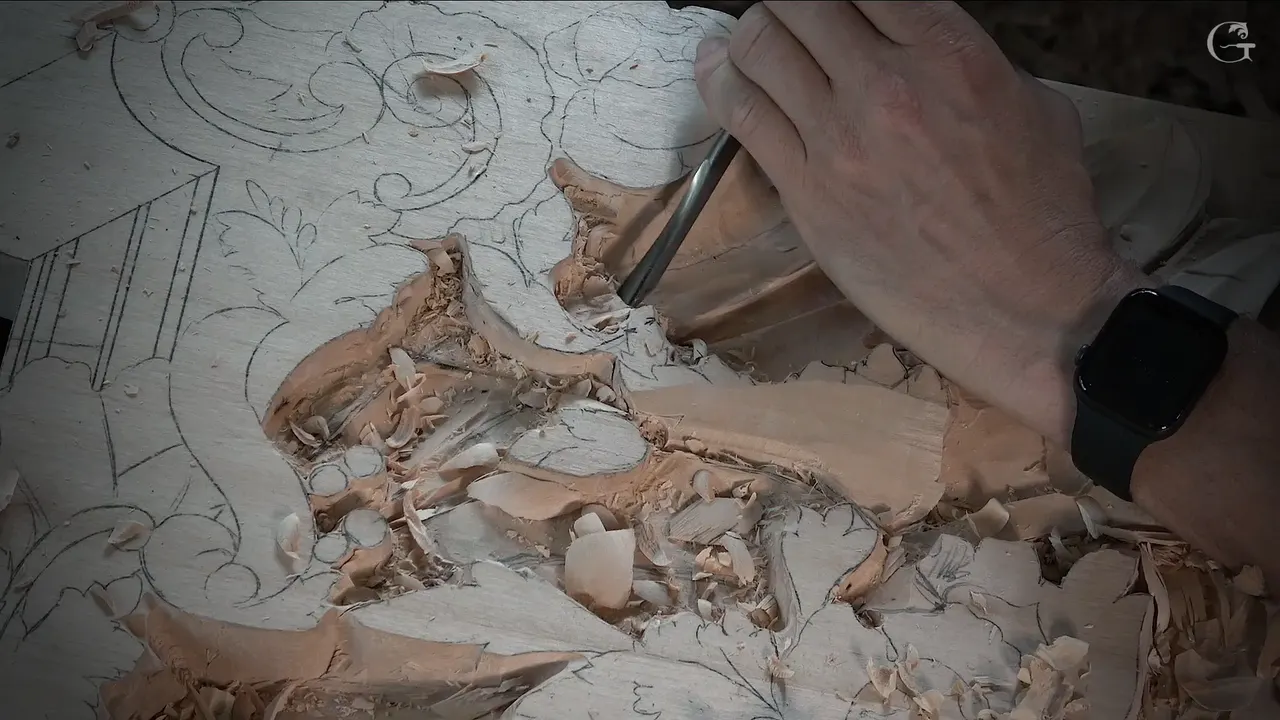

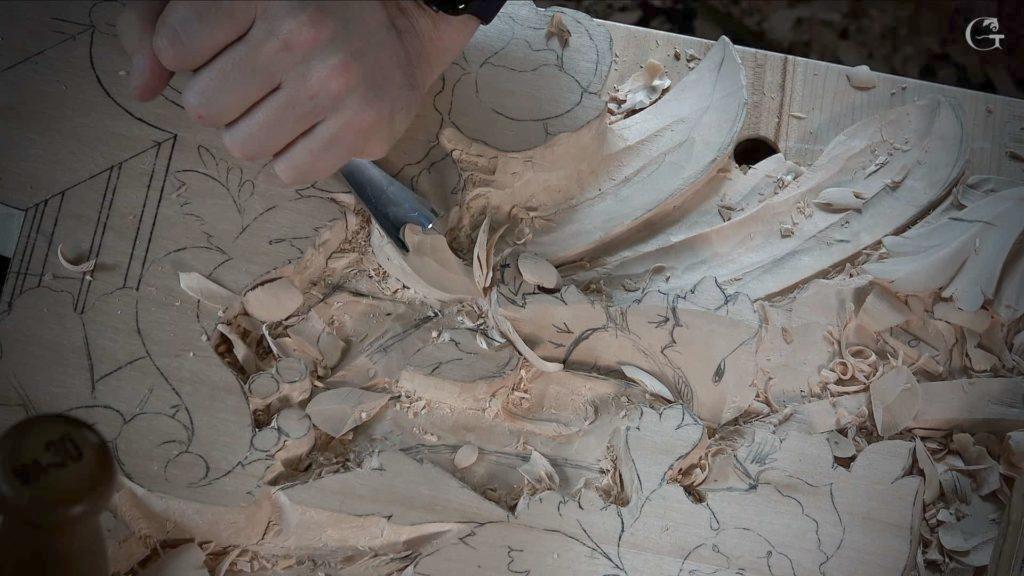
In video 3 of Venice Room 131 I say that a bigger tool is "much quicker" and that I can "just redesign." Below, that word follows me through other lessons of mine, and every line has a cue behind it.
Ever stood over a leaf you drew on paper and seen it look different in the wood? Maybe a knot opened up, or a gouge took more than you meant. Here is what I said, and where else I said it.
What happens in part 3 of lesson 131?
The part opens with clean-up. I could, I think, adjust a little bit "just to get rid of some of that" and then, "Let me see what is going on on the side. So let me clean now all that mess." Then, "All that mess has to be gone." Number nine is the tool I name, and then, "It could be number 11."

Next comes the leafage. Probably I can "start developing" it right there, but I "need to create a better shape first." For that job I will probably get a "big number seven" to "remove a little more material."
A bigger tool brings a remark: "Just much quicker with the bigger tool." The line this page is about follows. "That takes me a couple of seconds, and I can redraw everything and just redesign if I need to redesign."

After that a smaller tool comes up: "Let me get number 11 and clean a little bit this section." It is "obviously" going to be undercut, I say. The plan could be to "go even with the smaller tool right away, like number 11 and maybe 3 millimeters" (about 0.12 in), a little deeper underneath that long leaf, "even if I'm not done with that." That will be "easier for me to establish the line drawing," I say. A size of "maybe 2 millimeters right away here" (0.08 in) comes up too.

A line about the shadow follows. "You can see shadow revealing, it's a really, really deep shadow, beautiful, that's what I'm after." Then my plan: "let me redraw, redesign, and I'll catch you after that."
What comes after is "not going to be as complicated" and I call it "a really interesting movement." The leafage is "not a canvas," just "some type of leafage" and I plan to add "some kind of classical elements." I think it will look really good.

From there the parts go one over another: "that part going to go underneath of this line" and at the end, "all that part going to go underneath of that line." The picture I give is "just like stacking on each other."
My plan is number 11 at 12 millimeters (0.47 in), to start "the most far part, I guess." It will be "the lowest part." The plan is to bring it "almost really close to the height of my long leaf because it has to feel like it's actually laying right on top of it." My figure carries a maybe: "about one-eighth of an inch, 3 millimeters higher."

Number seven comes up: "it doesn't matter, I actually can take number seven." Then the move: "gradually move downhill this way." After it, a smaller one, number 11, will "go right underneath, which means I really have to undercut," though "not deep undercut yet. So just preliminary."
Then comes a change of mind: "Well, actually, you know what? I can do it right away. Same idea." Then, of this small leaf, "it's going to grow from underneath of that one." Next on my list is number seven, and I will "create the concave this way."

I say one of the edges is "going to lay almost on top of this design" and I plan to "redraw a little bit the idea." That part will be "gone," I say, but it will "give me some shadow spot. Beautiful shadow spot."
A choice comes next: "I need to make the decision how I want to see this." Concave it "over this side or opposite direction"? I think I would "just create the opposite direction concave" with "Same number seven" and "I'll roll it this way."

Where else do I say redesign?
The same word turns up in other lessons of mine, beside broken wood, a knot, a hidden basket, drawings that fell short, and two panels that have to match. Every line below names its own lesson and video.
What comes with redesign when a piece breaks?
In Byzantine Acanthus 6, video 3, a piece breaks, and I say "Oops, I broke something." Then I put the question and the answer in one go: "If I broke something, what do I do? You just glue it, no, I'm going to redesign it." Next, "It meant to be." Further on I say, "I need to make it little lower" and "going to make better sense because I really need to blend everything" follows.

Byzantine Acanthus 9, video 2, brings the word after a note on relief cuts where leaves separate: "You have to relief first." Then, "See, I already made a mistake." Then the question: "So what do you do if you make mistake? Redesign it. What mistake?" I am "not going to change too much shape, but be careful" and I would use "probably smaller tool next time."

In Roman Acanthus 2, video 4, I talk about glue. "Not all of carving you can just glue back, and it's better not to glue anything," I say, and "I prefer not to glue." My line for a break: "if I broke something, let it be. That means it meant to be like that. Just redesign around that broken part."
I use "number seven, half an inch, 13 millimeters" there, for my "preliminary background," while I am "still establishing the main form, the main movement."

The Tray of Blessing 6, video 3, comes with a grain problem: "see I'm catching the grain so that means I can't force it." A mistake is on my mind: "that would be big mistake if I would just continue that." Then I ask, "what do you do when you make the mistake like this" and answer, "Redesign? Redesign, yes. Create even more beautiful design."

What goes with redesign when a knot shows or a drawing falls short?
In Lily Box 6, video 11, a knot shows: "a lot more damaged, not damaged, but knot on inside than I expected." Then, "Maybe I have to redesign something in this area, because for now it doesn't look too good." "Lots of it" will be covered with the flower, I add, "but still." After that I say I will probably need "something smaller to work on the side here" and "Let me try 2 millimeters number 11" (0.08 in).

Lily Box 3, video 8, uses the word as a limit: "I'm not doing too much redesigning" and "it still just stays in the same boundary, original boundary, what I designed before." A warning follows: "please don't make that mistake. Don't make that mistake. Don't jump." No cuts straight down with the gouge right away. The relief cuts come first, with "a 1/16 of an inch or approximately couple millimeters tool" (about 1.6 mm).

In the first video of that lesson I say I want to be "close to my original design, but if I'm a little off, I'm okay also." One more line: "sometimes you have to change that design, which you design on the paper, slightly on a piece of wood, because when you see how it looks in real life." I used "number three and about 10 millimeters" (0.39 in) "to redefine my form right here."
In Venice Room 75, video 10, it is plain: "I just looked at it, and it didn't make too much sense, so that's why I changed the design, it doesn't change overall movement, it just changes minor details." I plan number 11 at "5 millimeters, 3/16 of an inch." My reason: "on a paper, sometimes it looks one thing, but in real life, it just doesn't look too good."

In Greek Acanthus 5, video 1, I say "we lost a lot of fine details on the outside." About one leaf, the change goes "a little more underneath." Overall, "I didn't lose too much of the details."

Over in Venice Room 3, video 12, a small figure comes up. About a design change I say, "I'll do a little bit, like in case, like here, I just moved approximately eighth of an inch, about three millimeters."
In Venice Room 53, video 3, I say, "I have to change a little bit the design." And then, "I am changing my design, okay? Not changing design, it's still same flow, but I am changing little bit how it's going to feel overall." I say I "really like the idea that I moved my middle line to this direction."

Which changes wait until later?
In Hashemi Flowers 6, video 5, I plan a V-tool for my cleaning cut, and I name a later job: to redesign "the main movement of the basket, which is hidden underneath." Then a mallet: "barely hit the mallet, okay?"

Tray of Blessing 2, video 2, has a short one. "That's what I do sometimes," I say, and then, "you redesign stuff right on the fly, you know, just you think, oh, it's gonna look better this way now, but I have to be careful." My next plan is to clean this up a little bit.
In Floral and Molding 6, video 1, I want to check my previous piece: "How deep it rolls. It actually rolls differently a little bit." A slight change comes to mind. Then, "maybe just start my movement from all the way here" and it might look "more organic," though "I'm not sure." A quarter-inch knife (6.35 mm) is my plan.

Video 2 of that lesson has a line about finishing a detail. Some people tell you to take it to the finished look, and others say you will have a chance to clean later. "I probably belong to second group because I do a lot of changes sometimes on design later on," I say, and "a lot less frustration" comes if I "change some movement," because "I didn't spend as much time." The finished look waits for "that final stage, at the cleaning stage."

Modern Acanthus 3, video 2, says it nearly the same way: "don't overdo it. Okay, if you're gonna overdo it you're gonna get frustrated because we could probably later on change the design." And, "I'm working on overall project first."
In Furniture Panel 17, video 4, a warning about depth comes up: "if you dig too deep inside of this detail, you'll break that detail" and then the choice is to "redesign everything or just remove deeper your background." A number seven for chopping "a little closer to the final line" is my plan.

Where does the design have to stay put?
The limit in Furniture Panel 16, video 10, sounds like this: "I don't want to make again the mistake what I made before. I really want to save those points of the leaves." The rule: it is okay for one panel, but "not okay if you have to do multiple panels, like two panels which supposed to be symmetrical to each other. So you can't really change too much."
And, "you could change to the certain degree, but then you have to do it on both panels. But it is not the best."

In Lily Box 5, video 10, the design stays put. I use a number 11, "again, one millimeter" (0.04 in), to give a shadow line and an undercut. You "could wait until this step," I say, but I do not expect to change the design, so I do not think an undercut right away is a problem for me.
Does the word come back in Venice Room 133?
Venice Room 133 follows lesson 131 in the same room. Video 2 has me saying, "I need to redesign how I want to see this guy" and "I'm going to redesign it." Another thought: "maybe I can actually do something interesting and get one of the sides to go right underneath." Then comes doubt: "I'm not sure. Maybe not."

A long leaf is near it again, as in lesson 131: "let me reestablish some separations. Again, this side has to go all the way down underneath of this leaf." And, "that side is flipping above that long leaf." For some of the excess material, I plan to use number 11.
Five kinds of spot where I said redesign
| Beside | Where I said it |
|---|---|
| A bigger tool and a long leaf | Lessons 131 and 133 of the Venice Room, videos 3 and 2 |
| A piece that broke | Byzantine 6 and 9, Roman 2, Tray 6 |
| A knot or a drawing that fell short | Lily Box 3 and 6, Greek 5, Venice Room 3, 53 and 75 |
| A later change, or one on the fly | Hashemi 6, Tray 2, Floral 6, Modern 3 |
| A dig that went too deep, or a design that stays | Panel lessons 17 and 16, Lily Box 5 |
Where did a pencil line of yours stop matching the wood? All the videos for this panel sit inside one tuition plan. On the Part 11 course page you will find workshops 122 to 131 of this wood carving room, and lesson 131 holds all three videos. Lesson 130 comes right before it. Tool sizes in millimeters and inches stay as I said them, and the design stays yours.

How it's done
- Take a bigger tool. The words are "Just much quicker with the bigger tool," and "That takes me a couple of seconds."
- Redraw, then redesign. After the shadow line I plan to "redraw, redesign."
- Go smaller. A smaller tool is in my plan, a number 11, for going deeper next to the long leaf.
- Look at the shadow. A really deep shadow shows, I say, and "that's what I'm after."
- Plan the lowest part. I plan to start the lowest part with a number 11, almost close to the height of my long leaf.
Frequently asked questions
What did I say right after redesign in lesson 131?
Right after, I said I would "clean a little bit this section" with number 11. A smaller size came up too, maybe 3 mm (about 0.12 in), for going deeper beside the long leaf, with the word "obviously" said before an undercut.
Which tools came up in part 3 of lesson 131?
I named number nine, plus number 11 as another choice, a big number seven for more material, and a smaller number 11 beside the long leaf. My plan for the lowest part was number 11 again. Number seven came up for a concave, and it came back with the words "Same number seven."
What did I say about redesign after a break?
In Byzantine 6, a break brought the words about a redesign instead of glue. Roman 2 says to just redesign around that broken part. In tray lesson 6, redesign was my answer to a mistake.
What to carve next