
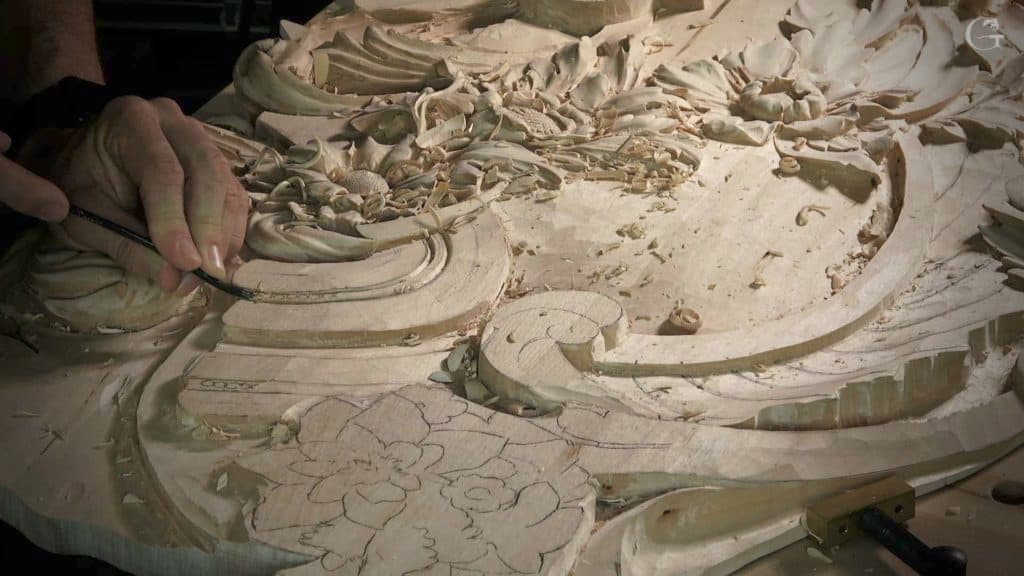
Alexander Grabovetskiy, woodcarver, School of Woodcarving · Published 2021
What does a wood carver mean by "appropriate"?
Quick answer: In Venice Room 140, video 3, I called a 2 millimeter number 11 a more appropriate tool once I got to the beads, after a 4 millimeter looked big. In other lessons I use the same word for gouges, skews, knives, V tools and a jigsaw blade.
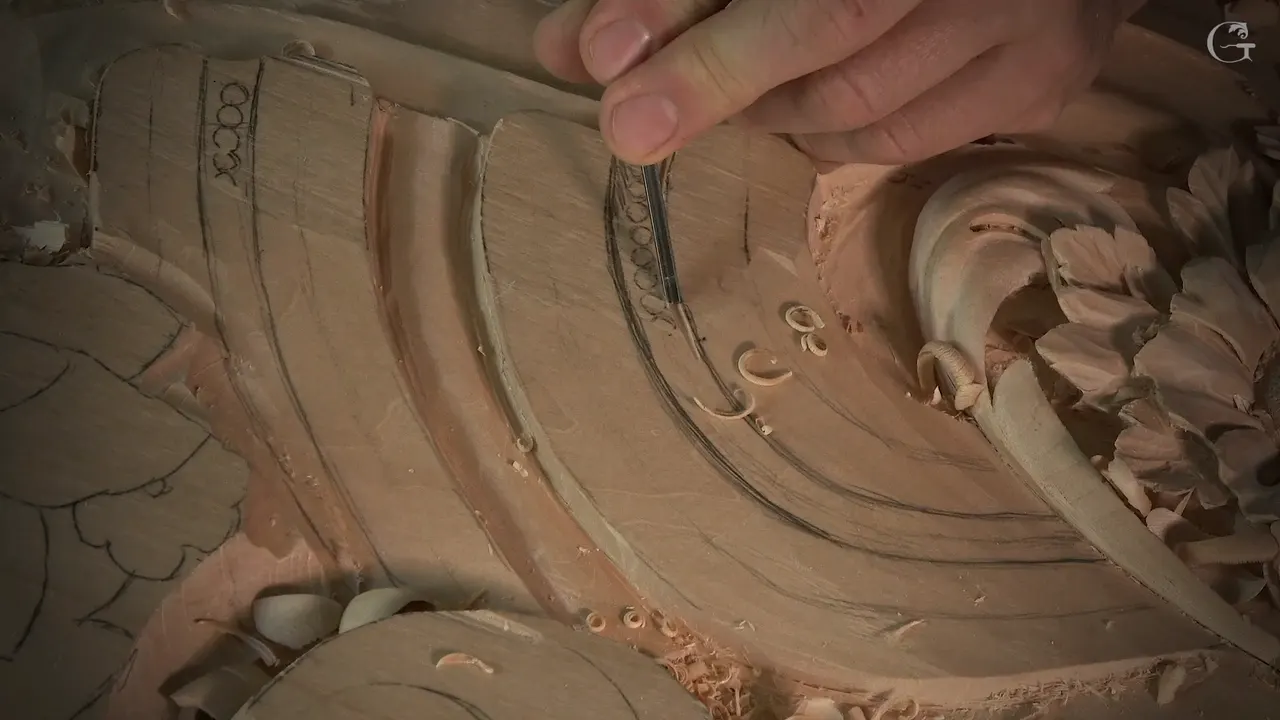

In Venice Room 140, video 3, I tell you "Maybe 4 millimeters is a little too big. Maybe I'll just use 2 millimeters" and then "I think 2 millimeters would be a more appropriate tool for this." The word comes back in my Hashemi, Furniture Panel, Greek, Corinthian and Hazelnuts lessons, beside gouges, knives, skews and V tools, and even a jigsaw blade. My own lesson is first below, and the others follow, grouped by the tool.
Ever stood over a drawn line with a chisel in your hand and asked yourself whether it was the right size? Did you wonder if a smaller one would keep the wood from tearing? You know the pause, then. Below is what I said before each choice, one lesson after another, with the sizes I named.
What was the 2 mm tool for in video 3 of lesson 140?
Beads. The video opens with "So I want to make sure I have plenty of material for the beads" and the size question comes next. A 4 millimeter tool (5/32 in) is "a little too big" and "maybe I'll just use 2 millimeters" (5/64 in). I also admit "yes, I am eyeballing" and I try to get "nicer lines." Before the first pass I stop: "Let me think first."
One side is a little wider, and I tell you so. The distance "here and here is supposed to be equal, but looks like I've got this side a little wider." My plan is to stay "a little bit on the side of the line."

My first pass will be a number 11, 2 millimeters wide: "my first cut" and "the bead's going to go all the way." A screen shows it differently. On a screen the piece "doesn't look as nice as it looks in real life," I say, and in real life it "just looks much better." About the view I add "even this one just shows you a bigger picture."

I plan "at least one cut" right away. About the mess around it, "I'm going to probably do it off camera," I say, "but you'll get an idea." After that I can go "deeper and closer to the final beads" and I could use 3 millimeters (just under 1/8 in), a number 11 "of course."
What did I say when the tool started to tear?
"And that's probably it. Cannot go deeper than that. It's already tearing, and I have to switch again to 2 millimeters to get that much cleaner." Before the switch, I say, I want to "take a back bend."

Henry Taylor makes the back bend I plan to use, a maker whose tools I "kind of like" for how they feel. It will make "preliminary convex" and I call that "only the first step." Another tool is planned to "get rid of edges" and I note it is "a good idea to attack that from the other side."

A different back bend is next, "number eight." Its stamp is next. "Don't pay attention to number two." It is "just the way Swiss made they mark it." An eight "means it's a sweep, number of sweep. So the curvature." Six millimeters (a bit under 1/4 in) is "a quarter inch" in my words, and my plan is "just a quarter-inch bead."

Did the same size question come up in the other two videos of lesson 140?
The size comes up in the other videos too. Video 1 returns to "the same tool, maybe even just the 30 millimeters" (about 1 3/16 in), a number 11 "of course." In video 2, I plan a 4 millimeter to clean "all that mess" and then I say "I could use probably smaller one, maybe 2 millimeters." All three belong to lesson 140.

Which big gouge was appropriate for a quicker pass in my other lessons?
Hashemi Flowers 8, video 2, starts with a number three. Then a second thought: "I could use a bigger number seven, actually." The seven is "appropriate" in my words. The one-inch seven (about 25 mm) is named for its gain, "a lot quicker move, a lot cleaner cut in a single pass."

Number five, "about 20 millimeters" (about 0.8 in), is "maybe appropriate" in the twelfth video of Furniture Panel 21, "to use it right here" with a mallet planned to help. The movement is "a beautiful movement," I say, but "I got to be careful," because "it's becoming more fragile and fragile."
Number nine or number eight is my plan in Greek Acroterion 1, video 3, at "about 3/8 of an inch" (about 10 mm), to "just work my way in." The mallet gets praise as one of my "favorite tools in wood carving" because I "can easily control" it and "take little by little." The last knock calls for care, because "I can actually make a damage."
Across the grain, a bigger tool is the call in Venice Room 148, video 3: "probably 20 millimeters" (about 0.8 in), "maybe even number nine." The word I give it is "probably more appropriate." A little later: "I'm not going all the way to the line."

How small can an appropriate number 11 get?
Venice Room 62, video 12, names a veiner, number 11, 7 millimeters (about 9/32 in), and then a second thought: "Maybe I can take just number six or seven." The test is stated outright: "see if" it is "appropriate right here." The pass is "preliminary cut" with "a clean cut" later, and I stop short on purpose to "preserve wall of this element."

Depth is the point of Furniture Panel 22, video 1: "a deeper cut" then number nine, or "even actually, I can start with the number 11" at 3 millimeters (0.12 in). That is "also appropriate," I say. Then comes "That's going to give me really good depth." A concave or a convex "can go sometimes both ways."
Four millimeters (5/32 in) is the size in Venice Room 146, video 1: "I think it's going to be appropriate and create even deeper shadow." A short "Why not" follows, and a plan to undercut "right here."

Choosing is still going on in Corinthian Acanthus 4, video 1. "The next step would be to take a smaller gouge," I say, and "let me think which one is going to be appropriate." The pick is hedged: number nine, "but I would probably use around half an inch" (about 13 mm).
A starting place is the subject in Venice Room 102, video 1. A transition "has to be a really nice transition" in line with the "overall design." A convex that starts "right on this line" is what I call "appropriate." Width has a limit. "I don't want to do too wide."

Is a V tool appropriate for the in-cut on a hazelnut?
Carving Hazelnuts 3 gives the V tool its place in video 1, "if you have a V tool" as the "appropriate tool to create that in-cut." Depth is "maybe nine millimeters" (a bit over 1/3 in), and a caution rides along: "Really be careful because you are carving right inside."

When was a back bend, a skew or a straight gouge appropriate?
Hashemi Flowers 13, video 3, repairs my own word before it names a tool: "the piercing" is "a more accurate description" than the gap. The back bend is "also appropriate" with maybe a number 11 "to clean it." The aim is "not to hit with the tool any of the edges" and my finger becomes a "leverage point."

Skew is the pick in Venice Room 49, video 8. "I could use number 11, but I don't have to." Number three could work, or "just even skew" and "That would be appropriate in this case, just a skew." The aim is an "eye shape" on both sides, going underneath.
A straight gouge, number seven, could bring a side "to the center line" and that is "also appropriate." Greek Acanthus 7, video 2, moves on to "clean that pipe."
Was a knife ever appropriate instead of a gouge?
Yes, beside a V tool. Flower Rosette 4, video 1, plans "my V tool" for the initial pass, and the knife is "also appropriate in this case."
Fragile wood sets the scene in Greek Acroterion 4, video 7, where "if I'm pushing too much, I can break it." A knife is the tool of the moment. A gouge would be "appropriate too" and my reason for the knife is "probably some of you don't have too many gouges to choose from." I add "it's a good idea to have them."

A ridge left by my tool leads to a knife in the first video of Greek Acanthus 6: "I could use knife again" and I call it "appropriate." Care comes with it, "without damaging the middle line" and a V tool again "if it's not flying out like this."

The knife in the tenth video of Furniture Panel 22 is "just the number 12 knife, and that's a Swiss Made" and "one of my favorite knives." Straight down at "90 degrees" would "not be appropriate." What I could do instead is "probably give right away somewhat undercut," leaning "little inside, inward." For a quick job, "I love that approach myself" and "there is some limitations of this approach."

A name earns it in Greek Acanthus 4, video 4. I am "slicing it," from the right-hand side of my sweep to the left-hand side, and "Some people call it carver's cut, which is appropriate."

Where else did I call something appropriate?
Depth gets it in the first video of Greek Acroterion 2: "I don't want to go too deep," I say, and "about maybe halfway" is the depth I call "appropriate." To find halfway, "I'll just eyeball it" with my middle finger against the wood to "find my midpoint." Then "I'll just divide it in a half."

A direction gets it too, in Venice Room 43, video 9: "I could get this movement from down below upward like that." That move is "also appropriate," I say, and I add "That would look good."
A whole design earns it in my beginners' workshop 2, video 6. I tell you "don't get frustrated" when the first try does not give the same result, and "The worst thing what can happen, you just buy a new piece of wood and keep trying." Then: "the frame around the picture" gets "that type of carving," "also really appropriate." Some more V cuts are planned.

A word gets it in Hashemi Flowers 30, video 2. Of "waviness" I say "I'm not sure if I even can say waviness, if that is appropriate word." Smaller tools "later on" refine it.
And a blade can be wrong, in Venice Room 1, video 7. The jigsaw blade is "not appropriate blade for that thick of a wood, so I shouldn't do that" and I say "I'm going to use progressive. That's the way to go."

Even glue is on the list, in my April 2020 livestream. A brown glue line "distracts the eye" on lighter wood, but "You could use Titebond III on a darker wood or if you're planning staining. So that would also be appropriate."
Where does each tool sit in the lessons I named?
The table keeps one row for each lesson that names a tool, with the size and what I said.
| Lesson and video | Tool I named, and its size if I gave one | What I called appropriate |
|---|---|---|
| Lesson 140, third video | Number 11 at 2 mm (5/64 in) | More appropriate |
| Venice 62, twelfth video | 11 veiner, 7 mm (about 9/32 in) | A test |
| Hashemi 8, second video | A bigger one-inch (25 mm) number seven | Bigger seven |
| Furniture 21, twelfth video | Number five, and a mallet to help | Maybe appropriate |
| Acroterion 1, third video | Number eight or nine gouge and mallet | Working in |
| Venice 148, third video | Bigger gouge, maybe number nine, across grain | Across grain |
| Furniture 22, first video | Number 11, 3 mm (a bit under 1/8 in) | Deeper start |
| Venice 146, first video | 4 mm (about 0.16 in), for deeper shadow | Deeper shadow |
| Hazelnuts 3, first video | V tool, in-cut, if you have one | Appropriate tool |
| Corinthian 4, first video | Number nine, half an inch (13 mm) | Still choosing |
| Hashemi 13, third video | Back bend, then maybe a number 11 | Also appropriate |
| Venice 49, eighth video | Number three, or just even skew, underneath | Just skew |
| Acanthus 7, second video | Straight gouge, number seven, to the line | Center line |
| Furniture 22, tenth video | My number 12 knife, leaning inside, inward | Not appropriate |
| Rosette 4, first video | Knife, beside my V tool, for starting | Initial pass |
| Acroterion 4, seventh video | Knife or some gouge, on fragile wood | Appropriate too |
Which tool on your own bench would you call appropriate for your next wood carving pass: gouge, knife or V tool? Every lesson named here opens with access to the school, paid monthly or yearly and renewed automatically until you stop it. Lesson 140 lives on the Part 12 course page, with lesson 139 before it and lesson 141 after. Venice panel work, relief in the Hashemi flowers, acanthus leaves and glue are all part of wood carving.
How it's done
- Size the tool down. A 4 millimeter tool looked big, so 2 millimeters was my plan for the beads.
- Stay beside the line. One side of my layout came out wider, so I planned to stay a little on the side of the line.
- Go deeper with a bigger tool. To get deeper and closer to the final beads, I thought I could use 3 millimeters.
- Switch back when it tears. Tearing stopped the deeper pass, and the plan was 2 millimeters again for a cleaner surface.
- Plan the back bend. With the back bend, the plan was a preliminary convex, then another tool for the edges.
- Name the last tool. A back bend, number eight, 6 millimeters wide, for a quarter-inch bead.
Frequently asked questions
What size got the word in video 3 of lesson 140?
A 2 mm number 11, about 0.08 in. A 4 mm tool, about 0.16 in, looked a bit big to me as the beads began, and I told you I wanted to think first.
What happened when the wood began to tear?
"Cannot go deeper than that," I told you, and "It's already tearing." A switch back to 2 mm (about 0.08 in) was the plan, to get a much cleaner surface. Before that, a back bend was planned.
Which back bend made the preliminary convex?
The one by Henry Taylor, a maker whose tools I kind of like for how they feel. It was only the first step. Another tool was planned for the edges, and a different back bend, a number eight 6 mm wide (about 0.24 in), was next.
What to carve next