

Alexander Grabovetskiy, woodcarver, School of Woodcarving · Published 2020
What do you do when something is not helping your wood carving?
Quick answer: A thing that is no help is my name for what fails to make a pass easier. In my workshop 30 part, the grain ran against my carving, I said so three times, and I thought of attacking it with maybe a smaller tool. The job, I said, would take a little longer.
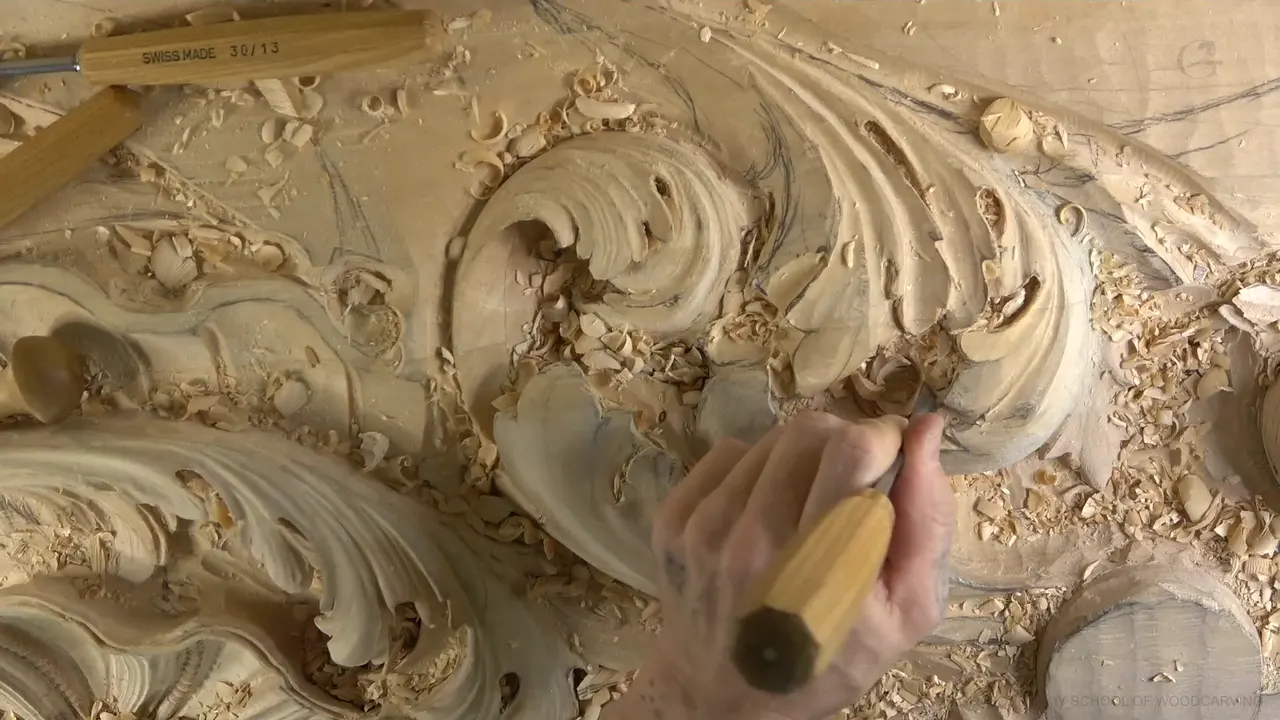

Not helping is my plain way of saying that the grain, a tool or the light is not making the work easier. In part 6 of Venice Room workshop 30, I said the grain was not helping, and then I looked for another way in.
Ever pushed a gouge into wood that fights back? Ever tilted a piece to catch the light and still seen nothing? This part has just 354 words. The rest of the page sets twenty-one of my other video parts beside it, one "doesn't help" after another.
What slowed me down in this part?
The part opens with me going deep, and by 00:16 I said I could go deep with that technique. Twice more I said to get even deeper. Then the doubts come. The right depth was unclear to me. Nor was I sure I should connect an opening. Logically I could, because I still had to undercut, but I did not know whether the inside would look too empty.

By 02:04 I called it probably deep enough. Undercutting could start this way, I said, and this direction also. Same tool or something else? My pick was a smaller one, "maybe number nine at first," to get a little cleaner.
Then the back bend came up, and at 03:44 I said, with it, I could probably attack from that side. A big one, all the way at the inch (25.4 mm), would go in too, but I did not think I needed it. Half an inch (12.7 mm) was my pick. At 04:17 came "The idea is the same. Just go in."

At 04:34 I named a spoon gouge, number nine or even number 11, and said ten millimeters (0.39 in). That is a hard area, I said. Maybe not the spoon, then, but the medium bend. Later, at 05:40, I wanted to see if I could use a little bigger one.

What was my plan for the grain?
At 05:59 I called carving against the grain not really helping. The same words came again at 06:08, and once more at 06:13 with "at all" on the end. Three lines in a row. Then came my plan: "But I have to attack it somehow, maybe with a smaller tool."

It was going to take a little longer, but I needed to excavate all that stuff from underneath, I said, and go "maybe up." Next, at 06:48, I told you that you don't see what I'm doing, "but it's deep." Then 07:12 brought "probably good from this side."

Where else did the grain not help?
Six other parts say it out loud, and three of the six come with a way around it. In my own part the way was a smaller tool. The others start with the Greek Acroterion course.
Lesson 3, part 4, has me making "my rotating move" while the grain ran against me. "And against the grain is not helping," I said at 01:32. Then I said to take this concave all the way to the middle section. Next came "Let me try from this side," at 01:54. The cut would be much cleaner from there.

In the Hashemi Flowers course, lesson 12, part 8, my cut went uphill, and the grain was against me, "which doesn't help at all." It was not my clean cut, I said. I "can always come back and clean it from the opposite direction." For now I really could not make that cleaning, because this was on my way.

End grain comes in at lesson 40, part 1. My plan was to lay it on the left-hand side and carefully undercut it, with real care. Then: "It doesn't help." Sometimes it is almost impossible, I said. It is possible, "but still, I just have to put up with a lot of fight." I also had to keep from hitting the edge of my flower.

Hashemi lesson 36 has a short line. First I had to remove with the V tool and undercut in one direction. "And yes, grain doesn't help," I said, because I was working completely against it. Then came "But it's okay."
The Lily Box course has it in lesson 7, part 4: "So that really doesn't help," I said, since I was carving against it. Right after, the next area was mine to work, where I needed to redraw the movements I had right there.

Venice Room 42, part 7, puts grain and direction together. "Please understand the anatomy of the wood and the grain," came at 05:35. The grain was against me and the cut ran more or less upward. I called it no help at all. Back at 05:10 I had said maybe I should use a smaller tool than that one.
There I was not able to do the other way. "I have to," I said. After that my pick was "probably spoon," to continue my cut inward with just a spoon. In three of the six, then, the answer was another side, the opposite direction later, or a spoon.

What else did I call no help?
Wood in the way is one thing. In Floral and Molding for the Panel, lesson 2, part 2, I measured the old piece line to line and transferred it to my new piece. "I need to probably take out some of that mass," I said. "It's not helping." But I would establish a couple of spots.

Lines are another. In Venice Room 49, part 9, I was cleaning, and my plan was to remove whatever I didn't need. "When you have too many lines, it's just destructive. It's not helping at all." The same tool could undercut a little, though not deep yet, since I did not need that. At least a little bit, so I could see exactly what was going on.
A number 11 was my next plan, a little bigger than a quarter inch (6.35 mm), so seven millimeters (0.28 in), to take that mess away.

A ridge made the third. In workshop 53 of the Venice Room, part 10: "I need to get rid of this ridge because right now it doesn't help me at all, and I can't get deeper underneath." The area was "so nice," I said. A beautiful shadow could come from there, and some of the movement behind it would show a little bit.

The wood itself can be the problem. In lesson 3 of the Lily Box, part 4, the board I found was glued together from small planks. One plank, a number two plank and a number three plank were all visible, and then I said "right here, that's a glue line." "And that doesn't help." Half a millimeter (0.02 in) came next.

Lily Box lesson 7, part 1, brings a second kind of wood trouble. I had a lot of microcracks in the wood. Number seven was my first try, then I thought maybe a bigger tool was not such a good idea. "Use a little smaller, maybe about 10 millimeters" (0.39 in), I said. Even that was "kind of shaky."
"Remember, I don't have any glue underneath, and that doesn't help when you're working on those small details." Those details, I said, "make the whole of the world difference." Next, in part 5, there were a lot of cracks inside the wood that were "not really helping too much." A few seconds later came "It's actually a good idea," I said, to use that natural movement. "I kind of like what just happened."
What do you do when you cannot see the cut?
In Furniture Panel 22, part 4, we had not set the final form, but I wanted the shadow to show. "Really want to see that shadow," I said, hoping you could, too. I was unsure about closing my hand, and called that no use. The shadow was really deep anyway.

Part 6 has the light. I thought one detail looked awesome, but you probably can't see that, I said, so I would try turning off one of the lights. "Try to play with the light, and maybe you can see that way." Then: "No, doesn't help." Another light was next, and with it came some imperfections that I could see and take care of.

The Lily Box has the opposite trouble, in lesson 11, part 12. Those undercuts and tiny details, I said, were just for the shadow casting. And I had "a lot of light going on right now, which doesn't help to see that shadow." Once we put that piece in place, I said, you should be able to see and understand what I mean.
In the Butterflies plate course, lesson 11, part 1, I said it was much easier to see, but I was not sure you would be able to. After one more try came "And again," then "It does not help." Next: "Just have to find the right angle."
Or, I said, I would just see the line, and it looked like it would be a lot easier for me to start right there. "That's a slow process, but I'm okay with that."

What if the tool is the thing not helping?
Part 8 of Venice Room 7 comes from my first Venice Room course. The tool marks, I said, did not really worry me at that point. "I'm not sure if it's helping or not." A moment later: "It actually doesn't help too much." A different tool was next. Soon afterward I said I thought it looked good.

A tool can help one way and not another. In Hashemi lesson 49, part 7, number three, I said, could probably do a lot, but it can't do too many movements. Then: "It's much quicker, definitely. At least it helps to do the main forms, I would say. It doesn't help with the waviness, though."
Brand matters too. Some brands make a really big skew, I said in Venice Room 19, part 4, "so that would not help me right now." Of the skew in my hand I said, "I really like this skew." Venice Room 18, part 6, has number 7, pretty much only the corner of the tool: "But at a certain point, even this one not going to help me. Well, it still helps."
A dull tool is plainer. In Venice Room 17, part 12, I said maybe just clean a little underneath. "Your tool must be sharp. Otherwise, it's not going to help you," I said, and "it doesn't matter what kind of skew you're going to use." If it's dull, nothing about it helps at all. After that I was happy, at least, with the look of it, and of those two sections.

How do the nine places fit side by side?
Here are nine of the places side by side, with what stood in the way and what came next.
| Lesson | What I called no help in each place | What came next |
|---|---|---|
| Workshop 30.6 | Grain, with my carving going against it | A smaller tool |
| Greek Acroterion 3.4 | A rotating move, and the grain against me | Another side |
| Hashemi Flowers 12.8 | Carving uphill, on top of the grain problem | The opposite direction, later |
| Venice 42.7 | Carving upward, with the grain still in the way | A spoon |
| Lesson 49.9 | Too many lines in one spot, which was just destructive | Clean it |
| Venice 53.10 | A ridge that kept me from going deeper underneath | Remove it |
| Panel 22.6 | A detail you probably could not see under one light | Another light |
| Butterflies 11.1 | Not being sure you could see the line | The right angle |
| Workshop 17.12 | A tool that is dull, whatever skew you use | A sharp tool |
Read down the last column. Five of the moves change the tool or the side the wood carving comes from, one changes the light, one changes the view, and two take something away.
How do I take it when nothing helps?
I did not stop. Right after grain gave trouble in Hashemi lesson 36, I said "But it's okay." On the Butterflies plate I called it a slow process and said I was okay with it.
End grain was the one I called a fight. Cracks turned into the one I liked. Between them sit the rest of the voices on this page, each saying it in its own place and in its own words.

Look at your own bench now. Which way is the grain running under your gouge? Is the light where you need it? If a pass is not helping, part 6 shows my next move on camera, and the lesson 30 page covers the whole workshop. For all my lessons in one place, start here.
The Venice Room course for workshops 26 to 37 holds the rest of this acanthus carving. These videos come from my Venice room carving and other courses of mine, and every figure in millimeters and inches on this page is mine, with the conversion beside it.
How it's done
- Say what is wrong. Part 6 puts it into words three times in a row, and the last one ends with "at all."
- Look for another way in. I said I had to go at it and to excavate from underneath, and that the job would run longer.
- Change the side or the tool. Other lessons name another side, a spoon, a different tool, or cleaning from the other way round at a later time.
- Take away what is in the way. I planned to take out some mass, to remove whatever I didn't need, and to get rid of a ridge.
- Change the light or the angle. On the furniture panel I said I would try another light, and on the Butterflies plate I needed the right angle.
Frequently asked questions
What slowed me down in part 6 of workshop 30?
Grain trouble. My carving ran against it, and at 06:04, 06:08 and 06:13 I said so. The way in was still open: I wanted to attack the spot some way and to excavate from underneath, even if the job ran longer.
How does workshop 17 treat a dull tool?
A plain rule sits in workshop 17: a tool must be sharp. A dull tool, I said, is no help whatever kind of skew you pick. Before that I said maybe just clean a little underneath, and afterward I was happy with the look of it.
What did I say about end grain?
In Hashemi lesson 40, laying it on the left-hand side and undercutting carefully was the plan, since end grain is no help. Sometimes it is almost impossible, I said, and when it is possible there is a lot of fight. The edge of my flower needed watching too.
What to carve next