

Alexander Grabovetskiy, woodcarver, School of Woodcarving · Published 2020
What does organic mean in wood carving?
Quick answer: Organic in wood carving is the word I use for a shape that looks right with the whole movement around it. In Venice Room 30, part 10, one detail was not as organic to the overall look, so it got a bigger, shallower concave, first with a number 11 and then a number five, and two more separations.
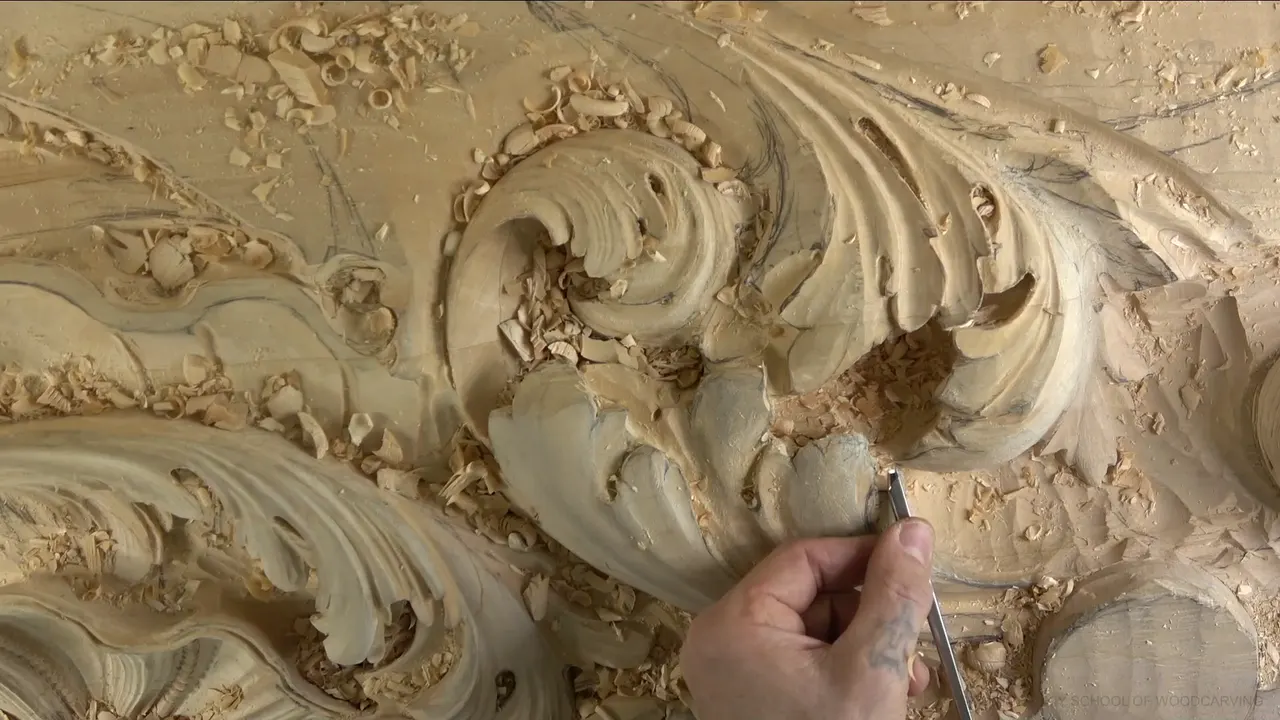

Organic, in my lessons, is the word for a shape that looks right with the whole carving around it, rather than just by itself. I check it by looking at the piece overall, and I said so in almost those words on a furniture panel. On the Venice Room ceiling board, in part 10 of workshop 30, a small detail of the acanthus leaf failed that look, and the part is me working on it and on the shapes around it. That is organic wood carving the way I use the term, judged by eye against the movement a piece belongs to.
Ever see a carving where each piece is clean and the whole thing still looks stiff? Or one part that seems stuck on, instead of grown out of the rest? That is what this word is for in my lessons. You get the spots on real boards where I said it, each with what the gouge did next.
What organic meant on my boards
- A part stays part of its movement, and on the 30.10 board I did not want one detail separated from it.
- I judge it by how the piece looks overall, by eye.
- Real flowers look perfect until you look closer, so mine can be not perfect-ish.
- Flowers carved identically in one area would look childish, almost.
- Depth matters too, with a little more of it at an eye and none where a piece has to stay raised.
- A slope or a taper can read organic, if it isn't overdone.
What was not organic on the Venice Room board?
A small detail was not, and I said so at about the one-minute mark of this part. When I look at it, I said, it's not as organic to the overall look, and I need to create something better.
Before that line the work had already started. A number 11 went in from almost nothing, with almost no concave at first, and then I rotated it to the right, in my case, the whole length, for a really beautiful undercut. Which size? Let me think which one, I said, and the answer stayed a maybe, that I could probably do four millimeters (5/32 in). A few minutes later a handle stamped 11/4 is lying on the board.

I had that movement inside, which is good, I said, but now I needed to blend it much better.

Concave or convex, which one makes a detail look organic?
Either could work there, and I weighed both before the next pass. I could create a concave, which sometimes is a possibility, or I could do a convex. Let me think, I said. Maybe a bigger concave, a shallower concave, will work really good. So the side of the gouge, the number 11 again, went in from almost nothing.
The next sentence is the closest this part comes to a definition. I also don't want to separate from this movement, I said. It still has to be part of this movement, and making that mistake was the thing to avoid.

Number five instead, maybe, was my next thought, going a little bit that direction to give it a movement inward. Then came the verdict. I think it's much better. It's not as deep of a concave, and then I corrected myself, well, actually, it is number five, but not even visible so much.
That number five needed sharpening, and I said so. Maybe just attack that from an opposite position, was the next idea, because going with the grain gives a much cleaner pass, almost a finished one. Okay, that is good.

How do separations help a carved shape look organic?
On this detail they gave it curliness. I was happy with the shape except one spot that needed to get a little nicer, where a separation would go. I still wanted another separation right there and right here, which is going to give me even more curliness, and I counted them off as they went in. One. Two.

The edge got refined after that, and twice I named the inside a letter S movement. Number five, this way, flip, that way. Next, I said, I can fix this separation, clean that point and remove some of the junk.

Painters had a name for that curve a long time before me. William Hogarth called an S-shaped line the line of beauty in his 1753 book.

Please note, I said next, I'm not taking too much right now from this piece, because I can carry that piece inside even more if I need to. A beautiful movement can come out of that too. My plan after it was to carry two separations a little farther, maybe, for an even more detailed look.

Near the end there was a beautiful, beautiful concave on this side, room for a subdivision right there, and a really nice movement on this side. I know those are really small, tiny details, I said, but they add up. They really add up. The part closes on me counting the last ones, one and two and three, and the next part, 30.11, opens with I think they add, and then, that's my personal opinion.

What do I mean when I say a carving looks organic?
The look of the whole piece. Working on one area of the background in lesson 19 of the furniture panel, I put it in words. What I'm after, organic, organic movements, I said there. When I'm saying organic, I really want to see how it looks overall. As of now, it doesn't look as appealing to me.
Maybe a couple more passes toward this direction, I said, and about half a minute later it looked much better. Much, much better. It looks more natural, I would say.

In lesson 5 of the Hashemi flowers the reason came with it. Logically the movement goes this way, so the higher point should be on my right-hand side. I know it maybe doesn't make sense right now, I said, but when you look at the final work, it's going to look organic, and just more pleasing to the eye. You can't explain those laws of movements and rhythm to everyone, but they're really important in the composition.
The trouble in workshop 59 of the Venice Room was a chunk. I still don't like this chunk, I said, and I think I should maybe get rid of it, because it just doesn't look organic. Then I put it a second way. It doesn't flow together. A little later I thought it looked much better, with one part going underneath and the other flipping this way.

The same check came up in workshop 41, on a leaf part that rotates. I want to make sure it looks organic with the overall movement, was how I put it, and I think it does.
The word is older than any of my boards. Frank Lloyd Wright coined the term organic architecture for buildings in harmony with the natural world around them, and biomorphism is the name for design modeled on shapes from living things.
Organic lines are a subject of their own. On a beginner board, in workshop 11 of the curly kitchen cutting board, I talk about finding my organic line and carrying it on to the next one. This page stays with shapes in relief.
Does organic mean perfect?
Quite the opposite, I said while carving the Chamomile and Bow Rosette. It doesn't have to be perfect, and I highly encourage you not to be perfect with those movements. In nature those flowers look perfect, but if you try to look closer, they're really not. So it comes out more organic if it's not perfect-ish.

Repetition can spoil it too. In class 3 of my Grinling Gibbons class in Maine one section of the flowers was somewhat lower. Doing exactly the same flowers in this area would not look organic, I said. Childish, almost. So the plan was to lower that section down and get the full shape of those flowers first, with the details after.
Class 4 gave a petal two choices, the simple round look the way Grinling Gibbons did it, or some waviness. If you do some waviness, I said, it will be a more natural look, an organic look.
Does an organic shape need more carving or less?
Both have happened on my boards. In workshop 29 I still kind of doubted one division, because it doesn't feel organic. Maybe I should give an extra movement right there, was the thought, because I think it's going to be more organic.
Even a smaller version turned up in workshop 63. With a number three I gave one spot a motion downhill, a little bit, maybe slightly underneath, and then it feels more organic, I would say. It feels a lot more organic.
Adding was the answer on the main flowers bouquet of the furniture panel, lesson 23. The inner part was to get some waviness and probably a really nice concave, and I said why. Otherwise, it doesn't look organic, and an organic look is what we are after.

Taking away is the other road. I got carried away in workshop 35 and ended up with too many separations, ones I should not have. I'm going to chop out this section, I said, otherwise it just doesn't look too organic. Workshop 33 has the same move, where it still doesn't look as organic, so I need to chop out a little more of this area, maybe even with the mallet.
How deep should you carve for an organic look?
It went both ways in my lessons. On a leaf in workshop 5 of the Venice Room, carving a little deeper at the area of the eye would look more authentic, more organic, I said. Workshop 32 was the other way. I would not go deeper in one area, because it had to stay a little raised up, and making it look awkward was the worry, so it needed a more organic look.

Too much depth can hurt it. The furniture panel background has a spot where the carving wraps down around a molding and comes back up, and there I said don't overdo it, it's got to be organic. We don't want to see sharp lines and a big valley or a big dip. And yes, I do like a lot of movements, even on a shallow carving. I really think it's still supposed to look beautiful and natural.
High relief has its own version. The shape in workshop 62 was a high relief and not full three-dimensional carving, I said, so it's not fully like a true round. It goes more like an oval, which the human eye reads as more organic.

Can a slope or a taper look organic?
It can, and those were hard for me when I started. One space in workshop 60 tapers all the way along. It had to be organic tapering also, I said, and the middle line was to run to the center and become part of this big movement.
More organic sloping, I said in part 12 of workshop 62, and then I owned up to something. Complicated movements like that, sloping and still visible from all of the points, were confusing for me also when I started to carve those. It's not that easy, even if it looks simple.
A concave can stay organic right up to an edge. Just the side of my tool went closer and closer to the edge in workshop 34. Still concave, but it doesn't feel unnatural, I said. It's still organic and feels good, and it keeps a really good convex in the middle.

Where did organic come up, and what came next?
Each row is one place from this page, the shape I was looking at, my verdict and what followed.
| Where | Shape | Verdict | Next |
|---|---|---|---|
| Part 30.10 | One small detail against the overall look | Not organic | A shallower concave, then two separations |
| Panel 19.8 | A spot not looking appealing to me | Organic movements | Much better, and more natural, too |
| Lesson 59.11 | A chunk that did not flow together | Doesn't flow together | This part underneath, that one flipped |
| Rosette 1.2 | Movements on a flower, kept not perfect | Not perfect-ish | Real flowers aren't perfect up close |
| Maine 3.2 | Exactly the same flowers in one area | Childish, almost | The plan was to lower it |
| Venice 32.11 | An area kept a little raised up | Organic look | I did not go deeper there |
| Board 60.1 | The space that tapers all the way | Organic tapering | Midline to become part of it |
| Venice 34.8 | A concave carved close to the edge | Still organic | Convex kept good in the middle |
Workshop 30 of Venice Room Part 3 has all twelve parts of that ceiling leaf, and part 10 is the one with the shallow concave and the two separations. When you want the whole board, lesson by lesson, Access opens every part. At sixteen I was the only apprentice of a fine art master in Russia, and he taught me to think like a tool.
How it's done
- I look at the detail. Set against the overall look, it was not organic enough yet.
- I weigh a concave and a convex, then choose. A bigger, shallower concave.
- I keep it part of the movement. The side of a number 11 went first, then a number five, so the detail would stay part of the movement beside it.
- I come in from the opposite position. With the grain, the pass is much cleaner, almost finished.
- I add separations. Two went in for curliness, then a letter S movement with the number five, this way, flipped, and that way.
- I leave wood for later. Not taking too much now means that piece can go inside even more if I need it to.
Frequently asked questions
Is organic the same as natural in wood carving?
Close, the way I use the two words. On the furniture panel I asked for organic movements, then after a few more passes said the spot looks more natural, I would say. In the Maine class a little waviness on a petal was a more natural look and an organic look, in one sentence.
Why does one carved detail look stiff beside the rest?
On my Venice Room board it was a blending problem. The movement inside the detail was good, but I needed to blend it much better, and I did not want to separate it from the movement around it.
Which gouge made the detail on that board look organic?
A number 11 first, on its side, starting with almost no depth. Then I said maybe a number five instead, and the number five gave a concave not even visible so much, which I liked better.
What to carve next