

Alexander Grabovetskiy, woodcarver, School of Woodcarving · Published 2020
Why does a wood carver ask "do I really need to?" before carving deeper?
Quick answer: Before I take a cut farther I ask myself if I need to. In Venice Room part 30.9 I said I could go even farther, then answered "of course not," because the finish gets harder. Other lessons show the same question with other reasons.
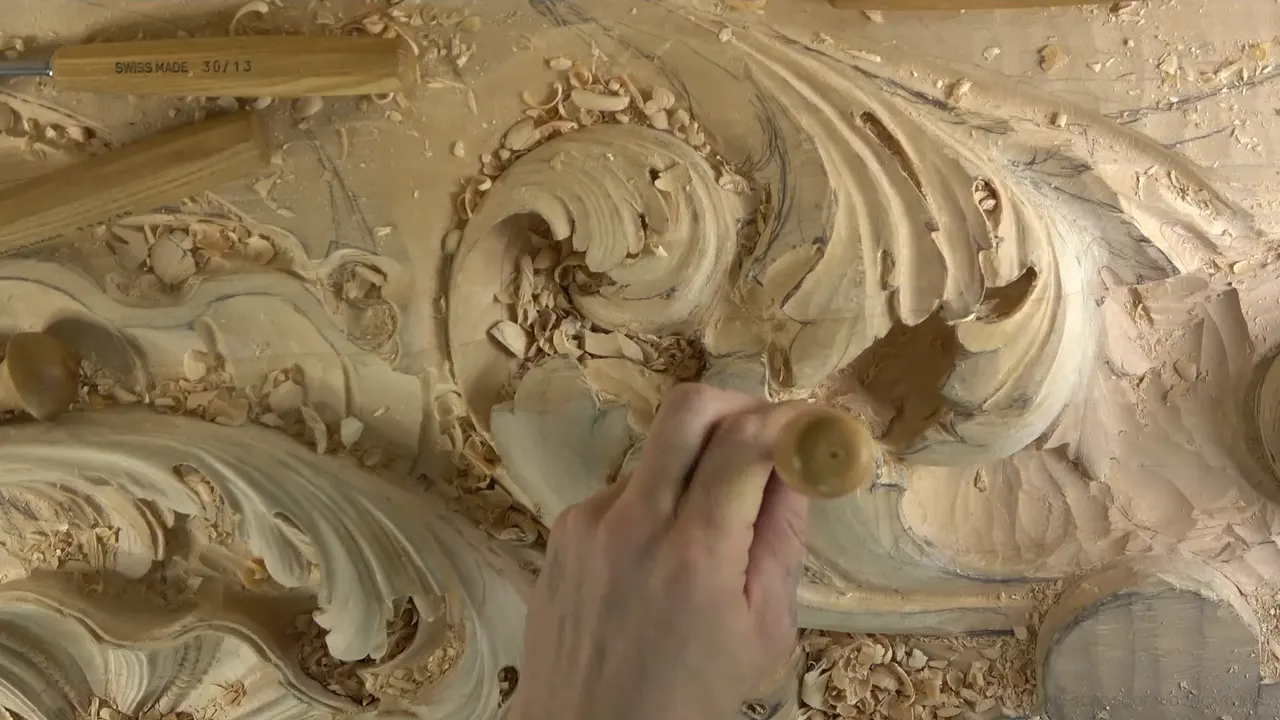
One short question comes to me before I take a cut farther: is it needed? In Venice Room part 30.9 I said I could go extreme and even farther, then answered it myself: of course not. My reason was short. Finishing would get harder.
Ever stood over a carving with a gouge in your hand and felt the pull to take one more pass? I say a question out loud in lesson after lesson. You will hear it first in the part this page grows from, and then in other rooms of my school.

What did I ask in Venice Room 30.9?
The part opens with a change of plan. "You know what? I should probably go in a different direction." I could use the back bend again, I said, and go in a little deeper right there, then "maybe even this way" to get rid of what I don't need. A back bend is a gouge with a bent shaft.
At one minute and fourteen seconds I could take a spoon, I said, a veiner in this case, a number 11 of 10 millimeters (about 3/8 in). With it I could go up against the grain and remove lots of what I don't need. At 2:14 I spoke of cleaning from this side a little bit with the grain, up to that detail, that movement.

Then comes the line this page is named for, at 3:22. "So I guess I don't want to do more than that. I mean deeper than that. I could go extreme and go even farther, but the question is, do I really need to? And the answer is, of course not. It's going to be harder to finish." I repeated that last sentence, and added "and I don't want to do that."

A little after four minutes I asked you to see how deep it was. It was going all the way, an inch, let's say (about 25 mm), and then "one inch almost." Next I needed to excavate inside right there and maybe connect, but with smaller tools.
The tool talk goes on. First I said I would use a number five of a quarter inch (about 6 mm). Seconds later I changed my mind: "Well, actually, number five will not work. Number nine and a quarter inch will do," because I wanted no mistake in that spot. Bigger tools can make mistakes too, I said. Near seven minutes I gave my reason for the small ones: "sometimes those smaller tools give much more control."

The part ends on a plan, so I keep it a plan. I had a chunk to develop, and I needed to think how I was going to do it. Right then it was kind of too big. I wanted more subdivisions still. To give it a lighter look I might use the same trick as before: get underneath with the number 11 and make a concave on the inside.

What does that question do in my carving?
It is a question I put to myself before one more pass. Look at the order of my words. First comes what I could do: go extreme, go clear through, clean a spot for as long as I wish. Next comes the question. Last is the answer, with a reason when I give one.
Here the reason was a cost, the finishing: going farther would make it harder. In other lessons the cost is a shadow I already have, a ridge I want to keep, a mistake I might make, or time I would rather spend on something else. I word it a few ways, with have to, need to or want to. Here is how it came out, one lesson at a time.
When is a deeper cut not worth it?
Depth is the plainest case. Back in Venice Room 8.7 I kept excavating and said that at some point I have to stop, "because I need to make the decision how deep I want to see it." There was thinking left to do about how I would paint on the inside. Next came, "Of course, I can go all the way through if I wish, but do I need to? That's the question."
From there I could attack my edges, I said, using a number six of three-quarters of an inch (about 19 mm). I did not want to go too deep, since cleaning would be much harder. But still, at least a little bit. Probably I could outline that side with the same number six, and that would be a void, because I wanted to see the deep shadow there too.

Workshop 36, part 7, puts the same question on a smaller area. Going around to make it a little deeper was possible, I said, to give it a little more dimension, and that also gives me really clean results. Then I asked: "Do I have to go around and get even deeper right there? I'm not sure. Maybe no." Getting deeper is no problem, I said, but I would leave it like that for now. "So there's no reason for me to get little deeper." My next job was cleaning the sides of the middle part with the gouge that matches closest, and probably I needed a number six.

The shadow was the point in Venice Room 64.3. My line was that I needed that shadow: "I need it, and I'll get it." A tool of seven millimeters (about 9/32 in) was a little too big to get underneath. One of four millimeters, a little bigger than an eighth of an inch (about 5/32 in), could go in, though even that was a little too big to get inside. After that came, "Actually, I don't need to do anything inside anymore. Inside, it's already deep shadow. Deep and everything is clean."
About a minute later the same step came up. "Yes, I can take it to extreme," I said, and added that of course it is possible. The same question came up once more. Then came "maybe 10 millimeters," and a remark on sizes. A tool called 10 mm (about 3/8 in), I said, is bigger than its label, almost 12 millimeters (about 15/32 in) or so, closer to half an inch.

Workshop 74, part 5, fits it in two sentences. I planned a better tool for it, in this case a large number seven, one of my favorite big tools. I also said I really wanted to keep that movement. Then came "And of course, I could take it to extreme and clean it even better if I wanted to. The question, do I need to or not? I don't think I need it." A somewhat flat tool followed, a number two of 50 millimeters (about 2 in), which I called more of a sculpture tool and a really good one to have.

The Lily Box course, lesson 11, part 12, has me saying I was carefully going to create my deep undercut. Going to extreme with it was possible if I needed to. I asked whether I had to, and answered, "No, not really." Next I would see how it looks from different positions and angles, and then I said, "I'm happy." After that I could probably attack this piece and make a better form, keeping an eye on how the grain of the wood behaves.

What if the answer protects part of the carving?
At times "of course not" is what saves a part of the carving I like. Venice Room 46.10 is where I had a really nice and gradual movement. I was going to leave only about five millimeters (about 3/16 in) for a concave, though it does not have to be five millimeters everywhere, and right there it would be only an eighth of an inch (about 3 mm), disappearing underneath.
First I needed a preliminary cut, which I call a clean up cut. I said, "I do not want to lose that edge because it's a really nice and beautiful edge." "But with the concave, it is possible to lose it. And do I want to lose it? Of course not." Soon after: "I really need that ridge." Undercutting underneath was for later. "As of now, I just need that ridge."

A mistake gets the same answer in Venice Room 59.8. "That's enough for now because, like I said, it's possible to make mistake. And do I want to make mistake? Of course not." The plan after that was to start undercutting underneath that moment with a number 11 in 4 millimeters (about 5/32 in), and see if I could get inside little by little.

What if the answer is about my time?
Here the answer is the same and the reason is not. Take Venice Room 67.9 next. Some stuff still had to come out of the inside, and I used a spoon, a number 11 of 5 mm (about 3/16 in). I showed you what I had just removed and said "Beautiful cut." Later I called it "just gorgeous," then "Wonderful." The piece needed maybe a little cleanup, "which I could spend all day long if I wish." Did I have to? "Oh, absolutely not. I don't need to spend long time on it."
For now I would probably leave it like that. Maybe I still had to hit that side slightly, because it has to blend in, and maybe off camera I would clean that section a little better. Then a plain sentence: "I'm pretty tired of this section."

The thing I might lose in Venice Room 20.10 is a clean look. I liked it because I used a really big gouge, and I would love to keep it. "But do I have to? Oh, absolutely not." Straight after, I said, "Let me think. Should I do or not that flipping backward movement? Maybe I should." If I did not like it, I would redo something new, and I planned a number seven to create roundness.

A technique can get the same answer. In the Furniture Panel course, 21.4, I said it still goes in and I could probably go even deeper, but to be careful. "That's called extreme undercutting." Now I could scrape a little bit, I said, which would show me the high spots and low spots. Did scraping need doing? That was the question I put to myself next. "Oh, no, absolutely not. But I think it's one of the techniques." Though I added that I don't use it a lot, I think I like it.

The Tray of Blessing course, lesson 8, part 4, gives me a teaching use. I was excavating and constantly checking how much material I had left, which is important for me. Taking out more of this material was still probably possible, I said, but whether I needed to do that came with an answer: "I know the way, absolutely not." For the sake of practicing, I said, it would be a good idea for you to do it.

A small one sits in the Grape Onlay course, 3.3. A triangle meant I had space for another grape, and I could get one more right underneath. Did I need to do that? "Not really." It would give me a more realistic look, I said, but for now I would only get a hint of it, and it would be right there later on.

One more, from Venice Room 76.4. I had made a plug cut on the inside with a number nine of 1/8 in (about 3 mm), and I said all of my cuts can go to the hole I created by removing that plug. Twenty seconds later I asked whether I had to do that, and answered, "Oh, no. Absolutely not." Next came "But I like shadows, okay?" The piece would be painted one color, just pretty much white, and the shadows would be really important.
Does the answer come out the same each time?
No, and that is why I ask. In workshop 37, part 3, I could probably go a little deeper in one area for an even better shadow. "But the question is should I or not?" My next words were "Now, let me think what else I should do," and then, I said, a number one, a double bevel, could take care of making it a lot nicer everywhere.
In workshop 28, part 11, I looked at a space with multiple ways to fill it. The first thing to settle was whether it needed filling at all. "That's the first question I have to answer." Soon after, I said it would make a lot of sense to create a movement repeating the one on the other side of it, and I had to figure out where I could stop it.
Even the "absolutely not" in 20.10 was followed by a new question about the flipping backward movement, and my own answer there was "maybe I should." So this question is not a rule for stopping. It is a step before I decide to go on or to stop.
What did I say each time, row by row?
| Lesson | What I might do | My answer |
|---|---|---|
| Workshop 30, part 9, Venice Room | Go farther | No, since the finish would get harder |
| Workshop 8, part 7 | Go clear through | Decide how deep I want to see it |
| 36.7 in Venice Room | Get even deeper in that area | Maybe no |
| 64.3 of the Venice Room | Go extreme, since it is possible | Inside, it's already deep shadow, deep and everything is clean |
| Part 5 of workshop 74 | Clean it even better, if I wanted to | Doesn't seem needed to me |
| Lily Box, lesson 11, part 12 | Take the undercut to extreme if I need to | No, not really |
| Workshop 46 has this one | Let the concave take that nice edge away | Keep it, a really nice edge |
| 59.8, Venice Room | Keep cutting where a mistake is possible | Enough for now |
| Workshop 67, part 9 | Clean it as long as I wish | Not needed, I need to go do something else |
| Furniture Panel, lesson 21, part 4 | Scrape the side to see the high and low spots | No, but I like the technique |
| Workshop 37, part 3 | Go a little deeper for a better shadow | Still deciding what else to do |
Every row is a line from one of my videos. The first column says which one. The second holds my options, and the third what I said about it.
Where do you ask it in your own carving?
Is there a cut you could still take deeper, a spot you could clean for another hour, or a technique you do not need today? Try saying the question out loud before the next pass. You may land on "of course not," as I did in Venice Room workshop 30, or on "should I or not." Either way you will know why you are cutting.
The twelve parts of workshop 30 sit inside the Venice Room course, workshops 26 to 37, a Venice room board full of acanthus leaves. Access opens every part, and in these videos I say what I am doing as I go.
How it's done
- Say what you could do. Name the option, going extreme and even farther.
- Ask if you need it. The question was whether I really needed to go on.
- Answer out loud. Out loud, the answer was no.
- Name the cost. The cost I named was a harder finish.
- Move to the next job. Smaller tools came next, then a plan for a concave inside a chunk.
Frequently asked questions
How did you answer yourself in Venice Room 30.9?
The answer was no. The one reason I gave was a harder finish.
Is it only about how deep to carve?
Other lessons use it for a clean look I wanted to keep, a scraping technique, extra cleanup inside a piece and a grape I could add underneath.
Does "absolutely not" mean you stop?
Not by itself. Workshop 37 has me asking about a deeper shadow, and thinking on. Lesson 20.10 gives an absolutely not, then a maybe about a new move.
How deep did that cut go?
What to carve next