

Alexander Grabovetskiy, woodcarver, School of Woodcarving · Published 2020
What does convenient mean in wood carving?
Quick answer: In my lessons, convenient is the word for a tool, a position or a setup that lets a cut go well for me. A palm tool was handier in a tiny spot in workshop 30.3, and in other lessons the word points to a back bend, a raised piece or a vise that turns.
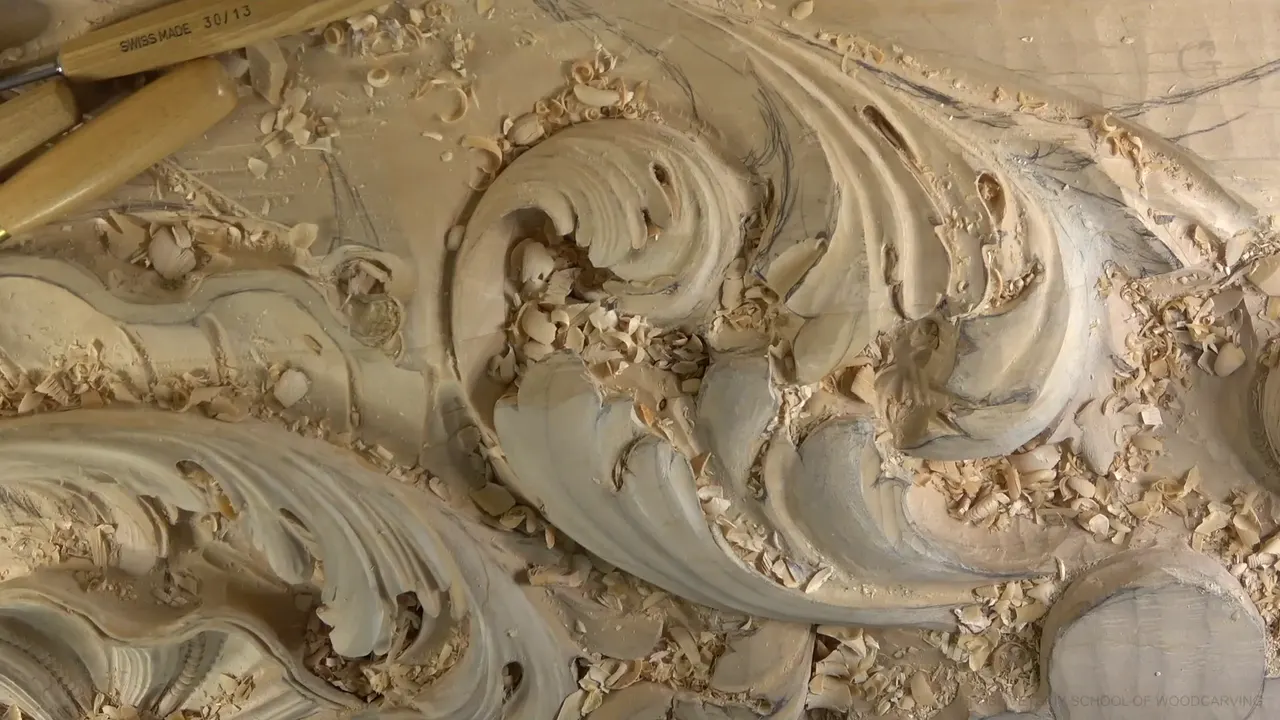
In Venice Room workshop 30, part 3, I called a small palm tool "much more convenient" in a tiny spot. The same word turns up in lessons across my courses, and behind it stands a tool, a position or a vise. Here are those lines, with the courses they come from.

Ever picked up the big gouge because it was in your hand, then fought the wood through the whole pass? A tight corner can make you wonder if a smaller tool would give you less trouble. I went through my courses and pulled out the lines where I say convenient, and the lines where I say it is not.
What was convenient in Venice Room 30, part 3?
The part begins with an edge. I wanted to take the carving to the edge, just to create a nicer transition right there. Number one with a double bevel came to mind first. Then I changed my mind. "I need to use different one, different number one," I said, a tool with "a much longer bevel."
A reason followed. "I can take it all the way to the edge and still maintain a really strong wall." What I am doing is hard to see, I explained, because it is just a little undercut and a cleaning. Beside it came the same move on an angle, "just like that."

A repair came next. The concave on the inside of that movement needed fixing, so I attacked it carefully with the number five and cleaned it a little bit. My undercut underneath meant the movement had to carry on a little more, probably with number one double bevel again.
Now the line this page is named for. Attacking from the side was possible too, with a small tool, "a palm tool, but sometimes it's much more handier to work in a tiny spots like that. Much more convenient, I would say." The payoff, in my words: "beautiful cuts and a lot less fight because it's closer to the blade and a lot more control."

A number 11 of probably just 1 millimeter (about 0.04 in) came next, to excavate whatever I had just cut. I was carving toward myself, "because I can't really rotate this piece, and I don't want to walk around." The inside was "all the junk" I did not have to worry about. I could leave it like that, or take the number 11 again, use just the side, and exaggerate that ridge a little bit.

Which tools did I call convenient in other lessons?
A moment right after some cleaning in workshop 75, part 2, shows the idea. A big tool was no longer needed, and "little, smaller tool will be more convenient for me to use in this case." I named a number seven, one inch (25 mm) or so, with number six working also.

Pipes were the job in workshop 62, part 6. One pipe got its roundness from a back bend, and I explained the pick on camera: everything was in my way, so a straight tool was out. "It's not convenient for me to use a straight tool," I said. The back bend "just helps me."

Over in the Floral and Molding course, lesson 11, part 2, I was chamfering both sides beside a raised part. A back bent would be really nice there. A straight tool, in my words, "would be in my way," so I chose a number three back bent and called it "a much better tool."

Approach decides a lot. Hashemi Flowers lesson 17, part 4, has a number seven at about 5/16 of an inch (about 8 mm) brought "all the way to that first cut." Then comes my verdict on the side: "for me, it is more convenient to attack it from this side."

Fit is the test in workshop 67, part 4. I had planned half a millimeter, grabbed one millimeter by mistake, and went back to the half. The area was hard. Something sat in my way, and I said so: "Really, it's not too convenient." A number seven came next, maybe 14 millimeters (about 9/16 in), and it "actually fits absolutely perfectly in this area."
What did I call not convenient about my position?
On the side of a pipe in workshop 62, part 5, I used a number 11 at 3 millimeters (about 1/8 in) and admitted it: "I'm doing the wrong way." I really don't like to carve toward myself. "I'm able to do that, but it's not really convenient."
Another warning comes from workshop 67, part 6, where I tried 5/8 of an inch (about 16 mm) and went even wider. "Not again really convenient," I called it, since I carved toward myself, and I encouraged you not to do it "because it's not the safest way." The risk is a slip: "you can slip and cut yourself, and that would be big mistake." The pass still gave me a pronounced pipe, with a nice concave that rolls to the convex and goes underneath. That does not make the position safe.

Seven millimeters (about 9/32 in) came first in workshop 85, part 1, then the complaint: "it's so inconvenient for me. I have to carve toward myself." Even the verdict moves, as workshop 81, part 8, shows. I was cutting toward myself and still called it convenient: "But for me, it's convenient." Minutes later another spot was "kind of interesting" and "not too convenient."
Grain made one spot hard in workshop 74, part 11. I needed a really deep hole, and a number 11 at two millimeters (about 5/64 in) was the tool. "Not your convenient spot," I called it, since I was carving pretty much against the grain. Still, I wanted to excavate somewhat deep to create a shadow, and getting in was almost impossible. A bump left from earlier cuts helped: "I'll take advantage of it."

A rounding job in workshop 47, part 6, belongs here too. I needed to round a spot somehow, and it was not a handy one. "And it's okay," I said. Three quarters of an inch (about 19 mm) with a number three blended the movement, because I probably had to attack that side too, so that I would know exactly how it ends up.
Another reason shows up in workshop 163, part 2, where a big number 11 worked toward a volute. "Really not convenient," I said, and the cause was "the camera positions and so on." The details were still coming. You should get the idea already.
The same trouble comes up in the Tray of Blessing course, lesson 4, part 2. After a separation between two shapes, I said I probably had to turn the piece over, and that was "not convenient." My apology followed: just the one camera, and the view was better from there. A different kind of not yet sits in workshop 49, part 11. Questions were coming in the chat from a livestream, and answering them while I carved did not work for me yet. I kept the same number three, about half an inch (about 13 mm).
How did I make a spot more convenient?
In these lessons the piece moved, not the tool. The Grape Leaves vase course, lesson 1, part 10, has me raising it a little bit, since it would be a lot easier for me to carve. "It's going to be a little more convenient."
Two steps show up in workshop 84, part 1. I said I maybe had to raise it a little bit, to "make it more convenient." One area was a challenging one for me to reach, and later I decided to change how I fasten the piece. After that it was "much better for me just from that position." I like the system I use, I said, because I can relocate it as many times as I want, "to find the right convenient position for myself."

A vise turns the whole question around. My Veritas carver's vise comes up in part 5 of workshop 81: I remounted the piece and could rotate it really easily. A little wobble was coming, I warned. "Hard to watch, probably, on TV." Still, working around the piece was, for me, "a lot more convenient." Two parts later the line is almost the same: working with that vise was "really convenient" because "I can rotate with no problem any direction."

Then the bench itself. My table needed a new arrangement in workshop 127, part 1, because carving that way did not suit me. What I like about it: I can rotate it and rearrange it, "whatever I want to do. So that is a really, really convenient way to work." I rearranged my workbench, and "now it's much better for me."

Compare that with part 3 of workshop 30. The piece could not rotate, and I did not want to walk around, so the palm tool came in from the side. In these other lessons the vise turned, the piece went up or the table moved.
Did I ever change the tool itself?
In the Venetian Flowers Rosette course, lesson 6, part 2, I picked up my background punches. You can make those yourself from a nail head or a screw head and a file, or buy them if you're in the United States or in Europe. The set I bought had two rows of teeth, "and sometimes they're just not convenient to get into some tight spots." I filed one down to a single row and modified it.

One row gave me a second benefit: I can get an angle right inside of the undercut and create some texture there, so it separates even better. A regular mallet is out for these punches, and I used just a hammer.
The knife marks a limit. In Hashemi Flowers lesson 45, part 1, the choice depended on the area, and I could use a knife to carve to the vanishing point. "With the knife, it's not always convenient. But it's still possible to make a cut until it disappears." Grain direction rules a knife out in some places, "but some spots I probably could."
My own hand can get in the way as well. The Rosette course, lesson 5, part 2, has me using a small tool for a concave cut, carefully removing material toward that line. If you could not see it, I asked you to forgive me, "because sometimes it's not really convenient. My hand's right in the camera."
Does convenient mean the same thing for everyone?
Workshop 81, part 7, shows where it stops, and I say so on camera. My apology came first, since the vise was going to wobble a little. Then I spoke to those of you who are not used to a wobbly workstation: it is "kind of hard," I said, "but for me, it's okay." The line after it: "For me, result matters a lot more."

The Hashemi Flowers course uses the word in a smaller way. Lesson 2, part 1, has a section of the design rising above the grid: "you can call it grid, you can call it basket, whatever is more convenient for you." A basket it is, pretty much. In that spot the word chooses a name, and no tool is involved.
Safety is a different question. One way in workshop 75, part 2, gets the label "not the safest way," and if you want to do it like that, I said, make sure you really feel the grain of the wood, what it does. A stronger line about carving toward yourself is in workshop 67. When you borrow a position from my lessons, borrow that care too.
Which convenient lines sit side by side?
| Where | Situation | Move | Words |
|---|---|---|---|
| Venice 30.3 | A tiny spot beside an undercut edge | Palm tool | Because it's closer to the blade |
| Workshop 75.2 | Cleaning a wall after the big cuts | Smaller tool | I don't really need any more |
| Lesson 62.6 | Pipes with everything else in the way | Back bend | Everything is in my way now |
| Hashemi 17.4 | Taking out the rest of the material | Other side | To attack it from this side |
| Floral 11.2 | A raised part next to the chamfer | Back bent | I'll use just the back bent |
| Vise 81.7 | A wobbly vise that turns any direction | Veritas vise | I can rotate with no problem |
| Video 84.1 | A challenging area for me to reach | Refasten it | To find the right convenient position |
| Grape 1.10 | A spot easier to carve if raised | Raise it | A lot easier for me to |
Is there a spot on your piece where the tool fights you? A smaller tool, a back bend or a turned piece may take the fight out. You can watch the part in the Venice Room Part 3 course and on the workshop 30 page.
How it's done
- I look at the spot. Venice Room 30.3 had a tiny spot beside an undercut edge, and a palm tool took it on.
- I check what is in the way. Workshop 62.6 swapped a straight tool for a back bend.
- I try the other side. Hashemi Flowers 17.4 has a number seven that I found more convenient to attack from one side.
- I move the piece. I raised the vase piece, and workshop 84.1 changed how it is fastened.
- I weigh the risk. Workshop 67.6 has me telling you not to carve that way.
Frequently asked questions
How does a carver use the word convenient?
It points to the spot, the tool or the position at that moment. Part 3 of workshop 30 has a palm tool that reached a tiny spot, with a lot less fight and a lot more control.
Why use a back bend instead of a straight tool?
Workshop 62.6 gave my reason: the rest of the piece crowded a straight tool, and that was not convenient. The Floral and Molding course made the same call beside a raised part.
Is carving toward yourself convenient?
I called it inconvenient in three lessons, yet in workshop 81 I called it convenient. Workshop 67.6 adds a warning: you can slip and cut yourself.
What to carve next