

Alexander Grabovetskiy, woodcarver, School of Woodcarving · Published 2020
What is production carving in wood carving?
Quick answer: Production carving is the carving I do for a living, with a client waiting and seconds counting. In Venice Room 30.2 I said how other production carvers leave holes open, and I called it a business standpoint. My other lessons show where I save time and where I slow down.
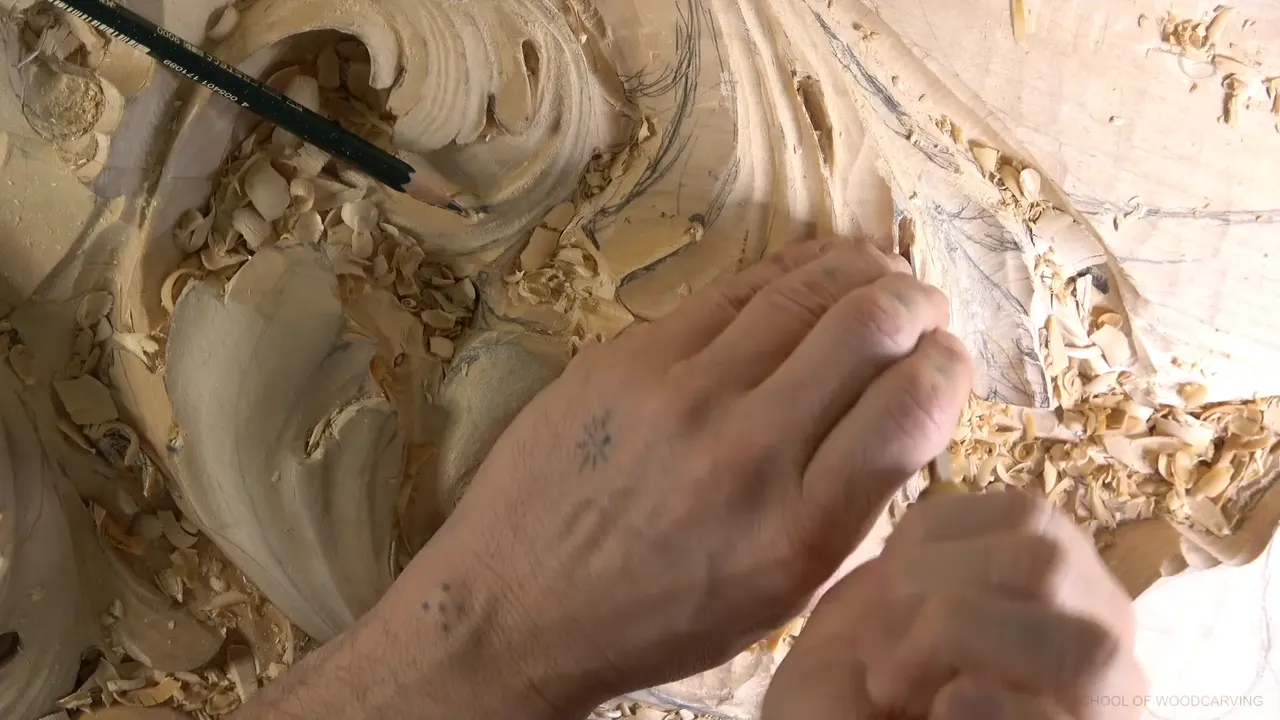
In my lessons, production carving is carving I do for a living: a job with a client behind it, where seconds count. The word turns up in many courses, and in the second video of Venice Room workshop 30 I used it about other carvers too. Here are those lines, with the courses they come from.

Have you ever watched a carving video and wondered how a person who sells his work can afford to go that slowly? Do you ever wonder what he leaves out when a client is waiting? I went through my courses and pulled out the lines where I say it on camera.
What is production carving in my lessons?
It started with a room. When I started the Venice Room in its opening workshop, I told you I did not expect anybody to follow me, because the project was huge, the whole room. "This project is pretty much for me everyday life," I said, "so that is just a production project." Later in that video I said I had not shown my production work before. I did not know if there would be interest, and not all clients want to show what they are getting.
On a livestream about the carving knife, in April 2020, I said some carvers still make their own tools, and it is not a complicated process. I do not make any tools anymore because it takes so long, and "I have to do my production work. I'm carving for a living." It was a choice between two jobs: spend the time making tools, or carve. On a livestream about the spoon gouge I described my day. I start early in the morning and carve until late at night, "because that's my life," and I had a "live production and people waiting on me." Both streams sit in the April 2020 livestream folder.

What did I say about production carvers in workshop 30, part 2?
The captions run almost nine minutes of plain carving. I followed the spoon gouge and took out whatever junk was there. Next came the walls, which I undercut with a number five. Any small tool will work, I said. Then I touched a spot I meant to leave alone, and I admitted a back bend would have been much safer for that cut. It still came out okay: "See how deep shadow it casts? Beautiful."

The eye needed fixing next, and I did not want to lose that detail. Maybe I could make the eye a little wider, I said, and knock out just the side of it. A small knife came to mind first, then I said I could probably use the number five, "but carefully." Not wanting the same mistake twice, I took the back bend to clean the wall. "So I just got a bigger eye," I said. "I didn't plan to do that big, but it's okay." Then I said I needed probably the back bend under one side, a little bit, for an extra shadow, and you can see how much deeper the shadow got.

I said I would use the number 11 again to carefully remove what I did not need, and I wanted to undercut underneath of one spot. "I could leave it like that," I said, and then I told you about the carvers who do.
"A lot of wood carvers, if you see production, sometimes they do for furniture. In Middle East, a lot of those people like that. They would just leave all those holes. They don't really undercut too much."
Style, I said, is not the reason behind it. "You could say it's already developed as a style, but in most cases, it's just laziness." My reason was money: "If you don't have to do and you get paid exactly the same, and a lot of people don't even know the difference, and only wood carvers will see that." They do not really care about it, I said.
I did not leave it at laziness. I said I think it's okay, since it is "just a business standpoint." They "have to make a living" and "have to carve a lot," and they are "doing a really good job, actually, creating somewhat the main form." My own words needed fixing too. "I shouldn't say only Middle East. I saw some of the wood carvers from South America. They carve for Catholic churches, and they don't really worry too much about the details and undercutting."

Back at my own bench I switched from two millimeters (about 5/64 in) to one and a half millimeter (about 1/16 in) with the number 11, to go a little deeper.
"I don't have to," I said, "but I think it's going to be focal point for the shadow." The light source was going to hit from that side and cast a shadow. The captions end on "I need to sharpen this one."

How do I carve faster when the job is production?
My lessons answer with a handful of small choices made right at the bench. In Roman Acanthus lesson 9, part 6, I had shown the really deep excavation on one side while explaining how the shadow is created. On the opposite side, "when I'm doing just the production, of course, I'm doing it a lot quicker," and I did not have to explain anything. The cuts matched the first side, and I would not spend time removing the waste. "You can see how much material I can take just in a few passes."

The rosette course gives a quicker tool: a knife. In Flower Rosette lesson 5, part 1, I held the knife like a pencil and made straight-down cuts to set the outline. "This type of carving, I can call it carving on steroids," I said, "because it's actually a lot quicker. Production carving, I would say." In part 2 comes the background. In production mode I use a small router plane to take it down, and it "actually works miracles for me." The ring around the work was my stopper, so I removed the wood in several passes and kept the same thickness.

The Antique Style Rosette course says it from another side. In workshop 1 I put a number on it. Straight chisels would do, I said, yet there were 15 of them to make, "and for me, it's like production, and I always have to think how I can make it quicker." My router plane was not set all the way yet, and a second pass would lower it, so it would not go deeper than it was supposed to.

Some shortcuts came with a confession. In the fifth workshop of the Venice Room course, part 11, I said I had not used rasps much, because I thought they would be a fake to wood carving. "But not really." To set the main form I could probably use them, and "especially in production, I got to save time also." The design will be authentic, I said, though I had already broken some rules when I used a machine to plane my wood. Part 1 of the very first workshop has something close about a jigsaw: a bow saw would be authentic, but this is production work, I said, and "if I can incorporate a jigsaw or a scroll saw, sometimes I will."

What about a run of matching panels? In Furniture Panel lesson 17, part 8, a number 7 at one inch (about 25 mm) fit the area. Do lots of those panels for a production, I said, and you can record which gouges you used to match the profile and "remember exactly the location you used this gouge." That will help you a lot.

Does production mean rushing the work?
That is not what I say in these lessons. In Roman Acanthus lesson 13, part 4, I repeated a point I had probably made before: on production work I have to be much quicker, because I cannot waste time. "But I am more on the side of being more careful than rush it," I added, "and I've done those mistakes when I rushed too much." I was refining the eyes with a small gouge, an eighth of an inch (about 3 mm).

The Hashemi Flowers course adds a line of its own. Lesson 7, part 7, covers it. Sometimes the work is a quick process and sometimes a much slower one, "and so what? I want to make sure it looks beautiful. I don't want any of my pieces look just like production, like cut the corners." As fast as possible is what I would like, "but quality and how beautiful it's going to look at the end, it just makes more sense to me." Rushing did cost me once. Part 1 of Floral and Molding lesson 7 shows a mistake from pressing too hard. I was trying to rush it, "because that is a real production piece," and I had multiple conversations that morning. I had plenty of material left, and I used the slip to show what to do when something like that happens.
A smaller slip sits in workshop 51, part 10. "Oops. That's what happens if you don't relieve it," I said, and then admitted I make mistakes even though I had said it hundreds of times: relieve that cut. A few seconds were there to save, and "every second counts. I'm talking about if you're doing production carving."

Tool choice counts as well. In Acanthus over Moldings lesson 5, part 1, I picked a back bend and called myself a production carver who carves for a living, so "I really have to make sure I'm getting the right tools." A cast changes the job too. Greek Acanthus lesson 9, part 2, tells of work for a company that did plaster work and needed models made. Undercutting was out, because they would cast the models later, and "for the mass production, it's not practical." A standalone piece as art is different, and there "I'm always undercutting."
Why do some carvers leave the wall nearly straight?
Two reasons came first in workshop 52, part 10, before I started my excavation. A piece cut too thin gets fragile and breaks easily, although I said I have work with really extreme undercuts that I did not break. The second reason is where the piece will be installed. That one was going close to the ceiling, where people will not touch it so much, and only the cleaning crew would clean it, probably with a vacuum cleaner or a duster.

Then came the part that matches workshop 30. "Lots of people, they just do almost a straight cut. We call it wall undercut." It is almost straight down, just slightly angled, and sometimes you cannot even tell there is no undercut. That wall is really strong, I said, and a "much faster process of wood carving." People who do not know the difference are not going to say that is not good carving. "Quicker production, but you still get the same money. That's the point."
My thought on the history was only a thought. "There's a lot of carvers in the history, they did not develop specific way of carving just because it looks best. I think they were just smart people who wanted to work and get some food on the table." If you work fast, you get paid fast, I said, and "to make it fast, you don't under-carve deep."
When is a piece not production work for me?
The other side is in my lessons too, in plain words. Lesson 14 of the furniture panel has me saying, "I know it takes time because this project is not the production project for me. So it's not a priority project." In lesson 15, part 8, I said it was important not to rush anything: "This panel is, for me, not production panel. So I want to create a piece of art."
Which production lines sit side by side?
| Where | Situation | Move | Words |
|---|---|---|---|
| Roman Acanthus 9.6 | Repeating deep cuts on the other side | No explaining | Exactly the same what I've done |
| Flower Rosette 5.1 | Outlining with a knife held like pencil | Knife outline | Carving on steroids, a lot quicker |
| Flower Rosette 5.2 | Lowering the whole background in several passes | Router plane | It actually works miracles for me |
| Panel Lesson 17.8 | Matching one profile across lots of panels | Record gouges | Remember exactly the location you used |
| Venice Workshop 51.10 | The relief cut I forgot to make | Save seconds | I could save about few seconds |
| Venice Workshop 52.10 | Why carvers leave the wall nearly straight | Wall undercut | You still get the same money |
| Venice Part 30.2 | Holes left open on production furniture work | No undercut | They have to carve a lot |
| Hashemi Flowers 7.7 | Keeping a piece from looking like production | Quality first | Like production, like cut the corners |
Is there a piece on your bench that is yours and not for sale? Does another one have to leave the shop by Friday? If you answered yes to both, you already know why the pace changes, and you can watch mine in the Venice Room Part 3 course and on the workshop 30 page.
How it's done
- I say what the job is. My opening Venice Room video described it as a production project, and I did not expect anybody to follow along.
- I choose the quicker tool for the job. A knife for the outline in the rosette course, and a router plane for the background, taken down in several passes.
- I record the gouge and its place. On the furniture panel I said you can record which gouge matched the profile and remember exactly where you used it.
- I relieve the cut. Workshop 51 shows me skipping it, saying oops, and telling you every second counts in production carving.
- I decide how deep to go. Workshop 30 has a number 11 at one and a half millimeter (about 1/16 in), and I said I did not have to go deeper, but the shadow was my reason.
Frequently asked questions
Is production carving still done by hand?
My Venice Room is hand carved, I said, but if I can use a jigsaw or a scroll saw, sometimes I will. In the rosette course I also said that carving by hand is better without a powered router, and the router plane would be the true hand-done tool.
Why do some carvers skip undercutting?
I gave a few reasons in workshop 52. A thin undercut can break, a piece near a ceiling may get a duster or a vacuum, and a nearly straight wall is faster. Workshop 30 adds a business view: the carvers who leave the holes are making a living.
Do I rush when the work is production?
Once I did. In Floral and Molding lesson 7 I pressed too hard and told you I was trying to rush it. Lesson 13 of my Roman Acanthus course has me more on the side of being careful than rush it, because rushing too much gave me mistakes.
What to carve next