

Alexander Grabovetskiy, woodcarver, School of Woodcarving · Published 2020
What does "not yet" mean when a wood carver says it?
Quick answer: "Not yet" is what I say about a step I know is coming but is not ready to go. Details and one line waited in Venice Room 30.7 while I dug a deep excavation. Once I thought the dig was enough, I said right now was probably a good time for the details.
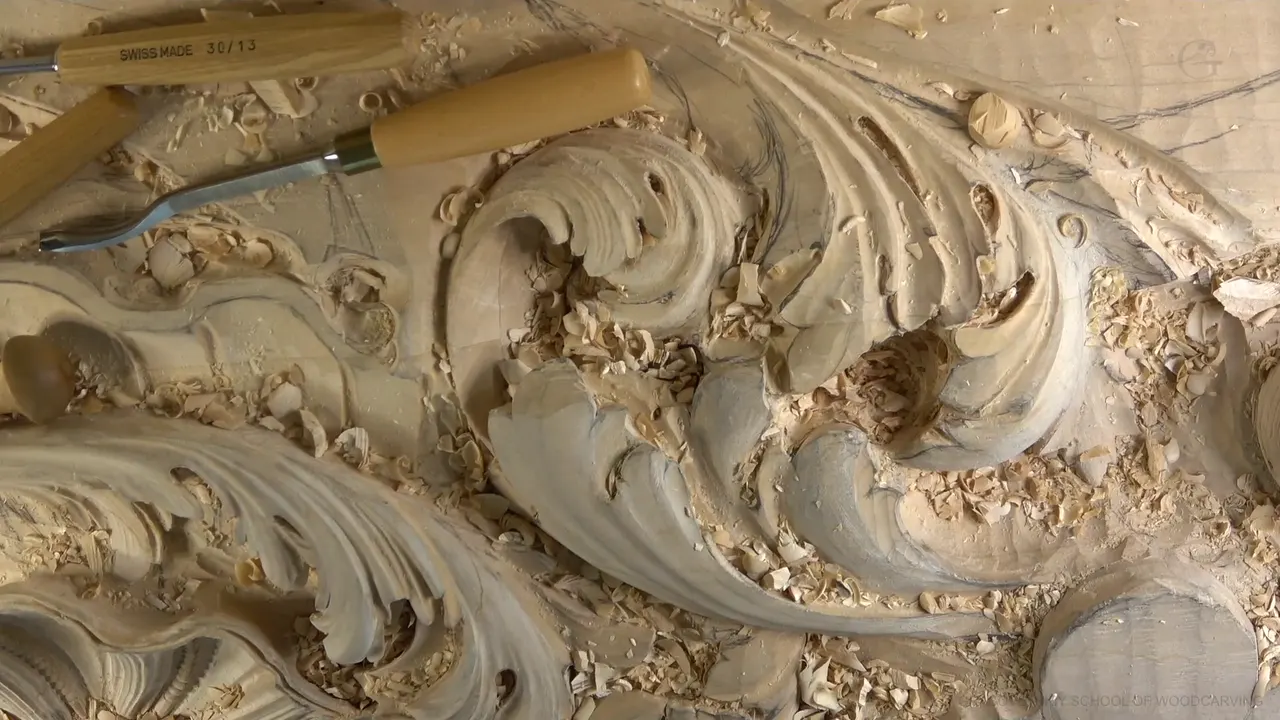

A cut I know is coming but have not made gets the words "not yet" from me. Venice Room workshop 30, part 7, holds back details and one line with a "yet," and in a number of my other videos it sits next to an undercut.
Ever stopped one cut short of the line on purpose in wood carving? This part has just 371 words. The rest of the page sets twenty-three of my other videos beside it, one wait after another.
What did I leave for later in part 7 of workshop 30?
The part opens with a plan. I say let me clean from this side, and that maybe I could use a little bigger number 11 to excavate a lot more out of there.

The reason arrives at 01:35. My details wait "because I knew I'm going to excavate some of the stuff right here." How deep I would go, I did not know, and I still needed that material for leveraging, since I would "crank against that."
A page on this site covers the leverage point, so I stay with the waiting here. Sometimes, I said, I leave some of the details "to the end until I'm ready."
A line gets the same treatment. "See that line right here?" I ask, and I tell you it was not cut to yet, since I planned to leverage against that side. "And I can destroy that side easily."

When does "not yet" turn into "right now"?
Digging comes between the two. At 02:19 I said we were doing "a really good thing," with a deep excavation right there and another one anywhere else, and that this would be really good for the shadow.
Chips were next on my list: "Let's get those chips out." A little later I asked, "See how deep I go?" Going too deep was a worry, and the spot already looked like a really deep dig, enough that way, I thought.
At 04:31 the details come up again. They still had to be worked on that side, and it was "probably a good time to work on details right now." The word "yet" is gone from the sentence, and "right now" stands in its place.

Next I pointed to a separation that you probably don't see, and I said "let me try to show you from different perspective." The leaf was going downhill, with a separation division that needed to be all cleaned, and I could make a few cuts carefully with the number five, probably upside down.
Near the end I had connected, "pretty much," one opening with the next. I needed to get rid of whatever I had chopped out. Next I could attack from this side and blend that transition nicely with number 11, while number 9 would work too.

Why does an undercut get a "not yet" from me?
One version sits in Furniture Panel 16, part 6. "Please make sure you don't undercut it," I told you, and then, "You really don't want to do it," with "not yet, at least" to close. Soon after, I said I needed to sharpen my veiner a little bit.

Its part 8 repeats it. A plan to clean a spot later comes first, "or even better, with the sharp veiner, like number 11, three millimeters" (0.118 in), and then the undercut gets the same request: "Please don't."
Then I named a detail of 1/16 inch (about 1.6 mm). "We have lots of those later on. So really important not to destroy them." The verb matches the one in 30.7, where a side is easy to destroy.

Another reason comes from Venice Room 59, part 6. My tool was a number 11 at 12 millimeters (0.47 in), and I said any gouge would do. Undercutting waited, I said, because "I still have to create the final shape on this," and the thought closed with a second "not yet."
The leaf there was going to "stick from underneath" and "go deeper," I said, for a really nice interweaving movement below it.

Two steps show up in Acanthus over Moldings 2. I would undercut "later on," after I made sure that part of the leaf was "on the right level." Checking right away was a probably good idea, I said, "before too late."
The other side shows in Venice Room 36, part 4. Undercutting "yet" would be "too early," I said, so double-checking and cleaning nicer had to come first. After that came a turn: "I will, but not yet. Maybe I will. I shouldn't say I will."
The turn came with a word, development: a few different ways to go were open, so maybe the undercut would not happen at all, and maybe I would do something different.

Depth comes in with Venice Room 81, part 10. I was "not undercutting really deep yet," and I did not really need it. "Later on, I absolutely will fix this shape." For that I would need, probably, a three millimeter veiner (0.12 in), number 11.
The same stretch plans to "create little nicer transition downhill." Downhill is a word I used for the leaf in 30.7 too.

Details come first in workshop 102, part 3. "It's already casting a really good shadow," I said, "But I'm not ready to the final undercut until I just get all of the details done."

What else gets a wait besides an undercut?
A clean edge does. I kept away from the true ridge on purpose in Venice Room 61, part 9, and the carving was exactly how it was supposed to look, "even if it's not finished yet." Once I'm ready to clean 100%, my plan was to take my gouge, like number five, and bring everything to the edge.
My reason: "there's going to be a lot of excavations around, so I'm not going to risk it." I wanted it kept strong and stopped short of "that extreme." The worry in 30.7 was a side I could destroy easily.

A whole movement can wait. I leave it for when I'm ready to work on that movement and jump to one side, to clean it and reestablish the movements inside (Venice Room 150, part 3).

Messy wood can wait as well. At Venice Room 98, part 7, one thing had to wait "because I see a lot of messy areas." That was okay, I said, and I would fix it a little later. My plan was to "establish the outline first, and I'll clean everything."
Cleaning can come ahead of the undercut. We would start undercutting in Furniture Panel 20, part 4, and I caught myself: "Well, no, not yet." A part still needed care, because for me it was "not finished yet."
I planned a cleanup first, "let me clean little bit," for a nicer canvas where I can see much better what is going on.

Depth gets a hold too. On the lily box, in part 8, the note was "don't go too low with this one," and I gave it the same two words again. All I needed there was to separate the upper leaf from the lower movement, with a quarter inch number six (6.35 mm).

How do I tell that the wood is not ready yet?
At times the wood answers by looking wrong. In lesson 15 of the furniture panel, part 6, I said "let me check if I'll be able to do anything right here," then "Maybe not yet. Maybe let me get it a little higher." Later came "that is not high enough yet, I guess."
My other thought was to spend a little more time with my veiner, number 11, 3 millimeters (0.12 in), to "just get little deeper cut."

Lesson 21, part 14, has a self-correction. I started to say I would fix something, then "it's not fixing. I didn't even address this side yet." The line had to go all the way, and my verdict was "Looks like it's not yet."

Shape counts too. For Venice Room 84, part 11, I said I would use a number 11 at 5 millimeters (0.2 in) and try to get a pipe "a little more logically accurate." Then, "It's just not yet." I added that I have got to be careful how I do it, without breaking that grain.

A division can come up short. In Venice Room 34, part 3, I said "this is not yet what I want to see," so that division probably needed to be a little bigger. I named a number six of about 12 millimeters (0.47 in) and apologized for first calling it a five.

The Dining Table Apron workshop has a short one. I say "oh, no, not yet" because I still have to work right there, and I named my small gouge for it, then number five.

Is a decision still open when I say "not yet"?
It can be. In lesson 14 of the furniture panel I needed to fill the space with movements, and if I don't like something, "I can always change, okay?" Then: "It's not set in stone, I should say," and "not yet, at least" to finish.
I did not kind of like "how far those eyes are," I said, and after a change, "I think I like that."
The grape leaves vase has an open door of its own. There were spaces I could fill with grapes, and "I don't know if I want to do it or not yet." Movements on the inside were another idea, "but not now yet."
An airborne part under an open spot comes up in Venice Room 87, part 1. I could "just create the hole and just penetrate right here," I said, and I was "not sure" about it, "or not yet."
Whether to do a side at all is my question in Venice Room 18, part 12. Maybe I should stop and "continue on development other area until I'm ready for this one," I said, or I could start on that movement.

A reason shaped like the one in 30.7 sits in Venice Room 19, part 2: "So that is why I did not develop that shell completely on this side because I knew I'm going to do something else." The word "yet" is missing there, and the waiting is the same.
Does a mistake get a "not yet" too?
I had chopped too much in Venice Room 62, part 7. "It's not a big deal," I said, and then, "I did not lose yet, not yet, I mean, I'm not planning to lose." A few lines later: "But yes, I have to be more careful."
How do the waits compare in one table?
Each row below comes from a different video, with the lesson, the step that waited and my own words.
| Lesson | The step that had to wait for later | What I said |
|---|---|---|
| Furniture Panel 16 | An undercut I asked you to hold off on | Please don't |
| Venice Room 59 | An undercut, before I create the final shape | Don't want to undercut |
| Workshop 102 | The final undercut, after the details are done | Not ready |
| Furniture Panel 20 | The start of undercutting, after a cleanup | Well, no |
| Workshop 150 | A movement I left alone until later | Leave it |
| Dining Table Apron | A spot where I still had work to do | Oh, no |
Four of the six rows are undercuts: one twice, then a final one and a start. The other two are a movement and a spot. This part holds details and a line, and the reason on the page is a deep excavation and leverage.
What do these waits have in common?
Most of the clips carry a reason right beside the words. A final shape comes before one undercut, a set of details before another, a level before a third. Edges, clean surfaces and open choices take their turns too.
The lines also point ahead. "Later on, I absolutely will fix this shape" is workshop 81, "I'll fix it a little later" is workshop 98, and "we have lots of those later on" is the furniture panel.
The videos give no fixed rule for how long a cut waits. In this part, "yet" comes at 01:39 and "right now" at 04:39. The lesson 30 page covers the whole workshop.
Look at your own bench now. Is there a line you have not cut to yet? Would the wood you leave there help you later, the way mine helps me push a tool against it? For all my lessons in one place, start here.
The Venice Room course for workshops 26 to 37 holds the rest of this acanthus carving, with workshops 29 and 31 on either side. These videos come from my Venice room carving and other courses of mine in wood, and every figure in millimeters and inches on this page is mine.
How it's done
- Name what waits. In this part two things wait: some details, and a line I left uncut.
- Give the reason. I gave it on camera: an excavation was coming, and I needed that wood for leverage.
- Work around it. I dug a deep excavation, got the chips out and stopped when I thought it was enough that way.
- Lift the hold. After the digging, the wording turns from yet to now.
- Finish the transition. I could attack and blend the transition with number 11, and number 9 would also work.
Frequently asked questions
Which parts did I leave undone in part 7 of workshop 30?
Details on one side, and a line I had held off on. Both waited on a deep excavation and on material I planned to push a tool against, wood I called easy to destroy.
When did I go back to the details?
After the digging. At 04:31 I said details on that side still had to be worked, and at 04:39 "right now" took over from "yet."
Why did I hold off on an undercut in the sixteenth furniture panel lesson?
Part 6 has me asking you not to undercut it. Part 8 repeats the request and names a 1/16 inch detail (about 1.6 mm), with plenty more of them later on, so it mattered not to destroy them.
What to carve next