

Alexander Grabovetskiy, woodcarver, School of Woodcarving · Published 2020
What does a wood carver mean by "little guy"?
Quick answer: Little guy is my phrase for one small part or tool. In Venice Room 67 I said, in part 2, "I'm still not too happy about this little guy," after a blend with a spoon, number three. In other lessons my words are about outlining one, taking one down, or doing a part later.
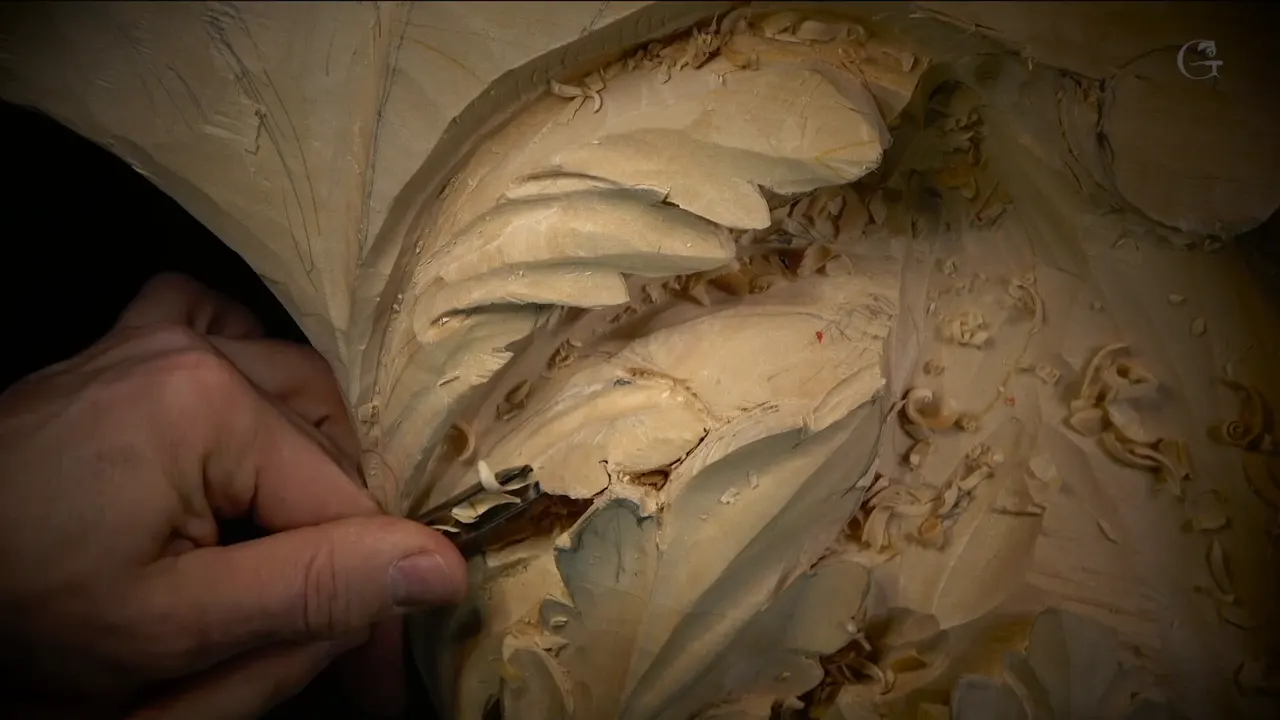

Little guy is a phrase from my own lessons. It is in Venice Room workshop 67, part 2, said while I blended. In other courses the same two words went on leaves, grapes, flowers and tools.
Have you ever looked at a carving and found one small spot you could not leave alone? Did you wonder what a carver does about it next? Here are my words from this part and from other courses, each linked to its lesson.
What did I say about the little guy in this part?
Part 2 of workshop 67 has "that way I can actually achieve two results," and "I can blend nicely this side." Next: "this concave has to go all the way to somewhere right here, to that point."

About depth: "It doesn't have to be too deep here," I said, and "it's not going to make sense to have a too-deep concave." Then "I'm going to give it some movement and some interest."
Then I said "That is a little too small," and weighed two sizes for the gouge out loud: "Maybe 12 millimeters, or maybe 10 millimeters first" (about 0.5 and 0.4 inch). A plan followed: "Let me use 10 millimeters and I'll see how it's going to look."
About a ridge: "I don't really need to see this sharp ridge. Absolutely no reason for it." A plan: "Let me use maybe just number three and try to clean it."

Then came the line. "I'm using just a spoon, number three, and kind of blend that a little bit. I'm still not too happy about this little guy." After it: "I also need to soften this side of the pipe, which I could probably do with the same tool."
"That is not bad," I said, and "In my opinion, it's not bad." Later in the same part: "Kind of looking a little messy, but it's okay."
Then: "hit a little bit with the bigger tool and soften overall movement," and "it's 15 millimeters, 5/8 of an inch," then "a little less than 5/8 of an inch."

I asked a question out loud: "Can you see all the shadow place? They are obvious." And "if you don't see it, that's I guess not my problem," then "I can see them."
Then: "I don't need that mark, and I also don't need this black marker also, I'm going to just get rid of it," and "I wish I didn't put those marks because it's kind of hard area to clean." Then "It's not impossible, but still."

My next words were "let me refine the edge," and "a little bit touch-up underneath." I called it a "tricky area because like I said, the grain and so on." The words after were "I hope my head is out of the way of our camera," and "on inside I can clean off camera with no problem."

Part 1 of the same lesson says little thing: "Let me attack this side also, or this eye, because there is also little thing," and "I've got that little thing going on."
Which cut comes first, the little guy or the flower?
Workshop 133, part 3, put the little guy first in my plan. Step one: "just outline first with that number 11," at "about half an inch, 12 millimeters" (the same size, about 1/2 inch). The order was "outline not the flower first, but" the little guy.

Then came a count. "There's a couple more going underneath. So my first cut and a second cut," I said, and only then the flower.
Workshop 136, part 3: "I need to make sure I'm outlining it with a smaller tool," I said, and named "number 11, and let me think, maybe about five millimeters or so" (near 0.2 inch). The little guy was "supposed to lay on top," and I added "I want to be safe."
Workshop 137, part 1: "Have to be careful. But actually, I'm safe." Then "This area is a little lower, so I should be okay," and I could outline "right away" the little guy.

Separations were coming, and I said "Even if we're going to have some separations right there, I still going to outline the main form first." Later: "looks like I am safely able to slope this guy underneath of that part."
Workshop 62, part 6: "I need to outline that little guy a little better, and there's going to be an eye. We do not want to lose that eye."
Furniture Panel 31, part 2, has "those three little guys," which I said I could probably work on right now, then "outline them first with the number 11." My pick was two and a half millimeters (roughly 0.1 inch), and I said two would do and even three would work. Next, in the third part: "I'll outline this guy also."

A number nine turns up in Floral and Molding for the Panel 3, part 1: "Ten millimeters, three-eighths of an inch, and I'll attack" one, I said, then "I'll just attack this little thing." Then: "What's the thing? How you call that thing? Volute." I planned room near the volute: "approximately a sixteenth of an inch space right here. About sixteenth. About one millimeter and a half."

When does a little guy go down?
Workshop 161, part 3, brings a plan to go piece by piece. "Like I said, I don't really want to lose the overall picture of what I've got right here." Then: "And let me take that down also, that little guy." Later: "That is probably it."

Back on the Furniture Panel, lesson 31, part 3: "Same number eight." Next, "let me actually get" the little guy "down, maybe all of them actually down." Details could wait: "I don't worry about the final detail yet," and I would "create those separations a little later, but at least I see overall movement."
In the second part of that lesson, a leaf gets the same name. "Little, um, leaf, it's gonna be laying on top of the left hand side," and "I'll use number 11 to lower that down this leaf," and "I want to do it somewhat extreme because I really wanna see some movements."
Workshop 98, part 3: "I need to use smaller number 11, so remove" the little guy. The size followed: "And again, 10 millimeters, number 11" (about 0.4 inch). "Going to clean up this area," I said.
What goes underneath a little guy?
Part 1 of workshop 131 has "I need to take care of the line, okay? So" the little guy "has to go underneath." Later in that part came "it's all about the shadows. See? It just casts shadow, and that separates this leaf from the rest of the picture."

Workshop 137's second part plans a side beneath one. "I'll take just the number two and clean this area," I said, then "take this side underneath of" the little guy, plus "create some variations."
Gibbons Maine 13, part 3, floats an undercut: "maybe actually even undercut underneath of" the little guy. "Get even more shadow." "I am working against the grain, please don't judge me, okay? I know what I'm doing," I said.
I gave a reason: "Sometimes it's just no other way, there's everything in the way." Under a stem I had "about 10 millimeters" (about 3/8 in). That class is on the style of Grinling Gibbons.

What does a little guy decide?
Depth, in Grape Onlay 9. "How deep I gonna go, gonna be determined by" the little guy. "I don't want to go deeper than that because it's gonna give me a trouble little later."

Workshop 107, part 3, sets one depth for several spots. I called it "my final depth," "equal to that spot," and "also equal to that spot," and also "I am consistent with that." Of those little guys, "exactly the same depth," and "no more than a quarter of an inch, about six millimeters. So no more than that."

Workshop 108, part 2: "Also right here, convex, concave," I said, and on the little guy, "convex and concave." Then: "And what I can do, I can actually right away pretty much create my initial cut and start undercutting. Not much, but little that I'm able to."
Class 3 of the Maine course, part 2: "Not the final detail yet," I said. Of the little guy, "the same movement," and "a part of that one."
Can a little guy wait?
It can, in workshop 159, part 1. "And yes, later on, I will create a small division on" the little guy, "but it's going to be little later, so I don't want to overdo it." The part itself: "a small little detail growing from underneath" the molding, "just flipping this way."

Grape Onlay 13, part 3, has "another grape also kinda small." "I can take it to the extreme a little later probably," I said, about those little guys. And "right now I have another opening that I have to fill somehow."
Workshop 147, part 1, deals with a line that looks wavy. What I have now, I said, are little guys, and "I can make it look really nice, just run and hit some of the spots and make it perfect." And "I'll take care of it a little later, so you don't need to watch it, but that's the idea."
Do I watch out for a little guy while I carve?
Workshop 106, part 2: "I outline it and just want to make sure I'm not destroying" the little guy, which was "my flower," and "going to go later right on top and maybe create some kind of twist." After it: "let me put actually a pencil mark. That way I'm not going to destroy that line."
Workshop 153, part 2: "I going to think what I want to do," I said of the little guy. One idea: "I could actually roll it, like that." "I use number three for outlining it," I said, and talked about "the position of my line."
The butterfly plate (lesson 6, part 1) has my plan: "before I create this cut I will attack" the little guy. In the same part: "if I'm gonna just create too much force, I gonna break this side, that's not gonna look nice."

Can a little guy be a tool?
Small tools for tight spots come up in Furniture Panel 32, part 2, where small planes get a mention. "You can get like one millimeter blade and you can get to the tiniest spots," I said (that blade is about 0.04 inch). A smaller tool followed, "even smaller guy." I named it: "That one is a microplane, I mean router plane." For small spots, I said, that would be a "really good tool."
Part 2 of Grape Onlay 14 opens with "by the way" and a new thing, and "Let me show it to you." What it was: "powerful blower," and "it's rechargeable."
Maine class 13, part 2: "four millimeters number nine" (about 0.16 inch). My remark: "See how tiny that is, I can work with the grain."
What if I can't name the little guy?
That happens. Class 2 of the Maine course, part 2, looks at a second block with smaller flowers, and I said "I have no idea what that is." Then, "But doesn't really matter. I mean you can name anything."

Of the section: "I still want to see what is gonna be."
One more use sits far from the bench. My talk on the law of space (design principles lesson 3, part 2) asks "have you ever seen Chinese fine art?" They "love mountains and trees and so on," and "they put tiny, tiny small house and a little guy." Then: "Humans are just a tiny spot and nature is a huge in the big picture."
Ten little guys in one table
Here are ten, in the order I wrote them down.
| Lesson | What I said about it | Close by |
|---|---|---|
| Venice Room workshop 62, part 6 | Needs a better outline, I said | An eye |
| Furniture Panel 31, part 3 | Number 11, I'll outline one | Actually, you know what, I'll outline this guy also |
| Venice 133, part 3 | I'll outline it, not the flower, first | A first cut and a second cut |
| Venice 137, part 1 | I could outline it right away | I still going to outline the main form first |
| Venice 161, part 3 | The plan was to take that down also | That is probably it |
| Venice 131, part 1 | It needs to go underneath, I said | It just casts shadow |
| Lesson 9, Grape Onlay, part 2 | How deep I go gets determined by the little guy | Deeper gives me trouble later |
| Venice 159, part 1 | Later on, I will create a small division | Just a small little detail |
| Lesson 14, Grape Onlay | By the way, I got a new thing | Powerful blower, I said |
| Maine 2, part 2 | No idea what that is, I said | It doesn't really matter |
Would you like to watch me outline one before the flower, or take one down? Then start with workshop 67, and find this room in the whole course.
How it's done
- Start with the small part. Workshop 133, third part: a number 11 of 12 mm (about 1/2 in), and the small part first, in my plan.
- Take a little guy down. Workshop 161 has piece by piece as the plan, in its third video.
- Put a side beneath it. My plan in workshop 137, second video: a side beneath the little guy, with some variations.
- Let a small spot set the depth. One little guy sets my depth in Grape Onlay 9, second video.
- Leave the division for later. Workshop 159 plans a small division for later on, with no wish to overdo it.
Frequently asked questions
Which part of Venice Room 67 has the phrase?
The second part, during a blend with a spoon gouge, number three. Right after it I said I also needed to soften this side of the pipe, which I could probably do with the same tool.
Does the little guy come first, or the flower?
Workshop 133, third part, had my plan: the little guy first, then the flower. The tool was a number 11, 12 millimeters (about 0.5 in), for the outline.
Which tool went with a little guy?
It changed from lesson to lesson. On the Furniture Panel I said I'd outline one using a number 11. In Floral and Molding my pick was a number nine of ten millimeters (three-eighths of an inch) for one I would attack. Maine class 13 gives four millimeters (about 0.16 in), number nine.
What to carve next