

Alexander Grabovetskiy, woodcarver, School of Woodcarving · Published 2020
What does a wood carver mean by "cheat"?
Quick answer: The word cheat comes from my own lessons. Venice Room workshop 67 has it in the fourth part, and a small tool follows. Other lessons pair it with rasps, planes, a router, a jigsaw and sandpaper, each one cued below.
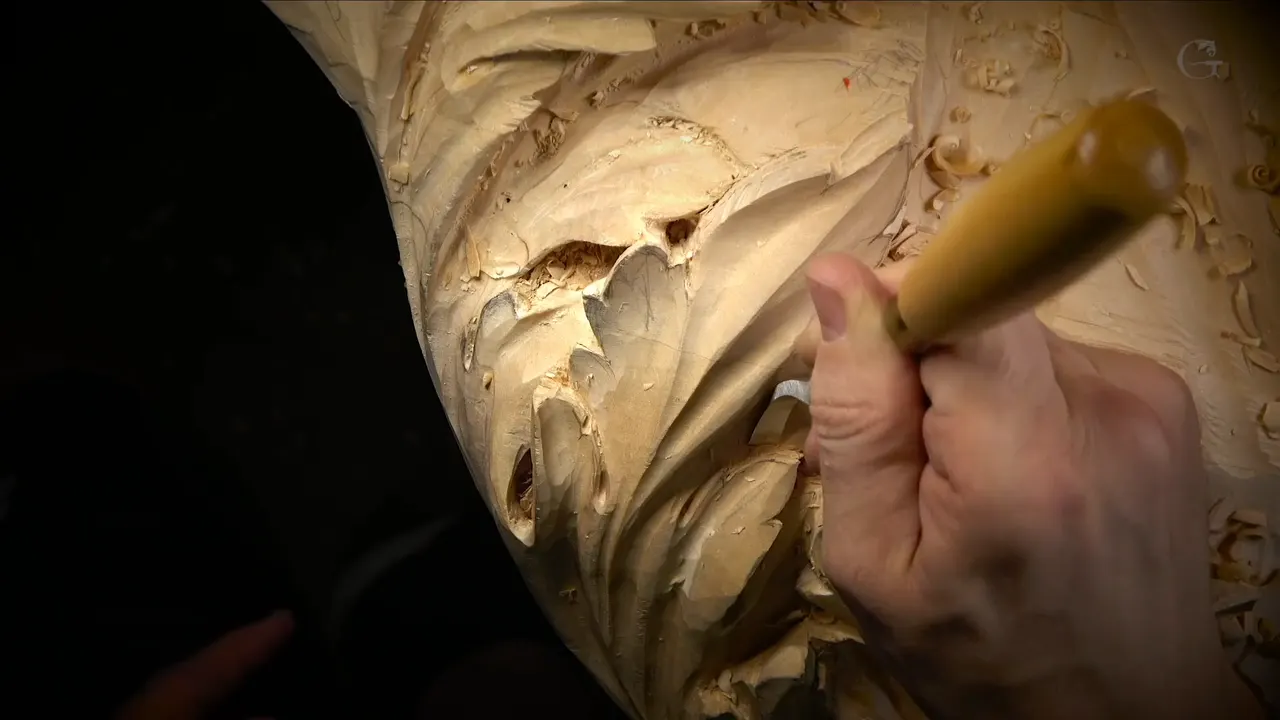

Cheat is a word from my own lessons. In Venice Room workshop 67, part 4, I say it, and a small tool comes next. Other courses put it beside a rasp or a hand plane, and in other lessons a router and a jigsaw.
Have you ever looked at a carved edge and wished a quicker tool could finish it? Did you wonder if I ever reach for one? Here are my own words from this part and from other lessons, each one linked to its lesson.
What did I say before I said cheat?
The fourth part of workshop 67 opens with a worry about my finish: "I don't want to destroy my beautiful finish." Then comes "And did I do that?" After it, "Looks like I did. That's okay."

The line this page is named for comes next: "You know what? I'll just cheat a little bit. I'll use half a millimeter" (about 0.02 inch). I caught a slip. I had named the small size and grabbed one millimeter (about 1/25 inch) instead, so my plan went back to the small tool "and clean all that stuff out."
The spot was awkward, and I said so: "But it's hard. The area, this is in my way. Really, it's not too convenient." I also told the viewers that "you should be able to catch what I'm doing."
Which tools came after the cheat in part 4?
A number seven came up. "I need to use number seven, I would say, in this area. Number seven, maybe 14 millimeters" (0.55 inch). I wanted to see whether it would "fit perfectly," and my answer was "And yes, it does." The angle was a plan too: "I also going to angle it slightly this way." What it made, in my words, was "an extra separation."

A smaller tool followed, "maybe smaller number three, three millimeters, one-eighth of an inch," to "get that detail a little nicer." My verdict was "That is somewhat what I want to see." For the cleaning I said "a little later, going to spend a little more time and clean inside everything and so on, but for now, it is good."

Waste came next, and I had a plan for it: "let me dig out some excess material, although I'm not going to be able to do it with just a normal way." Maybe, I said, I would blow my chips away. Looking at the result, I said "It does look good in my opinion," and then I planned to "jump again right here and finish up on the main form, in this area."
The pipe was nearly done: "I've got this pipe done pretty much, but I still have to work up this particular section." My view of the whole piece was "I think it looks really good," and I mentioned the flowers that were still to come.

What else did part 4 leave open?
The shell sat where filming was a problem. "I'm still going to do future development of the shell, which is going to repeat actually pretty much just the beads on inside." About filming it, it would be "hard for me to film it." The beading would happen "just off camera," and for how I had done it, "you have to watch previous segments."
Then came a question for myself: "I need to think about should I get deeper or not underneath of this leaf, or should I just leave them sticking together?" I named it "pretty much the question," and added "We'll see just in a moment how it develops naturally."
A skew entered the plan: "Maybe I can use a skew a little bit to clean up and create my canvas." My words for it were "Clean canvas for me to see much better what's going on," and "that way you can see exactly what needs to be done."
The camera was in my way: "But the challenge I have, it's a camera. A camera on my way." Still, "I could get it done off camera, of course, but I really wanted to show it to you what the development is and how I approach it." Of the leaves I said "Those two leaves are coming together. Really nice."

What did parts 3 and 5 say about small tools?
Part 3 has "Going to need the one millimeter, number 11" (1/25 inch) for "little longer cuts in the areas of micro-separations," and then "a little better definition."
Part 5 starts with "get underneath of this leaf a little better." Soon after I said "I just destroyed the edge. Well, actually, no, it's not that bad," and the tool changed to a smaller one. After "this tool is a little too big," I named "Two millimeters, number 11, okay? Right here." That size is 0.08 inch.
Did I take a rasp when I said cheat?
Part 4 of Venice Room 17 has a movement I called "a really nice movement right there." The first idea was "I could probably fix slightly this side" and "Create a nicer curvature." After that came "And again, let me do cheating. So it's a cheat code, like my children would say when they played some games on a computer. Just use a rasp and create that really nice curvature."

In part 9 of that workshop I picked a tool, saying "Now I can probably clean everything with this movement. And I'll use the number five again. Or number seven, actually, in this case, will work really good." The goal was "nicer separation right here," and later I said "Let me cheat again with the rasp." My next words were "See, it just blends nicely."

Workshop 145 had a clean-up first, in the second part: "all I'm going to do is just clean it and bring everything to the edge," and "I need 2 millimeters or 1 millimeter even" (0.08 or 0.04 inch). The turn came next: "I'm going to cheat. I don't know if it's cheating or not, but I'll take some rasps." Then, "I think it's just going to expedite my process. At least I hope so."

Smoothing came after it, and that part, I said, would be "off-camera." Earlier in the same part: "all the cleanup I can always do off-camera."
Workshop 147 had a plan, in its fourth part, for relief cuts in some triangles, with a tool of "maybe 3 millimeters or even 2 millimeters" (0.12 or 0.08 inch). A number seven of 14 millimeters, a little over half an inch, was my plan to "finalize the shape." Then I said, once more, that I would cheat, and I would use "my new helpers," and it was going to "save me a lots of time." The rasps were the tool to "blend everything."

My view of the result was "That doesn't look too bad at all, as far as the movement goes," though the edge "is not perfect yet, so I'll just clean it, and so on, but you get an idea."
Lesson 4 of the lily box course, part 13, has me taking my rasp again: "Let me actually take my rasp again and see how everything flows." My opinion followed: "And I actually like the rasp. Although it just feels like I'm cheating. But I know some other carvers, they always use it. It's actually working really good."

The marks it left were not what I wanted to see. "But I still have to recut that, okay? Because I need to see really nice facets from our carving tools. I really don't want to see just the rasp tools, okay? I mean marks. So I'll use a number two and recreate my cut." Next came "Just shave it," and later "I like it actually a lot."
What about a plane, a router or sandpaper?
Two parts of the Greek Acroterion course carry the word, both in lesson 1. In part 2 I wanted a straight line: "make my cut even deeper now. That way the line is going to be absolutely straight." I needed to make sure of "not going deeper than about 1/16 of an inch" (about 1.6 millimeters). My plan was a shoulder plane: "probably the easiest way would be just to take a shoulder plane."

The word came later: "Somebody would call that cheating, but I don't think so." And "It's still hand tools, and they used hand planes in ancient times." After that came a plan for a marking gauge: "Let me make that cut a little deeper with my marking gauge. Just establish that line a little more pronounced."
Part 3 opens with "So I can't say that when I'm using my hand plane, I am cheating." My words for the pace were "little by little." A little later: "I actually do like to use my hand planes a lot."
The Venetian flowers rosette course, lesson 1, part 2, shows an oval blank with a molded edge: "you can see on outside, I already got some kind of molding going on, and it's just a normal Roman ogee, and I used router. Okay? Yes, I cheated little bit because I need to finish this project, and I can't afford of losing time, not anymore at least. But the profile is simple."

Part 5 of Roman acanthus workshop 16 has one side that "doesn't look too good for me. So it's kind of rough." Sandpaper came into it. "And what I did, I told you I don't like to use a sandpaper, but in this case, I cheated, and I just used like a 80 grit, just a little bit to see how rough marks it's going to leave and so on." Then "Now I have to take care of it, okay?"

A plan followed for that job: "I'll use probably same number four, 10 millimeters" (about 0.4 inch), and "I'll create my cleaning cuts."
What about a jigsaw, a fluteroni or a macaroni tool?
Workshop 75 starts its first part with "This time," and a plan to "probably just cheat." Then "Not to cheat, but on another side, what I did, I just removed that section with the gouges," and "I think I can just do a jigsaw." For the outline, "I don't need to really be on outline. It's approximately." Afterward I said "So it took me literally just about 30 seconds."

The only downside I named was dust: "I hate dust in my shop. So that is no bueno." The fix was short. "But, of course, there is a solution," and "Just vacuum it."
In workshop 153, a part of my acanthus "has to go lower, too," and "I could probably clean this, again, a little lower and reestablish that line again." Then: "Maybe I should cheat and use just more modern tool, fluteroni." About Italy, "Italian also got fluteroni," and then "Get my cut like this." My last line there was "Just going to cheat slightly."

Workshop 159 deals, in its third part, with a bead molding that needs "the right height." My line was "sometimes it's a good idea to use a macaroni tool and just get the right height, at least the midsection of my bead molding," and I followed it with "But that would be cheating because that tool wasn't available yet back then."

Did I ever say it about someone else's work?
The dining table apron course (workshop 5) has a story about old doors. The veneer was "only eighth-of-an-inch veneer applied on the top of pine" (about 3 millimeters). I called my clients, and my words were "the original door builder or whoever did those interior doors, he's cheated." His method: "he just used the white pine, not white pine, yellow pine, and applied that veneer on top to make it look solid."
The way to make it beautiful, I told them, was "just a shallow carving," or shallow, "not as deep." About the name, "You can give it the name."
Every cheat in one table
Here they are, one row for each lesson.
| Lesson and part | What I said in that lesson | Tool I named |
|---|---|---|
| Venice Room 67.4 | I'll just cheat a little bit | Half a millimeter |
| Room 17, part 4 | A cheat code, like my children would say | A rasp |
| Workshop 17, part 9 | Let me cheat again with the rasp | The rasp |
| Lesson 145, part 2 | I don't know if it's cheating or not | Some rasps |
| Lesson 147, part 4 | And it's going to save me a lots of time | My new helpers |
| Venice 153, part 3 | Maybe I should cheat and use just more modern tool | A fluteroni |
| Workshop 75, part 1 | It took me literally just about 30 seconds | A jigsaw |
| Greek lesson 1.2 | They used hand planes in ancient times | A shoulder plane |
| Rosette lesson 1.2 | I can't afford of losing time | A router |
| Roman acanthus 16, part 5 | In this case, I cheated | 80 grit |
| Lily Box 4, part 13 | It's actually working really good | My rasp |
Would you like to watch me reach for a smaller tool in relief? Then start with workshop 67, and find this room in the whole course. Workshop 66 comes before it and 68 comes next.
How it's done
- Name the small tool. Workshop 67, part 4: I planned a tool of 0.5 mm (about 0.02 in) to clean out the mess.
- Check how the next one fits. That part also tried a number seven at maybe 14 mm (a little over half an inch) to see if it fit perfectly.
- Pick the quick tool. My other lessons name rasps, planes, a router, a jigsaw and sandpaper.
- Clean what it leaves. Workshop 147 left an edge that was not perfect yet, and I planned to clean it.
- Return to carving tools. In lesson 4 of that course I planned a number two to recreate my cut.
Frequently asked questions
Where in Venice Room 67 did you say cheat?
The fourth part has it just before I named my tool, and then I said I had grabbed one millimeter (about 1/25 in) and planned to use the smaller one.
Which tool came after the word in your other lessons?
It changed with the lesson. Rasps came in workshops 17, 145 and 147 and in the lily box course. The router belongs to the rosette lesson. Workshop 75 has the jigsaw, and the Roman acanthus lesson has 80 grit.
Why did you cheat with a router on the rosette?
The project had to be finished, and I could not afford losing time, not anymore at least. The outside molding was a normal Roman ogee, and the profile was simple.
What to carve next