

Alexander Grabovetskiy, woodcarver, School of Woodcarving · Published 2020
What does a wood carver mean by "over and over"?
Quick answer: In Venice Room workshop 67, part 8, I said it while I cleaned, undercut with a number three, then took a plug with a quarter-inch number nine. In Hashemi, Furniture Panel and other lessons, the same words come beside repeated work, a tool I was tired of and a mistake I saw in many people.
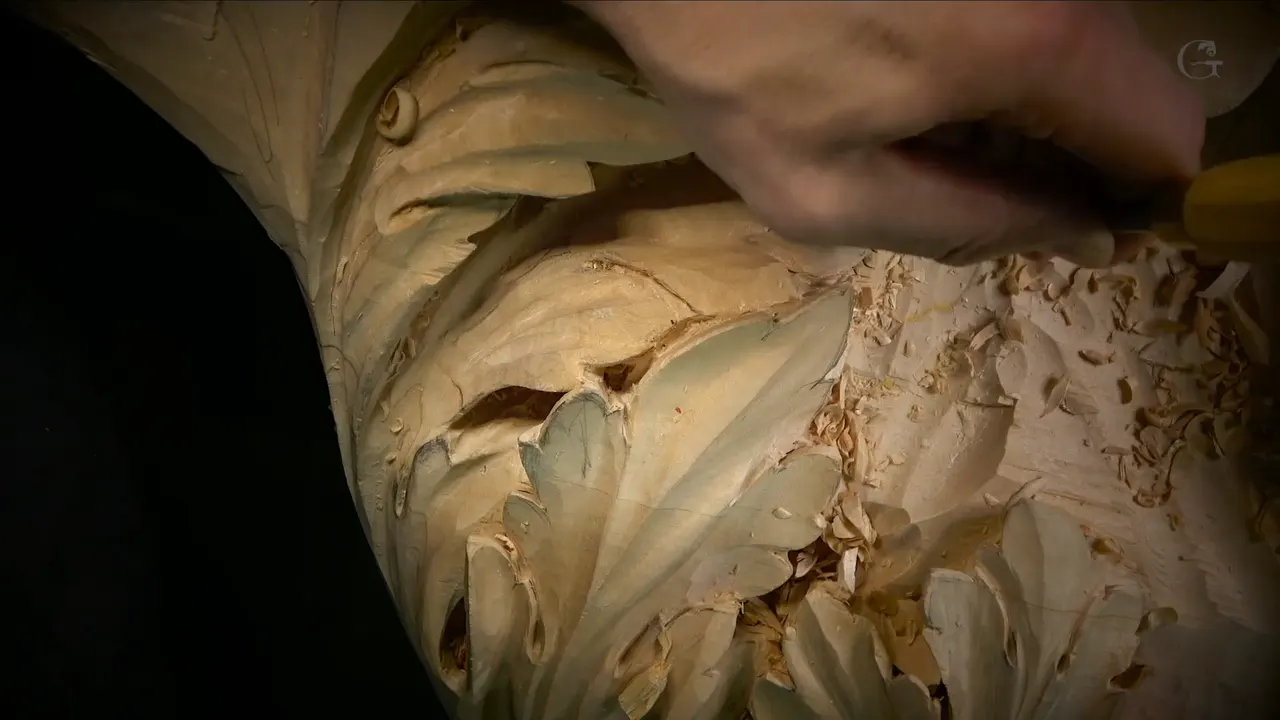

This page follows one phrase of mine from part 8 of Venice Room workshop 67 into my other courses. The words came while I cleaned a deep spot and began an undercut.
Part 8 comes first. After it, the page goes through the courses where I said the same words, one lesson at a time, each with a link so you can watch the bench. Wikipedia has a short page on wood carving if you want the craft in general.
What was going on in workshop 67?
The part opens on a limit. "It's already deep enough," I said, and going deeper "would be a big mistake." I planned a quarter inch (6.35 mm). That was to remove "whatever half an inch it didn't remove" (12.7 mm).
I said "let me double-check from opposite side," and then "it looks good, and it looks safe." The chop was planned with a number nine gouge. For the cleaning, "Number six or number seven will work," and "a lot of cleanup needs to be done."

In my hand was a spoon, a number six of about 12 millimeters (0.47 in). Later I planned to "attack that with a bigger tool, like one inch or so," to get rid of too many facets and tool marks. One inch is 25.4 mm. Another spot, I said, "could be done a little later."
Here is the line this page follows: "And again, some of that stuff doesn't have to be on the camera because it's just the same thing over and over". Then number three, "and kind of start my movement in undercutting."

My pinky came up. "I'm actually referencing my palm," I said, with the tool "really close," and "you've got to be really careful how you work." The rule I gave was "if it's possible to reference, do it. Only if it's safe, of course." The pinky has a Wikipedia page of its own.
In this case the cleaning "works fine because the grain runs that direction, and I could kind of break off excess." Then I added "Not in every area it's going to work the same way." The page on grain explains that word.

Now an undercut. "I don't want to dig deeper than what I need," I said, and "It's already kind of deep in this section." I would "create my excavation little by little like a plug cut, plug removal cut." That way, I said, I would "create beautiful shadow."

It was a "Quarter-inch number nine" (6.35 mm), and the plug came out. "Here's my plug. Beautiful, right?" Then a question to myself. "How many times did I say beautiful? I don't know. But I think it's a good word. Beautiful, great, wonderful, awesome, gorgeous. Everyone's supposed to use those words if you're an artist."

A limit again. "I do not want to go too deep because I have a limitation," I said, and "this part actually limits me." Then "that's already raising my tool, which means its angle's really deep." Deeper was possible. "It's not a big deal, I should say," but "I really don't need to."
For the angle I planned number three again, to "go on angle and go in." "It's almost laying already," I said, and "it's already angled. It's a really deep undercut already." I added "I know on the camera you don't see it." Left to do, in my words, was "just clean up pretty much." Next, "carefully, I'm going to attack this side also."

The part ends on the undercuts: "they actually make whole world of a difference." Then "approximately 12 millimeters, about half an inch, I'd say," and "My tool becomes a little dull." Part 9 begins with "It's already dull."
Where else did the same words come up?
The third part of Acanthus over Moldings lesson 10 has me ready for "the last step before I gonna take this out of my paper," and the work from the backside was that step. "I'm not going to do all of it on the camera," I said. It takes time, I added, and "You really don't need to see me do exactly the same on all of it."
My plan was to "concentrate on cleaning up. So all the facets that's what I'm gonna do." Two steps came out of that, "cleaning an eye" and "how to take those facets out." sandpaper was an option, I said, "but I'll show you what the normal procedure is." The piece was to be "just a white color," and "there's no reason to spend so much time on cleaning stuff." My first tool was to be a knife: "Let me do a knife first."

Workshop 95 of the Venice Room, part 10, has a cleaning stretch, and I called it "the same operation, same operation." I thought "I could leave this side alone," and "maybe it's a good idea for me, not to spend too much time make it smother and so on." Maybe I could use rasps, I said, "just to give a little bit of a cleanup job."
"let me double-check from all the sides," I said, and "I see some of the areas I need to address." Then "Maybe I'll just give a rasp job to it so we'll see."

At workshop 100, part 10, I said I did not want to spend too much time on just showing you the cleanup process. My cuts there were "going to be a lot more concentrated and finer," and "besides that, it's just the same process."
I wanted to "carry this cove all the way around this volute." "So that is why I didn't finish anything, and I still have some rough spots." Don't pay attention to those, I told you. About cleaning right away: "Sometimes I do, but not all the time." And "after I'm happy with the overall movement, I'll clean everything." Then a tool, "number 11 and 2 millimeters" (about 0.08 in), "around my volute."

Furniture Panel lesson 21 comes next, at this link. In part 14 I said "Apologize if I'm keeping quiet sometimes, but I am trying to concentrate on that movement". That was "pretty much doing the same operation." For it I said "I can probably use just a small gouge, like number eight," and then "maybe one-eighth of an inch, three millimeters." "Let me see if it's going to fit in," I said, and "yes, it does."
I planned to rotate carefully, "because I want to make sure I'm not going to break anything," and pop that center out. A little deeper was possible, "But again, not deeper than the background." And "still have to be thinking about the background."

Hashemi Flowers lesson 43, part 5, has me asking for forgiveness for working without talking: "please forgive me if I'm carving and not talking." It needed me to concentrate on the same technique. "I sometimes even don't know what to say." Then "Please be patient and forgive," and "Don't worry if it looks chunky a little bit at this point." And "Use a V-tool."

Part 1 of Hashemi lesson 49 starts with "Let's move to the next petals." At that point you "just repeat" the work, the same idea each time, and I named three things, "As wavy as possible, as deep as possible, and as clean as possible." Then "Those three main things." For flowers I named "approximately four basic tools," and the first was "definitely, you're going to need the V tool."
Later in that part I told you "I know it's impossible to repeat exactly what I'm doing. Just to get an idea, okay?" For one flower my plan was "exactly the same," "until I get to the point." On the waves I said "I kind of like that waviness, unevenness, and so on," and "I think it just looks better."
In part 2 of that lesson I said "by now, you should see there is nothing complicated about carving somewhat complicated flowers." What I did was "pretty much just repeating the same cuts." The only challenging part was, "at least for me," "how nice I want to see my final look."
"you can go as extreme as you wish," I said, and "So you will always find some imperfections." My teacher would tell me "If there's going to be a day when you look at your work and you're going to say, 'Wow, it's beautiful. I couldn't make it better,' he said, 'That's the last day of your artistry.'" And "the true artist always see imperfections in the work."

Back to workshop 67 for a moment. Everyone's supposed to use those words if you're an artist, I said there. Part 4 of Hashemi lesson 49 takes up cleaning: "the cleaning is actually the easiest part," and I don't have to show you how to clean. "You're just removing extra facets and so on."
On the facets I said "I could take just the number three, move it upside down, and make my rotating movements like this." My hand moved in "just the micro moves." And "many times, what I'm doing, I'm doing this off camera because it just takes so much time, and there is no reason just to watch it. And I have nothing to say while I'm just doing cleaning."
Part 6 has "I still have to undercut," with "again, number 11." After that came "I make it a little smoother," then "I'll use just a knife," a "number 12 knife." I told you "I can go as deep as I wish with this knife."
What about the same tool every day?
Floral and Molding lesson 10 has this in its third part. There I said "Even in my case, I change sometimes my preferences." Then "You really sometimes getting tired of the same tool and what tools you're using changes." And "Please understand, I do carve every day, and yeah, I also get tired of using the same tools".

"that's always joy to use some other tools. That's why I'm still collecting the old antique tools, because it's a joy, just use something, like even an antique piece, something what was used before." Then "this is a new tool, and that is my new toy, if you wish. I like to play with my new toys."
Hashemi lesson 25 has it in part 2: "you can achieve the same results, and that's why I actually like to have multiple tools." My explanation was "sometimes you get tired of the same tool if you're using that every day, and you want to approach something with different tool." Next, "I am getting tired sometimes using same tool," and "But looks like today, this tool works just fine for me."

The Grinling Gibbons Maine class, lesson 12, part 2, has it too. "You could use a number 11," I said, and "you have to change." After that, "it becomes boring after a while," and then "let me create that separation now."

Who makes the same mistake, and what is it?
In Grape Onlay lesson 2, part 3, I said "please forgive me if I'm, uh, telling you too much about it," and "maybe I just saw so many people are doing the same, same mistake". The mistake was "Concentrating too much on detailing. It's too early."
The picture I gave was a house: "you would build a house, you concentrate on a roofing before you put the basement in." And "You really have to concentrate on overall look like blocking in." I added that some carvers, "even professional wood carvers," "work just one area until it is done and I've done it also." On some projects "it is fine." In most cases "it is better to just block in, see how it looks."

In Vase with Grape Leaves lesson 3, part 2, I said "I don't want to bore you with showing". Then "At least not on this project." I wanted to undercut, and not pierce it. "looks like I wasn't too careful and I've got two weak fibers, but it's okay."
"So we're going to take again either number seven, initial number seven, and create the cut toward undercut." Then "hook out." And "that was really weak, so that's why it flew out, but it's okay." Then "I can recreate the movement right here." And "Nobody's going to know that."
How do all of these lessons line up with workshop 67?
The table lists them with workshop 67 first. The first column says where I was, the second the work I was doing, and the last gives a line of mine from the same place. Measures in the table text follow my figure first, then millimeters or inches.
| Lesson | The work I was doing at that spot | My line |
|---|---|---|
| Venice Room 67, part 8 | Cleanup, a number three undercut, and a plug | The same thing |
| Workshop 95, part 10 | Cleaning the piece, and maybe a rasp for a little cleanup job | Same operation |
| Venice 100, part 10 | Cleanup, with a cove still to carry around a volute | Concentrated and finer |
| Acanthus over Moldings 10, part 3 | Last step on the backside, then cleaning up the facets | It takes time |
| Furniture Panel 21, part 14 | The number eight, and a center I wanted to pop out | Keeping quiet |
| Hashemi 43, part 5 | Working without talking, and asking you to be patient | Be patient |
| Hashemi 49, part 1 | Petals that are wavy and deep and clean, with a V tool | Three main things |
| Hashemi 49, part 2 | Somewhat complicated flowers, and a plain run of the same cuts | Nothing complicated |
| Hashemi 49.4 | Cleaning, with the smallest facets left off the camera | The easiest part |
| Hashemi 49.6 | An undercut still to do, then a knife for smoothing | A little smoother |
| Grape Leaves Vase 3, part 2 | An undercut planned for all of those leaves in the vase | Two weak fibers |
| Floral and Molding 10, part 3 | Changing preferences, old antique tools and a new tool | My new toy |
| Hashemi 25, part 2 | Getting the same results with multiple tools | Works just fine |
| Gibbons Maine 12, part 2 | My number eleven, and a change of tools | Boring after a while |
| Grape Onlay 2, part 3 | A house, built with the roofing before the basement | Too early |
Where can you watch the full videos?
Every lesson named above sits inside one of my courses. All of part 8 is in workshop 67, with workshop 66 before it and workshop 68 after it, and workshops 62 to 73 are in Venice Room Part 6. The leaves, flowers, chisel and mallet pages linked here are for reading. To watch the full videos, start here.
How it's done
- Look at the depth from the opposite side. Going too deep would be a big mistake, I said, and I also looked from the opposite side.
- Clean with a spoon gouge. A number six spoon of about 12 millimeters (0.47 in) did the cleaning, and I said a number seven would work too.
- Reference your palm only when it is safe. My pinky referenced my palm, close to the tool.
- Take the plug. A quarter-inch (6.4 mm) number nine made the plug cut, and I said here's my plug.
Frequently asked questions
Which tool made the plug in that part?
A number nine did it, a quarter inch (about 6 mm). The plug came out of my excavation, and I called it beautiful.
How did I handle my hand near the tool?
My tool was really close, I said, and you've got to be careful. I referenced my palm with my pinky, and I said to do it only if it's safe.
When did I plan a bigger tool for facets?
Later, I said, with one inch (25.4 mm) or so. The goal was to get rid of too many facets and tool marks.
How did I explain my tools in Hashemi lesson 25?
What to carve next
- Venice Room workshop 67 lesson
- Venice Room workshop 66 lesson
- Venice Room workshop 68 lesson
- Workshop 62 to 73 course
- Venice Room workshop 95 lesson
- Venice Room workshop 100 lesson
- Acanthus over Moldings lesson 10
- Floral and Molding lesson 10
- Furniture Panel lesson 21
- Grape Onlay lesson 2
- Hashemi Flowers lesson 25
- Hashemi Flowers lesson 43
- Hashemi Flowers lesson 49
- Vase with Grape Leaves lesson 3
- Grinling Gibbons Maine lesson 12