

Alexander Grabovetskiy, woodcarver, School of Woodcarving · Published 2020
What does a wood carver mean by "for the sake of"?
Quick answer: Venice Room workshop 67, first part: I worked on an eye I called almost invisible from every point of view, and I said I still do it so you see it, and for the camera. Other lessons of mine use the same word, sake, beside the shadow, the lesson and the school.
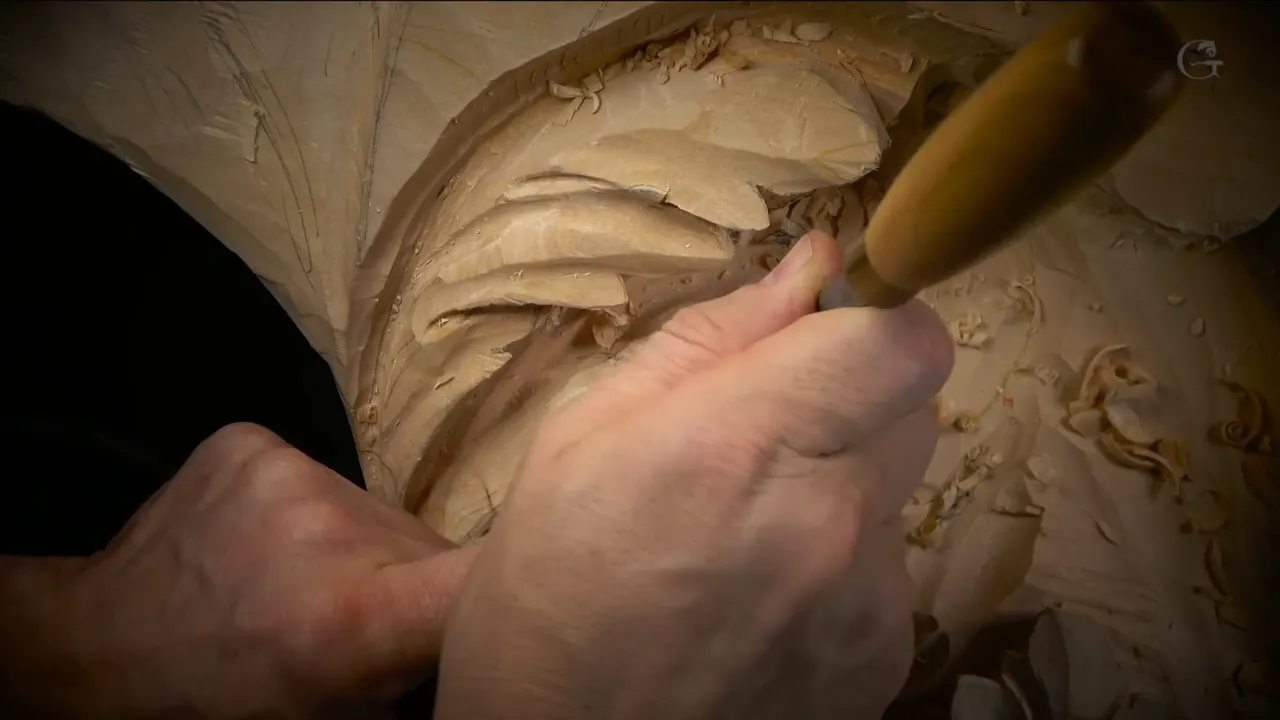

In Venice Room workshop 67, part 1, I worked on an eye I called almost invisible from every point of view. I still did it for the camera and so that you could see it. The word sake sits in other wood carving courses of mine too, next to the shadow, the lesson and the school.
Ever carved a spot you knew nobody would see, and wondered if it was worth your time? Here is each place I say that word, lesson by lesson.
Which spot did I work on in part 1?
The part opens with a plan: "now I'm going to work on this separation." My words after it: "I need to create the cut right on the side." Next I asked myself "am I going to do this part going underneath of this line or the opposite?" My guess was "I think probably it is going to be looking better if I take this one below that line and give a better twist inside." About the tool, I said "I use just a spoon gouge."

Next came a pipe: "Okay, here's a pipe," and it would "go all the way somewhere right there." So "at least on one of the sides, I need to create the concave." A plan for the tool: "a little bigger tool. Let me try 7 millimeters," or 0.28 inches. Then "Start for almost no pressure," with a plan to increase the depth.
Grain came into it: "And I need to bring that somehow in, and that's a tricky area because it cuts along the grain." My plan was to try this, "attack that from opposite side, just like that, which makes more sense the grain-wise."

Then the eye. "I could probably get that eye excavation a little deeper right away for you to understand exactly what I mean by that." The smaller tool was a plan too: "maybe let me try 1.5 millimeter, then I'll just go with the 1 millimeter or so" (0.06 in and 0.04 in).
And the line this page is named for: "Again, this area I'm doing, it's going to be invisible pretty much from all of the points of view. But I still do it for the sake of camera and for the sake that you see it."

On tools I said "Of course, it's number 11." Then "Almost all of at least this part of carving I'm doing most of the tools, it's just number 11s from half a millimeter all the way to 30 millimeters." That is 0.02 in up to 1.18 in. After that, "Just in case if you want to know the list of tools, just get all of the number 11s if you want to do something like that, okay?"

Another spot showed up: "let me attack this side also. Or this eye." I added "Not sure you're able to see that or not really clearly, but I've got that little thing going on." My idea: "what I could do, I could actually go with this line underneath of this, which I think is going to look really nice." The tool: "Again, number 11, and I'll take 1/16 of an inch, which is 1.5 millimeters, one and a half millimeters." Last, "I'll just outline it around. And outline it deeper."

The part ends on the next step: "now it's visible, but I need to blend." Before that, I said, I needed to create "another concave on this side," "also like a pipe right here." I planned 7 millimeters first, and said "but I hope so."
Did I say anything about the camera in parts 2 and 3 of workshop 67?
Part 2 has a question: "And can you see all the shadow place?" My answer: "They are obvious. If you don't see it, that's I guess not my problem." Then "I can see them." On my marks: "I wish I didn't put those marks because it's kind of hard area to clean." Near the end: "on inside I can clean off camera with no problem."

The third part comes back to the camera, with "I wish I did not put pencil marks, but it's okay." And "cleaning and refining everything could be done just off camera. Don't really have to watch hours of cleaning." The next line: "And cleaning sometimes takes actually the longest." While I worked in two spots, I said "Oh, you don't see it. My apologies. So I was working in those two spots. Okay? Just giving little deeper shadow."
One more from that part: "you see actually much better than me because on the camera, you see a lot closer to you."
Which cuts did I make for the shadow's sake?
The shadow shows in lessons from my Hashemi Flowers course to the Venice Room. Lesson 7, part 3: "For the sake of the shadow, I'll make my cut like this right here." My plan: "let me take small number nine, maybe about 10 millimeters" (0.39 in). It came again as "for the light's sake." And I said "I know some of you probably would say it's maybe overkill, and I probably have to agree with you."

Hashemi Flowers 34 has "Maybe a little bigger number seven," and my reason: "for the shadow's sake. Just to create it in the middle of the leaf, the ridge."
Lily Box 6, part 11, gives two ways to work an area. "I could just make a really smooth transition, or I could actually get a number 11." Next, "make concave cut and make it even lower and make it more for the shadow's sake." I named 3 millimeters (0.12 in).

Over in Venice Room 10, part 10, I said "Or I could use just the smaller number nine and go in even deeper. Again, for the sake of the shadow, okay? So that's the only reason."

Grape Onlay 11, part 3, has a tool choice: "why I'm using bigger tool as for the shadow's sake, obviously I could just use a half a millimeter" (0.02 in). But "you're not gonna get shadow with the smaller tool." And "I really wanna outline those branches with the shadow."
Later, in workshop 99, part 12, I wondered "maybe actually I'm able to do much deeper for just the shadow's sake." And "But on the other hand, I don't want to overcomplicate because I'm going to have a bead molding".
A dome shows in Lily Box 12, part 6. "I can take advantage of it and create a dome underneath." Next, "that's just for the shadow's sake." The shadow, I said, "will be beautiful," and "really important, especially on the darker woods." Sometimes, on darker woods, "it's harder to detect those shadows." And "more exaggerated shadows you do, more beautiful" was how I put it.
The same word runs through Venice Room 119, part 2: "Again, that's all for the shadow's sake, okay? Only for the shadow's sake." Then "We pretty much right now just exaggerating the shadow. That is what we do." And "If you look from above, you can detect that darker spot, which is the goal."
When did I carve for the camera's sake in other courses?
Modern Acanthus 2, part 2: "It really I have to just attack that from this side." Then "Don't do the way I do never point the tool towards yourself." It was "for the camera sake." Then the tool: "I'm gonna grab number seven, okay 14 millimeters" (0.55 in).

Byzantine Acanthus 8, part 1, has "I do what I do" before "for the sake for you would see, and I wouldn't rotate too many times, and for the camera, of course." I called it "One of the excuses I like to say."

Grinling Gibbons, Maine class 6, part 3, is about a spot I was not sure you could see clearly: "let me do actually rotate and I can probably show you a little bit this way." I asked "Can you see this spot or no?" Then "So it's not really convenient for me, but for just the camera's sake".

Carving Plate with Butterflies 2, part 2, has a butterfly. Its outline: "let me get like a black marker and I will outline it." The words after it: "so that way it's good in place" and "for the camera sake."
Acanthus over Moldings 3, part 1: "Just created lots of mess. I hope it's not gonna distract you." Also "for the camera sake right there, but it's okay."
In Grinling Gibbons, Maine class 12, part 2, I talked about pulling "my lamp a magnifier lamp" to "get really close and blend it really nicely." The next words: "for the filming sake it's just not too convenient".
Which steps were for the lesson?
Butterflies plate 10, part 3, has a plan: "just scrape it slightly. Just get rid of those pencil marks and you can see much better the result." Then "That's why I don't like to use pencil, by the way. But for the lesson's sake, it's all right."

A dot in Butterflies plate 9, part 3, was one I planned to put, "which I don't really have to," but "for the lesson's sake, on both sides."
Lesson 16 of Roman Acanthus, part 5: "Now, I have to clean this area because I left a pencil mark, and I left that pencil mark pretty much for the video sake, for the lesson sake. But usually, I try not to use a pencil, especially at the stage at the end, because it does create a lot of mess." My tool: "a number 4 and 10 millimeters" (about 3/8 in).

Grape Onlay 10, part 3: "I usually don't want to use a pencil and all because it's kind of hard to clean." I was using it, I said, for demonstration. About a fragile spot: "for the sake of art, okay? It's not like utensil."

Colors came up in Venice Room 94, part 1: "use a different color like orange. Because I've got too many lines." And about the markers: "for the sake of showing."
Furniture Panel 19 has, in part 1, these words: "I like that way better than the sandpaper because it doesn't leave any abrasive inside of the wood." Next, "for the sake of just showing the different techniques".

A piece in workshop 78, part 9, came with "I really didn't have to do this piece at all." I decided to do it for the school.
Part 11 of workshop 76 has "I could do it just the way I've done most of it, just from solid piece." After that, "for the sake of school, I decided to show you that technique, which is I love, actually."
Workshop 63 opens its part 6 with "I've done some of it just in the livestream for the sake of livestream, of course, because I really want to make sure people know about the school."
In the April 2020 livestream I talked about redrawing a flipped side, and my words were "I'm doing that quickly" and "for the sake of explanation."
What other sakes did I name, like an eye, a line or cleaning?
Workshop 23, part 4, has me saying I could "give little small concaves on the side" for the human eye, "to draw attention."
In workshop 129, part 3, I said "I'm not going to undercut yet." And "for the sake of establishing the shell movement" followed.
In Venice Room 121, part 1, I called for a "straight down cut, so to create that really, really, really 90 degrees." Next: "For the sake of keeping line, that's the only reason. Otherwise, I could change it."
Half an inch is named in Roman Acanthus 11, part 4: "number three and about half an inch, or 12 millimeters to be exact" (0.47 in for the 12 millimeters). Then "for the cleaning sake, it doesn't have to be exact."
Where did I say sake, lesson by lesson?
Each row below gives a lesson, my words for the sake, and what I named next. Some of these courses are named for acanthus, for Byzantine acanthus and for Grinling Gibbons, others for a grape onlay and a butterfly plate. If a tool word is new to you, Wikipedia has short pages on the mallet, the pencil and sandpaper.
| Course and lesson | Where I said the word sake | What I named after it |
|---|---|---|
| Venice 67.1 | For the camera, and so that you see it | A deeper eye, I could probably |
| Modern Acanthus 2.2 | A warning to you, and for the camera sake | Number seven, 14 millimeters (0.55 in) |
| Butterflies 2.2 | A black marker outline, for the camera sake | A 0.5 point liner |
| Roman Acanthus 16.5 | A pencil mark, for the video and the lesson | Number 4, 10 millimeters (0.39 in) |
| Butterflies 10.3 | Pencil, and for the lesson's sake it's all right | A slight scrape, my plan |
| Hashemi 7.3 | A shadow cut beside the main detail | Number nine, maybe 10 millimeters (3/8 in) |
| Lily Box 6.11 | A lower concave, for the shadow's sake | 3 millimeters (0.12 in) |
| Venice Room 121.1 | Keeping a line, the only reason | A straight down cut, 90 degrees |
| Venice 129.3 | Establishing the shell movement, no undercut yet | A smaller number seven, my plan |
| Roman Acanthus 11.4 | Cleaning sake, and it does not have to be exact | Number three, 12 millimeters (0.47 in) |
Where can you watch the full videos?
All the parts of workshop 67 sit in Venice Room Part 6, with the workshops 62 to 73. The other courses are linked above, each at its lesson. To watch the videos, start here.
How it's done
- Dig the eye with a smaller tool. First part of workshop 67: I could probably get that eye excavation a little deeper right away, I said, and I planned 1.5 mm (about 1/16 in), then 1 mm (0.04 in) or so.
- Deepen the outline. The plan was number 11 at 1/16 of an inch, which I called 1.5 millimeters, then to outline it around and outline it deeper.
- Blend what is now visible. Now it's visible, I said, but I need to blend. Before that, I needed to create another concave, also like a pipe.
- Try the other side across the grain. The spot cuts along the grain, I said. The plan, I said, was to attack it from the opposite side, which makes more sense the grain-wise.
- Expect the cleaning to take long. Cleaning sometimes takes actually the longest, I said, and it could be done just off camera.
Frequently asked questions
Which tools did I name for the eye in workshop 67?
A number 11. Maybe 1.5 mm (0.06 in) was the tool I named, and I said that in this part of the carving most of my tools are number 11s, from 0.5 mm (1/50 in) to 30 mm (1 3/16 in).
Which line did I give about pointing a tool at yourself?
In the second part of lesson 2 of the Modern Acanthus course I said "Don't do the way I do," and that I was doing it for the camera sake. There I planned number seven, 14 mm (about 9/16 in).
Can cleaning be left off camera?
Part 3 of that workshop has me saying the cleaning could happen off camera, and that nobody has to watch hours of it.
What to carve next