

Alexander Grabovetskiy, woodcarver, School of Woodcarving · Published 2020
What does a wood carver mean by "a shadow point"?
Quick answer: In Venice Room 67, part 7, I said a shadow point was coming out of a lot of excavation, and that it would be looking good. My other lessons carry the same words beside ridges, curls, edges, a chamfer and a plug cut, each lesson linked below.
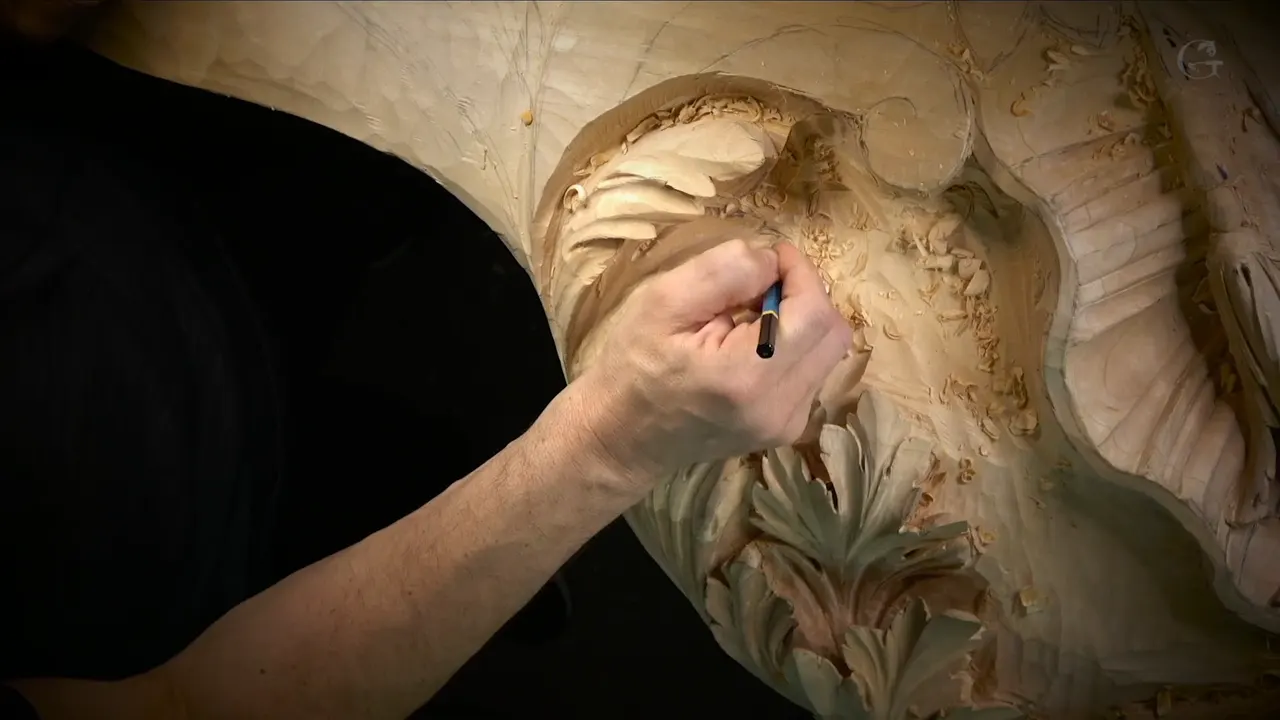

In Venice Room workshop 67, part 7, I said "It's going to give me a shadow point." That came right after "a lot of excavation right here." Below you get what I did around those words, and the places in my other lessons where the same words turn up.
Ever dug a hollow and wondered what the dark place beside it would do for the wood carving? Did you look at an edge and ask where its shadow should sit? Come along into part 7.
What did the excavation give me?
A lot of it, right there, and then a shadow point. That would look good, I said.
An edge came next. "And yes, I'll fix, of course, this edge," I said, and the result would look "really awesome." A thought about a line followed: "And maybe I can actually bring this line to that point and make this wider a little bit." It was not needed, I said, "because I have a movement upward and that's looking good already."

How do I attack this side?
I asked that next, and I answered it myself: "I guess I would attack it exactly the same way, just breaking the rule" and carve toward myself.
The rule comes from part 6 of the same workshop. About carving toward myself I said "I would encourage you not to because it's not the safest way." Why? "You can slip and cut yourself, and that would be big mistake."
If you do have to, I said you "really lock your elbows, your hands right on the piece." Even if you slip, the hand is not going to let you cut yourself, "and stay a little farther from this." That makes it "kind of safe, or safer, I should say." My line to you was "if you don't have to cut toward yourself, don't do it, okay?" And the honest part: "every carver does it."

What needed relief in this area?
"But I need to relieve this area," I said, and "Yeah, maybe I just excavate little by little this way." "Although it's not the best approach, I'll do the best approach right now."
A plan came after it: "Let me outline a little better with the black number five, talking about the movement itself." Then a check on whether it would work or not.
Wider was the next idea. "And maybe make this little wider, I would say." I thought it would make more sense. Later I said it would "look better to make it a little wider and get rid of this raised area."
"Yep. It looks good." Still not too happy about it, I said, and also really happy with the overall results.

How much space was underneath?
"Okay, so now I need to excavate underneath and since I don't have too much space right there, maybe I have to start again excavating with a smaller tool."
"I really don't need actually to excavate this area too much. It's not ever going to be visible. Not at all."
Then came a small move: "I can get a little deeper right there and I can clean a little bit right now underneath of here and even undercut it and create some shadow."
"One millimeter is going to help me," I said, and one millimeter is 0.04 in. Later: "Okay, that is good. That is actually really good."

The same size came back: "Again, I'll get one millimeter and try to excavate underneath of here."
Which gouge did I take for the plug cut?
"Although, I need to attack it from this side pretty much with the idea of a plug cut." My choice was "I'm going to take just number nine and I'll get my favorite number nine."
Then I changed course. "I could actually do a bigger one, I guess," and "there's plenty of space for me to do a bigger one." I broke off mid-sentence, and the plan changed.

"There is a big space. I don't have to waste time. So I'll just take half an inch and see if it's going to fit, and I'm pretty sure it will." That half inch is 12.7 mm, because an inch is 25.4 mm. The plan ended on "and I'm going to excavate."
What happened to the plug?
"I don't need that plug," I said, and later "And here you go. So chunk. Big chunk."

About the tool I said: "But I have a limitation with this tool. It actually has a tendency to go deeper, and I don't really need to go deeper."

Part 8 of the same workshop picks the plug up again, with a quarter-inch number nine (6.35 mm). "Here's my plug. Beautiful, right?" Before it came "create my excavation little by little like a plug cut, plug removal cut." Drilling in would create beautiful shadow, I said.
Depth came up again in part 8: "I do not want to go too deep because I have a limitation, okay?" And about the undercuts: "those undercuts, they actually make whole world of a difference."

Where else did I say shadow point?
In other lessons, and each one is linked here, so you can watch the minute yourself. The Lily Box comes first.
Does every little thing help a shadow point?
Lily Box 11, part 11, is the lesson on carving the lily flower. Here I said "So I need to create also undercut our separation point right here." Next, about a connection: "So I don't want to leave that connection without taking care of a shadow."
I explained it: "When I'm saying taking care of the shadow, every little thing helps me to create the shadow point, okay?" And: "It's all about the shadows."

A half millimeter came next, 0.02 in: "Okay, half a millimeter, of course, number 11, okay." A small apology followed: "I apologize if I forget sometimes to name the tool, but you get the idea."
Then a maybe: "I'll just get a better result with number one. Can get kind of deeper undercut."
Can a ridge cast a shadow point?
A ridge did it in Venice Room 6, part 3: "What I'm doing, actually, I'm creating extra shadow point. So that ridge also going to cast a shadow."
"And right here, the same idea," I said, and later "And little deeper cut." After that: "I need to check, keep an eye on my line I created." And last: "I need much deeper cut."

Is a shadow point on the inside of an edge?
Workshop 36 of the Venice Room, part 5, was about a rasp and an edge: "Just hit that with the rasp. Just the edge." After it came the inside: "I still have to go in and make it more shadow points."
And I said "So that edge is really important."

Where did I say I needed another one?
Part 1 of Venice Room 15 has "I need to create another shadow point somewhere right here." Soon after: "There is a trick, actually, they used back then to create that extra shadow."
Next, with the number nine: "let me outline a little better now." Then the plan for the waste: "remove some of the waste I don't need."

In part 3 of Venice Room 109 I said "Now I need to undercut underneath of this line." Then: "what's going to happen, there's going to be another shadow point. And the more shadows I create on outside, more three-dimensional it will look."
"So that's why I'm doing what I'm doing," I said, and I named the tool: "probably 10 millimeters will work" (0.39 in). "Of course, number 11, 3/8 of an inch."

On grain I said "I have to change the position because I see what grain direction." Then: "sometimes it just doesn't work because the grain against me." And: "Let me just do by hand because I think I have to be careful."
Does a curl bring another one?
Hazelnuts 3, part 3, gave me a curl. One part could probably drop a little more, I said, "and get curl this way." The curl would bring one more of them. Then: "I can probably drop this side even more in a concave this way."
Next came the pencil marks, which "make my work look really dirty." My words: "My number seven upside down. Going to kind of blend nicer," and I named the size, 10 millimeters (about 0.4 in).

Later in that part: "It is challenging area because, like I said, we are working into the grain. But still, not impossible. Still possible."
When did I not need to exaggerate?
In part 8 of Venice Room 38 I said "Let me use a spoon." And on the move itself: "Again, just barely creating a cut. All I need is just pretty much the shadow point."
On the pipes, I put it plainly: "I don't need to exaggerate those pipes in this case. Really don't. Just to give some idea, some movement." A maybe followed, with a gouge: "I could use probably, let me think, maybe five, number five gouge."

In Vase with Grape Leaves 3, part 4, I wanted to show something. "I also want to show you what you could do in areas like that. Okay, so just exaggerate those shadow points."
"If you've got a small tool, if you've got a small gouge, what we did on the side of those eyes, in every separation, we can just do exactly the same idea." The plug cut came as a plan: "We're going to create the plug cut, but careful, and remove that." The depth I gave was "about three millimeters deep" (0.12 in).

I explained the word plug: "What I mean by plug, so it's like when the tool makes the full rotation, and you can kind of drill in, right? And that's going to deepen. That's going to create an even deeper shadow."
"And we can do it in every location like this."
How deep did I want one?
One I wanted deep sits in Venice Room 48, part 11: "somewhat deep excavation right here because I really want to show that excavation." That spot was to be a shadow point.

My tool: "Number 11 and 4 millimeters, that's what I'm using, okay?" Four millimeters is 0.16 in. Another line: "deep shadow spot." Both shadow point and shadow spot sit in that one part of the Venice Room 48 lesson.
What was my plan for the edge in Maine 13?
In Grinling Gibbons Maine 13, part 3, it was an edge. "I'm gonna create like a letter s curvature right at the edge and I'm talking about this part going to go underneath and back. Okay, go like this then go in and then out. Okay, that's gonna give me extra Shadow point."
My next words were "it's gonna give me you know, some kind of challenge." And: "I like challenges sometimes." I put it as "Not always but you know once in a while."

Earlier in that part I had said "Don't pay attention to those chips, just think about the shadow." And later: "To 10 millimeters" (about 0.4 in), "that's what I have material."
Shadow line or shadow point?
Grinling Gibbons Maine 15, part 1, has me correcting myself in the middle of a sentence. "And maybe excavate the middle a little deeper. Make that shadow line. Not line, but Shadow point."
Soon after came "I'm using number 11 and 1 millimeter right now" (0.04 in).

Is there a light point beside a shadow point?
Roman Acanthus 16, part 5, shows one. I had made a chamfer: "See, I just created the extra ridge. Not the ridge, but chamfer, and that should catch the light."
"Should be lighter point, I should say. Should look little different from my shadow." I named both: "There's my shadow point," then "There's my light point."

A knife helped: "this is a small, tiny knife. Helps me a lot." A bigger one could do it, too, I said, "by the way."
How do the lessons line up side by side?
| Lesson | Words I said in that part | My next move |
|---|---|---|
| Plug, Venice 67.7 | Lots of excavation, then a shadow point | Plug cut |
| Flower, Lily 11.11 | Care for the shadow at that connection | Half millimeter |
| Ridge, Venice 6.3 | That ridge is going to cast one | Little deeper |
| Trick, Venice 15.1 | I need another one somewhere right here | Number nine |
| Edge, Venice 36.5 | Inside the edge, I would make more | Go in |
| Spoon, Venice 38.8 | All I need is pretty much that | Maybe five |
| Eye, Venice 48.11 | A somewhat deep excavation, a shadow point | Four millimeters |
| Undercut, Venice 109.3 | After the undercut, another one was coming | Ten millimeters |
| Curl, Hazelnuts 3.3 | A curl would introduce an extra one | Number seven |
| Chamfer, Roman 16.5 | A chamfer that makes a lighter point | Small knife |
| Exaggerate, Grape 3.4 | Exaggerate those shadow points in every separation | Three millimeters |
| Curvature, Maine 13.3 | An edge curve would give me extra | Drop deeper |
| Middle, Maine 15.1 | Not line, but shadow point, I said | One millimeter |
Where can you watch every line in full?
This part belongs to workshop 67, and the whole panel sits in the Venice Room Part 6 course. The lessons before and after it are workshop 66 and workshop 68. More of my lines sit in Hazelnuts and in Lily Box, and each course is on this site, with the tuition shown on the start page.
How it's done
- Say what the hollow gives you. A shadow point would come out of the excavation, I said, and the result would be looking good.
- Ask how to attack the next side. Next I asked how to attack this side, and I guessed I would attack it the same way.
- Relieve the area. The area needed relief, I said, and maybe I would just excavate a little at a time.
- Go small where space is short. Maybe I had to start again, I said, since I did not have too much space.
- Go bigger where there is space. There was a big space, so I did not have to waste time, and a bigger number nine could go in.
- Watch the depth. A tendency to go deeper came with the tool, I said, and I did not need to go deeper.
Frequently asked questions
Which gouge did I name for the plug cut in part 7?
A number nine, my favorite one. A bigger gouge could work, I said, since there was plenty of space, so I would take half an inch (12.7 mm) and see if it would fit. I was pretty sure it would.
Which tool did I plan to use in the space underneath?
There was not much space right there. Maybe I had to start again, I said, and excavate using a smaller tool. I also said that area needed little excavation, since it would not ever be visible.
Is carving toward yourself a rule I break?
Part 7 has me carving toward myself, a rule broken. Part 6 calls it not the safest way, since you can slip and cut yourself. If you have to, lock your elbows and keep your hands right on the piece, I said.
What to carve next