

Alexander Grabovetskiy, woodcarver, School of Woodcarving · Published 2020
What does a wood carver mean by "comfortable"?
Quick answer: In part 12 of Venice Room workshop 67, I said it was not convenient and that things were in my way. After it I planned number 11, with maybe seven millimeters (0.28 in). In other lessons I said it about spots, handles, holds and lines.
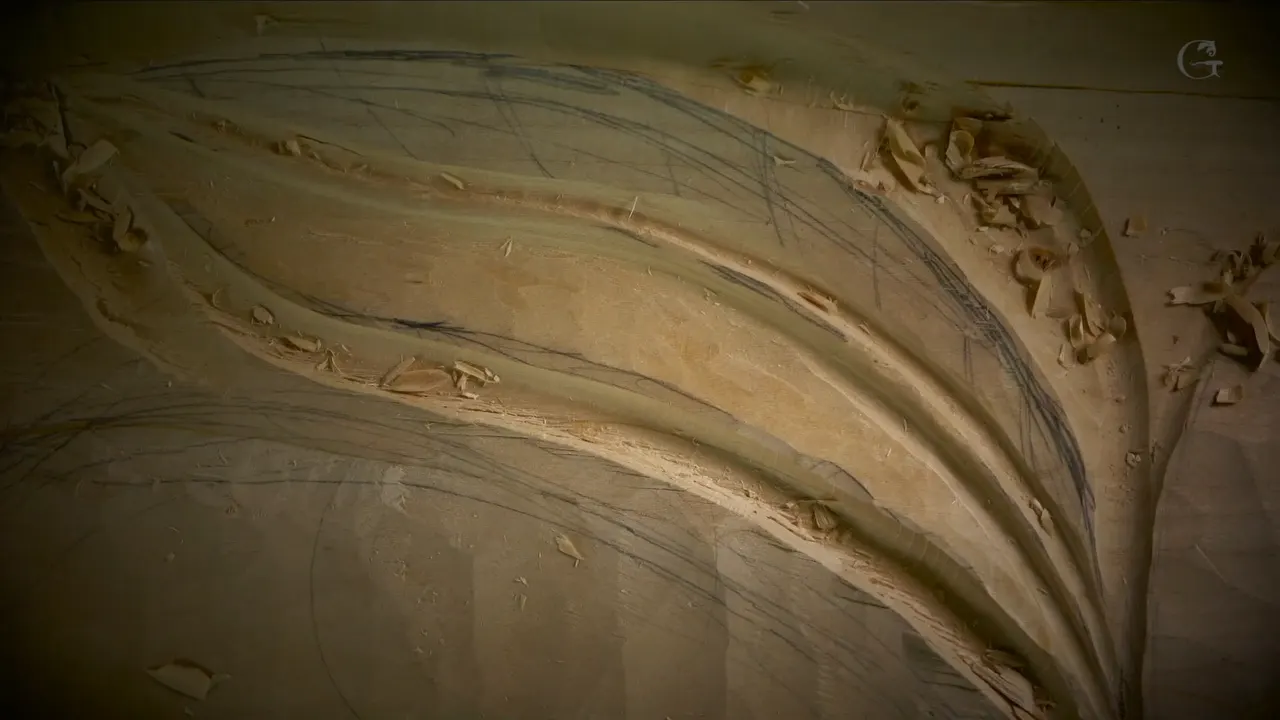

This page follows one word of mine, "comfortable," from part 12 of Venice Room workshop 67 into the lessons where I used it again.
Part 12 comes first, since the word is in it. Then come spots where something was in my way, then a handle and a grip, then what I told you to do on a line. Each lesson is linked. Wikipedia has a short page on wood carving if you want the craft in general.
What happens in workshop 67, part 12?
I said "I can always do deeper later." The next line was "But if I'm going to cut too deep right now, that would be a big mistake for me." Then came "That is really, really, really good."

Next: "Okay. That's good. Now I'm ready to develop, although this side is not ready. I thought I was ready, but I'm not." About tools I said "probably number six or so. Number six or number five." Then "Let me try," and after that "This is number six." And "I will just remove some of the ridges right here, too." After that, "Nice and long cut."
Bigger came next. "Maybe I can use a little bigger tool. Let me think. Maybe six, but 15 or 16 millimeters or so" (about 0.6 in). Then "That's not going to work." My next idea was "Maybe number three. Let's see if it's going to work out or not." And then "Number three and one inch" (25.4 mm).

It worked. "And that works really good, actually." Then "So it's gradually moving up," and "That is exactly what I'm after." Next came a plan: "Let me use 7 millimeters" (0.28 in), "number 11, and I will try to clean it."
"Again, just rising right on top of those fibers without pressing too much. Just really easy cut." I added "I can always clean that later, but now I'm ready to establish my, whatever I just said, movements."

How did I check the other side?
A plan came first: "But let me now check and reference another side. Maybe I have to just redo and do it differently." Next I said "And you know what? I actually got right on the money, just exactly like another side. So, perfect. Pretty much perfect. So those are going to be my convexes. So, convexes."
Then "Interesting, right? Without measuring, and I was able, actually, to get pretty much the same distance. I guess I've done it a couple times or more." For measuring tools, Wikipedia covers calipers.

What did I say was in my way?
"Okay, that's going to go all the way to the stem, and it's going to continue cut like this." Next, "So now, well, I also need to take care of this ridge because it's on my way, and I'm not going to be able to create a beautiful cut." For that ridge, my plan was "just a skew" to "cut that out."
About the grain, I said "Yes, I know I'm cutting against the grain, and I don't worry about it, okay? Anyway, most of it is waste anyway." Wood grain is explained on Wikipedia as well.
"But I need gradual movement. All right. And now I can clean it the normal way, like it's supposed to be, like that." Then the line itself: "It's not convenient for me. Everything is in my way, and it feels like it's not really comfortable."

"So now I'm going to take number 11, and again, maybe 7 millimeters" (just over a quarter inch), "and clean that." Wikipedia also has an entry on the chisel.

When is a spot not comfortable?
Workshop 65 has "Left side," and then "Not too comfortable." Next, "It looks like even back bent has to be bented even more." And "That's okay."

In Tray of Blessing 6 I said it was not comfortable from this position. Next, "Let me rotate the piece again."
The olives lesson, which is Lily Box 13, is the one on carving olives. Digging into one spot, I said "I am digging right to it. And yes, it is not too comfortable." A later part has "It's not like it's impossible" about another spot.

In Grape Onlay 5, I planned to excavate a little under a big line. Then I said "But see that is kind of really uncomfortable, actually not kind, but really uncomfortable spot."
Maine class 16 has these lines. "I am doing those bites because first of all, it's really uncomfortable to get my tool in." And in another part, "my apologies that I'm covering it." Then "That's the only way I can carve."

Attacking from the opposite side is the topic of workshop 23: "For me, it's not convenient to attack from opposite side. I should attack from opposite side." And the next words were "But it's not always comfortable. Not always comfortable."
In workshop 143 I said "I guess that attacked it from the right position." The next line was "Not necessarily really comfortable, but that's okay."
Complicated projects get a line in the Acanthus over Moldings 6 lesson: "You don't have comfortable position all the time." And in Floral and Molding 7, about how I approach this one, "I really have to get really close with my face for just to see it."
The lily lesson has me on micro cuts: "it's still uncomfortable because you're still poking, still creating micro cuts inside of your skin."
From Lily Box 6 comes "I'm probably going to use a smaller tool". My reason: a big tool felt uncomfortable "right here." A hold in Lily Box 12 was not comfortable, I said, "but it's okay." Grape Onlay 1 has a spot I called "Kinda not comfortable" with the reason "just because of the camera".
What about my hands and my tools?
"sometimes you're limited, and I am limited in this case because I don't want to rotate my piece, and I don't like to swap my hands because it's still not comfortable for me." This one is workshop 4. For the hand itself, Wikipedia has an entry on the hand.

Workshop 2 has swapping hands too. "So I could swap my hands and just go from the opposite direction." Then "But for some reason, I feel more comfortable when my gouge is in my left hand." Wikipedia's gouge entry covers the tool there.
Workshop 58 has "I'll use number seven and one inch" (25.4 mm). Of that tool I said "That's still not the tool I feel comfortable with," and my next words, a plan, were "Let me switch to number six."
The tools selection lesson is about handles, and my words were "If you hold that tool all day long and if it's rounded, for me, it feels more comfortable than octagonal handle like this." And "those rips in your hand all day long, it's less comfortable for me than the rounded one."

Why I choose certain brands comes with a few things I pay attention to in Lily Box 2: "Of course, how comfortable my handle is. And I really like traditional English handles." From Maine class 1 comes "I have a comfortable handle. So in your case, you don't".
About back bends in Lily Box 11: "I just really like the back bends for operations like that because it just feels really comfortable in my hand. You don't see that, but it just feels really, really comfortable between those two fingers when you're especially trying to get closer to the blade." Same lesson, another part: "it's also really comfortable to work like I'm working because it's placed on my finger."

In Lily Box 12 I said "Let me explain how it's comfortable to hold in hand." Then "See, I'm holding this tool right now upside down, and this part just fits my hand perfectly."
The Tray lesson shows a hold with the fingers: "And see how I placed my middle finger of the left hand side." That was "another way you use that middle finger." My words on why: "because I wanna protect, you know, the, the wood itself." And on the hold: "I think it's more comfortable way to hold the tool. In this case."

Furniture Panel 20 is about a knife. I said "That's why I actually reshaped that knife." Of blending cuts I said "sometimes it's more handy and more comfortable".
Plate with Butterflies 3 has "more comfortable for my hand." In its knife part I said of the angle, "you don't really have to measure it." Workshop 67 has "Without measuring" too.
Corinthian Acanthus 2 has "But I'll just turn this way. It's more comfortable that way." And Byzantine Acanthus 3 says "If upside down doesn't feel comfortable, use the normal way."
For a beginner's grip, Beginner workshop 1 offers "take your knife now, just like you would hold your pencil." Then "if you don't feel still comfortable, exactly the same grip what you used before."
What do I tell you when a tool or a line feels wrong?
In Hashemi Flowers 21 I said "And if you feel comfortable with the smaller tools in an area like that, just do that." Then "I just don't like sometimes to use too much of small tools." Of tools in Floral and Molding 10, "So you could use whatever is more comfortable."

The line in Hashemi 1 goes like this: "If you don't feel comfortable to be too close to the line, you can always just step away about a 16th of an inch" (about 1.6 mm). "You can step away about eighth of an inch" (about 3.2 mm). "But I feel okay. I feel comfortable."
Corinthian Acanthus 2 keeps a V tool off the line, "approximately eighth of an inch." Then "I've got even closer a little bit, about sixteenth of an inch." About that, "I have no problem with it."
In Furniture Panel 17 I said "I don't have to, but I feel comfortable of hitting that." Going right on the line may be uncomfortable for you, and I said "step away half a mil or so" (roughly 0.02 in). Then "Which is understandable."

Plate with Butterflies 4 has a count up to 13 and "Fibonacci sequence, of course." After them I said "Don't have to. Okay, please." As for anyone who does not feel comfortable about that, "don't do it." Then "Nobody's gonna count really." Wikipedia explains the Fibonacci sequence.
Lily Box 10 has me saying "I am actually holding two fingers, and another side of my hand is actually really stable on the table." Next, "But this limits my movement, for I'm not slipping." For anyone who is not comfortable with that, "then just don't do that, okay?" And "Don't work like me I'm doing right now, because you can slip and cut your finger with ease."
Not at ease with a move? In Maine class 14 I said "then don't do it, okay."
In Greek Acanthus 15 I said "Don't force it. It's not really nice when you got all the way to that stage and you feel too comfortable and force it too much and break it. So that is not really good."
In workshop 47 I said "No, I don't feel comfortable without preliminary doing this cut." I then planned: "And let me do, actually, a separation."
How do these lessons line up with workshop 67?
The table puts workshop 67 first. The first column says where, the second what felt that way, and the last whose comfort it was. Measures follow my figure first, then millimeters or inch.
| Where | What felt that way | Whose comfort it was, mine or yours |
|---|---|---|
| Workshop 67 | A ridge on my way, with the rest in the way too | Mine |
| Workshop 65 | The left side, where the back bent has to bend even more | Mine |
| Tray of Blessing, lesson 6 | From this position | Mine |
| The olives lesson, Lily Box 13 | A spot I was digging right into | Mine |
| Grape Onlay 5 | A spot under a big line I planned to excavate | Mine |
| Maine class 16 | Getting my tool in, so I took little bites | Mine |
| Workshop 4 | Swapping my hands, which I did not like to do | Mine |
| Tools selection | A rounded handle compared with an octagonal one | Mine |
| Lily flower lesson 11 | A back bend between two fingers | Mine |
| Furniture Panel 20 | A knife I reshaped, for blending cuts | Mine |
| Hashemi Flowers 1 | Working really close to the line | Mine, and yours if you step away |
| Greek lesson 15 | Getting too comfortable, then forcing it | A warning for you |
Where can you watch the full videos?
Every lesson named above sits inside one of my courses. All of part 12 is in workshop 67, with workshop 66 before it and workshop 68 after it, and workshops 62 to 73 are in Part 6 of the Venice Room. The Wikipedia pages linked here are for reading. To watch the full videos, start here.
How it's done
- Name what is in the way. In part 12, a ridge was on my way.
- Pick a tool for it. My plan was just a skew, and then to cut that out.
- Plan the clean-up. Next I planned number 11, to clean that.
- Step back from a tight line. In other lessons I told you to step away from the line.
Frequently asked questions
What did I plan for the ridge in part 12?
A skew.
Which tool did I plan next in part 12?
Number 11, to clean that.
Which lessons talk about a hold?
Beginner workshop 1 has a grip like a pencil. In Lily Box 11 it is a back bend held between two fingers, and in the Tray lesson it is my middle finger, placed to protect the wood.
Where did I mention a handle?
What to carve next
- Venice Room workshop 67 lesson
- Venice Room workshop 66 lesson
- Venice Room workshop 68 lesson
- Workshop 62 to 73 course
- Venice Room lesson 65
- Tray of Blessing lesson 6
- Lily Box lesson 13
- Lily Box lesson 11
- Maine class lesson 16
- Carving Hashemi Flowers lesson 1
- Carving Greek Acanthus lesson 15
- Tools selection lesson
- Venice Room lesson 4