

Alexander Grabovetskiy, woodcarver, School of Woodcarving · Published 2020
What does a wood carver mean by "downside"?
Quick answer: "Downside" is a word I said in Venice Room workshop 75, part 1, right after a jigsaw took the waste off and left dust in my shop. In other lessons it followed mirror paste, carbon paper, spray adhesive, knives and a wood.
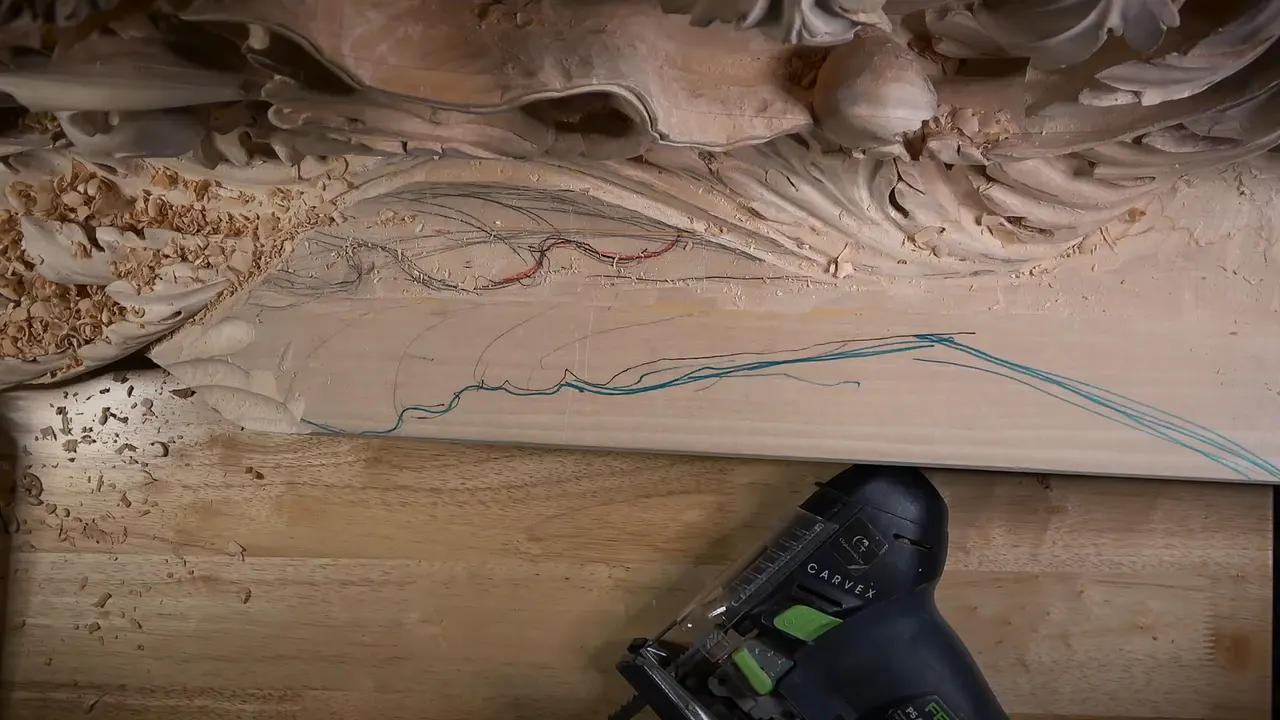

"Downside" is a word I said in Venice Room workshop 75, part 1, right after a jigsaw took the waste off. In other lessons it followed paste, carbon paper, spray adhesive, knives and a wood.
Ever found a method you like and still caught one thing about it you did not? Did you carry on anyway? Come through part 1 with me, then through the lessons where I named a cost right after I named a tool, and see what I did next.
What was I about to do in workshop 75?
On another side, I said, "I just removed that section with the gouges." This time my plan was different: "I think I can just do a jigsaw." A normal one, cut roughly, along a line that did not have to be exact: "It's approximately. That is the boundary I have to cut out."

How did I raise the piece for the blade?
Height came first: "let me raise a little bit," because otherwise my blade would hit the workbench. For that, "I'll just use the cookies. Bench cookies. Get three of them underneath."
The piece was big. "And this is heavy," I said, and later "High enough, I should say." Then a precaution: "just in case if it's going to fall or something, I'm going to place right there."
How long did the cut take, and what did it leave?
"There you go. So it took me literally just about 30 seconds." The offcut I would keep, "just for repairs and so on."

Next came my word. "Of course, the only downside to this operation, I don't really like to have any dust. I hate dust in my shop." The fix came in the same breath: "there is a solution. There's always a solution for that. Just vacuum it."
After the vacuum, the cookies. Two of them were to come out, "just like that," and then "carefully going to place it back." I ended it with "Okay, wonderful."
Where did my attention go after that?
To the design. There was "a preliminary design already," and I wanted to think about how it would flow "in the overall." Also: "I really want to make sure it looks really good."

My original plan was an acanthus, "a long movement acanthus going all the way this way," with a shell to overlap it. Before either, I said about "all that mess": "I need to take care of it."
Which tools dealt with the mess?
An outline first. The plan was "the number 11 and at 12 millimeters" (0.47 in), and I said I would need a mallet.

For the rest, "just to get really gradual movement," "there is a couple ways I could achieve it. The quickest way, probably just to use a super huge gouge like this, number seven."

Numbers closed the part. "So I left approximately three-quarter of an inch, about 20 millimeters or so, in this area, and I need to go actually about the same right here, too."
Did I say anything about this saw before workshop 75?
Workshop 1, part 6, has the same tool, in Venice Room 1. "I could actually cut right away pretty much to the line with my jigsaw," I said there. It "gives me absolutely the best cut, I would say, as far as the 90 degrees cut," and the blade "is absolutely 90 degrees. So that is one of the advantages of it."
Another blade in that part got the other word: "I am using just the progressive really fast, but disadvantage of this blade, it's cutting upward, and that's not the best practice, okay? So that is not the best."

Two blades side by side showed it. "This one cuts downhill and that one cuts uphill, so it just pulls out the fibers and this pushes down, and this one gives me a much cleaner cut." And: "This one is actually gives me quicker cut, so that's why I like this one also."
Did a paste carry a downside too?
One lives in Venice Room 76, part 7. "Well, sharpened or just buffed. I can probably use just the paste, and it should be okay." It was "a mirror paste."

About that paste: "The only downside of this paste, it actually gives me a really nice and beautiful result. I like how sharp it is, but it just creates such a mess. That's the only downside. But I love, like I said, the result it gives."
How much dirt did carbon paper leave?
In Venice Room 41, part 1, a detail would "give me beautiful feel to overall," and I said "just outline it." About carbon paper, I named one cost: it "just leaves a lot of dirt. The black marks all over."

Next, my view of it: "But I don't really worry about it. In this case, at least I don't really worry about it. Don't have to worry."
Which cost came with the spray adhesive?
The can shows up in part 1 of Acanthus over Moldings 1. First came "let me glue that piece to the board," and then the can: "It doesn't have to be that brand." It was "just a spray adhesive. I shouldn't say glue, but adhesive."

"I am ready to carve it," I said, and gave the cost: "it just collects dust. Okay. But it doesn't bother me that those details are quick to do, to make. It's just maybe one or two days, a couple of days, and it's all done, and then just to go on, on the next detail."
Did a paper sandwich cost something too?
In Chamomile and Bow Rosette 2, part 3, I first praised it: "you can see that paper method holding really well. Have no problem with the paper whatsoever." Right after, I named the cost of the paper sandwich.

"See all that dark spots? It's like a dust and whatever, rubbing hands and so on. It's a spray and it becomes kind of dirty, and it's not really appealing. But I'm okay with that, okay?" The detail would not take too long, I added, "so I'm all right."
Why a hair dryer and not an air compressor?
Part 10 of Venice Room 54 is about clearing waste. "Carefully remove all that waste which I don't need anymore," I began, and "It's time for me to clean this area." My tool: "I'm going to use my hair dryer."

"I like my hair dryer technique actually much better than air compressor. The reason why, because air compressor, as you know, it accumulates some water, and I don't really want the water on my piece and all."
I left room for the other way: "You could use air compressor with no problem, but I feel much safer not to." Noise was a second cost: "Air compressor gives you a lot of noise. It's also downside of air compressors." As for the vacuum cleaner, "you could vacuum it," and "I do that sometimes also."
Which cost comes with a knife?
Workshop 92, part 9, brings a different tool. "This not the only way, actually, you can do areas like that," I said. "I could use pretty much knife, and I do like to use knives."

"It's probably one of the quickest ways. The only downside of using knife, so you really have to control the depth of cut, okay? So if you're cutting too deep, so you can get in really big trouble. So you're not going to be able to clean the background, okay?"
And the other half: "But the result it gives, it's absolutely, really the quickest probably way I would say, at least for me."
What do knives leave on a surface?
A ridge starts the story in Venice Room 72, part 3: "I can actually hit this ridge also pretty much right away." Then: "I would love to get a little nicer, faceted less cut, if you wish."

The disadvantage I named belonged to knives and one more tool, which "just leaves so many facets or ridges." For me, I said, "ridge makes more sense. Ridges of tool marks or tool marks, whatever."
Wood grain as a downside?
In the Lily Box lesson, workshop 2, part 1, I was controlling my tool so it would not slip where the wood was crunchy: "the fibers are just breaking, okay, not just cutting, but they're breaking. Although my tool is really sharp."

Next, the wood itself: "The only one disadvantage of this wood, it carves good. It actually looks good and it carves good, and the grain is beautiful. The only one disadvantage, that grain can be in the way sometimes when you're trying to get small details."
"And that grain, even if you carve that nicely, sometimes it can distract how it's going to look. Just because your eye is going to be looking at the grain also. But on the main layer, I don't think it should create any problem."
What is the trouble with markers?
Markers get their turn in Venice Room 34, part 6. "I think I've got too many lines and that would be a mistake to keep," I said. Of markers I named "a disadvantage."

"You got too many thick lines and sometimes you're getting lost. If you're not taking care right away of that line you just placed. So sometimes you can get lost."
What can a camera not show you?
Grinling Gibbons, Maine class 13, part 3, was about a tulip. Some of the stuff needed to come out "right from the side of my tulip," and I could give "some kind of wavy edge right here. That way it's gonna look more natural, more if you wish organic."

Next came the camera. You don't see that much on it, I said, which is a disadvantage, since you can't come over to my piece and just look. My idea: I could "probably just connect my phone" and "just fly around and you'll see it."
What happened with a system that was heavy?
A single line in Venice Room 82, part 5, is about a system. I called it "the only downside," and then: "Because it's so heavy, I cannot make it tight enough. It's not holding as stable."

Does the same idea come in different words?
Part 2 of Venice Room 69 opens with a line about fibers: "Just barely hitting the upper part of the fibers. Okay, and that's really clean. I don't need to sand anything or anything." Yet "The only thing I don't like in this case is that center line is a little off."

I planned a fix: "I need to make sure this ridge is in proper position," with a tool of "probably around 10 millimeters" (0.39 in) "or even bigger, maybe 15 millimeters" (0.59 in). "I don't need deep cut, but still want to make sure the light hits and creates the right motion, right movement."
While placing lines in Venice Room 57, part 4, I said "I think personally, the only thing I don't like about moving that direction is this triangle. It creates that triangle, and that just creates the off look from this line."

And I said "I think it would look a lot more organic if I were to create my movement like that."
Two knives sit side by side in the Curly Kitchen Cutting Board workshop. About the tiny one I said "the metal of it, you can see the thickness of it. It's much thicker than this one, so that's not as flexible."

"But for some areas, like small, tiny spots, a smaller knife would be nice, just to get really inside of the really tiny spots. And I'm not using that every day. I'm using this one every day."
Was a cost named in the rest of workshop 75?
Workshop 75 has two more. Part 2 has "not the safest way to do along the grain." In the third, "Maybe that section is a little too deep, but I'm okay," and then "But I wish it didn't happen."
Where does each cost sit next to the others?
Each lesson on this page, with what I used and what I did not like about it.
| Lesson and part where I said it | Method used | The cost I put into words |
|---|---|---|
| This video, 75.1 | A normal jigsaw on three bench cookies, cut roughly | Some dust |
| Part 6 of the first workshop | A progressive blade | Cuts upward and pulls out the fibers |
| Workshop 76.7 | A mirror paste, result really good | Such a mess |
| Room 41, in the lesson's first part | Carbon paper | A lot of dirt, black marks |
| Acanthus over Moldings | A spray adhesive, details quick to do | Collects dust |
| Chamomile and Bow Rosette, part 3 | A paper sandwich | Dark spots, kind of dirty, not appealing |
| Lesson 54.10 | Hair dryer instead of a compressor | Water and noise |
| Venice 92, in the lesson's ninth part | A knife | Cut too deep and big trouble |
| Venice Room 72 | Knives, and one more tool beside them | Many facets |
| Lily Box lesson 2, part 1 | Wood, beautiful grain | Grain in the way of small details |
| Video 34.6 | Markers for the lines I placed | Getting lost |
| Grinling Gibbons Maine class 13, part 3 | A tulip | You can't come to my piece |
| Workshop 82.5 video | A system I said was so heavy | Less stable |
| Part 2 of Venice Room 69 | Really clean result | That center line is a little off |
| Venice 57.4 | Moving my lines in that direction | The triangle |
| Curly Kitchen Cutting Board 15, part 2 | Tiny knife | The metal is thick, not flexible |
Where can you watch part 1 and the lessons on this page?
You can watch part 1 in Venice Room 75. Workshops 74 to 85 sit in Venice Room Part 7. Every other lesson on this page has its own page, linked above, and each is open to you with school access. A workshop number means the Venice Room, and every other lesson carries the name of its own course.
Want to hear me say it in my own voice? Start here.
How it's done
- Raise the piece. Raise it a little, so the blade will not hit the workbench, and put three bench cookies underneath.
- Cut along a rough line. Use a jigsaw along an approximate line, a job of 30 seconds.
- Deal with the dust. The cost I named was dust, and my answer was to vacuum it.
- Outline the area. The plan was a number 11 and a mallet.
- Deal with the mess. A super huge number 7 was probably the quickest way. About 3/4 in (20 mm) stayed.
Frequently asked questions
What did I do about the dust in part 1?
My fix was to vacuum it. The jigsaw cut, on bench cookies, took 30 seconds, and I said I would keep the offcut for repairs.
How much wood was left at the end of part 1?
Approximately 3/4 in (about 20 mm) in one area, and I said I needed to go about the same in another. For the outline, my plan was a number 11 at 12 mm (0.47 in).
What does a knife demand, in my words?
You "really have to control the depth of cut." Cutting too deep, I said, can mean big trouble, and the background could not be cleaned. The result still made it probably the quickest way, at least for me.
What to carve next
- Venice Room 75
- Venice Room Part 7
- Venice Room 1
- Venice Room 76
- Venice Room 41
- Acanthus over Moldings 1
- Chamomile and Bow Rosette 2
- Venice Room 54
- Venice Room 92
- Venice Room 72
- Lily Box, carving the first layer
- Venice Room 34
- Grinling Gibbons, Maine class 13
- Venice Room 82
- Venice Room 69
- Venice Room 57
- Curly Kitchen Cutting Board 15