

Alexander Grabovetskiy, woodcarver, School of Woodcarving · Published 2020
What does a wood carver mean by "more stable"?
Quick answer: "More stable" is what I said in Venice Room workshop 75, part 2, about my wheels, after I said I did not know why it was moving. In other lessons the same two words came with a shim, clamps, a notch for the work, and my own hand.
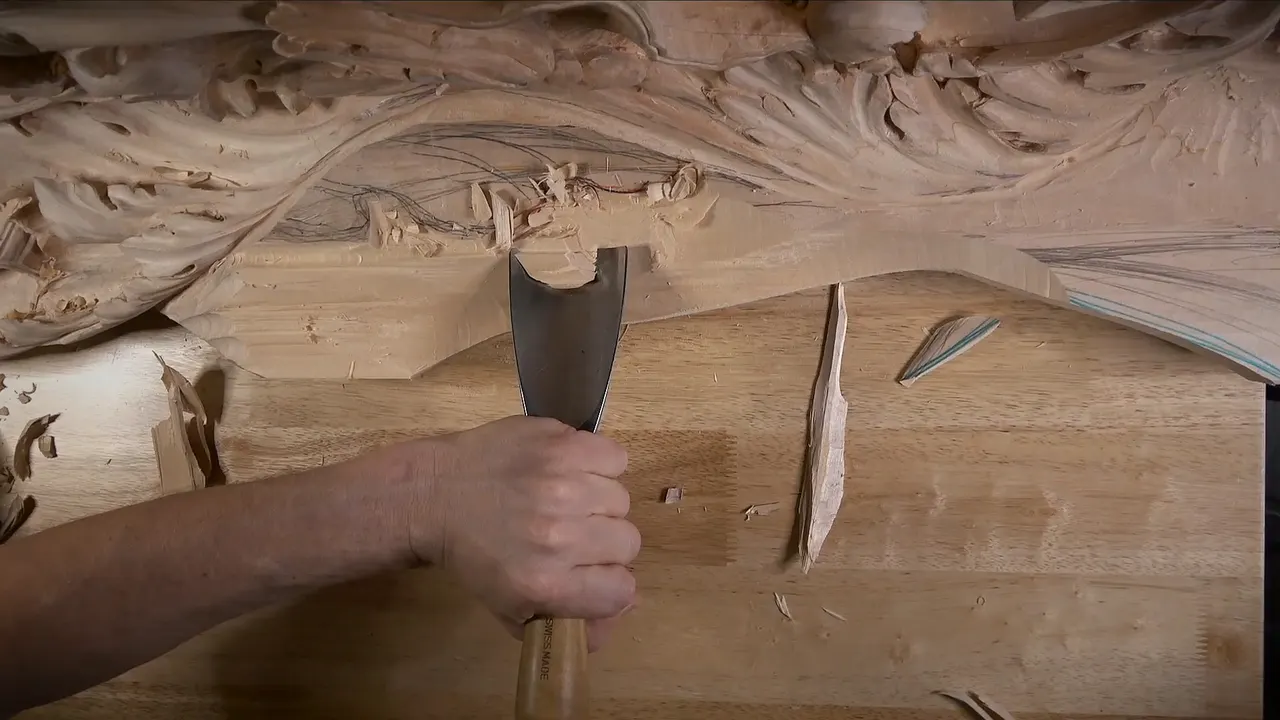

"More stable" is what I said in Venice Room workshop 75, part 2, after I said I did not know why it was moving, and said I needed to lock my wheels. Elsewhere it came with a shim, clamps, a notch for the work, and my own hand.
Ever felt a piece shift under your gouge just when you wanted one clean pass? Did you keep going and hope? Come through part 2 with me first, then through the lessons where I fixed it, or said I would, and see what came next.
What was moving in this video?
This video is a long stretch of work with gouges and few words. Early on I said, "That is, by the way, not the safest way to do along the grain." The long version of that warning lives in Venice Room 75. This page follows a different thing I said later.
Earlier I said, "And that is probably about 20 millimeters right here, 20 millimeters right there. That is good." That is 0.79 in. Later I picked a number 7, "one inch, 25 millimeters or so" (1 in, about 25 mm). Soon after, something began to move. "I don't know why is it moving that way," I said. Then came the sentence this page is built on: "I need to lock my wheels. It's going to be more stable."

Look at the tense: it is a plan. A little later I was still asking: "Why is it moving so much? It shouldn't." I have to figure out what is going on, I told you. Next, I let it go: "But anyway, I mean, I used to it. I hope it's not going to bug you too much."
The wood came up next. "I've got a kind of deeper spot right here because there is a split, so I have to take care of it." So the carving went on.

The first video of this workshop shows a piece that was a lot to hold. "And this is heavy," I said, and I raised it: "I'll just use the cookies. Bench cookies. Get three of them underneath."
Did I carve on a really stable workbench?
Other courses talk about my own bench, not yours. Roman Acanthus 5 has a part 3 where I describe how I carve: "Sometimes it's shaking, sometimes it's just kind of flimsy." I took a word back: "Not flimsy. I should not say flimsy, but on portable workbenches and so on."

The next line is the one I like. "If you have a really stable workbench, that is absolutely fine." I like my portable workbench, and I like the vise I'm using. I called it "a very tough vice," and I can take it out "really quickly." About the shaking: "it doesn't bug me when my workpiece is actually shaking." I know maybe sometimes it's hard to watch, I added, and this is the condition "most of the time I'm carving."
The Roman course brings it back in lesson 16, part 2. "Some of you probably don't like that my pieces are shaking while I'm carving, but that's the way I work." My setup is two vices. "That way, I can attack from different points, and I'm used to that." Then my words for anyone who dislikes the shaking: "please use a stable work bench and fasten it really nicely. But for me, it doesn't create a lot of problem." Huge pieces have gone on those carver vices, I said, like in the lesson with the lion head, and I still use exactly the same one.
How stable is stable enough for me?
The Lily Box course gave me a number to put on it. In lesson 2 of that course I showed a plate that goes inside my vise, and I said that gives me "a really good, flexible, movable workbench." The cost came with it: "Yeah, it's not as stable and not as solid, but I can always rotate, I can always just attack from different positions."

The clamps came next. About them, I said to make sure your hole matches: "exactly the same as the diameter of this clamp, okay, which is exactly 20 millimeters, if I'm not mistaken." In inches, 0.79. I really like those clamps, and I said why: "They hold them really well. And they're not in my way, and that's stable enough." I followed with "Let me fasten that a little better," and soon after came "It's stable."

Later in that part I said it again about my table. I can rotate it and come at the work from different angles, "and it's still stable enough for me." And to you: "I know some of you really like more stable setup, like a solid bench. Nothing wrong with that." A normal bench is okay too. I have carved on normal benches, and not just on benches, "but on dining tables."
Why did I stop to stabilize my table?
The shim lives in Venice Room 146. The third part finds me getting ready for "1 millimeter, obviously, it's number 11" (0.04 in). Then: "Not too stable. Let me stabilize my table. That's shaky. Hold on just a second. I need to put some kind of shim underneath."

Then came "Okay. Now it's more stable." With the wheels I had only a plan. After the shim I had a verdict, and my plan went on to "even deeper excavation on the inside."
Where did I clamp a piece to keep it still?
Venice Room 124 comes to big tools in its first video, and before them I said: "I just clamped it to the workbench. Want to make sure it's stable, and I got to remove this clamp, and I got to start." You can't see that clamp, "right in the corner."

In Venice Room 125 the same move is a plan: "Going to get the clamp and maybe clamp that somewhere right here." My thought was that it would be a little more stable, and then I called it a hope.

The piece in Venice Room 79, part 3, was "super heavy," and I had marked all its sides with a red marker. I said, "That's stable?" And then, "That's stable." After that came a plan: place it the way I want to carve it.
Venice Room 86 has a maybe. Its third part has me saying I could attack both directions, "and maybe it's a good idea to make it little more stable."
How do you hold a piece that has gone fragile?
Hashemi Flowers 15 starts, in part 1, with a warning: "as you see, this piece becomes really fragile and I can easily break it." Once it hangs on the wall, I said, there is no problem. To carve it, "especially heavy excavation," we do have one.

One way out was my MDF board, and I said "it's not that thick, and it has four inches apart, 20-millimeter holes." That comes to 102 mm apart, and 0.79 in for each hole. My idea was to take the piece out of the vise and clamp it on that board. When I need to flip it over, I said, unclamping is easy for me, and the piece would be really stable.

Lily Box lesson 13 gives another way, and it is one I credited to other carvers. Especially if you don't have a leg, "like in my case," you need to "support and bump against something." Some wood carvers prefer a notch in the wood, I said. "That way, you can just place inside of the notch," and I added: more stable, not moving right to the left. And in my case: "I should be okay."

I stopped in Lily Box lesson 12, part 4, with "Let me think." Then: "Lower this down a little bit. Get more stable on the workbench."

Hashemi Flowers 28 has a plate for my vise in part 1. Installing it was my plan: "It's just so handy, just for any type of carving, it's just so handy." Then: "It is stable. Well, or should I say stable enough."
Does my hand have to be stable too?
Lesson 16 of the Roman course has this in its first video. The depth was "only about 16th of an inch deep," about 1.6 mm, and I said we have to "really, really hold our gouge really stably. It has to be really, really stable."

How I held it: "I'm actually holding my gouge as close as possible to the edge, and I'm placing my hand right on a piece of wood, and I'm actually creating the support like a leverage point almost." Much later in that video I said, "But today is not too stable." Right after: "Use a smaller tool."
A quieter version sits in Venice Room 146, part 2. I was about to make a pass: "I'm going to create that cut. Just on the line." Then: "I'll try to be as steady as possible. I'm talking about stability of my hand. As stable as possible. I don't know if I can say that."

Fingers came into it in Venice Room 78, part 5: "I'm placing my fingers right underneath to support, and it's still kind of moving around. But just because it's along grain, and I have that handle, I'm still pretty stable."

And in the Antique Style Rosette course I was working on a rosette, doing end grain, and a section was "only eighth of an inch," about 3 mm. On rushing, I said, "believe me, it doesn't matter how stable your hand is, if you're trying to rush it, no matter how good you are," and the line will be wavy.

When does the wood itself get less stable?
The Furniture Panel gives one reason. In Furniture Panel 15, part 7, the panel was "only 10 millimeters," which is 0.39 in, and I said we were already removing 3 millimeters (0.12 in) right away. "But we need to get some stability. So you really don't want to go all the way."
My reason there: "if you're going to remove too much material right here, you create a lot weaker wood, and you create a problem, and it's going to move. It's not going to be as stable." Then I added, "it all depends how dry that material is. If it's dry enough, you can go all the way to a 16th of an inch, I'd say." About 1.6 mm.

Over in Venice Room 82, part 4, I said, "Now get with the 1 millimeter" (0.04 in). Then: "And this kind of shaky area. It's not as stable as I want it to be, but that is okay."
Which lesson said what, side by side?
Each lesson on this page, with my action or plan and my own words. Plans and hopes stay plans and hopes in the table.
| Lesson and part | My action, or my plan, for that spot | My words |
|---|---|---|
| This video, 75.2 | The wheels, which I said I need to lock | Plan: more stable |
| Roman course, lesson 5 | My portable workbench, with the workpiece actually shaking | Doesn't bug me |
| Roman 16, part 2 | A setup of two vises, which I'm used to | Not a lot of problem |
| Lily Box 2 | Clamps in holes of exactly 20 mm (about 0.8 in) | Stable enough |
| Workshop 146, part 3 | A shim for the table, a need I named | Stable after the shim |
| Video 124.1 | I clamped it to the workbench in the corner | Make sure it's stable |
| Venice 125, part 3 | Get the clamp, maybe clamp it somewhere right here | Only a hope |
| Hashemi 15, part 1 | An MDF board with 20-millimeter holes, four inches apart | A plan, really stable |
| Lily 13, part 1 | Some wood carvers create a notch to hold the work | Not moving right to the left |
| Lily 12, part 4 | A pause to think, then lower this down a little bit | Get more stable on the workbench |
| Roman 16, part 1 | Gouge by the edge, hand on the wood | Really, really stable |
| Venice 146, part 2 | I'll try to be as steady as possible | Stability of my hand |
| Room 78, part 5 | My fingers right underneath to support, and a handle | Still pretty stable |
| Furniture Panel 15 | Removing too much material, in a panel only 10 mm (0.39 in) | It will move |
| Room 82, part 4 | That kind of shaky area, in my words | It's okay |
| Hashemi 28, part 1 | Plan to install a plate for my vise, then start | Stable enough |
| Video 79.3 | A super heavy piece, all its sides marked with red | That's stable |
Where can you watch part 2 and the lessons on this page?
You can watch part 2 in Venice Room 75. Workshops 74 to 85 sit in Venice Room Part 7. Every other lesson here has its own page, linked above, and each is open to you with school access. A workshop number means the Venice Room, and every other lesson carries the name of its own course.
Want to hear me say it in my own voice? Start here.
How it's done
- Lock what moves. The plan in part 2 was to lock the wheels and get a steadier setup.
- Put a shim underneath. In workshop 146 I called my table shaky and said a shim was needed under it. Later, I called the table more stable.
- Clamp the piece. In workshop 124 I clamped the piece to the workbench to make sure it was stable. In 125 I planned one more clamp, and I called the gain a hope.
- Make a notch. In the Lily Box course I said some carvers create a notch and place the work inside it, so it holds without moving sideways.
- Rest your hand on the wood. In the Roman course I held my gouge near the edge, with my hand resting on the wood for support.
Frequently asked questions
What was my plan for the wheels in part 2?
My plan was to lock them, because it would be steadier that way. A moment later I was still asking why it moved so much. I had to figure out what was going on, I told you, and then, "I used to it."
Why did I stop for a shim in workshop 146?
My table felt shaky: "That's shaky. Hold on just a second." Next: "I need to put some kind of shim underneath." Right after it came "Now it's more stable." My tool: a number 11.
What about a shaky bench, in my words?
A bench that is stable is absolutely fine, I said in lesson 5 of the Roman course. In lesson 16 I asked anyone who dislikes the shaking to use one and fasten it really nicely. For my own bench, I said, the shaking is not a big problem.
What to carve next