

Alexander Grabovetskiy, woodcarver, School of Woodcarving · Published 2020
What does a wood carver mean by "same result"?
Quick answer: "Same result" is what I said in the third video of workshop 75, with a cavity in front of me and a number nine in mind. An 11 would do it too, I said. In other lessons the words came with V tools, knives, a jigsaw and other sizes, and in a few I said the outcome would differ.
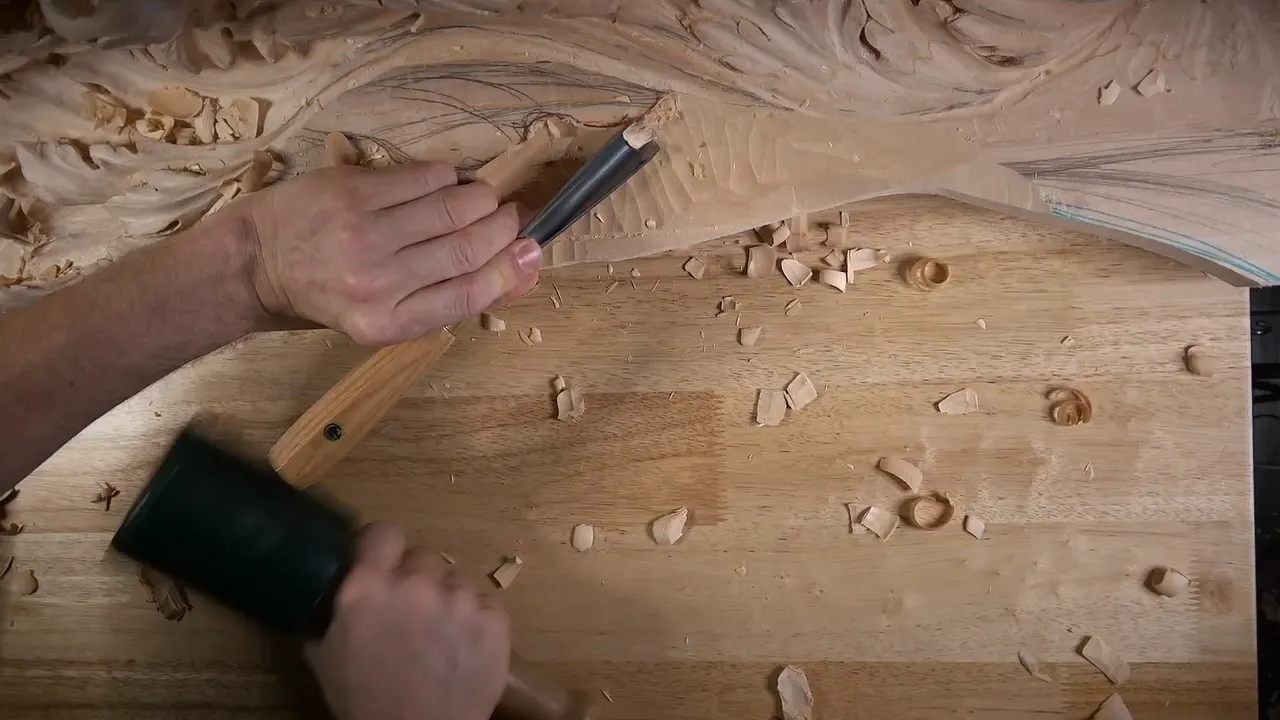

"Same result" is the phrase I used in Venice Room 75, part 3, while I picked a gouge for a cavity: the number nine, with an 11 and an eight offered as other choices. Other lessons carry it too, about V tools, a knife, jigsaws and other sizes, and a few say the opposite.
Ever stood at the rack with six gouges in front of you and wondered if only one of them is right? Did you reach for the one you own anyway? Walk through part 3 with me first, then through the lessons where I said it again, and see where the idea holds and where it stops.
What did part 3 say about the nine and the 11?
The part opens with a depth check. "Maybe that section is a little too deep, but I'm okay," I told you, and I counted what was left: "about 20 millimeters thickness right here" (0.79 in). Where the wood goes "a little more uphill," it was "maybe about an inch, maybe 25 millimeters." One spot was "maybe about three millimeters down" (0.12 in), and I guessed I would be okay.

Then came the line this page is built on. "So now I'll just go in this cavity with the number nine," I said. "I could go with the number 11, of course. It would give me the same result." A breath later: "Well, number nine or number eight will work in this case." Nothing was settled yet. "Let me think which one I should use."
My plan was "number nine and 20 millimeters first," to see how it worked, with maybe "just the help of a mallet." I called it "a three-quarter of an inch, number nine," and I said I would go "on inside of this cavity."

About two minutes later: "I don't think I'm going to need my mallet anymore. I'll just go by hand on that side." Soon after came a short report: "It's somewhat the shape that I'm after."

Did the number two get a second choice too?
The number two got one. "I'm going to use just the number two," I said, and one spot I would not worry about, since it would be gone when I work on my details. Next: "But now I'll just get the number two, or number three will work also, and give a little more cleaning."
The tool I described was "a bigger number two, like 50 millimeters, two inches," and I planned to "just kind of ride on top of those ridges."

Where else in workshop 75 did I name another tool?
The second video does it with smaller sizes. "Of course, I don't really need any more big tool," I told you, and a moment later, "Maybe I'll use number seven, I would say." Number six was the second name. The tool was "one inch, 25 millimeters or so."
The twelfth video puts it in a plain sentence. Close to the opposite side of a wall, I said, "Well, by the way, that is not the only tool you could use." Number 11 at 2 millimeters (0.08 in) was the other choice, and the next words were "go in." A saw shows up in the first video: "I think I can just do a jigsaw," and then, "Just a normal jigsaw."

Why did I point at other tools in Hashemi Flowers?
Take Hashemi Flowers 10, part 10, where a V tool was next for the waste, "Same V tool, number 16, and 6 millimeters" (0.24 in). I paused there: "please don't get me wrong. There is more than one way to achieve the same results. What I am trying to show you, my approach."
That lesson's ninth video praised a back bend, "I'm not prying anything against the material." My own words: "So really, it's safer." Then the other side of it: "I can achieve the same results with other tools, probably. But I think it's nice to have a back bend." Next, I said, "let me take again big number nine," at "3/4 of an inch or 20 millimeters."

Hashemi Flowers 11 has me planning, in part 5, an eye and "a pipe going to go all the way down." "Looks like I do have plenty of the material," I said, and I meant to take "number 11, and that's one millimeter" (0.04 in) to "try to undercut." Then an aside: "Oh, I also could use just a V tool." My goal, I told you, was "to show you so that there is a lot more ways." My summing up: "So pretty much, there is multiple ways."
Hashemi Flowers 25 gives my own reason. "Again, same 5/8 of an inch number seven" (about 16 mm), and then: "It doesn't have to be a 5/8 of an inch number seven. It could be different one, but looks like it works fine for me at least today." Some days a second tool gets there too, and "that's why I actually like to have multiple tools in my arsenal. Because sometimes you get tired of the same tool if you're using that every day."

The softest version is in Hashemi Flowers 42, part 2, about "the many techniques to do those flowers." My claim came in hedges, "probably," then "I should say," and last, "Or hopefully you can get the same result."
Could a plain gouge, a skew or a knife do the same job in the Venice Room?
The Venice Room has plenty of this. Back in workshop 52, I was about to start a first concave with "just probably number eight," and I added, "or number nine will work also. It will give me the same result." My size got corrected on the way: "about 10 millimeters or less actually. No, I'm sorry," it was "about six millimeters, so a quarter inch." Ten millimeters is 0.39 in.

Workshop 21, part 4, praises big skew chisels. Then comes "You don't have to. The same operation I could get done with just a gouge." My verdict had a hedge in it: "Not the same result, but about the same result." The skew brings a way into "those really tiny, small corners," where "I can use only a point of my tool."

Workshop 57, part 11, has me explaining a different tool. "When I was doing a big shell, I used different tool." My point, in my words, was "to drive point home that there is a lot more ways" to get "to the same result." I know "not all of you" own what I own, and you can be confident "that you can do same operation with the tools you have." One line of mine there: "I could do that, all the beads, with just a knife pretty much."

Which lessons told you to use the tool you already own?
Roman Acanthus 16, part 2, comes with a reason. "It's still the same idea," I said, and my pick stayed at number three, "since I'm pretty sure most of you don't have all the specialty tools. But number three will give me exactly the same result."

In Furniture Panel 15, part 5, it was a kind of hand plane: "you really don't need to buy that router plane. So it is possible to do without it." I named a number three or a number two, and "that's going to give you about the same results," I said. My own tool a moment later was "actually number four." Video 1 of that lesson makes the same point about a knife, which you could swap for another.

Acanthus over Moldings 3 says it in two places. In the first video, "you don't really have to have number 17, do not get me wrong. It's not one more tool you have to buy. You can use number 11." The third adds "there's a lot more tools you can use to get to the same result," and mine was "Number 17 in my case," at "six millimeters" (about 1/4 in).
Modern Acanthus 4, part 1, puts your size and mine side by side. "You have to grab a spoon gouge in your case. It would be 10 millimeters" in size. "In my case, that would be number 11. I use 7 millimeters." Those are 0.39 in and 0.28 in. Then I said a 10 millimeters one would do the same.

When did I say it would not be the same result?
A few lessons say the opposite. Part 3 of Lily Box lesson 3 talks through another way, a number five turned upside down, and the warning was "it's not going to be the same result, by the way," since it is hard to remove "all that junk." A tiny number three, I told you, lets you "go extremely underneath."

Over in workshop 7, part 7, a spot has "almost no position for me to attack that." My words: sometimes it's a wise idea to use "a skewed one, skewed back bend." Then: "It's still not the same result what I wanted to see."

The condition in Hashemi 45, part 6, was sharpness. "But tools, they absolutely must be sharp. Otherwise, you're not going to get the same results what I have." Next tool: "Number four. Quarter inch," about 6 mm.
Greek Acanthus 2, part 3, is about grain. "It's always better to work against the grain," I said, and then: "You can see you can achieve exactly the same results." The price came next, in looks: less clean, with undercutting still to come. My best practice: "Across the grain, okay?"

Does a saw, a knife or sandpaper get there too?
A sharpening lesson has saws in it too. In one video I was saving "at least 20, 25 minutes" when sharpening by machine, and some people "can control sharpening by hand a lot more than on machine." Then came a coping saw and a jigsaw: "You can use a coping saw for make a cope for the crown molding, or you can use a jigsaw and still have the same results."
Times followed. A coping saw takes "about five minutes," the jigsaw "just a few seconds, half a minute maybe, maybe a minute." Its home is the third video of the V-Tool Sharpening lesson.
Carving Plate with Butterflies 9 has me scraping in part 3: "Let's scrape this side also." The next lines: "you could use just sandpaper. It's going to work also." And a knife could scrape it too: "that's going to give you the same result. It's just going to dull it a little bit."
How do all these lessons line up side by side?
Each lesson on this page, with what I named beside my first choice and my own words for it. A hedge stays a hedge in the table, and the lessons where I said the result would not match are in it too.
| Lesson and part | What I named beside my first choice | My words |
|---|---|---|
| Workshop 75, part 3 | Number nine in a cavity, with an 11 and an eight offered as other choices | Will work |
| Workshop 75, part 2 | Seven for the smaller work, with a six offered too | A six too |
| Part 12 of workshop 75 | A small number 11, after I said other tools would do | Not just one |
| Hashemi 10, part 9 | Other tools besides a back bend, which I called safer | Probably, I said |
| Part 10 of Hashemi 10 | A V tool for the waste, and then my own approach to it | My approach |
| Flowers 11, part 5 | A V tool for the undercut I planned with a number 11 | Multiple ways |
| Flowers 25, part 2 | Another tool beside the number seven I named again | Tired of one tool |
| Lesson 42, part 2 | Many techniques for those flowers, and mine was one of them | Hopefully |
| Venice 52, part 3 | Number nine offered as another choice beside the eight | Same, I said |
| Venice 21, part 4 | A plain gouge in the place of a big skew chisel | Close, not equal |
| Room 57, part 11 | A knife for all the beads, after a big shell done with another tool | More ways |
| Roman 16, part 2 | Number three, with the specialty tools left out | Same idea |
| Furniture 15, part 5 | A three or a two where a router plane would go | Same results |
| Moldings 3, part 1 | Another tool, or the 11, standing in for a 17 | Not one more tool |
| Modern 4, part 1 | Your size of spoon gouge beside my number 11 at 7 mm (0.28 in) | Same again |
| Lily Box 3, part 3 | Upside down, a number five, after the way I had just worked | Not this one |
| Room 7, part 7 | A skewed back bend, where I had almost no position to attack | Not what I wanted |
| Hashemi 45, part 6 | A different tool, once I said sharpness is a must | Not my results |
| Greek 2, part 3 | Grain direction, which I called best practice, plus its price in looks | Not as clean |
Where can you watch part 3 and the lessons on this page?
Part 3 lives in Venice Room 75. Workshops 74 to 85 sit in Venice Room Part 7. Every other lesson here has its own page, linked above, and each is open to you with school access. A workshop number means the Venice Room, and every other lesson carries the name of its own course. The word wood carving covers all of them.
Want to hear me say it in my own voice? Start here.
How it's done
- Name a second tool. Part 3 had me put a number 11 beside the number nine for a cavity, and say an eight would work too.
- Try one and look. My plan was to start with that nine at 20 millimeters and see how the cavity went.
- Check what the second tool leaves. A five turned over, I said, would give a result that does not match the first way, and the waste is harder to clear.
- Keep the edge sharp. In the Hashemi course I called sharp tools a must, or you will not get my results.
- Use the tool you own. The Roman course had me sticking with a number three because most of you do not have every specialty tool.
Frequently asked questions
What did part 3 say about the number 11?
A number 11 was my other choice for that cavity, I said, with the same result as the nine. A moment later I added that number nine or number eight would work in this case. Then I told you, "Let me think which one I should use."
How wide was that gouge in the cavity?
I said I would try 20 millimeters first, and later called it "a three-quarter of an inch, number nine." Twenty millimeters is about 0.79 in. A mallet might help at first, I said, and later I did not think I would need it anymore.
Did a second tool work out each time?
One case says no: in Lily Box 3 a five used upside down would not match the first way. Hashemi 45 says results depend on sharp tools, and Greek Acanthus 2 adds a price in looks.
What to carve next