

Alexander Grabovetskiy, woodcarver, School of Woodcarving · Published 2020
What does a wood carver mean by "probably enough"?
Quick answer: In the fifth video of workshop 75 I said "That's probably enough. I can always come downhill completely, or I could kind of raise it up," and then I planned to stop at the slope. A section to excavate was my next plan. Below are the same words from my other lessons.
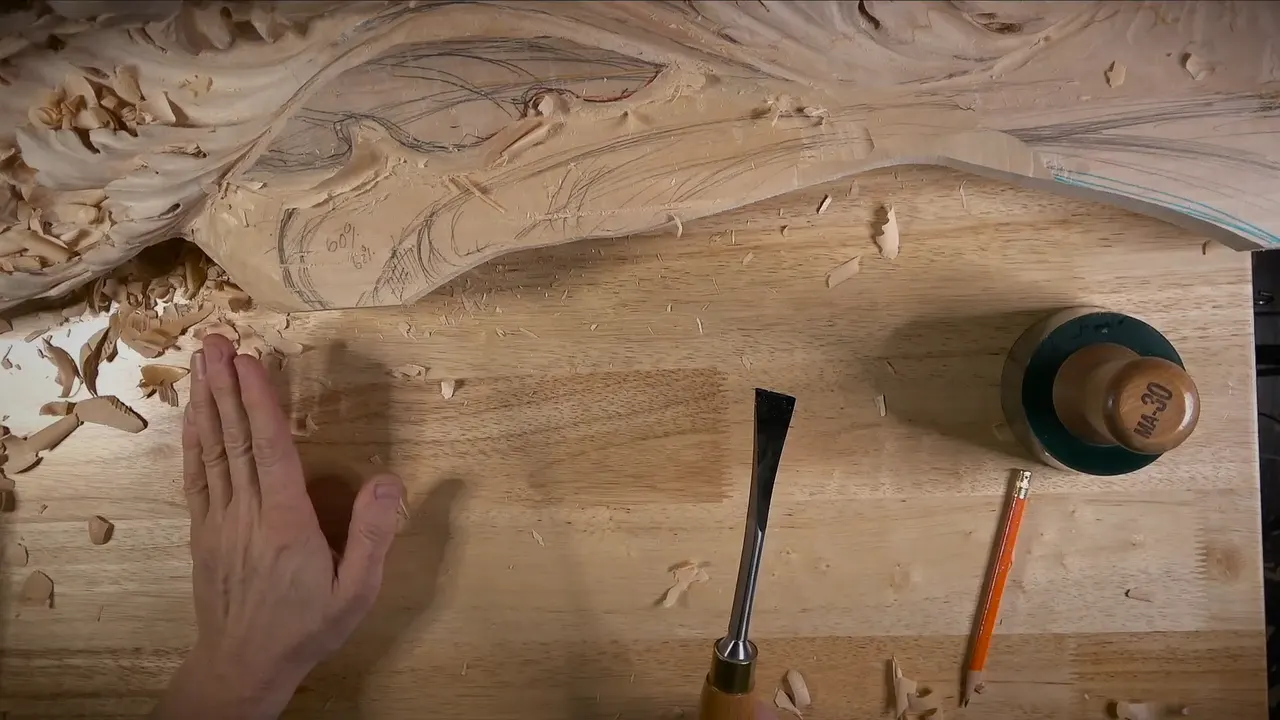

"That's probably enough" is what I said in the fifth video of Venice Room 75, and I went on, "I can always come downhill completely, or I could kind of raise it up." My plan was to stop at my slope. The same words turn up in other lessons of mine, and this page gives what I said right after each one.
Have you ever put a tool down because the spot felt done, and then wondered if you stopped too soon? Here the subject is one slope, in part 5. The other lessons on this page show what came after those words somewhere else, and they do not all end the same way.
What came right after the words in part 5?
The video opens in the middle of the work. Down or up, two roads were open to me, and I named both. I added, "I mean, the point." My next words: "But I think I'm going to stop at my slope. Somewhere right there."
Those lines give neither a number nor a tool size. All they hold is a choice between down and up, and a plan to stop there.

What was the plan for the section after the slope?
The section beside it came next. "Now, I'm going to excavate this section." My wish was to create probably an eye and the open spot. I added a doubt, "I don't really think it necessary," but "I think it's going to look really nice, so it's going to repeat the opposite side."
Where did I mean? "There's a lot of open spots like that on the other side." I made clear that I was talking about the other side of the overall design.

Where did the plan go from there?
The eye was on my list again, with a reason behind it. "Everything's supposed to have a motion like it's moving this direction." The whole piece came up, and I wanted to figure out the overall movement right there, because I thought it was probably time for some divisions.
About one part I said, "I left that for a corbel's sake." A corbel was coming, and I would work on that a little later. Right then I wanted to concentrate on that section.

How did the center line, the red color and the divisions fit in?
The center line was next. "If my middle line, the center line, going to be right there, I can actually use a red color." It would be "my high spot, at least for now." That line would go somewhere underneath, "so it's invisible."
Divisions followed. One was "the middle line of the division." Another one would have "movements still rolling that way." My thinking was not finished, and I said so: "But I'm not really sure yet."

The red marker drew a second thought from me. "I shouldn't probably use that red marker because it penetrates deeply. But maybe I just should to switch pencils. Just color pencils." For the future, I said, that was my plan, and "It is better."
Late in the video I said I would stick with that line. Skew was my next word. Then came "I need the mallet." A skew is the tool I named there, and the part closes on "All right. That is going to be a division."

How did parts 4 and 6 treat the same stop?
Part 4 carries a stop of its own: "Okay. That's enough." A job came after it, the "sloping part," and I said I needed to outline it all the way. One more need followed: I needed to lower the connecting section too.
A relief cut and a decision come up in part 6. I could probably give "a little relief cut" with "the number 11 and 10 millimeters" (0.39 in) right on this triangle, I said, and added, "not all the way. That would be a big mistake." Then I said I had to decide whether it would "go up like this" or "go down like that."
"Repeat the opposite side" shows up there too. It makes sense, I said, and maybe just go down, which "could make more sense." A second look came with it: "I could roll it backward again, but do I need to?" My answer was, "I don't think I need to."

Was more wood still to come when I stopped?
A reason comes right after the phrase in Venice Room 12, part 1, where I added, "because, like I said before, so I still have to use some of the material later on." I planned to use "number five, small one," a "Quarter inch" (6.35 mm), for the next move.

Another reason opens the sixth video of Venice Room 69: "I still have to later on carve this part, upper part, and I don't want to overdo it." Further on I said, "I've got the kind of shape I'm after," and then, "it's not the end yet."
Longer is part 6 of Venice Room 42. A question comes first: "should I or should not?" The answer: "I doubt I should." Then: "Because I can take one millimeter later on and excavate even deeper right here." One millimeter is 0.04 in. Later, I said I would leave it that way, "at least for now."
I also said, "I could carry away and I can make a mess." Next I named a plan, "Let me develop this piece right here," and an eye was part of it.

A thickness is in Venice Room 61, part 10. "I'm not going to chop anymore," I said, and I planned to "keep exactly the same thickness on the opposite side of my board." I needed the middle line next, and I had a decision to make about my division.

Was I holding back from going too far?
Part 5 of Venice Room 5 has me saying, "let me use the long bent, half an inch" (12.7 mm). Later in that part the phrase carries "for now," and I wanted no overdoing, or they would "create a problem."
"And why do I need extra problems?" I asked. A tool question followed: "Maybe number eight. A spoon gouge and attack it from this side. Oh, no, I'm not. That would be a big mistake."
Venice Room 29 shows the limit in another form. My probable move was to attack from the opposite side: "It would give me a much cleaner cut." I did not want it too deep.

A pipe is part of the work in Venice Room 40, part 4. "Don't want to go deeper than that," I said. About a deeper pass I added, "Maybe yes, maybe no." A size choice came with it: "7 millimeters would be mistake to use. I should use 5 millimeters or even 4. But let me try 5 millimeters first." Those sizes are 0.28 in, 0.2 in and 0.16 in.

Close to a hole, in Lily Box 10: "Got to be really careful how I'm doing it." The words went on, "Otherwise, I can overdo it again." A small job came up: "maybe clean a little bit this side."

A limit opens part 1 of Venice Room 144. I did not want to get "too crazy," because I was "feeling like I'm losing, making too much." I wanted "to keep it high." And still not to "lose the sides of my canvas."
Planned next, a separation "right at this point," with "the number 11 and 3 millimeters." Three millimeters is 0.12 in.

Did a number ever ride along with the words?
A number sits there, in part 3 of Venice Room 35: the words came with "as far as depth goes." The figure was "about 20 millimeters or so in, like three-quarter of an inch deep." Twenty millimeters comes to about 0.79 in.
My next thought was about shadow. Undercuts under two elements would make "really nice shadow spot." The seventh video of that lesson has the phrase "as far as how deep I want to go." Next I named "number five, like a quarter inch" (about 6 mm), to "try to get even deeper."

A figure turns up in part 7 of Venice Room 86 too: "I'm pretty close, so it's a quarter inch, six millimeters." I also wondered about "an even smaller number nine, maybe about 10 millimeters, to get to the final spot." Ten millimeters is about 0.4 in.

Maine class 15 puts the doubt in the line itself. The line reads "about maybe quarter inch in" (6.4 mm), then "maybe not," and "Let's see what I've got now." A figure near 10 millimeters (0.39 in) came out, and "that's good now with the same tool."
What job came right after them in other lessons?
The next job changes from lesson to lesson. Part 3 of Venice Room 5 goes to "a separation cut right here," and then to "the number seven and one inch" (25.4 mm).
One tool ties the words together in Venice Room 47: part 9 ends the phrase "with this tool." Divisions and the acanthus both surface in part 1 of Venice Room 50, where "the main acanthus movement" has its place "somewhere right here."
Movement is the subject in part 12 of Venice Room 53, with "start movement inward." Over in part 4 of Venice Room 59 I said, "Now it's actually gradually moving upward."

A result comes with it in Furniture Panel 20, part 8: "gives me really good shadow, and I can probably move on to the next detail, which is I have to go underneath of here."

Hashemi Flowers 11 has a different next line. In part 2 the phrase ends in "for now," and then "I'm still not happy how it looks," with a plan to follow: "Okay, I'll take number seven, one inch" (about 25 mm).
A leaf with no complete shape is the subject of Tray of Blessing 2, part 2. The words "indication of overall movements" come first, then the phrase with "as of now" added, then "We don't even have the complete shape of the leaf yet."

Did the door stay open?
Not always shut. Here is Venice Room 15, part 1: "Wonderful. That is probably enough. Maybe yes, maybe no. Maybe I should do even more than that. Okay. I really want to see more shadow right here."
Two millimeters are named in part 2 of Venice Room 42 ("Let me go with the 2 millimeters right away"). The phrase there ends in "for now," and then this line: "Of course, I could go with a smaller tool, no problem. But that is enough." Two millimeters is 0.08 in.
One more option sits in Venice Room 28, part 10: "I could do three if I wanted to." About ridges I said I'd knock them out with "some kind of sanding."
How do these lessons line up side by side?
Each lesson on this page sits in the table below, with what I named next and my own words near it. Every row takes its name from the course folder of that video, and the Venice Room rows carry a workshop number.
| Course and video | What I named next after the stop | Words I said |
|---|---|---|
| Workshop 75, part 5 | A plan to stop at the slope, then a section to excavate with an eye and an open spot | The open spot |
| Room 5, part 3 | A separation cut to make, then a number 7 at 25.4 mm (1 in) for the next step | Right here |
| Venice 12, part 1 | A cut to make underneath a detail with a small number 5, a quarter inch (6.35 mm), and some material left for later | Like I said before |
| Lesson 35, part 3 | A depth near 20 millimeters (0.8 in) and a plan to undercut for a shadow spot | Approximately |
| Video 40.4 | A pipe in the carving, a deeper pass left open, and 5 millimeters (0.2 in) to try first | Deeper than that |
| Workshop 42, part 6 | A question about taking more, one millimeter (0.04 in) for later, and an eye to develop | A mess |
| Room 47, part 9 | A stop with one tool, then the number 11 underneath | With this tool |
| Venice 50, part 1 | Main divisions planned in three parts at first, with the main acanthus movement somewhere right here | Three parts |
| Lesson 69, part 6 | An upper part still to carve, a wish not to overdo it, and a shape close to what I wanted | Not the end yet |
| Video 144.1 | A wish to keep the carving high without losing its sides, then a separation of 3 millimeters (0.12 in) | Keep it high |
| 20.8, Furniture Panel | A good shadow as the result, and a move to the detail underneath | Really good shadow |
| 11.2, Hashemi Flowers | A look I did not like yet, and a number 7 at about 25 mm (1 in) to try | Not happy |
| 10.10, Lily Box | A hole close by, a risk of overdoing it again, and a cleaner side to work on | Overdo it again |
| 2.2, Tray of Blessing | An early leaf with only an indication of movements and no complete shape yet | As of now |
Where can you watch part 5 and the other lessons?
You can watch part 5 inside Venice Room 75, and workshops 74 to 85 sit together in Venice Room Part 7. Every other lesson here has its own page, linked above. The word wood carving covers all of them. The corbel in part 5 and the acanthus movement in Venice Room 50 belong to the wider field of ornament, which has its own long history.
Want to hear the idea in my own voice? Start here.
How it's done
- Name the other roads. Part 5 names two, downhill or raising it up, before the stop.
- Pick a stopping spot. I picked the slope as the stopping spot.
- Say the next job. The plan moved on to the next section: excavate it, then create probably an eye and the open spot.
- Keep a reason ready. Workshop 69, part 6: the upper part is still to carve, and I do not want to overdo it.
- Leave a door open. In the second video of workshop 42, a smaller tool, "no problem."
Frequently asked questions
What came after the words in part 5?
Two roads, downhill or raising it up, and then my stopping place. A plan for the next section followed, with an eye and an open spot.
Was a number ever attached?
Not in part 5. Workshop 35 gave a depth near 20 millimeters (0.79 in), and workshop 86 gave "a quarter inch, six millimeters."
Did the words close the question?
Not every time. Workshop 15 adds more doubt, "Maybe I should do even more than that," and Venice 42, in its second video, leaves a smaller tool open, "no problem."
Which lessons gave a reason?
What to carve next