

Alexander Grabovetskiy, woodcarver, School of Woodcarving · Published 2020
What does a wood carver mean by "the previous tool"?
Quick answer: Within part 5 of workshop 83 I said "the previous tool" when I called for a clean-up that goes maybe a little deeper, and the sentence names no number. In other courses of mine the same words come with a number nine at 10 millimeters (0.39 in), a number seven and a 5 millimeter number 11 (0.2 in).
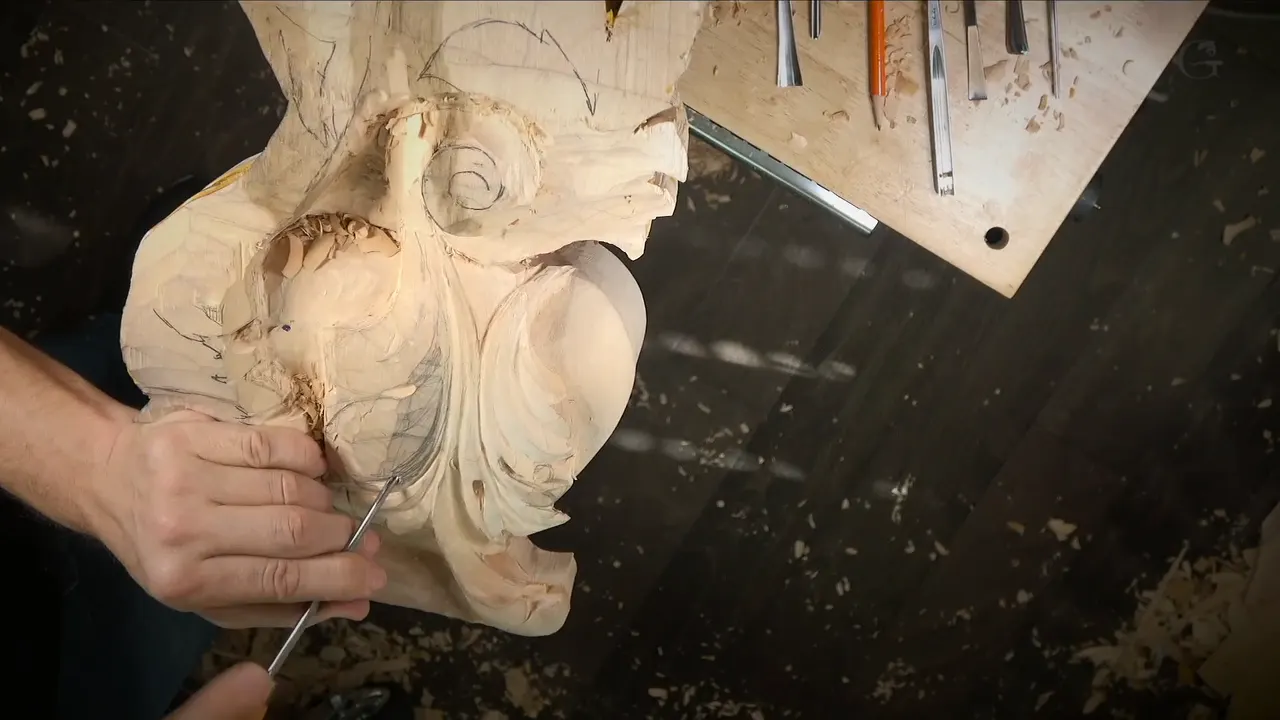

Workshop 83, part 5, has me calling for the tool before to clean a cut, aiming a bit deeper. The same call to the tool I held earlier is in other videos of mine, with a job after it and sometimes a size.
Have you ever put one gouge down, picked up another, and wanted the first one back? The video from workshop 83, part 5, comes first on this page. My other courses come after it.
What did I do in part 5 before I said it?
The video starts with a job I put off. An undercut, "which I can do a little later," I said, and the waste could wait too: "I'll remove it little later off-camera." Then "Don't need to do that right away."
A nine came next as a plan, "pretty much right away," for "the plug cut right underneath right here." A little section broke, I said, and my verdict came next: "which is okay. That's not a big deal."

For the opposite side I said "my concave going to be somewhere right here." For that side I named "the number 11 and 3 millimeters" (about 0.12 in), and I said "Go against the grain first." Wikipedia has a page on wood grain.

Size moved up to "number 11 and 7 millimeters now" (0.28 in). Clean little bit this side, I said. Another line was "I need to change the direction of the cut."

The convex came next, and I wanted it "exactly the same like on the opposite side." My plan was "probably number three, I would say," for "little by little, just to chamfer it multiple times." The chamfer is the technique, and Wikipedia covers it.

Here is the line itself. "Clean that with the previous tool and make it maybe a little deeper cut." Right behind it came "More exaggerated cut with more shadow." No tool number sits in that sentence. The page for shadow on Wikipedia is short.

Next I said "I want to kind of create better eye." Next came "I can't remember if I used 7 millimeters previously, but I'll use 7 millimeters" (0.28 in). Then "a little bigger eye," and "I think it's going to be looking good."

A choice was next, "how I'm going to divide that." My plan for the division was "maybe this way," and the verdict was "It doesn't look too good." Below it, "I'm probably going to stick another leaf because I kind of don't want to lose overall feel what I've done on 3D modeling."

The next division would be "like a S, letter S curvature." I weighed two jobs, "excavate all that or just outline it," and then the plan: "3 millimeters number 11 again, and I will outline it" (0.118 in).
Parts 4 and 6 of this workshop add a few lines. Part 4 has "Let me use number six" and then "Number 7, 14 millimeters works just fine in this case" (about 0.55 in). About my workbench I said "I've got too many tools on my workbench now, so it's time to clean up because I'm losing track of my tools." In part 6 I said "I'm breaking rules again and carving uphill, which is okay. As long as my tool is sharp, I am able to do that." And "get rid of whatever I just created fast."
Where else do I say it in my courses?
The call to the tool before turns up in more of my lessons too. Here they sit in three groups: going back to clean, naming a size, and a different tool taking over.
When do I return to the tool before, just to clean?
Chamomile and Bow Rosette, lesson 1, part 2, has it after "I'm after shadow, deep shadow." The gouge I used earlier was "Like one and a half millimeters" (0.06 in), and for the mess I wanted "chisel number one and straight down cut." After that I said "sometimes I have to go back to my previous tool." Then "make sure I created the cut all the way to the center part," to finish the thought. For a spot not clean, "I wouldn't worry about it right now." Next was "now it's time to develop those petals." Wikipedia covers the chisel too.
A corner is the warning in Carving Roman Acanthus Leaf, lesson 16, part 4: "pay attention not to dig with this corner on inside too deep, otherwise you're going to destroy that nice smooth transition we just created." My fix was "always better to go back," then the previous tool, "just to clean it." In that part I also said "until you don't see any roughness." There is also "I'm using just a straight gouge. It's a fishtail, but it's still straight."
In my Lily Box course, lesson 2, part 2, I said "I don't want to push too hard." "Better to grab previous tool," followed by "make the cleaning cut," and "I'm actually not holding my tool straight like this. I am twisting a little bit."

The Tray of Blessing, lesson 3, part 3, shows two cases. One: "you can still use your previous tool until you feel like it's completely cut." The other is a dig that went deep: "I can always take my previous tool, what I used previously, clean that slightly."
Carving Hazelnuts, lesson 7, gives two sizes. One size comes from part 1: "I can actually excavate little deeper" with "five millimeters veiner number 11" (roughly 1/5 in). Later there, "some kind of flatter gouge" is "about a quarter inch and number three" (about 6 mm), and "Remember, the direction of the grain is really important in this case." Then "Let me get previous tool," next "I can continue," and I said "I'm leaving extra material because I can always take it down later and make it much thinner." Later, in part 3, I said "get rid of all that mess," using the previous tool.
How do I name the size when I grab it?
Two videos in Modern Acanthus, lesson 3, give a size. One says "attack from the opposite side" and calls "that spot really important," then names the previous tool as a nine at "20 millimeters three quarters of an inch." The other says "keep an eye. Don't push it if it fights you change the position attack from other angle and you're gonna be safe." It calls "grab the previous tool what we use number nine and 10 millimeters" (0.39 in), and the job is "refine that cut." Later in that part: "Don't make it too thin. It's a weak area."

A reason comes first in lesson 5 of that course, part 2: "it's gonna give us more Shadows," from "that bulging inside." Then a nine at "3/8 of an inch" (about 9.5 mm) for "Excavating right on the side of the middle part." The plant is acanthus, and a short Wikipedia page covers it.

Floral and Molding for the Panel, lesson 14, part 2, gives an amount to take: "approximately, I would say, maybe quarter inch. It's about six millimeters or so." The tool is "number seven, the previous tool that I used on another side," and my note is "It's not on glue, so it should be safer." A worry follows, a part too weak where it connects to my shell. Then "just to flip my tool upside down and create like a fillet."
Over in lesson 13 there, getting the tool back comes up in part 2, with "a couple of ways you could attack that." One was a number five placed "right on the line" for "a straight-down cut." Later came "let me grab the previous tool." The size was "1.5 millimeters number nine or number eight" (about 1/16 in).

Lesson 1 of the same course, Floral and Molding 1, part 3, has "I am staying away slightly from my line." Then "the previous tool, number seven," for "the cut right straight down. Cut would be like 90 degrees."
Acanthus over Moldings, lesson 7, part 1, has a mess under a center part: "I don't worry about all that mess underneath of the center part." Afterward, "I use the previous tool and remove some of that stuff out."
A deep pass is held back in Furniture Panel 29, part 2: "it's not gonna be really deep cut," with a molding "going right underneath of those petals." I added "I don't wanna dig deeper than that molding," and then "Let me get previous tool, quarter inch, six millimeters." Another option: "I can either just get upside down and blend right away."
A plug comes first in Furniture Panel 36, part 2, as in workshop 83. "I'm gonna place it straight down like this, so it's a 90 degrees pretty much," I said, and "My plug out right there." After "remove this section," I named a number nine at "quarter inch, six millimeters" as the previous tool.
In lesson 3 of Carving Hazelnuts I said, in part 2, "another concave right here." Then "I need the previous tool," I said, with "number nine in a quarter inch" (about 6 mm). The plan was "concave-concave again."

Venice Room workshop 73, part 3, includes "I don't need to do too much, although I still need to blend a little better this section." Then "Previous tool," paired with a number eight, 5 millimeters (roughly 1/5 in). Then, "again, limitation. But it's okay." Next, "I kind of like the overall idea."

Carving Grape Onlay, lesson 6, part 3, carries the call while drilling: I would "remove some of the excess material all around" with the previous tool, then "get little more drilling done." And "Try not to break anything."
Lesson 13 of the same course, part 1, pairs the call with a past pass: "recreate my previous cut." The size of that cut was "probably two millimeters" (about 0.08 in).

What if the tool before is wrong?
A change of mind is in my Hazelnuts course, lesson 5, part 1. "It doesn't have to be the true roundness, but still," I said. I would get the tool from before, I said. Then "No, I'll get the number 11."
Back in lesson 7 of that course I warned, in part 2, "don't dig too deep to the background," and "really hard to clean." I planned to get the earlier tool. After "I think I need to change to a smaller tool," I named a spoon at "about 3/16 of an inch, about five millimeters."
Furniture Panel 17, part 4, goes the other way: "even without previous tool, I'm able to use just No. 11 and 3 millimeters" (just under 0.12 in), with "only left side of the tool." It "becomes like No. 3 pretty much for me."

Over in lesson 21 of that panel I said, in part 5, "much better to create that preliminary relief." I could "go really deep, pretty much the same depth as my background. So about one-eighth of an inch, 3 millimeters." I could reach for the tool before "or whatever the matching tool I want to use" and "start cutting inside," with "slightly undercutting right away because it's going to slope a little." Also "keeping that side for my future slope." Wikipedia covers relief too.

Venice Room workshop 7, part 1, covers a spot where "it's not flying out": "I have to just go back to the previous tool" for going "little deeper, like in this area right here." Then "kind of excavate a little deeper, which is not going to hurt." On pressure, "I'm almost not creating any pressure."

Work across the grain needed help in Furniture Panel 24, part 3: "I'm going to need to help with the mallet." The mallet has a page of its own. I named "the corner" of the tool before, a number three at "about 10 millimeters" (just under 0.4 in), and added "Without forcing it."

The tools side by side
| Which video | The tool or size I named | What I said in that video |
|---|---|---|
| Venice 83.5 | A deeper cut, and no number named | "Clean that" |
| Venice 73.3 | A number eight at 5 millimeters (0.2 in) | "Previous tool," |
| Acanthus 3.1 | A nine at 20 millimeters, three quarters of an inch | "attack from the opposite side" |
| Acanthus 3.2 | Used to refine a cut, a nine | "refine that cut" |
| Floral 14.2 | A seven, taken from another side | "not on glue, so it should be safer" |
| Floral 1.3 | A seven, then the cut right straight down | "like 90 degrees" |
| Furniture 36.2 | Quarter inch number nine (6 mm) | "remove this section" |
| Hazelnuts 5.1 | Number 11 instead of the one before | "doesn't have to be the true roundness" |
| Hazelnuts 7.1 | A number 11 at 5 millimeters (about 3/16 in) | "I can continue" |
Where can you watch every video on this page?
You can find part 5 in workshop 83, and the workshops around it are 82 and 84. All twelve sit in the Part 7 course. Is there a gouge on your bench you keep reaching back for? Wikipedia has pages on wood carving, woodworking and hand tools.
How it's done
- Name the first size. The start was a number 11 at 3 millimeters (0.118 in), with a seven-millimeter one (0.276 in) named next.
- Plan the surface. Probably number three, I said, to chamfer it little by little, this side and that side also.
- Reach back for the earlier tool. I called for a clean-up with the earlier tool, taken a little deeper.
- Ask for more shadow. My next words asked for more shadow, and then I wanted to kind of create better eye.
- Decide the next division. I said I needed to make the decision about dividing the part, and then named a letter S curve.
Frequently asked questions
Which tool did I mean in part 5?
The sentence gives the job, a clean-up that may go a little deeper, and it has no number. Later I said "I can't remember if I used 7 millimeters previously, but I'll use 7 millimeters" (a bit over 1/4 in). I name no number for the one before.
Which plan did I make for a number nine in part 5?
The plan was to pretty much right away take number nine and create the plug cut right underneath. A little section broke, I said, and I called it not a big deal.
How big was the first number 11 in part 5?
Three millimeters, roughly 1/8 in. Then 7 millimeters (a bit over 1/4 in) came up, and near the end I named the 3 millimeters again.
What to carve next