

Alexander Grabovetskiy, woodcarver, School of Woodcarving · Published 2020
What does a wood carver mean by "reshape"?
Quick answer: In part 2 of workshop 83 I said I broke the number seven and used the word reshape for it, right after I tried a big gouge against a curve and said it did not fit the profile. Other videos use the word for skews, tools from the manufacturer, knife heels and scroll edges.
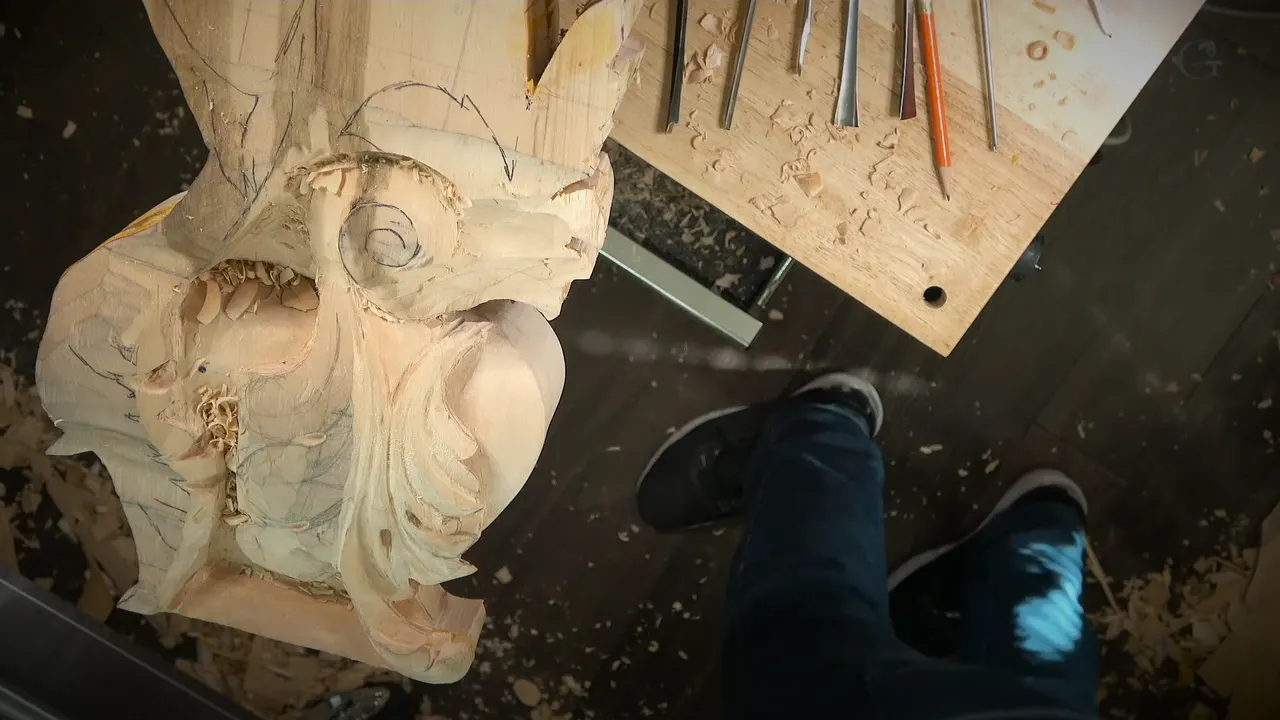

Reshape is the word I said in workshop 83, part 2, about a number seven that I broke. My other videos use it for skews, new tools, knife heels and scroll edges.
Do you own a gouge that came out of the box? Have you picked up a big tool and found it did not match the shape in front of you? This page starts with that part of workshop 83. The other videos follow it.
Where did part 2 begin?
The part opens in the middle of the work: "And kind of smooth everything out." A moment later I said "Here you go. It's a really smooth transition." And then, "Yeah, it's kind of rough, but I'll take care of it."

For the rough spot I said "I can just ride right on top with my gouges and make it really nice and smooth." The clean-up was "not a big deal for me to clean up a little bit."
My next idea was another place. "But right now, I think I want to jump on this side. Or not. Maybe I have to just clean a little bit this curvature, which is not too nice yet."

How did a number seven come into it?
I wanted a tool for that curvature: "Okay, and to clean that curvature, maybe I can just use a big gouge, maybe number seven, and see if it's going to fit the profile, which in this case, it's not." I added "It is not."

After the broken seven I said "Let me do just by hand, just with the number seven small one." And: "So I really need to make sure it's a really nice and smooth-looking transition, okay?"

What came next on the carving?
A hollow was my plan: "but let me create a concave cut right here. I think concave cut will do the trick, and I'll see exactly what needs to be done." Later I said "That is my concave."
Light came into it as well: "But I've got too many shadows. Or too much light, I should say. Let me get rid of one of the sides and maybe refine a little more this side." Afterward I said "So now it's looking better."

Sandpaper entered next. I said "So let me jump on this side, okay?" and "Although, I could touch up with the sandpaper." A little later I spoke of the grit: "Well, it's not that bad and all, and later on, I can probably just touch it with a higher grit, like maybe 400 or something like that." Then "Oh, here's a 240." About the result, "it does look not bad." Wikipedia has more on sanding, if you want to read how people do it.

What did I leave for later?
One area still had me unsure: "except this area is still not too happy. It just doesn't make too much sense. Maybe I just have to get rid of the whole section right here and just keep this part. Okay? But I'm not sure yet. I'm not sure." Leaving it for now was my plan.
The other side was clear to me: "Well, actually, that's a simple side. So I've got a bunch of leaves and the center line going all the way, of course, this way, right? Everything goes to the center." The last lines are plans: "Maybe I can actually prolong that pipe." And "Let me actually do a pipe like that."

Which sizes did the other two parts of workshop 83 name?
Part 1 opens with "And I'm going to switch to two millimeters, number 11," and two millimeters is about 0.08 in. A smaller size is "I could go extreme and just use one millimeter," about 0.04 in, and then "one and a half millimeters," about 0.06 in.
In part 3 I said "So I'll take, again, number 11 and 7 millimeters," and then "Let me use 3 millimeters, not 7." Those are about 0.28 in and 0.12 in. Another line was "Maybe 10 mill, number 11 will do a better job in this case" (10 millimeters is about 0.39 in).

A flat tool is named in part 1. "And again, I'll just use a normal chisel, like number one chisel, laid flat on the previous surface and use just the corner of it and slice it to the deepest spot." Wood is the topic in part 3. "It feels like in this area, fibers are more dense than in other areas," I said, and then "Much denser, which is not really common for the basswood, but it's okay."
Blending is in part 3 too, with tools I named: "a left wing to blend it little bit, and a right wing to blend the right side." For a hump, "the flatter tool, like number three," and "I create really good downhill cut." I also said "I'll just take my time and break the rule of the cutting downhill with the grain, and I'll just go that direction."
Where did I give a back bent a skew?
In lesson 65, part 6, I said "Maybe skew will help. Back bent." And "It slices much better, and I can get much cleaner cut." Then came this: "And no, you cannot buy that tool. You have to reshape. That's just a normal back bent, and I reshaped that as a skew." A separate line was "I just reshaped that to my taste."

Workshop 99, part 7, has a tool of the same kind: "if you would ask me where to get the skewed one back bent, it's actually a normal back bent. I made my skew myself. Okay? I reshaped it myself."

A skewed tool is in lesson 102, part 4: "I skewed that myself. I reshaped that myself." About that tool I said "It's going to be just really handy for me to work in areas like this."

The Corinthian acanthus course, lesson 5, says this about skewed gouges: "And sometimes it's hard to find on the market those skewed gouges. You can easily make yourself, actually. Buy just a normal gouge, and you can remake, reshape, whatever, resharpen those gouges. But you can get to really tiny spots."
A chisel got the same work in lesson 42, part 1, where "I reshaped little bit my skew chisel" begins a line about thinning it: "I've got thinner from both sides."

What did I say about a new tool?
The micro tool sharpening course, video 1, talks about stages: "there is different stages of sharpening. And the main stage is actually to reshape. Okay? So you really have to take a tool and completely reshape." My reason followed: "Because the tools, when they're coming out from a manufacturer, they're not shaped correctly."

At the Maine Coast sharpening class I said "Then I want to reshape it. Once it's becoming dull, I want to reshape," and "So I have to make the decision what bevel I'm going to have on that particular tool." And "most of my tools, low bevel." A bevel and sharpening both have pages on Wikipedia.
For the fingernail gouge video I said "So let's remove that felt wheel and take an 80 grit," with "And like I said, we're going to completely reshape this tool, and I'm planning to do extreme fingernail" as the next words.
On a new gouge in lesson 2 of the first Venice Room course I said "This is a new gouge, and I never reshaped that one."
Workshop 50, part 3, is about a set of seven tools: "I opened one and I already reshaped one." Of the size, "number three in 20 millimeters, 3/4 of an inch." I added "I reshape the usual way I reshape it. I've got a really long bevel. That's the way I love to shape my tools." And "There's absolutely no difference between really high-end, expensive tools and this one, which costs you $10 a tool."

A bigger tool was on my mind in lesson 69, part 6: "And the normal way would get the bigger tool, which is going to fit, and I need to reshape that one also. My bevel on this one is not established yet the way I like, and that is also number seven."
In workshop 39, part 9, I used the word for a tool "sharpened for the harder wood," and said "that's not how I like to see it." Lesson 93, part 12, has "Maybe it's a good idea to get two sets and then reshape some of them to make it smaller a little bit." With it came "I could make it just a single run to get to the tiniest spots."

Which blades and knives did I reshape?
The Furniture Panel course, lesson 15, part 7: "You can actually reshape just the normal blade," I said, and "you can get even to the most complicated spots, to the sharper points if you need to." Of that: "I really don't need to, but if you like to do that, that's possible."
Grinding a heel is the subject in lesson 17, part 3: "But in my case, it would not be enough just grinding heel, so I need to completely reshape my blades and leave just a slight spot for the cutting." The grinding I mean has its own page on Wikipedia.

A size shows in lesson 16, part 1: "So that's actually 1.5 millimeter." It "just feels almost like just 1 mil," so about 0.06 in and 0.04 in. Then, "Maybe I reshaped that. Yeah, that's exactly what I did, actually." I also said "I made that smaller," about the same tool.

On knives, lesson 20, part 1: "I'm using the backside of the knife, okay? I'm using only this part of the knife. That's why I actually reshaped that knife." In the Lily Box course, lesson 13: "So that's why on some of my knives, I actually reshaped that heel." A knife has a page on Wikipedia too.

For undercutting, the Q and A course on different shapes of V-tool says "The only way you can do it, if you reshape your V tool." The wings get a bevel: "I create the bevel on the wings, okay?"

Which parts of the wood did I reshape?
From Hashemi Flowers 8, part 6: "as soon as I see that, I'll go back with the pencil, maybe right now, and reshape." Then "I have to take this out." Also "And maybe a knife is going to be better in this case."

Hashemi Flowers 2, part 3, has "first of all, I'll just reshape the edge of it, and then I'll create the concave cut." And "to reshape it, I can use the same number three carefully."

Another line in Hashemi Flowers 8, part 1, says "I still going to reshape some of the edges of those leaves and so on." And "You don't have to repeat exactly the movements I do." Lesson 10, part 2, speaks of a tool: "This one needs to be resharpened, reshaped."

Lily Box lesson 8, part 4: "And let me reshape this movement." The Greek acroterion course, lesson 3, has "And reshape this part a little bit."
The opposite is in lesson 45, part 3: "Letter S movement right here, and I can actually undercut right away. Because I like the movement, so I'm not going to reshape it, I should say."
The lines side by side
| Video | About | My words |
|---|---|---|
| 83.2 | A big gouge that did not fit a curve | "I broke the big one, number seven" |
| 65.6 | A back bent that I shaped as a skew for a cleaner slice | "It slices much better" |
| 99.7 | The skewed back bent I made myself, with a plain back bent as its start | "I made my skew myself" |
| Corinthian 5 | A normal gouge that can become a skewed one | "you can remake, reshape, whatever, resharpen" |
| Micro 1 | Manufacturer tools | "the main stage is actually to reshape" |
| 39.9 | A tool in my hand | "right now it's sharpened for the harder wood" |
| Panel 17.3 | Blades, and a slight spot left for the cutting | "a slight spot for the cutting" |
| Lily 13.1 | The backside of a knife, the heel side | "I created a bigger heel" |
| Hashemi 2.3 | A scroll, before its concave cut | "first of all, I'll just reshape the edge of it" |
| 45.3 | A movement I planned to leave as it was | "Because I like the movement" |
Where can you watch these videos?
Workshop 83 holds part 2, and the Part 7 course holds workshops 74 to 85. Sharpening videos sit in the sharpening course. Do you have a spot on your own carving that you are not sure about yet? hand tools and wood carving both have pages on Wikipedia.
How it's done
- Look for the tool that fits. I wondered whether a big gouge would go with the curve. In that case it did not.
- Say what happened to the tool. I named the big number seven as the one I broke, and the word reshape came with it.
- Take the small one. By hand, with the small number seven, was the plan I named.
- Check the transition. The line I wanted was a smooth-looking transition, and I said I have to make sure of it.
- Try a concave cut. A concave cut might do the trick, I thought, and then I would see what has to be done.
Frequently asked questions
Which gouge did I say might not fit the curve in part 2?
A big gouge. I wanted to see whether it would go with the curve, and in that case it did not. Working by hand with the small number seven was what I named next.
Can you buy a skewed back bent?
Lesson 65 says you cannot buy that tool and you have to reshape it. Mine is just a back bent that I made into a skew myself, from workshop 99. The Corinthian course calls skewed gouges sometimes hard to find.
Does a new tool need reshaping?
The micro tool video says tools coming out from a manufacturer are not shaped correctly. Reshaping is the stage I called the main one. On a new gouge in lesson 2 of the first Venice Room course I said I never reshaped it.
What to carve next