

Alexander Grabovetskiy, woodcarver, School of Woodcarving · Published 2020
What does a wood carver mean by "sticking out"?
Quick answer: Sticking out is my phrase in workshop 83.11 for a point I planned to leave on a leaf and for small parts that stuck out originally. In other videos I said it of leaves that go under another leaf and come back out, of a chunk I wanted to save, and of a petal, a grape and a brush.
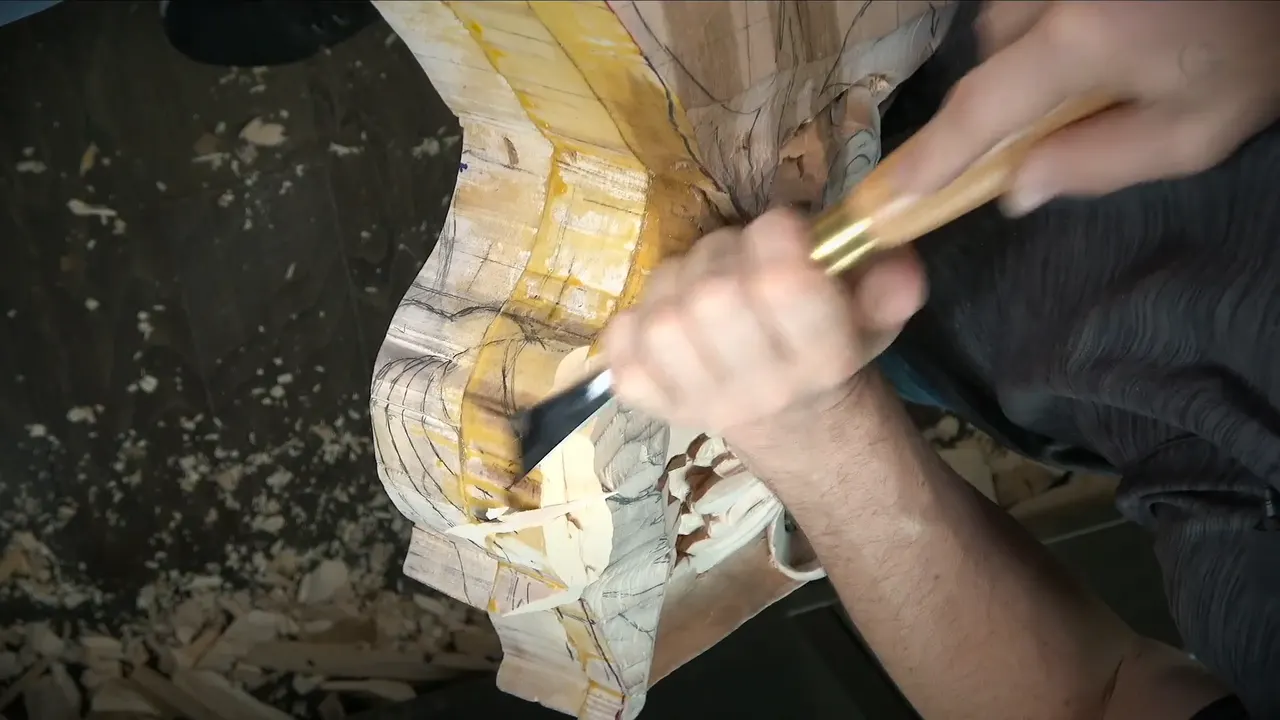

In part 11 of workshop 83, sticking out came up for a point I planned to leave on the leaf and for small parts I had originally.
Ever looked at a leaf in a drawing and wondered which point stays and which one goes? Does a piece that stands up from the wood look easy, and still make you slow down before the gouge touches it? Follow one phrase of mine through a corbel and a few other courses, from a point on a leaf to a grape on an onlay.
Where I said sticking out, in six short lines
- Part 11 starts with a skew.
- Just one point on the leaf, I said, was the one I would leave.
- A fragile point, I said, can always come out.
- The movement needed a double-check, and I called it the main one.
- Small parts sticking out came up as a space to fill.
- Other videos use the same words for leaves, grapes, a tool and my head.
Which tools did I name in part 11?
A skew comes first. "And I'll use, again, from the beginning, just a skew," I said, and that is the first line in the file. Later I wanted a different gouge, probably a number six or a number seven, then "I should take probably number seven in one inch" (25 mm).

My next plan was sharpening that gouge a little bit, and it stays a plan on this page, because that is how I said it. After that, the file has "Okay. So it is somewhat rounded." and, a little later, "And I think it is good. So it is going like this and wrapping. Right. It is good."

How did I frame the movement before the point came up?
Time to figure it out. "So now it's time to figure out what am I going to do," I said, with the movement "like this" and no plan to repeat exactly what I designed. "Approximately, okay?" All my movements, I added, are supposed to just follow the logic.
Plastic came into it too. "I do have a previous plastic," I said, and "I can probably just figure out what is going on right here." The plastic in the frame below is a sheet with a drawing on it.

Then the decision, in my words: "for me, it's not the challenge, but for me, I have to make the decision." My question was how many big divisions I would have, and my answer was "Same like what I had on this side."
One of them would be this one, obviously, I said. Which is the main movement? It would go "from all the way here," and it was "already given." Then came "So I need to take out this chunk so it's on my way."

What did I say about the point I would leave?
The chunk first, with a number nine: "I can easily remove it with no problem."
Another look. "I think I can actually remove more," I said, and then "I'm going to leave just that point."

Next: "That is going to become whatever the sticking-out part." Right behind it came "Which actually it doesn't have to," a plan with an exit in it. If the point is going to be too fragile, I said, "so I can always take it out."
Read it as a plan, because it was one. The point would become the sticking-out part, but it did not have to, and a fragile point could come out.
Which line was the main one?
Then, in my words, "But here you go" and "double-check the movement." After that, in my words: "the main, central, whatever you call it. The center. Not really the center, but in this case, it is a really interesting movement."
"And I also have to fill this space," I said. The other use of the words, the one in the answer above, follows it: "Originally, I do have some kind of small parts sticking out, so which makes sense, and I going to do it."

Here the file ends. Which small parts I meant, I did not say. All I have is the space to fill, the word originally, and that it made sense to me.
Which leaf comes out from under another?
Just before, in 83.10, the question shows up. "That piece supposed to stick out," I said, then asked "But which one is it? That is the question." Other videos show other leaves, and my words for them repeat.
Over in Venice Room workshop 56, part 10, a movement would run "all the way to the eye" and go "underneath of this leaf." It would stick out again, I said. And step number one: "I have to create the cut around."

Workshop 66, part 2, has a piece "sticking out from underneath," and "I cannot, and I do not want to lose it." A motion with the piece curling from underneath was possible, I said, to expose the lower part, which makes the deep shadow. "One of the possibilities, and I think it's a really good possibility."

A livestream in April 2020 uses the same words for an "acanthus movement sticking out from underneath." In the Roman acanthus course a leaf "goes underneath of that" or comes out "from inside out," and I planned a number seven for that leaf.
Venice Room workshop 58 says it plainly about a piece of molding. It goes "like that, and then it hides, and then it sticks out and exposes right here." The first tool that day would be no gouge at all, I said: "I'll take just a skew." That chisel is the same tool that opens part 11.
Why leave a piece standing?
At times the reason is that I like it. Workshop 55, part 7, has "I still want to save this chunk because I really like that it's a little bit sticking out." Next, "let me think what's the best way," and I could roll and create exactly the same idea I had done in another area.

Workshop 68, part 9, holds an idea of mine. A deeper shadow on one side was possible, I said, and "just leave that piece sticking out like that," then get rid of the chunk. "Maybe it's a good idea, right?" I added.

Height is another reason. One part in workshop 2, part 12, was much higher because it would sit above. I wanted to make sure it was visible, and even sloped slightly it would still "stick out."
And sometimes I leave it alone. In workshop 92, part 6, gluing little pieces could make a part "more sticking out," but I really don't need to, since it will be visible from the bottom and look fine anyway.
Workshop 69, part 4, has leafage, "like some leafs sticks out." Waviness comes up in workshop 76, part 12, for "just the parts which is going to stick out."
When does a part stick out too far?
The words work as a warning too. During workshop 28, part 5, I was "double-checking if something sticks out" and found a couple of spots. One "sticks out too much, and I need to blend that nicely." You can't catch that on the camera, I said, but I look from different angles, so I can.

Workshop 44, part 3, has "I'm really not too happy about how far that sticks out. But it's okay." Then "Not a big deal," and a part to take down. By workshop 55, part 9, the line was "I don't really like how it sticks out too much," followed by "Maybe I do, maybe don't."
A marker and a plan came next in 55.9. I could move that inward, I said, so the piece would go "like that, but little shorter," wrapping underneath of the main movement, with that section excavated.

One more sits in workshop 53, part 3: "That part also going to stick out. Let me think what I can do." My reason came right behind it, "as of now, it does not make too much sense how it looks." Next, I said I need to make the decision on what matters more to me.
Can a part that sticks out stay strong?
Fragile is the word in part 11, in the line about the point I could take out. The Tray of Blessing course asks it too, and I said of one piece "this one is gonna be" sticking out, "but it's gonna be fragile though."

Right after came "Could Be fra. Well, no, because I have a connecting point right there. It should be okay." The connecting point settled it for that piece.
Glue is another way to get a part out into the air. In workshop 83, part 7, I did not want to take it all out, since maybe I would stick another piece on inside right there. My own word needed fixing: "Sticking out piece, okay? Not piece, but some kind of leaf."
The Lily Box course shows a picture with some parts, "like a leaf sticking out and a couple smaller flowers," and I did not make those from the same piece of wood.
Besides leaves, what else sticks out in my videos?
Plenty of things that are not the corbel. The Grape Onlay course has a "grape sticking out right here" and, in another video, "there's gonna be probably a leaf sticking out." One leaf in lesson 6, "part of the leaf," was "gonna be sticking out." Then another leaf is on "a lower level."

Workshop 29 of the Furniture Panel course has "a small, small section" sticking out, one I could take advantage of and excavate a little more, or "create cut right underneath." By 29-3 I had "my small tiny petal sticking out." The design lessons use the words for a drawing: "another leaf just sticking out. Grow like this. I think it makes sense."
The Roman Acanthus course gave me a naming problem. "Those sticking out design elements," I said, and "I don't know what's the best name for those." Then "It looks like the end of a egg," and "So let's call them just eggs." In part 4 of that lesson I say "sticking-out volute part, egg part, if you wish to call that as an egg."

Waste and tools get the words as well. In the vase course a brush was "honestly not the best brush," and maybe I would shave it a little to "get rid of the sticking out stuff." On a livestream about the knife I asked "see this sticking out" and said a knife would still undercut it. The words fit tools and my own body, too.

Of a tiny number nine, a quarter inch (about 6 mm), I said it is only about 10 millimeters (0.39 in), "about three-eighths of an inch sticking out." In that same live talk: "Sorry if my head is on the way, just sticking out. Please forgive me for that." Rosette lesson, with a number 11 in 5 millimeters, 3/16 of an inch: "You can see half of it sticking out."
The plan in workshop 148 was "There's going to be a small acanthus sticking out." Soon after, I said "I would like to change that" and that I was going to create something different. If you ask me why, I said, "I think it's just going to look much, much better."
Where each video says it
| Video | Doing | Words |
|---|---|---|
| 83.11 | Leaving one point on the leaf, in case it is fragile | whatever the sticking-out part |
| 83.10 | Asking which one it is, in the part before this one | That piece supposed to stick out |
| 83.7 | Thinking about sticking one more leaf on the inside | Sticking out piece, okay? |
| 56.10 | Running a movement underneath a leaf and out again | underneath of this leaf |
| 66.2 | A piece curling from underneath that I cannot lose | I cannot lose it |
| 55.7 | Saving one chunk because I really like how it looks | a little bit sticking out |
| 44.3 | Not too happy about one part, and calling it okay | But it's okay |
| 55.9 | Not liking one part, then an idea to move it inward | Maybe I do, maybe don't |
| Grape Onlay 6-1 | One leaf part, and another leaf on a lower level | part of the leaf |
| Furniture Panel 29-3 | A possible undercut in two directions, then a petal | tiny petal sticking out |
| Roman Acanthus 2.4 | A V tool planned around the end of a volute | sticking-out volute part, egg part |
| Vase 3.10 | Maybe shaving a brush a little bit, to fix it | the sticking out stuff |
Where can you watch all of these videos yourself?
The corbel work is in the Venice Room Part 7 course, and workshop 83 has its own lesson page. Workshops 55 and 56 sit in Part 5, workshops 66 and 68 in Part 6. The Roman Acanthus Leaf course, the Grape Onlay course and the Furniture Panel course each hold their own sticking out leaves, and the April 2020 livestreams hold the rest. A wood carving page on Wikipedia gives the long view.
Would a point you leave on a leaf still scare you a little? Would you like to watch one move from a pencil line toward a carved edge, with the doubts left in? The whole Venice Room is open on one tuition plan, and this leaf is waiting in it.
How it's done
- Name the tool. A skew opened 83.11, and a number seven in one inch came next.
- Ask what the main movement is. My question was how many big divisions, and which one is the main movement.
- Clear the chunk. A number nine could take it out, and maybe more.
- Leave one point. The plan was one point, with an exit if it turned out fragile.
- Check the movement. I said "double-check the movement," and then named the main one.
- Fill the space. A space needed filling, where small parts were originally.
Frequently asked questions
Which gouge did I name in part 11?
Probably the seven, in a one inch size (25 mm), after I weighed it against a six. The video opened with a skew, and a nine came up when I talked about the chunk on my way. Sharpening the seven was still a plan, as I said it.
Did I keep the sticking-out point?
Nothing in my words settles it. I said I would leave just that point, and that a fragile point could come out. The file ends before an answer, and I will not guess one.
What did I call the main movement?
A name I could not settle on: "the main, central, whatever you call it." I added "not really the center" and "a really interesting movement." Earlier I had said it was already given.
What to carve next