

Alexander Grabovetskiy, woodcarver, School of Woodcarving · Published 2020
What does a wood carver mean by "take my time"?
Quick answer: In part 3 of workshop 83 I said it, right after naming a 3 millimeter tool. In other videos, across several courses, the same words sit beside end grain, marriage lines, eyes, stems, scoring lines and a shadow I wanted deeper.
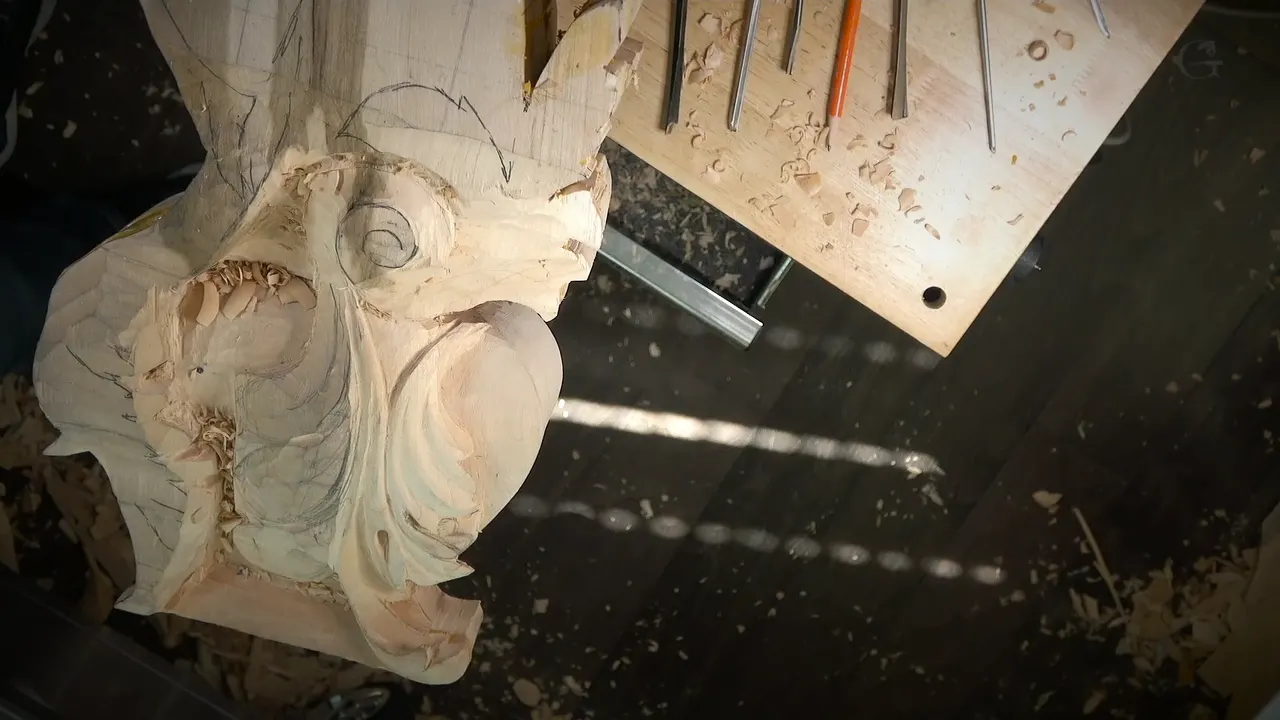

In workshop 83, part 3, I said "I'll just take my time and break the rule of the cutting downhill with the grain, and I'll just go that direction." Other videos have the same words next to end grain, an eye and a shadow.
Have you ever stood at the bench holding a gouge, with a spot in front of you that you could not afford to spoil? Part 3 of workshop 83 comes first on this page. The other videos follow after it, taking one place at a time.
What came before those words in part 3?
The part opens with "Okay. And to create those pipes, again, the same idea." Then comes a plan about the light: "I need to relocate my light where I would see much better." Next I said "So that is much better."

Tools were next. "So I'll take, again, number 11 and 7 millimeters," I said, which is about 0.28 in. The plan went on with "First of all, I need to make the decision" about my point, and maybe following "the original point, which, in this case, is going uphill somewhere right here." A comment followed: "I was really pretty close."
Then I said my concave cut would be "somewhere right in this section."

Where does part 3 say it?
Right after a change of size: "Let me use 3 millimeters, not 7. Okay." In inches, 3 mm comes to about 0.12. The sentence from the top of this page came next, with its direction. The next line was "Change the position."

For the deep cut I said I needed to switch to "7 millimeters or even 10 millimeters, number 11." Ten millimeters comes to about 0.39 in. I wondered "Maybe 10 mill, number 11 will do a better job in this case." I also said "Let me blend a little bit with the 7 millimeters."
The other side got the same plan, "exactly the same idea," on the opposite side of my middle line. Later I said I would need "the 7 millimeters, number 11." Then came "10 millimeters."

How did the wood behave in the rest of part 3?
"It feels like in this area, fibers are more dense than in other areas," I said. Then: "Really interesting." My plan was "a left wing to blend it little bit, and a right wing to blend the right side."

Then I said "Actually, you know what? I can do it right away also with the right wing." Next came "That doesn't work." Then: "Interesting. Much denser, which is not really common for the basswood, but it's okay." And "All right, so I'm happy with that."
My words about the hump were "I've got the big hump, so which doesn't look too appealing, and I can just knock that down with the flatter tool, like number three, and I create really good downhill cut." A second spot got a plan too: "I also have a big raised up area right here, so I need to blend that, too."

The part ends this way. "All I need to do is just to really blend it nicely in," I said. "But that is the final shape of this section, so I safely can actually remove all the waste."

Which videos have the same words beside the grain?
Hashemi Flowers 11, part 8, has "This is a one-inch number five," about 25 mm. Then "And I'll fix overall movement." A reason came with them: "because right here is the end grain." Next was "Okay? And sometimes I do have to attack from different angles."

Furniture Panel 16 has them with a longer reason. In its part 5 I said "I am cutting against the grain," and said mistakes were what I wanted to avoid in that area, "especially because this element is going to be really tiny element, like about maybe 16th of an inch." That is about 1.6 mm. Micro cracks inside this element were another thing to avoid.

Uphill work is the subject in workshop 41, part 10. "And again, I have to go uphill with the number 11," I said. Then came "and not force it," and next "So I am working against the rules." Wood grain has a page on Wikipedia.

Something that has to be deep appears in workshop 26, part 4. "But it kind of have to be deep because, again, it's going to be visible from the bottom." It also has "I got to stop logically somewhere because, again, I have to keep in mind how I'm going to finish it."

Workshop 37, part 10, has "Maybe I should use a smaller number seven." Then "Smaller spoon," and the words. Two lines follow: "careful not to crank too much against this edge" and "Maybe that was too early that I created my cut on this side."
Part 6 of workshop 54 has "careful how I do that." Then come the words and "and do it little by little," a line I followed with a remark that the same went for you, too.
Where else does a marriage line come up?
Workshop 125, part 1, has "I want to see really good concave in this area." Then "I'm using only part of my tool." The reason came next: "because there is a marriage line if I going to force it."

It went on: "So I'm going to break it." That was not good. Another sentence reads "I call it the marriage line, when grain just not in favor of my tool." And the name is explained: "because I going to marry that spot." Marrying those two cuts was the plan.
Part 2 of workshop 142 has "I really have to slice," I said, "but it's still possible to make a really nice and smooth cut." And then "I'll just go all the way to the marriage line." And "Not to push too hard."

What came up beside a line, an eye or a stem?
The eye is the topic in workshop 68, part 7. My first line there was "I have to go really careful on this side because I do have a middle line." After that came "I don't want to hit that middle line, and I don't want to hit my eye, and there is an eye. Okay? So for me, it is important not to make the mistake." Right after that the words come, and with them "and little by little start excavating."

Light is in that part too: "Need to move my light out." Then "Change the lighting."
A shadow is in Plate with Butterflies 11, part 2. "Let me find a better position for me, for I would not mess up with my shadows. I do have a shadow from the light." My next words were "and just go in that line."

That lesson's part 3 has "and just try to be as accurate as possible to my scoring line." Then: "But please, this stage, you really have to be careful."

Chamomile and Bow Rosette 2 has a stem: "And work around my stem," I said. Next: "Good idea not to rush it." It ends with "All I'm after is just a good shadow."
A flower sat near the background in Acanthus over Moldings 10. "Really good, and especially I have to pay attention how I attack my flower because it's really close to the background."

A butterfly part was in the way in Plate with Butterflies 6. "Because I have that part of my butterfly right on the way," I said. "So I have to just be careful how I remove it."
In Grinling Gibbons Maine class 13 the topic was an edge: "I'm talking about the edge of the barrel is raise up." They come next, with "Don't need to force it."
Which other lessons use them beside a shadow or a small tool?
A deep excavation is the topic in workshop 33, part 9. "And I really would like to get that excavation to get really deep because I really want to see a really good shadow right there." The sentence ends with "and do that."

Floral and Molding 7, part 2, has the words and then "maybe I have to just grab a little smaller tool, half a millimeter, and do exactly the same, but much deeper." Half a millimeter is about 0.02 in, and I said it would "create really beautiful shadow." Wikipedia has a page on shadow.
Venetian Flowers Rosette 4, part 3, sets a size: "But smaller version, like a six millimeters," or about 0.24 in. They go with "to get much nicer cuts without the rushing."
Tiny tools are the subject in Furniture Panel 15, part 9. I would need "just the tiny tools," with "probably three millimeters and two millimeters," about 0.12 in and 0.08 in. After them: "and get pretty close to the final depth."
Distances are in workshop 58, part 8. "I'll stay approximately maybe a couple millimeters away," I said, "maybe about one and a half millimeters away, like about 16th of an inch from those lines." One and a half millimeters equals about 0.06 in, and 1/16 in measures about 1.6 mm. Then: "Maybe about three millimeters some spots, like eighth of an inch," meaning 3.2 mm for the eighth, and 3 mm is 0.12 in. After that came "And carefully," and then the words.
Carefulness shows up in workshop 95, part 6: "Carefully, carefully, carefully." Then "Get in," and the words, and later in the part "And I will use a smaller tool."
When did I say what I meant?
Depth is the matter in workshop 105, part 2: "And all the way to three-quarters of an inch, 20 millimeters or so." That depth is 19 mm, and 20 mm is about 0.79 in. The final depth was not settled, because "I really want to make it three-dimensional." They come after "Maybe I'll go deeper."

An explanation follows: "What I mean by that, I'll see how it looks first, and if it looks okay with three-quarters of an inch deep, I'll stick with that. If I feel like I need more, so just do a lot more."
Acanthus over Moldings 9 has the words in part 3, followed by "I'll make my time. I guess."

Furniture Panel 28 brings in the camera, with "I could do a lot more extreme, you know, nicer job let's say," I said. The same words follow with "off camera and clean everything and you can see how it blends."

Grape Onlay 4, part 3, goes this way: "So it's better to attack from different points of view and see what the grain does." Then "I'll go back on another side," with "plenty of the material" close behind.

Lily Box 13, part 3, has a mistake: "my mistake was that I used the big tool right away, pretty much on a really fragile spot, and I should use a really small tool first before I use a larger tool." Then "Maybe I should do that."

In part 2 of Furniture Panel 17 they are followed by "Especially in an area like that, I have to change the position to make sure I'm not just going with my cut straight to the line."
The lamp is in Furniture Panel 21, part 6: "Got to bring my lamp again and attack that corner." "And yes, I do" comes next. Then "Let's blend that little bit."
A flowing line comes with Hashemi Flowers 3, part 1, and I wanted to be sure it looks flowing. Next came the words, then "And I need bigger now."
Grinling Gibbons Maine class 15, part 1, has me saying I did not want to rush. Those words are followed by "Because that's really important."
Roman Acanthus 16, part 1, says "I'll just try to make my cut toward this cut, but not too hard." Breaking it was what I wanted to avoid. The words come first, and "Don't break it in. Careful." follows them.
The lines side by side
| Video | About | My words |
|---|---|---|
| 83.3 | A direction I gave after a change of size | "go that direction" |
| Hashemi 11.8 | A spot where the end grain sat | "right here is the end grain" |
| Panel 16.5 | A tiny element with cracks to avoid | "really tiny element" |
| 125.1 | A spot I could break if I forced it | "there is a marriage line" |
| 68.7 | A middle line and an eye beside the pipe | "there is an eye" |
| Moldings 10.3 | A flower near the background | "attack my flower" |
| 33.9 | A hollow I wanted deep, with a shadow | "a really good shadow" |
| Plate 6.2 | A butterfly part right on my way | "right on the way" |
| 105.2 | A depth I was not sure about yet | "What I mean by that" |
| Lily 13.3 | A fragile spot after I used a big tool | "a really small tool first" |
Where can you watch every video on this page?
You can find part 3 in workshop 83, and workshops 74 to 85 sit in the Part 7 course. Is there a spot on your own carving that you would want to approach slowly? Pages on wood carving, the chisel, hand tools, woodworking, the mallet, relief and sculpture sit on Wikipedia.
How it's done
- Plan the light. A new spot for my light was the plan, and then I called it much better.
- Decide where the point goes. I planned to decide where the point would sit, and maybe to follow the original one.
- Name the small tool. The tool I named was 3 millimeters, not 7, and a direction came with it.
- Switch for the deep cut. The deep cut got a plan of 7 millimeters or even 10, with a number 11.
- Knock down the hump. A flatter tool, like number three, could knock down the big hump, and the waste could come off.
Frequently asked questions
Which rule did I plan to break in part 3?
Carving downhill with the grain. A direction came with it, and the next line was about the position. The number three came up later for a hump, with "really good downhill cut."
Which wood did I call denser in part 3?
One area, in basswood. Fibers felt more dense there than in other areas, and "Really interesting." After it, "Much denser," and "I'm happy with that."
What about the light in part 3?
A plan for a new spot, where I would see much better. Part 3 also has me calling the result much better. In workshop 68, part 7, I said "Need to move my light out," and then "Change the lighting."
What to carve next