

Alexander Grabovetskiy, woodcarver, School of Woodcarving · Published 2020
What does a wood carver mean by "nice flow"?
Quick answer: A nice flow is what I wanted to see in part 9 of workshop 83, and later I said I think my carving has it. In the panel course, lesson 20 holds my own words: the curvature flows itself, and the movement is not sharp.
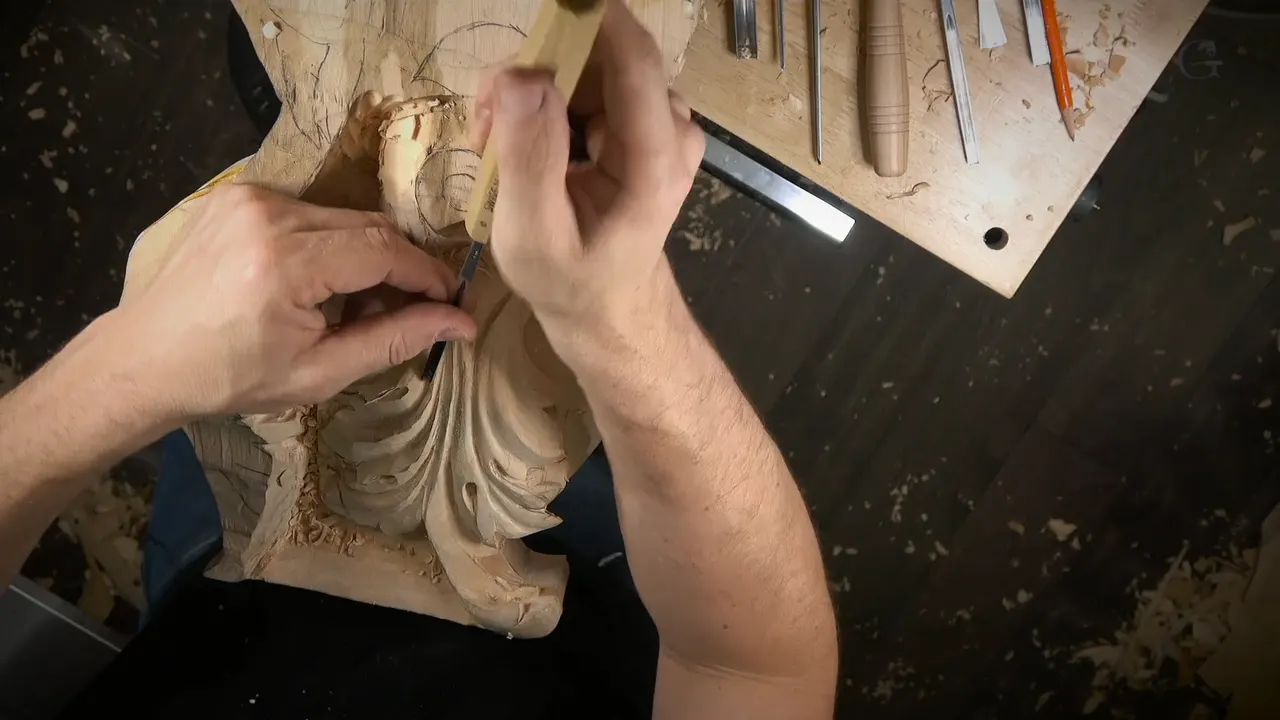

A nice flow is, in my words, a movement that is not really sharp, one that runs on the way a river does. Furniture Panel lesson 20 has my own wording of it. In part 9 of workshop 83 I wanted to see one in my carving, and later in the same part I said I think it has one.
Ever run a finger along a carved line and feel it catch? Will a shape that looks fine from above ever look wrong when you turn it and look along its side? One plain word of mine covers both. It comes back in my other videos, and this page follows it from part 9 into them.
How does part 9 start?
Part 9 opens on a flatter tool. "With the flatter gouge, with the number three, that's what I am doing," I said. A plan came next: "let me get again five millimeters, and maybe excavate a little deeper cut right here." Five millimeters is 5 mm (0.2 in), and the gouge has a short page on Wikipedia.

A second size shows up with the same tool: "in about 10 millimeters, three-eighths of an inch." That reads as 10 mm (0.39 in), though that fraction is 9.5 mm, so my two figures sit close together. My direction was "that direction right here." My next word was "Wonderful."

A need came next: "So now I need to fillet that pipe." Soon after: "Or make it roundy, make it more convex." Both lines are needs, not finished jobs, and the captions show neither one done yet.
What did I say when I looked at the movement?
"Here you go," I said. I named one spot: "Although I can see one of the problems right here." I took it back: "It's not really a problem, but I'd like to see a really nice flow." Those captions do not say which spot I meant, and I will not guess at it.

"Okay. And one more right here." The verdict this page is named for came next: "I think it has a really nice flow." In my own order, that is a wish first and a verdict later.

How did the convex and the S curve fit in?
"Also, I'm going to convex a little bit this side," I said, and right after that: "Oh, first of all, let me clean it because it doesn't look too nice." Later came "And now I can kind of make it convexy," followed by "Just like that."

Next, a plan for the line: "let me reestablish my movement." My words for its shape were "letter S curvature going like that." A question went out to you as well: "Can you see the development of this? It is simple, but looking good one." Then another verdict: "I think this one is looking good."

What was left to do on that section?
Cleaning, in my words. "Of course, once I'm going to clean everything and so on, it will make more sense. And it's going to look more appealing. But you see how I develop it." A tool came next: "I'll use a spoon, number six."

"Now it's all about cleaning," I said, and "It's the same process that I've done before." About the eyes I said: "Clean those eyes, get a really deep excavation. Create a beautiful deep shadow." Of that I said "So same idea. Exactly the same idea," and I planned a movement: "Let me also create this movement right here."
"And that's it," I said near the close. Of that section I said "what needs to be done is just to clean up and make it lighter, more light, airy, if you wish." A last pass stayed a maybe: "maybe I should probably touch a little bit with the sandpaper."

Do the parts on either side say anything about movement?
Over in part 8, I say "But overall, I'm happy with that movement," and a little later "Of course, I need to prolong that cut." I also named work ahead: I would continue "those cuts" on my volute. On the pipe, I said the area did not need to be deep, and that it would get deeper toward the end.
Another movement opens part 10. "And that is a really interesting movement," I said, and I wanted to develop this acanthus, which is "wrapping like this and just wraps this way." A line there echoes part 9: "let me round this side. Okay? Fillet it, if you want to say it that way." Elsewhere in that part I said "That's not the right mallet," and of the basswood: "if you see the dark spot like this, the material is a little mushy, which is absolutely okay."
How did I explain flow in Furniture Panel lesson 20?
In lesson 20 of the Furniture Panel course, part 2, the word comes up. First came a plan for deeper and deeper chamfers. Then: "And I also need to take care of the overall movement. I really don't like how it looks right here." My meaning, I said, was that I wanted a nice flow even on small flowers.

Next I explained the word itself. "What I mean by flow, it has to be just like the curvature is supposed to flow itself, the movement. It should not be really sharp movement." My picture was a river: "So it should flow like a river." And I owned up: "I don't know how to explain that, but anything."
"It should have a really nice curvature in every element I'm carving," I said, and looking really close you can see that "has to be gone." My verdict was "Nice movement, I should say." Curvature gets its own entry on Wikipedia, if you want the long version.

Is nice flow a law?
The same lesson, in part 8, calls it one. "I can see I need to fix my movement," I said, and "Really important." Then: "Again, that's a law of flow. Okay? So everything's supposed to have a nice flow."

About one spot I said "for example, right here, it's not good spot. It has somewhat like a waviness." I would use "just probably number 3 and 1/8 of an inch, three millimeters." That inch figure is 3.2 mm. A try at fixing that movement came next, and "it is not that easy." A bit later: "looks like I was able to fix that."
For the inside I said "I can see that I can develop even further and make it nicer." A condition followed: "to develop it nicer, you have to make the decision first what's going to be nicer." Later still, I looked over the whole: "Let me see how it looks overall. And it looks really good."

Does a knife help a line flow?
Lesson 15 of the Furniture Panel course, part 1, says a knife does for me. I could outline my flowers, I said, and named two ways: "with just a knife outlining," or a number 11 at three millimeters (0.12 in), which I called one-eighth of an inch. Wikipedia carries a page on the knife too.

Many lines crowded the design. It is sometimes really hard, I said, to catch where to be among so many lines. My preference followed: "That's why I really like to use a knife at this point of carving, okay?" Using a knife, I said, gives me a flowing movement that is really nice.
Can an edge flow too?
Over in part 11 of that lesson, I say so. "Since we don't have a paper anymore, I can take care of that thick part and get a little closer to the edge right now," I said. Then the condition: "But I need to make sure my edge is a really nice flowing edge."

One more move was on my list for that element: "go a little bit, just like that, underneath." It would "give me a feel that this element goes a little bit underneath," but "I need to make sure it looks the right way all the way." My plan for the edge was to approach it "little by little." My tool was a number eight at "1/8 of an inch," about 3 mm, and I said "That's what I'm using."
How does a flow run high, then low, then higher?
Hashemi Flowers lesson 2 gives one picture in part 2. A leaf "from underneath of flowers" could go lower than another piece, I said, and it would go downhill. The flow I could make, I said, runs "from high point, then lower, then going high, and even higher."

My tool was "just number 9. Same number 9. And carefully." I could attack it "from this side, just across the grain," and my warning was blunt: "Just keep an eye on the edge. I don't want to hit this detail." A ribbon would run under that leaf, I said, and "that's going to create even more a three-dimensional look."

A rough line shows up in part 3 of that lesson. "Right now it's kind of rough, and I don't want to see that as rough," I said. I would make it a "more or less refined line." About something there I said it will have a scroll: "That's how I call them." To reshape the edge I could use "the same number three carefully." Last: "Just follow the line."

What about a flowing line beside a small detail?
Venice Room workshop 46 puts it into words in part 8: "let me get a really nice line, like a really nice flowing line." I said a really nice detail was going on underneath, and I did not want to lose it.

"Get a smaller tool and remove around that element like that," I said, and then: "I know it's a small detail, but it's going to be visible." And if it did not show, I said, it would still make me happier. A last line: "I can always refine everything."
Can the camera show a flow?
In Venice Room workshop 86, part 6, I said "I need to go a little deeper because this is a high spot and still has to go down." Then: "You don't see that from the camera, and it's impossible for me to show that to you, but you should understand all of the movements, they have to be really smooth and nice flowing movements."

A measure came next: "And I'm approximately 10 millimeters above my original line, and I can live with 10 millimeters, no problem." That is 10 mm (0.39 in). "So I do like that slope," I said, and the movement would be "just gradual movement downhill."
Does flow count in three dimensions?
In Lily Box lesson 5, part 7, a slope was coming. First I wanted to check that it has a nice flow "in a three-dimensional world this way." Then, in my words: "it doesn't have to go all the way downhill. The reason why, because this part starts above that part."

Then: "But carefully, again, because this part is also a kind of weak spot, especially with a small detail like this. So I've got to be really careful how I approach it." My plan was "number nine and a quarter inch," about 6 mm (0.25 in), to see how it behaves.
Why look at a part sideways?
Acanthus over Moldings lesson 10, part 2, holds my reason. One part was "not flowing nicely. If you look from above it looks okay, but if you look from the side, it does not look, okay." And I needed to make sure, I said, that it goes really nicely downhill.

"So that is why it's really important to look from different points of view and really important if you're working in 3D to look from the side." Then: "And now it looks really nice. I believe it looks much better."
Acanthus over Moldings lesson 9, part 2, comes back to the idea. I said I would follow the same idea as the nice flowing movement I had just made going down, at "about 3 millimeters" (0.12 in).

Where each of these videos sits, side by side
| Video | What my hands were doing there | Words I used |
|---|---|---|
| Workshop 83.9 | A pipe and a spot I looked at | nice flow |
| Workshop 83.10 | A wrap I called really interesting movement | a cloth drop |
| Panel 20.2 | Curvature that flows itself, not sharp | my meaning |
| Furniture 20.8 | A wavy spot I planned to fix | a law of flow |
| Furniture 15.1 | Knife work near a crowd of lines | flowing movement |
| Panel 20.11 | An edge near a thick part | a flowing edge |
| Hashemi 2.2 | A leaf that could go lower | high, low, higher |
| Hashemi 2.3 | A rough line to be refined | a scroll |
| Venice 46.8 | A line beside a small detail below | a flowing line |
| Room 86.6 | A high spot that still had to go down | smooth movements |
| Lily Box 5.7 | A part checked before any sloping | three dimensions |
| Moldings 10.2 | A part that looked fine from above | a side view |
Where can you watch every video here?
You can watch it in workshop 83, and all twelve workshops sit in the Part 7 course. Next time you run a finger along a line you carved, will it catch, or will it run on? A wood carving page on Wikipedia gives the long view, and Venice has its own page.
How it's done
- Name the tool and size. Part 9 opened on a flatter number 3 gouge, with 5 mm (about 0.2 inch) planned and maybe a little deeper cut.
- Say what you want to see. I told you I would like a nice flow at one spot, and later that I think the carving has it.
- Reestablish the movement. A letter S curvature was my plan, and I asked whether you could see the development.
- Clean and lighten the section. Next came a plan for a number six spoon, and then I said the section needed to be cleaned up and made lighter, more light, airy, if you wish.
- Look along the side. Check a 3D part along its side, as I said in the tenth Moldings lesson.
Frequently asked questions
Which problem did I name in part 9?
One of the problems was right there, I said, and then I took it back: it was not really a problem. The captions do not name the spot, so I cannot either.
Which meaning of flow did I give in the panel course?
The curvature is supposed to flow itself, and the movement should not be sharp. My picture for it was a river. I also told you I could not explain it any better than that.
Which tools did I name in part 9?
A flatter gouge, a number 3, with two sizes named beside it: 5 mm (0.2 in) and about 10 mm (three-eighths of an inch). After that I planned a number six spoon. Near the close I said maybe a touch of sandpaper.
What to carve next