

Alexander Grabovetskiy, woodcarver, School of Woodcarving · Published 2020
What does a wood carver mean when he asks "okay?" in a lesson?
Quick answer: In workshop 83, part 6, my "okay?" comes right after a line I want you to follow: a blend meant to look grown from below, a plan to leave material for a small detail, and what I expect from one section. Elsewhere it sits beside a plea to understand, a size or a warning.
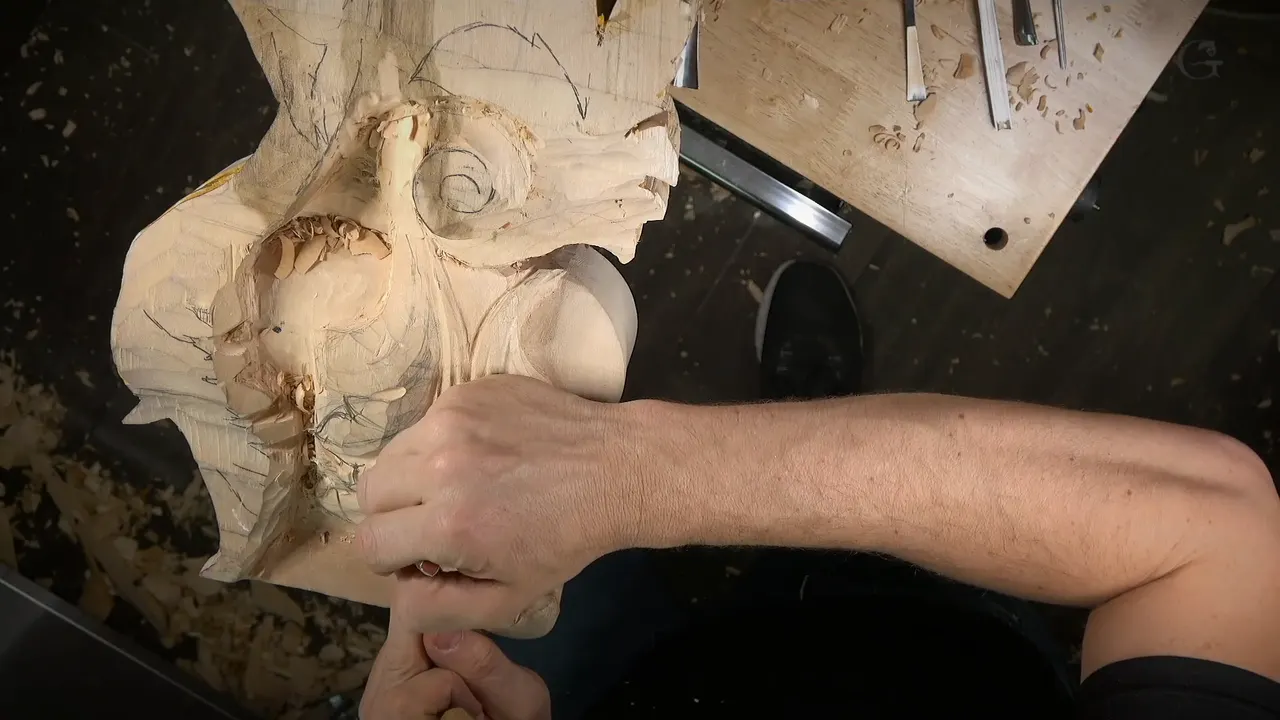

Part 6 of workshop 83 has me asking "okay?" three times while I shape one leaf. Each lands right after something I want you to follow: a blend, a detail I will leave below, and what comes next in the carving. My other courses use the word too, and I read them for this page.
Have you ever heard a carver say "okay?" in a video and wondered what it was for? The video from workshop 83, part 6, comes first on this page, and the rest of my lessons come after it.
What did I say before each "okay" in part 6?
The video opens with "And really carefully." A thought follows: "You know what? I could actually make this part also wider, same like what I've got on another side." That other side is "much wider," so "let me do that." The result I expected: "just overlap a little more."

Next I said I would need "the one millimeter" (0.04 in), and "go that direction." One more need: "I need to clean up this section." My verdict on the look: "Now it looks a little messy." Later came "There you go."

Here is the first one. "And of course, it needs to be blended in, so it has to feel like it is growing underneath right there. Okay?" The reason comes first, and the word comes right after it.
Right behind it I said "And yes, I'm breaking rules again and carving uphill, which is okay. As long as my tool is sharp, I am able to do that." That "okay" is a verdict, not a question. After it came "Really good," then "Now I'm happy with that," and "Let me remove some of that material."

A hand got in my way. "And I know I'm covering with my hand, but there is no other way for me to remove the material." Then a joke: "At least my hand is looking better than my head in a camera."

The second "okay?" follows a plan: "I'm going to leave some of the material below," and "small detail later on, just like sticking piece from underneath. Okay?" Right after it came "Double layer." My plan stays a plan in this video.

After that: "now I can probably do a much deeper eye. Deeper and nicer." Another need: "I also need to knock down a little bit this section, because it has to blend nicely." Next: "Let me take number 11 and 7 millimeters" (0.28 in) "and get rid of whatever I just created fast."

"And it does not look too bad," I said. Next: "Something doesn't make sense, but I'll figure this out a little later." The third one comes after that: "So but now what I want to do, I want to do this section, and I'll know exactly what's going to happen. Okay?" It follows a wish and an expectation.

The part ends on layout. This leaf, I said, goes underneath the leaf I will create right there. Marking comes next. I named "the middle line" and "the boundary," with a separation to follow. I said "Okay, let me outline it," and the last line is "That all has to be gone."

Do parts 5 and 7 of the same workshop use it too?
One sits in part 5: "I want to kind of create better eye. Okay?" Several sit in part 7. One fixes my own word: "Sticking out piece, okay? Not piece, but some kind of leaf." Another follows a decision about the pipe: "which I think I'm going to keep it like this. Okay? So let me start with the smaller tool, with the three millimeters number 11" (0.12 in).
The same video says why, in plain words. "I hope you can see what I'm doing." After it: "Of course you see, but I want to make sure you understand." That line sent me looking through the rest of my lessons, and the groups below show what sits right before the word there.
When does "okay" come after a reason?
Venetian Flowers Rosette, lesson 1, part 1, gives me two in a row. "If you look from the side, it just has a curvature, really nice curvature. The crown molding going to go right behind that. Okay?" Right after, a verdict: "And it looks okay. It looks fine. Okay?" Wikipedia explains crown molding.

In workshop 58, part 7, the word comes four times in under a minute. I called a deep excavation "almost like a crown molding." Then: "If you're in United States, you will understand what I mean, on inside. Okay? Like a Shaker crown molding, I would say." I backed off a little with "It's not Shaker crown molding, but you get the point," and added "Hope it makes sense, and I'm not confusing nobody." Shaker furniture on Wikipedia shows the style.

The slope in workshop 31, part 5: "it has to slope this direction," with "the head of acanthus" named. The dig had to be "really, really deep," a "double slope," and "You'll see." Next: "For me, it's kind of hard to explain what I mean, but you will understand in just a moment. Okay?" The cut around it would use "a bigger tool, like 20 millimeters" (0.79 in), and "Number nine will work also." The plant is acanthus.

Workshop 93, part 9, brings a design rule. One part "is going to be a little different. Okay?" The reason is fewer lines than the side I carved: "It's going to repeat this side." My next line: "I think it's important to understand dynamic symmetry." A side that is not dynamic is "exactly the same," while this one is "somewhat the same, but little different. Okay?" A fuller talk would wait for "a design course I'm planning to do." Wikipedia covers symmetry.
When do I say "okay" to help you understand?
The start of workshop 69, part 5, is about a size. "I really like to use huge tools because it just gives me a much quicker result," but "not all of you have exactly the same as what I have." So: "I really want to make sure you're also able to do what I'm doing. Okay?" I work "little by little" while "establishing the main form."

Workshop 56, part 11, starts with tool size. I wanted people "from all over the world" to understand "exactly what size tool I'm using at this point. Okay?" The sound behind me was my number 11 on the strop, and I used a machine because "it's not as loud as other machines while I'm filming." For background, see sharpening on Wikipedia.

Part 1 of workshop 104 has me talking about a tablet. I can print "a piece of paper," and "transfer that to the piece of board. Okay?" I said "I don't want to mumble," so that you "understand the process. Okay?" My example was "36 inches by 120 inches" (914 mm by 3,048 mm), "3 feet by 10 feet long, okay?"

Two more come from the Venetian Rosette course. In the first video of that course came "you do understand what I want to show. Okay?" The piece was a paint grade and "paper thin," so I stabilized it with super glue: "it's really thin. Okay?" In part 2 came a shape, the highest spot "somewhere right there," then "sloping down, okay, all the directions." And: "So really important to understand that. Okay?"
Carving Vase with grape leaves, lesson 2, part 1, puts it after a size: "Three-quarter of an inch, about 19, maybe 18 millimeters." Then "Okay?" A promise follows: "you'll understand the whole process. Okay?" My cut there was "even less than a sixteenth of an inch" (1.6 mm), "maybe about one thirty-seconds of an inch deep or so" (0.8 mm).

Chamomile and Bow Rosette, lesson 1, part 2, ties it to a hill: the center of that petal "is like a hill. Okay?" Next comes a tool chart: "Number three, number four, number two will work if it's a European chart. If it's an English chart, number two is not going to work because number two in the London pattern would be a skewed chisel. Okay?" The chisel is covered on Wikipedia.

In lesson 4 of that course, part 3, I changed one: "I left only one row, and I've got a couple notches." Its job: "I can actually get underneath if I need to, and I create the texture. Okay?" Then: "In this case, I don't need it, but it's a good idea to understand the principle behind it. Okay?" The small round ones get "just a hammer, just a normal carpenter's hammer." The hammer has a Wikipedia page.

The V Tool Problem video covers a part I could not show. "I can't show that to you, but I'll try to explain and I hope you do understand." Then: "Let me actually draw that and maybe understand much better. Okay?"

What happens when the camera cannot reach?
In Floral and Molding for the Panel, lesson 3, part 2, I said "There's no way I can get the camera in a area like that. It's kind of hard. Okay?" My fix was the phone: "I can grab my iPhone again and try to show that to you what's going to happen, and I hope you will understand. Okay?" Next: "I hope you can see this area, and my apologies for how shaky that is." After "I am attacking this section. Okay?" came "that would be a volute." The volute is a scroll shape, and Wikipedia covers it.

Lesson 8 of that course, part 1, uses the phone too: "I connected my phone and you should be able to see it's somewhere right there. Okay?" Then: "that is the part I'm working on." My reason was that "I'm not going to do it all the time, but I think it's a good idea for you to understand. Okay?" The plan after that was "a small gouge, really small, tiny gouge," "I would say 2 millimeters, number eight" (0.08 in). For tool background, the gouge has a Wikipedia page.

Back in the Chamomile course, part 2 of the first lesson has a line that ends "without getting in the camera. Okay?" The next one is "I'll take some kind of flatter tool and blend with the number three and 1/8 of an inch" (3.2 mm).
Does "okay" hand a choice to you?
Carving Hashemi Flowers, lesson 27, part 1, has the clearest case. "Whatever the wall I found on the carving, I under-carved from the backside. Okay?" Then "So you can do it on your own. I don't think you need instruction for that." The backside "does look a little rough on the backside, which is absolutely fine." And "just make sure you're working on details. Okay? So details, and that's up to you now how far you want to take it. Okay?"
My own choice shows there too: "I do like this project to leave a little rougher." On the second layer I took "an 8-quarter piece of material, which is approximately two inches" (51 mm), "to be exact, one inch and 15/16 after I planed everything" (49 mm).
The Tray of Blessing, lesson 7, part 1, offers shapes. "You can do it just wrapping around," I said, and one is "wavy like this. Okay?" followed by "that is gonna be also legit." My note with it was to understand how you will excavate it and what tools you have, and then "Okay?" Floral lesson 8 offers the same: "You can be creative. It's up to you pretty much."

Does "okay" come before a warning?
In Lily Box lesson 6, part 3, it comes before a promise and a warning. The promise: "I know it looks really messy right now," but "at the end, you'll see the result. Okay?" The warning has a size, "a number 11, three millimeters" (0.12 in), "to separate lower volute movement from upper one. Okay?" Then the warning itself: "don't undercut it underneath," and "that would be big mistake. Okay?"

The "okay" lines side by side
| Video | What I was explaining | What sat right before that word in the video |
|---|---|---|
| Here, 83.6 | A blend that must look grown from below | a reason |
| Again, 83.6 | Material to leave for a small detail | a plan |
| Last, 83.6 | What I expect from one section | an expectation |
| Venice 58.7 | A concave inside, like crown molding | a comparison |
| Venice 93.9 | One part that repeats a side, a little different | a design rule |
| Room 69.5 | The tool size, and doing what I do | a size |
| Rosette 1.2 | A highest spot, then slopes in every direction | a shape |
| Floral 3.2 | A spot the camera cannot reach | a limit |
| Hashemi 27.1 | How far to take the details | a choice |
| Lily 6.3 | An undercut I warn you to avoid | a warning |
Where can you watch every video on this page?
You can watch part 6 in workshop 83, and the workshops around it are 82 and 84. All twelve sit in the Part 7 course. Is there a line you say at your own bench with nobody there to answer? Wikipedia has articles on wood carving, relief and the workbench.
How it's done
- Give the reason. Part 6 says the blend has to feel as if it grows from below, and the first okay follows that line.
- Name the plan. My plan was to leave material below for a small detail to come after, and the second okay comes right before "Double layer."
- State the expectation. For one section I expected to know exactly what comes next, and the third okay follows.
- Say what you want understood. Across my other lessons the word sits beside a size, a slope or a rule that I hoped you would understand.
- Admit what the lens misses. When the camera cannot get in, I say so and grab my phone.
Frequently asked questions
How many times did I ask "okay?" during part 6?
Three. The first came after the blend meant to grow from underneath, the second after my plan for the material below, and the third after my expectation for the next section.
Was every "okay" a question in part 6?
No. "Which is okay" was my verdict on carving uphill with a sharp tool, and "Okay, let me outline it" opened a step.
What was my plan for the material below?
To leave some of it for a small detail to add afterward, something sticking out from underneath, a double layer. It is a plan in that video, not finished work.
What to carve next