

Alexander Grabovetskiy, woodcarver, School of Woodcarving · Published 2020
What does a wood carver mean by "not now"?
Quick answer: In Venice Room 85.1 I put a plug cut in a corner and said "At least not now" about going deeper. The same words come up in my videos on cleaning, undercuts, a deep shadow and a thin edge, and each time a different job is waiting.
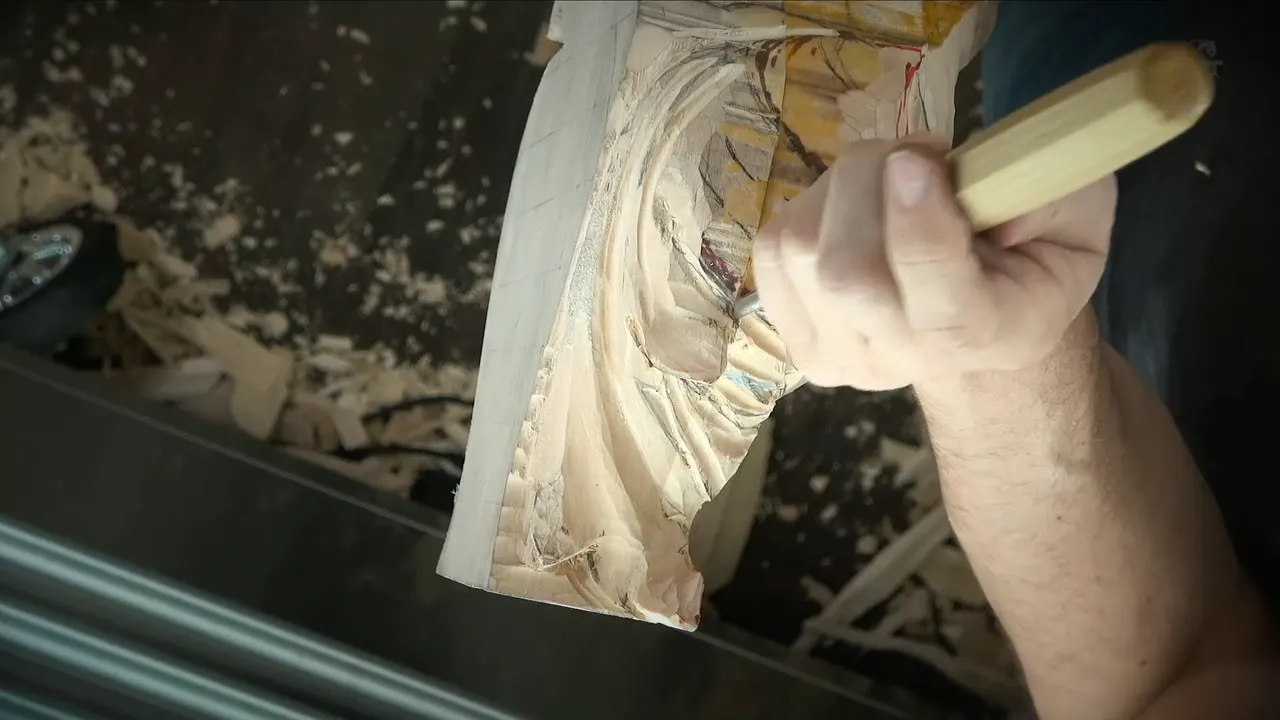

Not now is what I said in Venice Room 85.1 over a plug cut at one corner of my carving. I say it in other videos too, and each one has its own job waiting.
Have you ever left one job for later so you could do the job in front of you? Did the piece come out better for the wait? Follow two words of mine through my corbel and my flower panel, then a lily box and a grape vase.
What I said, in six short lines
- I stopped short of going deeper in one corner.
- Shadows were what I needed.
- One part was sure, and one waited for later.
- Other videos put the words beside a clean or an undercut.
- Two reasons I gave were a thin edge and a noise on the camera.
- Within one video, workshop 22 shows me changing my mind.
Where was I in workshop 85, part 1?
My first words were: "Right here in this corner, which I have to outline first, the upper part." Then came "Let me outline it" and "And also this way."
Next I said I could create a plug cut inside, with "a deep shadow right in this point." The tool I named was a number 9 of 1/8 in (3 mm), and I thought it would cast a beautiful shadow.

Then I hedged. "Maybe it's too early, by the way, because I still have to figure out this section. But that's okay." Then: "I'm not going to do it deeper than that. At least not now."
I said it again: "I'm not going to do deeper now, I should say." And then: "But later on, I could do much deeper." Two more lines were about shadows, "But I need some shadows," and then "I really need some shadows." After that, "So it is good," and I would clean a little bit.
How did I mark the movement?
"Let me use marker," I said. The lines would go down "like this movement," and then "also like that." One of them would go down "which you don't see," and still "the movement is going to be there."

Then the middle line: "It is going to go like that, the middle line." I would have a couple of separations, and "this movement is easy."
What was the one thing I knew?
First I said: "Except this one, I still have to figure out later." After it: "But one thing I know, this part going to go underneath of this line no matter what."

"Which means I can now go ahead and outline it right away," came next. Later: "Even make it little deeper if I wanted to." One spot was still open, and one was settled.
Which side stayed off-camera?
A lot of lowering down waits, I said, and showing that side is "almost impossible," so some of the stuff would be done off-camera and I would show the final picture instead. The reason is plain: "there's no way I can stick the camera right there."

Which gouge went into the triangles?
Relief cuts with a number 11 were needed in those triangles, one and two. The idea is the same, I said, "a couple concaves," and the eye position was not in the right position.
The eye, I said, should be somewhere right there. One concave would run all the way like this, and another one this way, and it would blend somewhere at one point. Seven millimeters (0.28 in) was my plan to try first. Then my reach: "it's so inconvenient for me," and "I have to carve toward myself."

What came next in parts 2 and 3?
The next video explains why I did not attack one spot the usual way. The grain ran "way uphill," and "I can easily break it." I had to carve with the grain, and I said so plainly: "I am breaking the rule, which I encourage you not to." Then: "I guess everyone breaks the rules. You have to."
More of the same waiting shows up there. "The detail I get, later I'll work on that detail, but now what I want to do, I want to just blend this side." For blending I said I would use number three upside down, 10 millimeters (0.39 in), about three-eighths of an inch.
Near the end of that video I called the result "the preliminary form." We would see about that big section, I said, and "I'm not really sure yet what I want to do."
The third video has that part going underneath this one, with "I hope I'm doing the right thing." Even on 3D computer design "it doesn't look the same in real life," I said, and in real life I have to make a lot of different choices and decisions, and I would rather change something I don't like pretty much right on the fly. One section I had not done, "which I'll take care once I'm going to get done with this drop." Today I wanted to start on the drop: "I want to work on this drop." The movement had to flow together, and "Later on, I'll make some pictures, and you'll see exactly what I'm doing."
Where else do I say not now?
A search through my videos turns up the words in the Venice Room, in other courses and in my Maine class. The lines that follow come from those videos, one at a time.
What waited in workshop 76?
Part 8 of workshop 76 has me saying I would not do too much to a piece, and I did not go all the way, "like I said before." There was no reason, I said, "until I develop the ends." I had the movements and somewhat of an undercut, and I had "pretty much just brought everything to the edge." A little cleaning was left. I meant to do it "a little later, not now."
Right then I needed to go on my main body and work on my flowers. I called it "the result as of today."

Which side waited in workshop 84?
One side in workshop 84, part 1, had to go down a little more to the corbel: "Not the corbel, but to that main body. But not now." The main form still needed to be established.
My plan for outlining that side was a number 11 of 7 mm (about 9/32 in). Ten millimeters (0.39 in) will work, I said, but in this case I have to be a little more careful.

Can an undercut wait in Furniture Panel 25?
Working on the middle of a flower in Furniture Panel 25, part 3, I said it is "not just a half a sphere," and I would like to get some kind of undercut, "If it makes sense." The next words were "later on not now." Preliminary, I can probably do it somewhat that way too, with number 16 again.

How much material was left in Byzantine Acanthus 8?
On one side of Byzantine Acanthus, lesson 8, part 1, I said there is a lot of material. All of it goes away later, I said, and "not now." Next I said we're going to dig inside and create a deep shadow.

What did I skip in workshop 43?
A third line sits in workshop 43, part 3. Here I said "Maybe not now," and an undercut and a shadow all around would come later. At that point I really did not need to. I needed just to refine those divisions and create the somewhat final shape.

What stayed open on the grape vase?
Carving Vase with Grape Leaves, lesson 1, part 7, shows me looking at negative spaces I could fill with grapes if I wanted to. I did not know yet whether I wanted to. Movements on the inside, like the intersections of the wine, were another idea. Maybe that is what I would do, I said, though "not now yet." Now I needed to create the idea.

Why wait on a vacuum?
In Venice Room workshop 1, part 8, I said "Get all that dust out." A vacuum is better, and I would use one later, but I did not want to make a noise on the camera. "Maybe in future, not now."
Soon after, I planned to keep that pattern for the future, since I would measure from it. Calipers would do the measuring, and the pattern would be my reference.

Where would walnut go in Furniture Panel 38?
One thing that kind of did not look nice comes up in Furniture Panel 38, part 3. A scraper can scrape that out, "with the dentist I should say," and glue in a piece of walnut later on. My words about that were "I don't wanna do it now."

Why was I afraid to dig deeper in the lily?
In Lily Box 10, part 3, excavating much deeper had to wait a little later on, I said, with "Not now, because it's going to be too fragile." I was afraid that if I did it now and went to work on other petals, I could break the edges.
I thought I should leave it like that. Measuring exactly how long all of my petals should be was something I could do now, because I would not touch the middle part of it. A small strip of green tape, maybe about five millimeters, 3/16 of an inch, was one way.

Why not stop and show you?
In workshop 15, part 2, with number nine to clean, I said "I know you don't see what I see, but you will later." I did not want to stop just because I wanted to show it. "I want to show it to you, don't get me wrong, but at the right time."
"It casts beautiful shadow," I said, and it gives beautiful shadow and really nice movement. I was really happy about that.

Can a spot wait and then not wait?
In workshop 22, part 10, I said I can always clean a little better inside the eye, and I would spend a lot more time on it. "But not now because I can't concentrate right now just on the cleaning." Some stuff I might change later.
Later in that video, undercutting inside could wait a little. "Well, actually, you know what? I could actually do some of it right now." The number seven was in reach, and I could probably excavate a bit.

What did I put off in workshop 113?
Workshop 113, part 1, has me saying "Let me relief this area." To undercut, I said, we would lay the tool on one of the sides, a number 11. I added: "But I'll take care with that a little later, not now, okay?" The reason was "some more details on inside," and "I don't want to jump too early to that stage."

And in the Maine class?
In the Grinling Gibbons class in Maine, lesson 14, part 2, a movement would give me more shadow. "I can safely undercut right underneath of here later on not now, but later on." The stem was about five millimeters (0.2 in) right then, and later it would be much less, maybe about three millimeters (0.12 in) or so.

A table of where each video says it
| Where I said it | Words I said |
|---|---|
| Corner work in workshop 85 stops short of going deeper | Maybe it's too early |
| Part 8 of workshop 76 leaves a clean for later | still need to clean little bit |
| Workshop 84 lets one side wait for the main body | a little more going down |
| Furniture 25 holds an undercut in a flower center | not just a half a sphere |
| Byzantine Acanthus 8 keeps a lot of material for now | dig inside and create a deep shadow |
| Venice 43 skips a shadow all around for the moment | I really don't need to |
| Grape vase 1.7 leaves spaces open for grapes or movements | or not yet |
| Venice Room 1 waits on a vacuum to keep the camera quiet | better to use a vacuum |
| Furniture 38 puts walnut off for another day | I don't wanna do it now |
| Lily Box 10 keeps thin petals whole while I work nearby | work on other petals |
| Venice 15 waits before showing you more | don't get me wrong |
| Room 22 puts off cleaning the eye for another time | can't concentrate right now |
| Lesson 113 holds an undercut until more details are in | more details on inside |
| Maine class 14 plans to undercut underneath a movement | I can safely undercut |
Where can you watch all of this?
Workshops 84 and 85 sit in the Venice Room Part 7 course, and workshop 113 is in Part 10. The flower panel, the lily and the grape vase each have a course of their own, linked above. A wood carving page on Wikipedia gives the long view.
Is there a job in your carving you want to leave for later today? Would it help to name the job you will do right now? The whole Venice Room is open on one tuition plan, and the corbel is waiting in it.
How it's done
- Outline the corner first. In 85.1 I said this corner has to be outlined first, the upper part.
- Place a plug cut for shadow. I planned a plug cut inside, using the number 9 gouge, to make a deep shadow.
- Mark where the movement goes. A marker was my plan, to show how the movement goes down.
- Name what is settled. The part that goes under the line could be outlined, I said.
- Plan relief cuts in the triangles. Those triangles needed relief cuts with the number 11 tool, one and two.
- Try the smaller tool first. The 7 mm size (about 9/32 in) was the one to try first.
Frequently asked questions
Which gouge did I name for the plug cut at the start of 85.1?
The number 9, 1/8 in (3 mm). A plug cut on the inside would give a deep shadow, right in that point.
Which size did I plan for the concaves in 85.1?
First came relief cuts, number 11, in the triangles. After the concaves I said "let me take seven millimeters" (0.28 in) and "I'll try with the seven first."
Why did I plan to carve off-camera in 85.1?
Showing the side was almost impossible, I said, and there is no way I can stick the camera right there. The final picture would be shown, and the rest of the side would stay off-camera.
What to carve next